
The first five years as an attending will either quietly build your leadership future or quietly erase it. There is no neutral.
You cannot “see how it goes” and accidentally end up running a service line, chairing a department, or directing ethics policy. Leadership is a trajectory, and your early attending years are the launch pad. You either plan them, or someone else’s priorities will fill them for you.
Below is a year‑by‑year, then quarter‑by‑quarter and sometimes month‑by‑month guide designed specifically for women physicians who want to lead. With ethics and personal development built in from the start—not bolted on at the end as an afterthought.
Big Picture: Your 5‑Year Leadership Arc
Before we zoom into specific years, hold the overall arc in your head:
| Year | Primary Focus | Leadership Output |
|---|---|---|
| 1 | Stabilize & observe | Reputation for reliability |
| 2 | Quiet influence | Small leadership roles |
| 3 | Formal leadership | Title-bearing positions |
| 4 | Strategic impact | Programs, policies, ethics work |
| 5 | Visibility & succession | Promotion packet, next-step role |

| Category | Clinical | Leadership/Admin | Teaching/Mentoring | Scholarship/Ethics | Personal Development |
|---|---|---|---|---|---|
| Year 1 | 70 | 5 | 10 | 5 | 10 |
| Year 2 | 65 | 10 | 10 | 7 | 8 |
| Year 3 | 60 | 15 | 10 | 10 | 5 |
| Year 4 | 55 | 20 | 10 | 10 | 5 |
| Year 5 | 50 | 25 | 10 | 10 | 5 |
You are moving from “safe pair of hands” to “obvious choice for leadership.” Systematically.
Year 1 – Stabilize, Observe, Document
Your first attending year sets your baseline reputation. At this point you should optimize your clinical credibility and start invisible prep for leadership, not chase titles.
Quarter 1 (Months 1–3): Land the Plane
Your only real targets:
- Become clinically solid and predictable.
- Learn the unwritten rules.
- Start collecting data on yourself.
Month 1–2, week by week:
Week 1–2:
- Clarify expectations with your direct supervisor: RVUs, teaching, call, committee work. Ask explicitly:
- “How will you evaluate my performance at 6 and 12 months?”
- “What do your strongest junior attendings do differently?”
- Get the org chart and actually study it. Who runs what. Who people defer to.
- Clarify expectations with your direct supervisor: RVUs, teaching, call, committee work. Ask explicitly:
Week 3–4:
- Shadow or sit in on department meetings. Do not talk much. Watch who speaks, who is ignored, who decides.
- Start a simple “wins” and “conflicts” log. Short entries: date, issue, what you did, outcome. You will use this later for promotion, leadership narratives, and ethics reflection.
Month 3 checklist:
- You can manage standard cases without extra help.
- You know basic institutional policies around end‑of‑life care, consent, reporting, and professionalism.
- You have introduced yourself to:
- Department chair
- Division chief
- Nursing unit leaders you work with most
- Key admin (clinic manager, OR scheduler, etc.)
At this point you should say “no” to almost all extra tasks unless:
- It is directly tied to something you want long‑term (e.g., ethics committee, quality improvement).
- It is time‑limited and clear (e.g., 3-month task force).
Quarter 2 (Months 4–6): Map Power and Problems
Now you are not drowning clinically. Time to look up.
Month 4–5:
Identify 2–3 “pain points” on your service. Examples:
- Disorganized handoffs causing near-misses.
- Moral distress in ICU end‑of‑life decisions.
- Discharge delays from poor communication.
Ask nurses, social workers, and residents:
- “What is one thing that would make your workday less frustrating?”
- Do more listening than talking.
Ethics angle:
- Note where patient care is consistently colliding with policy, time pressure, or economics. These are leadership leverage points later.
Month 6 – Midyear review:
- Prepare like it is a job interview:
- Bring a 1‑page summary: clinical volumes, teaching feedback highlights, any QI or ethics participation.
- Ask your supervisor directly:
- “If I wanted to be considered for a leadership role here in 3–5 years, what would you want to see?”
Write down the answer. Most people will never ask that question. You will.
Quarter 3–4 (Months 7–12): Strategic Early Yes’s
Second half of Year 1, you start choosing one or two arenas for future leadership.
Possible anchor domains:
- Quality & safety
- Ethics / professionalism
- Education (residents, students)
- Diversity, equity, and inclusion (DEI)
- Operations / throughput
At this point you should:
Say yes to:
- 1 committee aligned with your anchor domain (e.g., hospital ethics committee, QI team, DEI council).
- 1 small, well-defined project (e.g., update consent process, pilot a handoff checklist).
Say no to:
- “We just need a woman on this panel” roles that are pure optics with no power.
- Ongoing, unbounded “help with this” roles (usually invisible labor).
Ethics/personal development:
- Start a monthly ethics reflection session for yourself:
- One case that bothered you.
- What values were in conflict.
- How leadership could have helped.
This is where your leadership philosophy starts—quietly.
Year 2 – Build Quiet Influence and Skills
By Year 2, your colleagues know you. This is the year you deliberately stack leadership skills and ethical credibility.

Q1 (Months 13–15): Start Formal Leadership Development
At this point you should enter a structured leadership lane, however small.
Month 13:
Enroll in one of:
- Hospital or system “emerging leaders” program
- External course (e.g., Harvard CME in leadership, ELAM if eligible soon, local med school leadership certificate)
Identify a senior woman leader you respect (does not need to be in your specialty). Request a 30‑minute meeting. Ask:
- “What specific roles did you hold in your first 5 years?”
- “What do you wish you had refused early on?”
- “If you were me, what would you spend Year 2 doing?”
Month 14–15:
- Start tracking your time for 2 weeks:
- Clinical direct
- Charting/admin
- Teaching
- Leadership/committee
- Personal development
Rebalance. If everything outside of clinical is <5%, you are on track to be a workhorse, not a leader.
Q2 (Months 16–18): Lead Tiny, Low‑Risk Things
You need reps. Not titles.
Options:
Run a portion of your committee’s work:
- Draft the agenda.
- Summarize decisions.
- Propose one small change with clear metrics.
Take on a micro‑project:
- Create a brief decision aid for a common ethically fraught decision (e.g., feeding tubes, trial of labor after cesarean).
- Standardize a note template that improves communication.
Ethics integration:
- Volunteer as the “ethics point person” on your unit or in your group:
- Not formal call. Just the one who will look up policy, call ethics consults appropriately, and debrief learners.
Q3–Q4 (Months 19–24): Build Credibility and Visibility (Not Fame)
End of Year 2, your goals:
- Be the person:
- Trainees go to when care plans feel wrong.
- Nurses trust to not cut corners under pressure.
- Colleagues know will follow through.
Concrete tasks:
Give 1–2 talks:
- Grand rounds, noon conference, or local CME on an ethics topic embedded in your clinical area (e.g., “Ethics of resource allocation in heart failure admissions”).
Join 1 promotion/selection process as observer:
- Residency selection committee, fellowship interviews, hiring panel.
- Watch for gender patterns: who gets labeled “a strong leader” vs “a bit intense.”
Document everything:
- Update your CV quarterly.
- Maintain a “leadership impact” file: specific cases, projects, quotes, and metrics.
Year 3 – Step into Formal Leadership
This is the year you move from informal influence to visible, title‑bearing roles, without losing your ethical center.
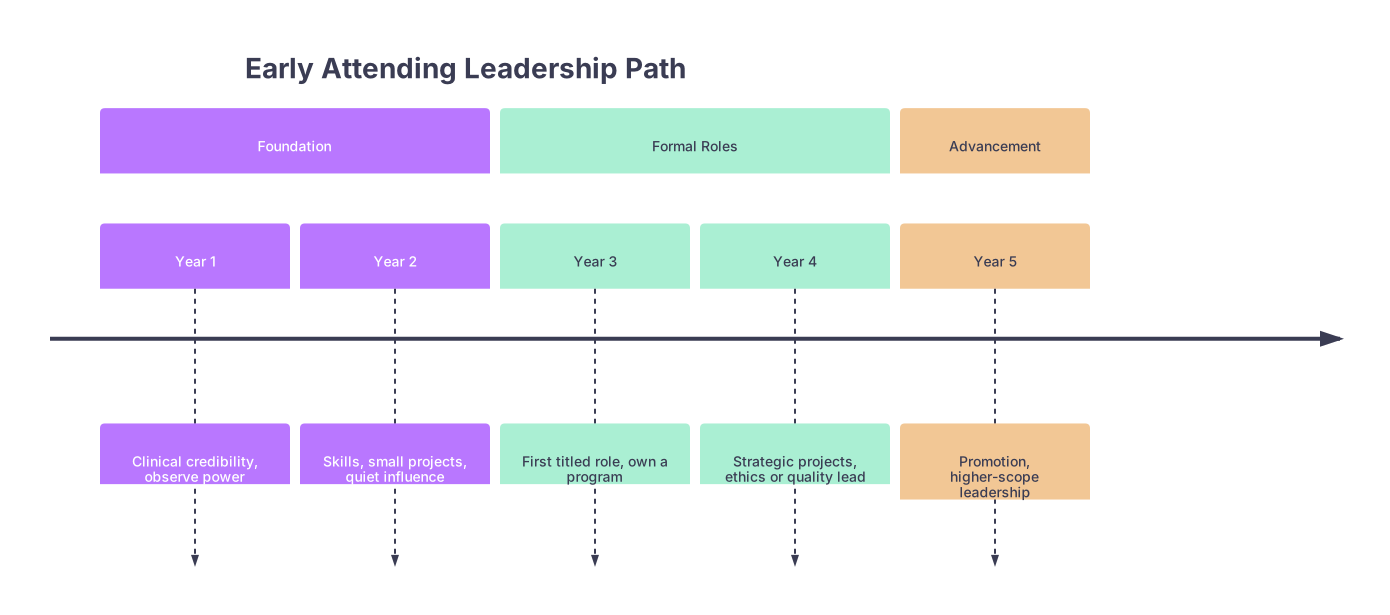
| Period | Event |
|---|---|
| Foundation - Year 1 | Clinical credibility, observe power |
| Foundation - Year 2 | Skills, small projects, quiet influence |
| Formal Roles - Year 3 | First titled role, own a program |
| Formal Roles - Year 4 | Strategic projects, ethics or quality lead |
| Advancement - Year 5 | Promotion, higher-scope leadership |
Q1 (Months 25–27): Choose Your First Real Role
At this point you should secure one of the following (not all):
- Medical director of a small clinic or unit
- Associate program director or key education role
- Chair or co‑chair of a committee (ethics, quality, DEI, professionalism)
- Lead for a specific pathway (rapid response, end‑of‑life care, sepsis)
Your filter:
- Does this give me:
- Decision‑making power?
- Access to data?
- Regular meetings with senior leaders?
If the answer is no, it is probably ornamental. Skip it.
Q2 (Months 28–30): Run Your Scope Like a Mini Department
You now treat your little domain as a training ground.
Within your area:
Clarify:
- Mission (in one sentence).
- 1-year goals (3 max).
- 2–3 simple metrics (not 12).
Build structure:
- Regular agenda with time boxes.
- Written decisions and accountability (who, what, by when).
- Feedback loops with frontline staff.
Ethics/personal development:
- Embed ethical checks:
- For any new process, you ask out loud:
- “Who benefits?”
- “Who is burdened?”
- “How will we monitor for unintended harm?”
- For any new process, you ask out loud:
Q3 (Months 31–33): Start Saying Intentional No’s
This is where women leaders get trapped in “service hell.”
At this point you should:
Protect your bandwidth:
- If asked to join something new:
- Ask for a written role description.
- Ask about time expectation.
- Clarify term length.
- If asked to join something new:
Use this line:
- “I am fully committed to [your existing leadership role] this year and want to do it well. I cannot join this now, but if a more strategic opening arises in [your domains], I would be very interested.”
You will feel guilty. Ignore that.
Q4 (Months 34–36): Mid‑Plan Assessment and Recalibration
End of Year 3 is a checkpoint.
Sit down for 1–2 hours and answer:
- What am I actually known for now?
- What am I being asked to do more of?
- Does that align with where I want to be at Year 5?
Meet with:
Your division chief or chair:
- “I would like to be on track for [specific role: section chief, associate program director, ethics chair] in the next 2–3 years. What gaps do you see?”
Your mentor:
- Have them review your CV and leadership impact file as if for promotion.
If you are way off course (e.g., buried in low‑impact service), Year 4 is where you correct.
Year 4 – Increase Strategic Impact and Ethical Authority
By now, you should not just be “helping.” You should be shaping.

Q1 (Months 37–39): Own a High‑Impact Project
At this point you should lead one significant, measurable initiative that matters to the institution.
Examples:
- Redesign end‑of‑life pathways to reduce ICU deaths without sacrificing family support.
- Implement a new handoff system that cuts errors and addresses trainee burnout.
- Develop and roll out a professionalism/harassment reporting and response process.
Structure it like a real leader would:
- Written charter
- Timeline with milestones
- Clear metrics (clinical, ethical, and experience outcomes)
- Regular updates to leadership
Q2 (Months 40–42): Deepen Ethical and Policy Expertise
If you are serious about ethics and leadership, this quarter you:
Complete or enroll in:
- A formal ethics course, certificate, or fellowship (even part‑time/online).
- Or advanced training in quality/safety that includes ethics modules.
Take on:
- Regular ethics consult participation, or
- Leadership of an ethics working group (e.g., moral distress rounds, policy review).
You are moving from “interested in ethics” to “go‑to person for ethics in [your department].”
Q3 (Months 43–45): Build External Visibility
At this point you should not be invisible outside your hospital.
Concrete moves:
Submit:
- 1–2 abstracts to national meetings (ethics, education, quality, specialty society) based on your projects.
- An opinion piece, brief report, or case commentary on an ethics issue you have worked on.
Join:
- A national committee, task force, or working group aligned with your domain.
Why this matters:
- Promotions and high‑level roles look at regional/national impact.
- Credibility in ethics and leadership is partly built outside your own institution’s politics.
Q4 (Months 46–48): Mentor and Sponsor Intentionally
Leaders are judged not just by what they do, but by who rises around them.
At this point you should:
Formally mentor:
- 1–2 trainees or junior faculty, especially women and underrepresented colleagues.
- Help them get talks, committee roles, and credit on projects.
Practice sponsorship:
- When asked to do X, occasionally say:
- “I am booked, but [Name] would be excellent for this and is ready.”
- When asked to do X, occasionally say:
This shifts you from individual performer to node in the leadership network.
Year 5 – Consolidate, Promote, and Aim Upward
Year 5 is your launch window. You are not “junior” anymore. You are either on a leadership trajectory or stuck. Time to lock in the former.
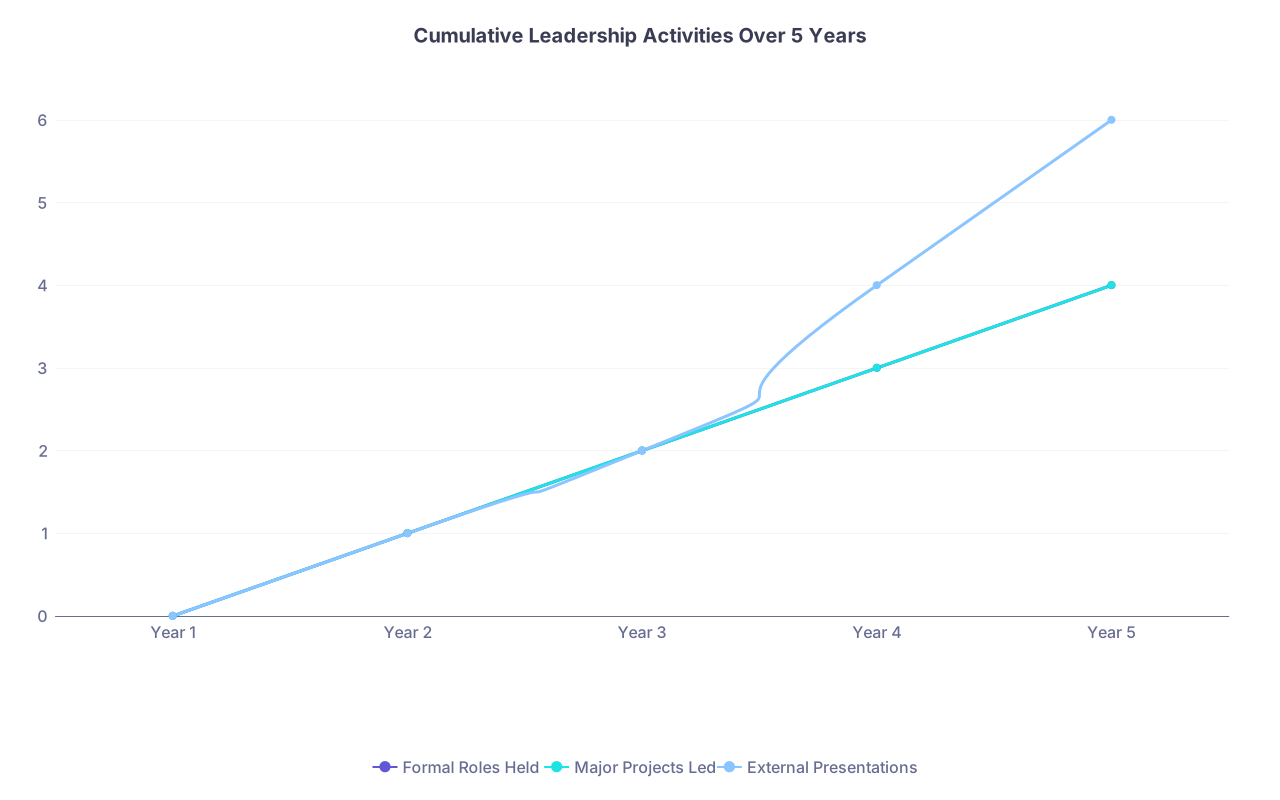
| Category | Formal Roles Held | Major Projects Led | External Presentations |
|---|---|---|---|
| Year 1 | 0 | 0 | 0 |
| Year 2 | 1 | 1 | 1 |
| Year 3 | 2 | 2 | 2 |
| Year 4 | 3 | 3 | 4 |
| Year 5 | 4 | 4 | 6 |
Q1 (Months 49–51): Prepare Your Promotion and Leadership Case
At this point you should assemble a coherent narrative of your first five years.
Tasks:
Update CV and personal statement with a clear theme:
- “Leadership in ethically grounded quality improvement in [specialty].”
- Or “Advancing professional culture and trainee development in [department].”
Create:
- A 1–2 page “Leadership and Ethics Impact” document:
- Key roles
- Major projects with outcomes (numbers and stories)
- Ethical challenges addressed
- Mentoring and sponsorship
- A 1–2 page “Leadership and Ethics Impact” document:
Meet with:
- Department leadership to discuss promotion timeline.
- Ask explicitly about next‑step roles: section chief, program director, vice chair, director of ethics or quality.
Q2 (Months 52–54): Target Next‑Level Roles
You should now apply or position yourself for roles with broader scope.
Possible trajectories:
- Operations/Clinical: associate medical director, section chief, service line lead.
- Education: program director, clerkship director, vice chair for education.
- Ethics/DEI/Professionalism: chair of ethics committee, director of professionalism, DEI leadership.
At this point you should:
Update your leadership elevator pitch:
- 2–3 sentences on what you do, what you have achieved, and what you want next.
Have 3–5 advocates who can speak in rooms you are not in:
- Chair
- Senior woman leader
- A respected male ally with influence
- Nursing/operations leader
- Someone external (for references)
Q3 (Months 55–57): Decide: Double Down or Pivot
Look honestly:
- Are you energized by your current leadership lane?
- Do you feel you are trading too much of your time or ethics for it?
If misaligned:
- Pivot options:
- Shift from heavy admin to more policy/ethics and teaching.
- Move from dysfunctional department to a healthier one or a different institution.
- Rebalance toward part‑time leadership plus focused clinical niche.
You are not chained to your first five‑year choices. You are simply better informed now.
Q4 (Months 58–60): Reset for the Next 5 Years
Final quarter of Year 5, take a deliberate pause.
At this point you should:
Write a 1‑page personal leadership statement:
- Your core values.
- Your non‑negotiables (e.g., transparency, fairness in scheduling, support for parental leave).
- The kind of culture you are committed to building.
Plan your Years 6–10 at a high level:
- Desired role(s).
- Skill gaps (finance, negotiation, conflict management, media).
- Key relationships to build.
And then commit. Not to “doing everything.” To pursuing leadership that is ethically clean, strategically focused, and actually sustainable for you.
Three Things to Remember
- The first five attending years silently decide whether you are seen as a workhorse or a leader. Guard your time and say no aggressively to low‑impact service.
- Ethics and personal development are not side projects; they are the spine of credible leadership. You build them case by case, policy by policy.
- Every year, at each “at this point you should” checkpoint, ask: Does this move me toward the roles I actually want—or just keep me busy? Adjust accordingly.