
The most dangerous mistake women med students make with sexist comments is thinking the problem is them, not the behavior.
You are not overreacting. You are not “too sensitive.” You are being tested—in ways that have nothing to do with your clinical skills and everything to do with power, culture, and boundaries. And how you respond can either quietly protect your future or slowly trap you in a pattern of being minimized and dismissed.
Let me walk you through the most common errors I see women med students make when responding to sexist comments—and how to avoid each one without blowing up your career.
1. Believing You Must Pick Between “Silent” or “Nuclear”
The first trap: thinking there are only two options.
- Say nothing and swallow it
- Explode, confront publicly, and risk being labeled “unprofessional”
That false binary is exactly what keeps a lot of women stuck.
The mistake
You hear:
- “You’re too pretty to be in surgery; you sure you want this?”
- “We need someone to smile at the patients; you go in first.”
- “Women don’t usually like nights; you probably want the lighter schedule.”
Your brain goes:
- If I say nothing, I feel disgusted with myself.
- If I say something direct, I risk retaliation or being tagged as “difficult.”
So you freeze. Nervous laugh. Awkward smile. Subject change. Then you go home, replay the moment twenty times, and hate that you said nothing.
That is not a personality flaw. That is a system training you to absorb disrespect as the cost of belonging.
How to avoid it
You need middle-ground responses. Calm. Clear. Non-dramatic. And repeatable.
Examples:
- “I’m here to learn medicine, not to be evaluated on my looks.”
- “I prefer to be assigned like everyone else. What’s the usual system?”
- “Actually, I’m fine with nights. Let’s keep the discussion about the rotation requirements.”
Short. Boring. Fact-based. You are not making a speech. You are refusing the premise.
Do not chase the perfect mic-drop line. You are not in a courtroom drama. You are setting a boundary in a hierarchy that can retaliate. Choose language that:
- Names the issue (or sidesteps it with a refocus)
- Signals you are not playing along
- Cannot easily be twisted into “unprofessional”
You are not choosing between silence and setting the room on fire. You are choosing between self-erasure and measured self-respect.
2. Over-Accommodating to Protect Feelings Instead of Protecting Yourself
Too many women in medicine have been socialized to manage everyone else’s emotions. Especially male attendings, senior residents, or older staff.
So when someone says something sexist, your instinct is:
- “I don’t want to make them uncomfortable.”
- “He didn’t mean it that way.”
- “She is old-school; she grew up in a different time.”
The mistake
You spend more energy explaining away their behavior than examining its impact on you.
You respond with:
- Nervous smile and, “Ha, yeah, I guess!”
- “Oh no, I didn’t take it badly, don’t worry.”
- “I know you are just joking!”
You are doing emotional clean-up for the person who made the mess.
The cost:
- They think their comment was fine. Or even appreciated.
- They may repeat it—or escalate—because they got positive or neutral feedback.
- You’ve signaled to everyone else in the room that this is an acceptable way to talk to you.
How to avoid it
Stop protecting the comfort of the person who crossed your line.
You do not need to be cruel. But you do need to stop performing reassurance.
Better options:
- Neutral disconfirmation:
“I do not find comments like that helpful.” - Quiet boundary:
“Let’s keep this about the case / the patient.” - Mild naming:
“That came across as sexist. I’d rather focus on my work.”
Notice what you are not doing:
- You are not saying, “I know you didn’t mean it.”
- You are not saying, “It’s OK, really.”
- You are not cushioning them from the reality that the comment landed badly.
They created discomfort. They can sit in it for a second.
3. Trying to Argue Your Humanity Like It Is a Debate Club Topic
Another common mistake: treating sexist comments like they are rational arguments that can be “won” with enough data.
You know the ones:
- “Women just are not as physically strong for surgery.”
- “Female docs always end up part-time once they have kids.”
- “Women are more emotional, that is just biology.”
The mistake
You start debating:
- Citing studies about outcomes by female physicians
- Explaining work-hour distributions
- Telling stories of female attendings who are “exceptions”
You walk away exhausted. They walk away entertained. Or even more entrenched.
Because this was never about data. It was about power and bias. You are not going to out-evidence someone out of sexism in a five-minute ward conversation.
How to avoid it
Treat these comments as boundary violations, not academic prompts.
You are not there to run a journal club on misogyny. You are there to protect your standing and your sanity.
Better responses:
- “The evidence about women in medicine is not the issue. The way you are talking about women is.”
- “Whether you believe that or not, I expect to be evaluated on my work, not stereotypes.”
- “I’m not going to debate my right to be here. Let’s move on.”
You can absolutely mention evidence later in a safer context (feedback meetings, DEI committees, formal complaints). But in the moment, your goal is not intellectual conversion. It is self-protection and clarity.
4. Ignoring Patterns and Treating Each Comment as a One-Off
Huge mistake: treating each sexist comment as isolated, random, and not connected to anything else.
“He probably did not mean it.”
“It only happened once.”
“That is just how he jokes with everyone.”
So you normalize.
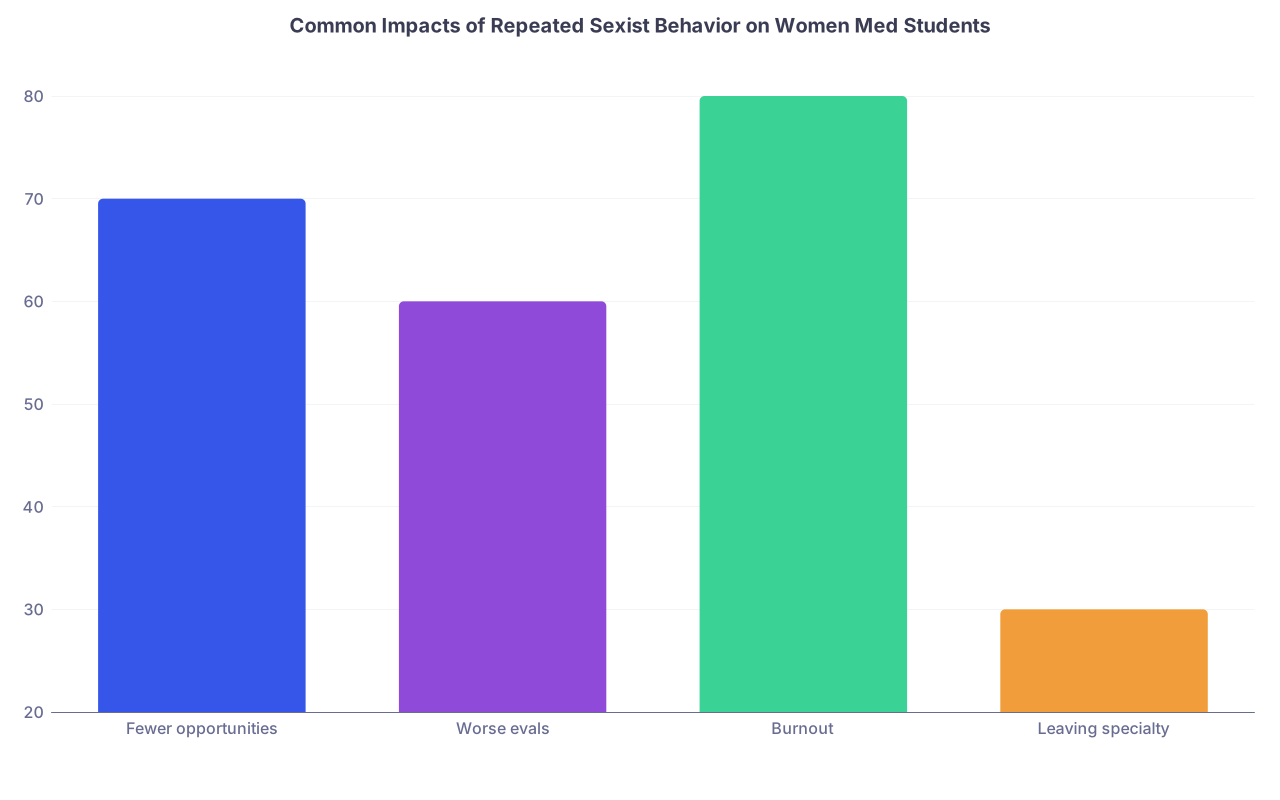
But sexism in medicine rarely stays “just comments.” It bleeds into:
- Who gets procedures
- Who gets introduced to visiting faculty
- Who gets the benefit of the doubt on call
- Who gets written up for “attitude”
| Category | Value |
|---|---|
| Fewer opportunities | 70 |
| Worse evals | 60 |
| Burnout | 80 |
| Leaving specialty | 30 |
Those numbers are illustrative, but the pattern is very real. I have watched it play out repeatedly.
The mistake
You tell yourself:
- “He only said it once, so I will just let it slide.”
- Then it is twice. Five times. Ten.
- Then he “jokingly” questions your commitment.
- Then your eval mentions “seemed less interested” or “not a team player.”
You missed the moment to notice the pattern and document it.
How to avoid it
You do not need to escalate everything. But you absolutely must:
- Track patterns: notes on your phone, dates, who was present, exact phrases
- Notice escalation: from comments → exclusion → undermining
- Recognize when a “personality issue” is actually gendered behavior
When you see repetition, change your strategy:
- Move from informal boundary-setting to documentation.
- Consider a quiet check-in with a trusted faculty member, resident, or clerkship director:
“I am noticing repeated comments of X nature from Y person. I want this on your radar while I continue to handle it professionally.”
You are not “making drama.” You are building a record so you are not gaslit later.
5. Failing to Read the Power Map Before Responding
Another big error: responding the same way to a peer and to an attending with control over your grade. That is not bravery. That is naïve.
The mistake
You use the same level of directness with:
- An intern who makes a sexist joke
- A chief resident who comments on your body
- An attending who hints that women are not suited for the field
You might snap back at the attending the way you would at a classmate. It feels good for five minutes. Until you see your eval. Or your letters. Or your rank list.
Should you have to play politics around basic respect? No. Do you live in the system as it is, not as it should be? Yes.
How to avoid it
Before you respond, quickly scan:
- Who has formal power here? (Evals, letters, schedules)
- Who has informal power? (Influence, friendships with leadership)
- Who else is present? (Allies? Witnesses? People who will back you?)
Adjust your approach:
Peer / classmate / intern:
You can be more direct.
“That is sexist. Do not talk about me like that.”
“Not funny. Cut it out.”Resident with eval influence:
“That comment came off as sexist. I’d appreciate if we kept it professional.”
If they push back: “This is not about a sense of humor. It is about keeping the environment respectful.”Attending who controls your future:
Soften the surface without surrendering the point.
“I know this was probably not your intention, but that comment about women in surgery felt discouraging. I am committed to this field and hope to be evaluated on my performance.”
You are not required to sacrifice your career on the altar of the perfect clapback. Smart response is not cowardice. It is strategy.
6. Taking Feedback About “Professionalism” at Face Value When It Is Gendered
You respond—firmly but appropriately—to a sexist comment. Later, you hear:
- “You came off a bit defensive.”
- “You seemed emotional.”
- “Be careful, some people think you are hard to work with.”
The mistake
You immediately assume:
- “I messed up.”
- “I should have let it go.”
- “This is my fault; I handled it poorly.”
You internalize their framing of your boundary as unprofessional. And next time, you silence yourself.
This is how cultures stay toxic. Women who speak up get framed as the problem. Then other women watch that and decide never to speak up.
How to avoid it
You must learn to decode feedback.
Ask yourself:
- “Would a man be called ‘defensive’ for calmly saying, ‘That comment felt disrespectful’?”
- “Is my ‘tone’ being criticized more than the actual content?”
- “Is there a pattern of women being labeled ‘difficult’ when they push back?”
If yes, then you are not getting neutral professionalism feedback. You are getting gendered pushback for having a boundary.
Actions that help:
- Write down exactly what you said and how you said it.
- Run it by someone you trust (ideally another woman in medicine, or an ally with a spine).
- Ask: “If a male student said this, would it be seen as assertive or problematic?”
Do not automatically downgrade your internal compass because someone with power did not like being challenged. Adjust tactics if needed, sure. But do not absorb their bias as truth.
7. Going It Alone and Not Using the Support Structures That Do Exist
A lot of women med students make a quiet, understandable mistake: they assume no one will help them, so they never try to get help.
They think:
- “The school will protect the faculty.”
- “Everyone says this is just how surgery / EM / ortho is.”
- “Reporting will ruin my career.”
The mistake
You stay isolated.
- You never compare notes with other women in your class.
- You never talk to the one female attending who actually gets it.
- You never quietly approach the clerkship director or student affairs office.
So when things escalate, you have:
- No documented history
- No allies who know your story
- No one to counter the narrative if you are painted as “the problem student”
How to avoid it
You do not need a public crusade. You do need a bench.
Concrete actions:
- Find 1–2 women ahead of you (residents, fellows, early attendings). Ask for a quick meeting. Say plainly:
“I am starting to encounter sexist comments and want to make sure I handle them without hurting my career. Can I run a few scenarios by you?” - Loop in student affairs or an ombudsperson early, not after things explode:
“I am not filing a formal complaint right now. I want a record that I have been experiencing X behavior from Y person and I am concerned it may affect my training.” - Compare experiences with classmates:
Often you will find the same person has said similar things to multiple women. Pattern = power.

| Step | Description |
|---|---|
| Step 1 | Sexist comment occurs |
| Step 2 | Set boundary in moment |
| Step 3 | Start documenting |
| Step 4 | Talk to trusted resident or faculty |
| Step 5 | Share documentation with student affairs |
| Step 6 | Monitor for recurrence |
| Step 7 | Formal report if needed |
| Step 8 | Pattern or one time? |
| Step 9 | Escalate? |
You are not weak for seeking backup. You are smart.
8. Misjudging “Jokes” and Letting Testing Behavior Slide
Many sexist comments are wrapped as jokes:
- “Relax, I am just teasing.”
- “Do not be so serious; I treat everyone this way.”
- “You are fun when you are not being so feminist.”
The mistake
You treat these as trivial. Meanwhile, the other person is often testing:
- How far can I push her?
- Will she laugh along if I sexualize a patient?
- Will she stay quiet if I make fun of female surgeons?
If you pass the test—by laughing, blushing, or letting it go—they learn exactly how to talk to you in the future.
How to avoid it
Treat “jokes” as data about character and safety.
You can respond in ways that make the test backfire:
- Flat affect, no laugh, and:
“I do not find that funny.” - “Jokes about women not belonging here are not my thing.”
- “If that is your sense of humor, please leave me out of it.”
You are not overreacting. You are preventing the slow normalization of hostility.
9. Confusing Self-Blame With “Professional Growth”
One last mistake that quietly eats people alive: you file everything under “personal improvement” instead of “systemic problem.”
You think:
- “If I were more confident, this would not bother me.”
- “If my clinical skills were better, he would not say this stuff.”
- “If I were funnier, I could handle these jokes better.”
That is how you burn out. Not from the work. From the constant internal narrative that every sexist interaction is a referendum on your competence.
The mistake
You respond to bias with self-fixing:
- More reading
- More extra shifts
- More perfectionism
You cannot out-perform misogyny. You can only see it clearly and decide how you will respond to it without losing yourself.
How to avoid it
Separate these two questions:
- “How can I grow as a clinician?”
- “How am I being treated because I am a woman?”
Do not let #2 hijack #1.
Example reframes:
Old story: “He made that comment because I am not good enough.”
New story: “He made that comment because he holds sexist beliefs. That is about him, not my worth. I will still keep improving my skills—for me, not to prove him wrong.”Old story: “If I were tougher, this would not affect me.”
New story: “Any reasonable person would be affected by repeated disrespect. My reaction is normal. I will manage it strategically, not shame myself for it.”
You are allowed to be both:
- Ambitious and angry
- Professional and fed up
- Polite and unwilling to be demeaned
Those pairs are not contradictions. They are survival skills.

What To Remember When It Happens Next Time
You will hear something sexist again. On rounds. In the OR. At 3 a.m. on call when everyone is tired and filters are gone.
When it happens, avoid these critical errors:
- Do not default to silence or explosion—aim for calm, clear, middle-ground responses that protect both your dignity and your record.
- Do not protect their feelings at the cost of your own boundaries—stop reassuring the person who crossed the line.
- Do not isolate yourself—track patterns, loop in allies early, and recognize when “professionalism” feedback is really gendered pushback.
You are not the problem for responding. The behavior is the problem. Your job is not to be endlessly accommodating. Your job is to become a competent, ethical physician without letting this system shrink you on the way there.