
You are in exam room 4. You are already 45 minutes behind. The patient in front of you—late 50s, arms crossed—leans forward and says, “No, you’re going to write me out of work for the rest of the month. I don’t care what the policy is.”
You feel that familiar flash: irritation, a little spike of fear, and the automatic guilt. Because you are the “nice” doctor. The “sweet” one. The one patients say they prefer. And you also know what happens when you say no. Complaints. Bad reviews. “Uncaring.” “Rude.” Possibly “that woman doctor had an attitude.”
Here is the hard truth: if you do not build a deliberate framework for setting boundaries with demanding patients—especially as a woman—you will either burn out, start practicing defensive medicine, or both. You cannot “out-nice” the problem. You need structure.
This is that structure.
1. Understand What You Are Up Against (Gendered Dynamics Matter)
Start here: the problem is not “you are too nice.” The problem is the intersection of:
- Patient entitlement and system pressure.
- Gendered expectations of warmth and agreeableness.
- Real ethical and legal obligations that do not care if a patient yells.
I have seen the same behavior play out differently with male and female physicians in the same clinic, same day, same complaint. Male: “Doctor was firm, but I respect him.” Female: “She was rude and dismissive.” Same words. Different gendered lens.
So you are not imagining it. And you are not weak for struggling.
There are three common traps women physicians fall into with demanding patients:
Over-accommodating to avoid conflict
Saying yes to inappropriate requests because:- “I don’t want a complaint.”
- “They seemed so upset.”
- “It’s easier to just do it.”
Over-explaining to justify appropriate boundaries
Long monologues about “the guidelines,” hoping if you explain enough, they will like you and accept the limit. They often do neither.Over-identifying with their distress
Feeling personally responsible for their emotional state. If they are angry, you feel you failed. That is a setup.
You need a framework that:
- Protects your license.
- Protects your time and energy.
- Respects the patient without rewarding manipulation.
- Works even when you are tired, rushed, or emotionally flooded.
2. The Core Framework: C‑L‑E‑A‑R Boundaries
Use this as your backbone. Simple enough to remember in the middle of a chaotic clinic.
C‑L‑E‑A‑R:
- C – Clarify the request
- L – Link to policy / standard
- E – Express your limit clearly
- A – Acknowledge emotion but don’t negotiate ethics
- R – Redirect to what you can do
Let’s break this down with actual words you can use.
C – Clarify the Request
Demanding patients often start vague, emotional, or accusatory:
- “You are not helping me.”
- “The last doctor always did this.”
- “You have to write this prescription; I know my body.”
If you respond emotionally, you lose control of the frame. You need to pull it back to something concrete.
Phrases to use:
- “So I understand clearly, you are asking for…?”
- “Let me make sure I have this right. You want me to…?”
- “What are you hoping I can do today for you?”
This does three things:
- Forces specificity.
- Shows you are listening, not dismissing.
- Buys you a few seconds to think.
L – Link to Policy / Standard
As a woman, if you present a boundary as “my preference,” it often gets treated as optional. If you link it to standards and systems, it lands differently.
You are not “being difficult.” You are following a structure.
Examples:
- “Our clinic’s policy is not to prescribe controlled substances on a first visit.”
- “The standard of care for this condition does not support long-term antibiotics.”
- “Legally, I am required to document that time off work is medically necessary.”
When possible, shift from “I don’t want to” to “This is how we practice here.”
You are anchoring your boundary in something bigger than your mood or personality. That is crucial for women who are judged more harshly for saying no.
E – Express Your Limit Clearly
This is the part many people dilute. They talk around it. They hint. They trail off.
You need one clear sentence that starts with:
- “I cannot…”
- “I will not…”
- “I am not able to…”
Not:
- “I’m not sure if I can…”
- “I don’t think we should…”
- “I prefer not to…”
Examples:
- “I cannot prescribe opioids for chronic pain in this situation.”
- “I will not write a note for permanent disability based on today’s visit.”
- “I am not able to extend your work excuse beyond 2 more days without seeing you again.”
Short. Direct. No apology. You can be warm in tone, but the content must be firm.
If you are tempted to add five more sentences to “soften” it—do not. Every extra sentence is an invitation to argue.
A – Acknowledge Emotion but Don’t Negotiate Ethics
Demanding patients often escalate when they realize you are holding a line. They may:
- Cry.
- Yell.
- Question your competence.
- Accuse you of not caring.
You can acknowledge their feeling without changing the boundary.
Phrases that work:
- “I can see this is very upsetting for you.”
- “I hear that you are frustrated and feel no one is listening.”
- “I understand you are worried about losing your job.”
Then immediately re-anchor:
- “Even so, I still cannot prescribe that medication.”
- “Even so, my note has to reflect what is medically appropriate.”
- “Even so, I will not change the documentation to say something I do not believe is accurate.”
Empathy without capitulation. That’s the line.
R – Redirect to What You Can Do
Never end on “no.” End on “here is what I can offer.” This is not placating; it is efficient.
Examples:
- “I cannot extend your disability indefinitely. What I can do is refer you to a specialist to evaluate for longer-term support.”
- “I will not prescribe the medication you are asking for. What I can do is discuss other options for managing your pain.”
- “I cannot write this as a work-related injury without evidence. What I can do is document your symptoms accurately and recommend light duty.”
This keeps you in the role of problem solver instead of adversary. You are still the doctor trying to help, within ethical and legal lines.
3. Scripts for High-Risk Scenarios
Let’s run the framework through common nightmare cases. You need ready-made language, not vague theory.
Scenario 1: “I Want More Pain Meds, Now”
Patient: “I need a refill of my oxycodone. The ER always gives me 30 pills. If you do not, I will report you.”
Use C‑L‑E‑A‑R:
Clarify:
“So you are asking for a refill of oxycodone for your back pain today, correct?”Link:
“Our clinic policy and current guidelines are to avoid long-term opioids for chronic back pain, especially without clear indications.”Express limit:
“I will not prescribe oxycodone for your chronic pain today.”Acknowledge:
“I hear that you are scared of being in pain and feel like no one is helping you. I do not want you to suffer.”Redirect:
“What I can do is adjust your non-opioid medications, refer you to pain management, and work on a long-term plan that is safer for you.”
If they escalate, you repeat the limit once and then set a process boundary:
- “I understand you are angry. I have explained what I can and cannot do. If you continue to raise your voice, I will need to end this visit and we can schedule a follow-up with another provider if you prefer.”
Then follow through.
Scenario 2: Manipulative Work Notes and FMLA
Patient: “You are going to write me out of work for 3 months. My cousin’s doctor did it for her. If you do not help me, I will lose my job and it will be your fault.”
C‑L‑E‑A‑R:
Clarify:
“You are asking for a note excusing you from all work duties for 3 months, starting today, right?”Link:
“For medical work notes, I need to base my recommendations on your condition and what is medically necessary and supported by documentation.”Express limit:
“I am not able to write you out of all work for 3 months based on your current exam and history.”Acknowledge:
“I understand you are under a lot of stress and worried about your job. That is a very real pressure.”Redirect:
“What I can do is document your diagnosis, recommend specific restrictions that are medically appropriate, and fill out what I believe is accurate for any forms you bring. I cannot change the medical reality to fit what your employer wants to see.”
Again, if they push: repeat the core line, do not elaborate into a new negotiation.
Scenario 3: Sexualized or Boundary-Crossing Comments
This one is gendered and ugly. You will see it.
Patient: “You are too pretty to be a doctor.”
Or: “If you were my wife, I would never let you work this hard.”
Or directly: “Let me see you smile more, sweetheart.”
You still use structure—but it is slightly different. The boundary here is about respect and safety more than clinical requests.
Steps:
Name the behavior:
“That comment is not appropriate.”State your role:
“I am your physician, and we are here to focus on your health.”Set consequence:
“If the comments continue, I will end this visit.”
Example:
- “That comment about my appearance is not appropriate. I am your physician, and we are going to keep this professional and focused on your health. If the comments continue, I will end the visit.”
If they continue, you end it. You do not warn three more times. You do not laugh it off “to keep the peace.” And you document.
4. Protect Yourself Operationally: Documentation, Allies, and Policies
Boundary-setting is not just about words in the room. It is about your system backing you up. Otherwise, you are just absorbing the blow alone.
Document Like a Future Complaint is Coming
Not paranoid. Just realistic. You should assume that any high-conflict encounter could lead to:
- Portal messages.
- Complaints to administration.
- Online reviews.
- Board complaints.
Your note should clearly reflect:
- The request made (“Patient requested long-term opioids for chronic back pain without new injury or findings.”)
- The information you provided (“Discussed clinic policy and CDC guidelines on opioid prescribing.”)
- The boundary you set (“Explained I would not prescribe opioids today but offered non-opioid alternatives and referral.”)
- The patient’s reaction in neutral terms (“Patient expressed frustration and raised voice; visit ended after explaining limits.”)
Neutral. Factual. No editorializing about “difficult patient.” Just the data.
Use Allies in Real Time
You do not have to solo every confrontation.
- Ask a nurse or MA to stay in the room when you sense escalation.
- Step out and discuss briefly with a colleague: “Here’s what is happening; my plan is X. Agree?” It takes 60 seconds and gives you support.
- In some clinics, security or an admin lead can be on standby. Use them before it gets ugly, not after.
As a woman, the presence of a second person often changes patient behavior. That is unfair but real. Use it to protect yourself.
Shape Policy to Support You
If your clinic or department does not have clear policies on:
- Opioid prescribing.
- Work notes and disability forms.
- Early refills.
- Abusive behavior.
…you will pay the price in every room, every day.
You do not need to “fix the whole system,” but you can push for:
- A written policy for controlled substances that is handed to patients at intake.
- A standard script or form for work notes with specific, limited durations.
- A posted statement: “We do not tolerate abusive language or behavior toward staff.”
These give you a reference point:
- “As you saw in the paperwork you signed, we do not prescribe early controlled substance refills.”
- “Per our policy, any threats or abusive language will lead to the visit ending.”
This is especially critical for women, who otherwise get framed as “overreacting” when they enforce boundaries.
5. Internal Work: Guilt, Fear, and the “Nice Doctor” Trap
Let me be blunt: your biggest enemy is not the demanding patient. It is your own internal script.
Women in medicine are trained—formally and informally—to:
- Keep everyone happy.
- Be endlessly patient.
- Absorb emotional labor for the team.
You have to rewrite that script.
Separate “Good Doctoring” From “Making People Happy”
You are not a customer service rep. You are a professional with ethical duties.
Ask yourself, in any tense encounter:
- “What action here protects this patient’s safety, my license, and the integrity of care?”
That is the right action. Even if it makes them furious.
If you find yourself thinking:
- “If I say no, they will hate me.”
Translate it:
“If I say no, I will be uncomfortable.”
That is the real fear. And it is survivable.
Expect Some Fallout—and Decide It Is Worth It
You will get:
- Negative reviews.
- Complaints framed as “she was rude” when you were simply firm.
- Pushback from admins who care about “patient satisfaction scores.”
Decide now:
“I would rather have a complaint about my tone than a board complaint about my prescribing.”
That is the calculation. Every time. And it is not even close.
6. Practice: Micro-Reps So It Feels Natural
You cannot go from over-accommodating to rock-solid boundaries in one week. Your nervous system needs reps.
Here is a simple progression.
Step 1: Plan 2–3 Core Lines
Write down:
- One line for medications you will not prescribe.
- One line for work notes.
- One line for disrespectful behavior.
Example set:
- “I will not prescribe that medication; it is not appropriate in this situation.”
- “I am not able to complete the form the way you are requesting because it does not match my medical assessment.”
- “That comment is not appropriate. If it continues, I will end this visit.”
Memorize them. Out loud. In your car, in the shower, on a walk.
Step 2: Use Them Once Per Day
Pick one boundary you will hold today, no matter what. That is it. One.
- Maybe it is saying no to an early refill.
- Maybe it is ending a visit if someone yells.
- Maybe it is declining to change a diagnosis to please an insurance company.
Use the line. Notice the discomfort. Do it anyway.
Step 3: Debrief and Adjust
At the end of the day, ask yourself:
- What did I say?
- Where did I start over-explaining?
- Did the world end when they got upset?
You will see patterns. Maybe you hold the line but then keep talking. Or you soften your language (“I’m just not able to…”) and watch patients treat it like a negotiation.
Tighten the language next time. Less apologizing. More clarity.
Step 4: Share Wins With a Peer
Find one colleague who respects boundaries. After a rough encounter, tell them:
- “Patient demanded X, I used my line, they got mad, I held anyway.”
You need this witness. It normalizes the discomfort and reinforces that you did the right thing.
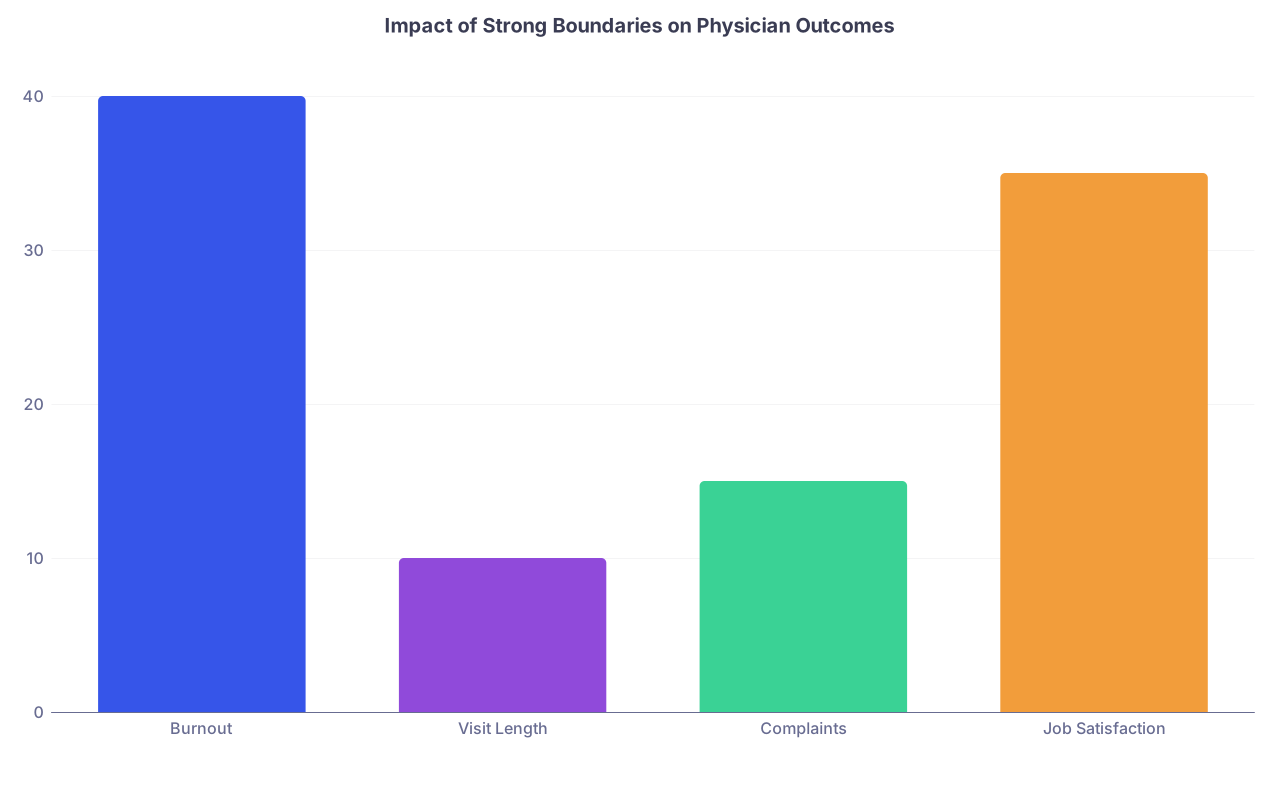
| Category | Value |
|---|---|
| Burnout | 40 |
| Visit Length | 10 |
| Complaints | 15 |
| Job Satisfaction | 35 |
(Example concept: After implementing clear boundaries, physicians commonly report decreased burnout, slightly shorter visits, fewer serious complaints, and higher job satisfaction.)
7. When It Gets Dangerous: Safety Before Service
There is a line where “demanding” becomes threatening. Women are targeted more for:
- Stalking behavior.
- Sexualized threats.
- Comments about harm if they do not comply.
Symptoms you are past “difficult” and into “unsafe”:
- You start altering your schedule to avoid them.
- You feel anxious seeing their name on the schedule.
- They have crossed personal lines (social media, waiting outside clinic, etc.).
Here is the protocol:
- Flag the chart (if your system allows): note the concerning behavior.
- Loop in leadership: send a factual summary email to your medical director / risk management.
- Set a formal boundary:
- Letter from the practice restricting contact or dismissing the patient from the practice.
- Security or escort awareness.
- Never see them alone: always two staff in room if they must be seen urgently while dismissal is processed.
You are not being dramatic. You are being prudent.

| Step | Description |
|---|---|
| Step 1 | Patient makes demanding request |
| Step 2 | Clarify request |
| Step 3 | Link to policy or standard |
| Step 4 | Express limit clearly |
| Step 5 | Redirect to what you can do |
| Step 6 | Acknowledge emotion |
| Step 7 | End visit and document |
| Step 8 | Inform leadership and staff |
| Step 9 | Escalation? |
| Step 10 | Abusive or unsafe? |

8. Pulling It Together: Your Personal Boundary Playbook
You do not need a 50-page policy binder in your head. You need:
- A simple framework (C‑L‑E‑A‑R).
- A few core lines you can say under pressure.
- A system that backs you up when you enforce them.
Here is what your personal playbook can look like on one page.
| Situation | Core Line | Backup Action |
|---|---|---|
| Inappropriate med request | "I will not prescribe that; it is not appropriate." | Offer alternatives, document |
| Work excuse or disability demand | "I am not able to write that based on my findings." | Offer accurate restrictions, document |
| Disrespectful / sexual comments | "That comment is not appropriate." | Warn once, then end visit if repeated |
| Yelling / aggressive tone | "If you continue to raise your voice, I will end this visit." | Step out, bring staff, document |
| Threatening behavior | "This visit is over." | Leave, notify security/leadership |
Print something like this. Keep it in your work bag. You will not need it forever, but for a while, it is your script until the words are in your bones.
Your Next Step (Do This Today)
Do not just nod along and move on to the next thing. Change does not happen that way.
Take 10 minutes today and:
Write down three exact sentences:
- One for a medication boundary.
- One for a work note / documentation boundary.
- One for inappropriate comments.
Say them out loud five times each. Stand up while you do it. Feel how they sound.
Tomorrow, use one of them with the first demanding patient you see.
That is how you build a framework: one clear sentence, said out loud, in a real room, by a woman physician who has decided that her ethics and her well-being are not up for negotiation.