
The unspoken rule that you should “just let it go” when a colleague crosses a line is dangerous—and wrong.
If you are a woman in medicine, you already know this: the system is not naturally set up to protect you. You have to walk in with your own emergency protocol. Just like ACLS. Just like sepsis. You do not improvise those. You follow a script.
This article gives you that script for when a colleague crosses physical or verbal boundaries—attendings, peers, nurses, techs, anyone. Not theory. A working protocol you can run in real time and afterward.
1. Know Your Thresholds Before Anything Happens
You will not set boundaries effectively in the moment if you have never defined what your lines are.
Here is the blunt reality: medicine normalizes a lot of garbage as “banter” or “he is old-school” or “she is just like that.” That normalization is how people get away with everything from inappropriate jokes to actual assault.
You need your own definition, not the culture’s.
What “crossing the line” looks like
You do not need it to be criminal to call it unacceptable. Have your categories clear in your head:
Verbal boundary violations
- Sexual comments about your body, clothes, or appearance.
- “Jokes” about your marital status, sex life, or orientation.
- Gendered insults: “too emotional,” “bossy,” “aggressive,” “bitchy,” “princess,” “sweetheart,” “honey.”
- Comments tying your competence to your gender, pregnancy, parental status, or relationship status.
- Repeated unwanted comments after you have already asked them to stop.
Physical boundary violations
- Any uninvited touch: rubbing shoulders, hand on lower back, hugging without your consent, hair touching.
- Standing too close and not backing off when you move.
- Trapping you in a room or corner.
- Any forced touching, kissing, or blocking your exit—this is assault territory.
Power/role abuse tied to gender
- Threats or implied retaliation if you “do not play along” or “you are no fun.”
- Linking evaluations, letters, shifts, or OR time to social or romantic access.
- “If you have a drink with me, I’ll make sure your schedule looks better.”
You decide your line. Not them. If the thought “that felt wrong” crosses your mind, that is enough.
Now you need a protocol.
2. Immediate Response: The “Code Boundary” Protocol
Think of this as your emergency response algorithm. You will not always use every step. But you should know them cold.

| Step | Description |
|---|---|
| Step 1 | Boundary crossed |
| Step 2 | Name and stop behavior |
| Step 3 | Exit situation |
| Step 4 | Document details |
| Step 5 | Report and escalate |
| Step 6 | Informal support and monitoring |
| Step 7 | Safe to respond now? |
| Step 8 | Need formal action? |
Step 1: Safety check
Ask yourself quickly:
- Am I physically safe?
- Am I alone with this person?
- Are patients present?
- Is this escalating?
If there is any question about safety:
- Move toward a door, hallway, or nurses’ station.
- Use a “patient excuse”:
“I need to check on my patient in 12 now.”
Then leave. You do not owe them closure.
You are not overreacting when you prioritize your physical and psychological safety.
Step 2: Use a clear boundary statement (if safe)
You need 2–3 memorized phrases you can run like a reflex. Not polite. Not vague. Clear.
Here are scripts that work in clinical culture:
- “Stop. That is not appropriate.”
- “Do not touch me.”
- “I do not joke about that at work.”
- “Comments about my body / relationship / pregnancy are not acceptable.”
- “We are at work. Keep this professional.”
Say it in a calm, even tone. No nervous laugh. No extra apologizing. You do not debate. You state.
For repeated behavior after a prior ask:
- “I told you before this makes me uncomfortable. This needs to stop now.”
- “We have already talked about this. If it continues, I will escalate it.”
You are not threatening. You are stating your plan.
Step 3: End or change the interaction
Once you have drawn the line, do not linger to make them feel better.
Tactical exits:
- “I have to get to my next patient.”
- “I am due in clinic / OR / conference.”
- “I need to finish notes.”
Then you walk. Even if they are mid-sentence.
If the situation is minor and you feel it is enough to have set the limit, fine. But do not stay and make it “less awkward” for them. That is how lines get redrawn in their favor.
3. If Physical Contact Occurs: Treat It Like a Medical Emergency
When a colleague crosses into physical contact without consent, you need to treat it like what it is: an immediate violation that deserves decisive action.
Immediate on-the-spot options
If possible, you respond in real time:
- Move their hand away.
- Step back.
- Say, clearly:
- “Do not touch me.”
- “That is not okay.”
If they laugh it off—“Relax, it was just a joke”:
- “No. It was not a joke. It was inappropriate. Do not do that again.”
If they try to minimize—“You are being too sensitive”:
- “I am telling you my boundary. Respect it.”
You do not argue sensitivity levels. You assert your boundary. Period.
If you feel frozen or shocked
Freezing is common. I have seen brilliant surgeons and chiefs of service freeze when something crossed a line. Your brain is not broken. It is doing what brains do under threat.
If you froze:
- Do not blame yourself for not reacting “better.”
- Focus on what you can control now: document and decide next steps.
You still have options after the fact:
- Later that day or next time you see them (ideally with a door open / visible space):
- “About earlier. You touched me in a way I did not consent to. Do not ever do that again.”
- “What you did in the OR / call room / clinic made me uncomfortable. That cannot happen again.”
You are not asking permission to be upset. You are issuing a directive.
4. Document Like You Are Writing a Note for Court
After any significant verbal or physical boundary crossing, you need a contemporaneous record. Not in your EMR. In your own secure space.
You are a clinician. You know how to write a clear, objective note. Use that skill.
What to record (as soon as possible)
Open a secure document (personal device, locked notes app, password-protected file). Write:
- Date and exact time (approximate if needed).
- Location (clinic room, OR 3, physician lounge, hallway outside ICU).
- Who was present (names and roles).
- Exact words used as close as you can recall.
- Exact physical actions (where they touched you, how).
- Your response (what you said/did).
- Any immediate follow-up (they apologized, they laughed, others reacted).
Example structure:
2026-01-08, 10:15 am, OR 2
Attending Dr. X, scrub tech Y, circulator Z, anesthesia MD A, me (R2).
During skin closure, Dr. X said, “You have great hands for a girl; no wonder your boyfriend is happy,” while looking at me and laughing. Others looked down; circulator Z shook head slightly. I said, “That is not appropriate.” Dr. X replied, “Come on, relax,” and continued laughing.
This kind of note becomes extremely powerful if patterns emerge. Or if you later choose to report.
5. Decide Your Escalation Level: The “Three-Path” Model
Not every incident needs the same level of escalation. You have three main paths:
- Internal management only (you handled it, you document, you watch).
- Informal support / warning system (mentors, chief residents, program leadership).
- Formal reporting (HR, Title IX, GME, compliance, licensing boards).
You choose based on:
- Severity (physical vs verbal, one-off vs pattern).
- Power differential (peer vs attending vs leadership).
- Risk to patients and others (is this person pattern-dangerous?).
- Your emotional and career risk tolerance.
| Path | When to Use | Main Goal |
|---|---|---|
| Internal only | Minor, one-time, stopped fast | Protect self, monitor |
| Informal support | Patterns, gray zones | Get backing, options |
| Formal reporting | Serious or repeated behavior | Stop harm, accountability |
Path 1: Internal management only
Use this when:
- It is a lower-level verbal incident.
- You set a clear boundary and they stopped.
- There is no prior pattern with this person.
Your steps:
- Document the incident.
- Tell at least one trusted person (friend, co-resident) so there is a witness that you reported it informally.
- Watch for recurrence.
If it happens again, you move up a path. No third chances.
Path 2: Use your informal support network
This is underused and powerful when done correctly. You are not “gossiping.” You are gathering data and protection.
Who to consider:
- A woman faculty member you trust.
- Your program director (if safe) or associate PD.
- Chief resident (for residents / fellows).
- A senior nurse who has seen everything and is honest.
- Institutional ombudsperson, if available.
Your script:
- “I want to run a situation by you and get your advice. I am also documenting this for safety.”
- Then present like a case: facts, your response, your concern, what you are considering.
A good senior person will:
- Validate that it was inappropriate (or tell you if the culture has already flagged this person).
- Tell you how the institution usually responds.
- Help you strategize timing and approach if you choose to report.
If the first person you tell blows you off—“That is just how Dr. X is”—you do not stop there. You are gathering multiple data points.
Path 3: Formal reporting
This is where many women hesitate, and for good reason. Retaliation is real. So you do it strategically.
When to strongly consider formal reporting:
- Any non-consensual physical contact.
- Any behavior that made you fear for your safety.
- Repeated incidents after clear boundaries.
- Use of power to coerce social / romantic / sexual access.
- Behavior toward multiple people (you hear similar stories).
- Anything you would want reported if it happened to your trainee.
Entities that commonly take reports:
- HR or Employee Relations.
- Title IX office (if your institution is linked to a university).
- GME office (for resident/fellow situations).
- Compliance or institutional hotline.
- Medical staff office or professionalism committee.
You are not obligated to go first to your program director if the offender is in your chain of command. In fact, sometimes you should not.
6. How to Report Without Destroying Your Career
You can report with strategy, not naïveté. The goal is: protect yourself and others, minimize retaliation risk, and keep control of your narrative.
Before you report
Get your materials together:
- Your contemporaneous notes.
- Any texts, emails, or messages.
- Names of anyone who witnessed or might have noticed your distress afterward.
- A concise timeline.
Then decide:
- Do you want to report confidentially (advice only) or formally (triggering an investigation)?
- Do you want a support person with you (mentor, ombuds, union rep if applicable)?
Some offices allow hypothetical consultations:
- “If a trainee experienced X from an attending, how would your office handle that? What options would she have?”
- This lets you gauge their culture before committing.
When you actually report
Use clinical-style communication. Direct and factual:
- Lead: “I am reporting unprofessional / harassing / inappropriate conduct by Dr. X.”
- Provide:
- Specific incidents with dates and locations.
- Your responses and any prior attempts to set boundaries.
- Any witnesses.
- Patterns (if known).
State your needs:
- “I am concerned about retaliation and want to know what protections exist.”
- “I do not feel safe working alone with this person.”
- “I want this documented even if no formal action occurs immediately.”
Write down:
- Who you met/spoke with.
- Date and time.
- Summary of what they said they would do.
Follow up with a brief email:
“Thank you for speaking with me today about the conduct of Dr. X on [date]. As we discussed, I reported [brief description]. You indicated [actions they said they would take]. I appreciate confirmation of the next steps.”
This quietly locks in their accountability.
7. Handling the Backlash and Gaslighting
If you challenge inappropriate behavior, some people will make you the problem. Expect it. Plan for it.
Common moves you will see:
- “You misunderstood.”
- “You are too sensitive.”
- “It was a compliment.”
- “Everyone knows I joke like that.”
- “She is overreacting because she is stressed / hormonal / pregnant.”
- “She is trying to ruin his career.”
Do not waste energy trying to convince everyone. You are not running a public relations campaign. You are protecting your boundaries and, often, others.
Your anchors:
- You know what happened.
- You documented it.
- You sought advice.
- You responded proportionately.
If a colleague says, “I heard you filed a complaint about Dr. X; what happened?” you are allowed to keep it tight:
- “I am not discussing it.”
- “It is being handled through the appropriate channels.”
Or, if you want to signal that the behavior is real without oversharing:
- “I raised concerns about unprofessional conduct. I hope the process makes the workplace safer for everyone.”
8. Emotional Aftercare: You Are Not a Robot
Boundary violations are not just “events.” They have aftershocks: shame, anger, fear, self-doubt. I have watched women question their competence because they felt gross after a hallway incident. That is not a character flaw. That is trauma physiology.
You need an aftercare plan as deliberately as you need a response plan.
Short-term:
- Name it: “What happened was inappropriate / harassment / assault.” Denial protects the perpetrator.
- Talk to at least one person you trust outside the chain of command.
- Sleep and food: Yes, I am serious. Your resilience plummets when you are already biologically depleted.
- Movement: Walks, runs, quick workout. Shakes off some of the stress hormones.
Medium-term:
- Counseling: If you have access through your institution, use it. Otherwise, private therapy if possible. Someone who understands workplace trauma, not just “stress.”
- Peer space: Women in your specialty, online or in-person, who know the dynamics. Not to wallow— to strategize.
- Boundary practice: Role-play responses with trusted friends. It makes you faster next time.
You are not weak for needing support. You are a human in a system that has normalized abuse for decades.
9. Preventive Work: Setting a Reputation for Firm Boundaries
This part is uncomfortable to say, but it is true: when people know you have firm, enforced boundaries, they are less likely to test them.
You build that reputation over time:
- You do not laugh along with sexist jokes.
- You do not ignore “small” comments—at least once in a while, you say, “Not funny.”
- You shut down rumor-y conversations about trainees’ bodies or personal lives.
- You back other women up when they draw a line:
“She is right. That was inappropriate.”
When a known boundary-crosser realizes that with you, it will not be fun, easy, or silent, they often redirect to easier targets. That is ugly. It is also how predators operate. Ideally, institutions stop them altogether. Until then, you make yourself a hard target.
10. Special Situations: Patients, Supervisors, and Social Settings
Not all boundary crossings come from colleagues on your exact level. Three particularly messy zones:
A. When it is a patient
Separate but related. Quick protocol:
- Clear, calm statement:
- “That comment is not appropriate. I am here as your doctor / your nurse / your PA.”
- If repeated or severe:
- “I am going to step out and have a colleague join us.”
- Document in the chart: “Patient made sexual / inappropriate comments; boundaries set; chaperone recommended.”
- Notify your attending or charge nurse.
You are never obligated to stay alone in a room with a patient who is harassing you.
B. When it is your direct supervisor
Power gradient is steep. Strategy matters more.
You rely heavily on:
- Documentation.
- Off-chain allies (mentors in other divisions, ombuds, Title IX).
- Group reporting if others have similar experiences (there is safety in numbers).
Often the safest sequence:
- Quietly gather others’ stories (without pressuring them).
- Consult with an ombuds or equivalent confidential office.
- Approach a higher-level leader together or through a formal channel.
C. Social or “gray zone” settings (conferences, dinners, retreats)
Boundaries count there too. And things often get sloppy.
You pre-decide:
- Your alcohol limit (or none) at work-related events.
- Your exit lines: “I have an early clinic,” “I need to call my family,” “I am heading out.”
If a “friendly” interaction starts drifting:
- “I keep work and personal life separate.”
- “I am not comfortable with this kind of conversation.”
- “I am heading out now. Have a good night.”
And then you leave. You do not owe anyone a drink, a dance, or a ride home because they mentored you.
11. Build Your Personal “Code Boundary” Card
You have code cards for ACLS. Do the same here. Literally write it out.
Front side: On-the-spot scripts
- “Stop. That is not appropriate.”
- “Do not touch me.”
- “Comments about my body / relationship are not acceptable.”
- “We are at work. Keep this professional.”
- Exit: “I have to see my patient / get to clinic / finish my notes.”
Back side: After-incident checklist
- Am I safe right now?
- Write down date, time, place, people, exact words/actions.
- Tell one trusted person today.
- Decide: internal only / informal support / formal report.
- Schedule one act of aftercare (friend, walk, therapy, sleep).
You keep this in your phone notes or even on an actual card in your badge holder. It sounds extreme until you need it once. Then you will be glad it is there.
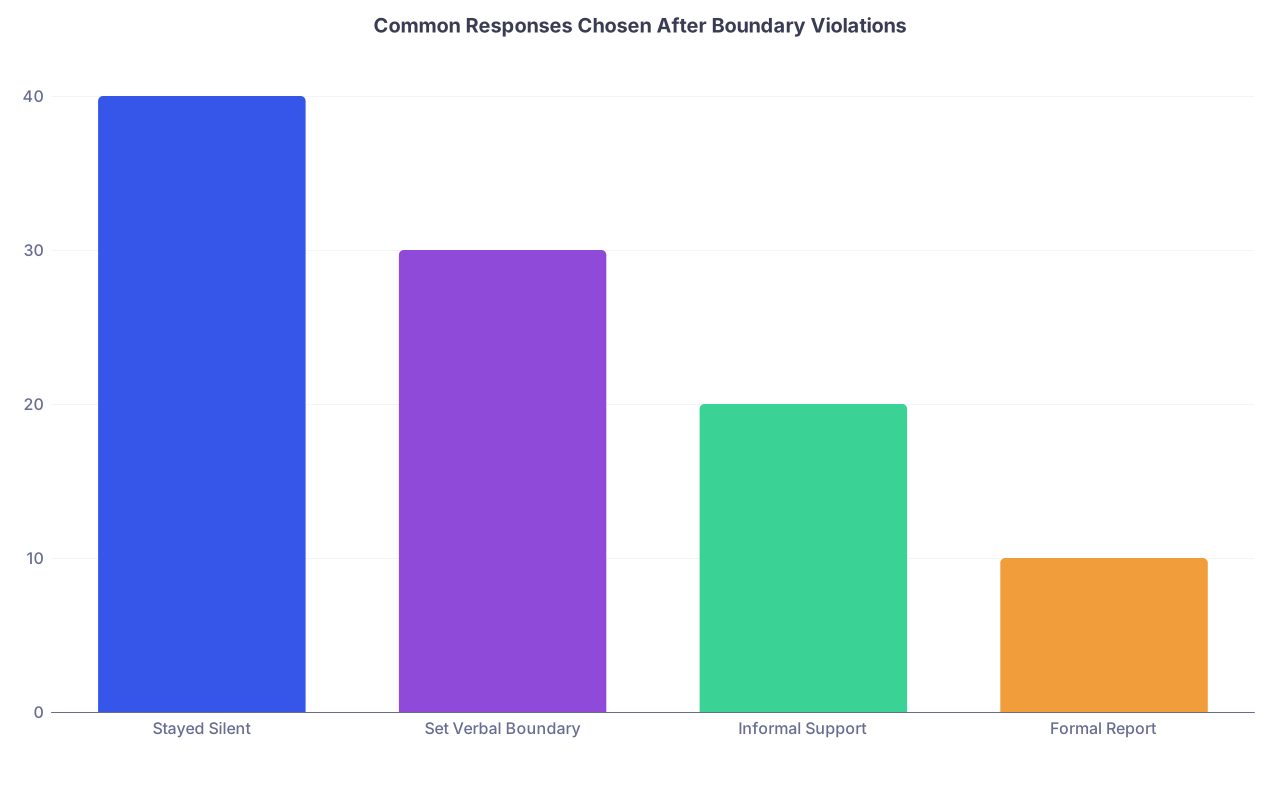
| Category | Value |
|---|---|
| Stayed Silent | 40 |
| Set Verbal Boundary | 30 |
| Informal Support | 20 |
| Formal Report | 10 |

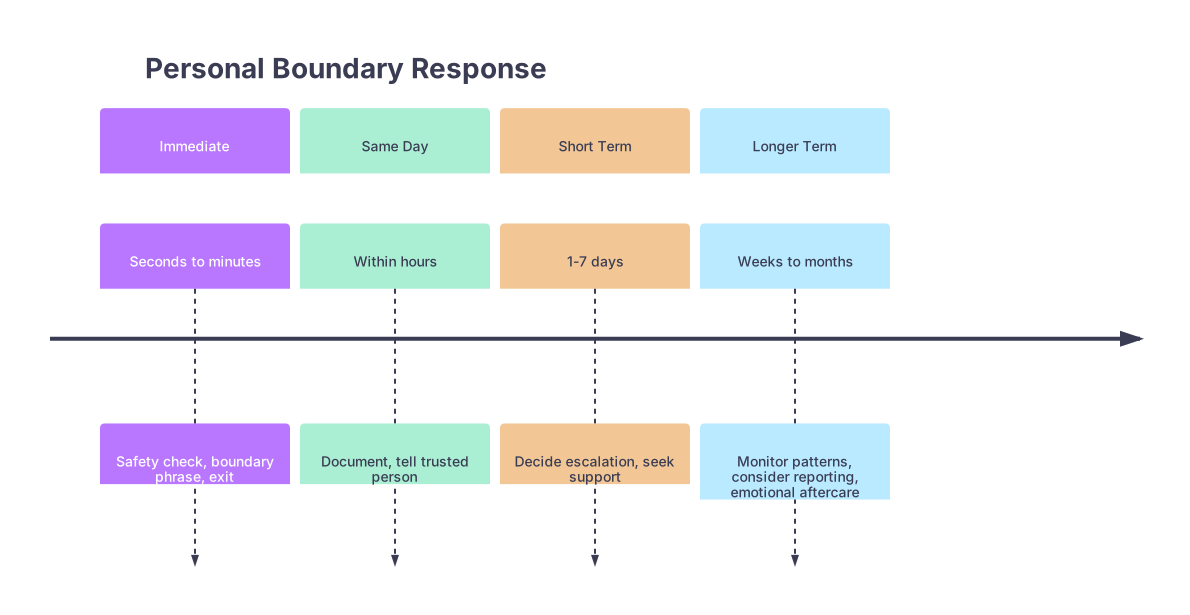
| Period | Event |
|---|---|
| Immediate - Seconds to minutes | Safety check, boundary phrase, exit |
| Same Day - Within hours | Document, tell trusted person |
| Short Term - 1-7 days | Decide escalation, seek support |
| Longer Term - Weeks to months | Monitor patterns, consider reporting, emotional aftercare |
FAQ (Exactly 3 Questions)
1. What if I am not sure whether what happened was “bad enough” to act on?
When in doubt, document and talk to one trusted person. You do not need a legal opinion to justify your discomfort. If it stuck with you enough that you are replaying it, that is your sign. You can always choose a lower-level response (internal management, informal advice) now and escalate later if a pattern appears.
2. Will reporting or pushing back ruin my career or evaluations?
Retaliation is a real risk, which is why you do this strategically. Document everything, consult with confidential resources (ombuds, Title IX, GME), and avoid solo confrontations with high-power offenders when you can bring support. Many institutions now take retaliation very seriously on paper; some actually enforce it. Your paper trail and allies make it harder for someone to quietly tank you without consequence.
3. How do I support another woman in my workplace who is dealing with this?
First, believe her. Say so explicitly. Then ask what she wants: to vent, to plan, to document, to report. Offer concrete help: going with her to talk to a mentor, helping her write her incident timeline, watching for corroborating behavior at work. Do not push her into actions she is not ready for, but do not minimize it either. Your visible backing makes her safer—and signals to others that the days of silent tolerance are over.
Open the notes app on your phone right now and create a “Code Boundary” card with three phrases you will use and a five-step after-incident checklist—so the next time someone crosses a line, you already know exactly what to do.