
Only 27% of women emergency physicians report feeling “usually safe” commuting to or from night shifts.
The Real Landscape: Night Shifts, Gender, and Risk
Let me be blunt. Night shift in emergency medicine is not just “a circadian problem” for women. It is a security problem, a harassment problem, and sometimes a bodily autonomy problem. The clinical work is the same. The context is not.
You are walking to your car at 3:15 a.m. in an unmonitored back lot.
You are in a locked ED with a psych boarder who keeps asking if you are married.
You are the only woman on a skeleton team when a drunk patient comments on your body while your male colleague laughs awkwardly instead of shutting it down.
Those are not abstract ethics scenarios. Those are Tuesday nights.
Let me break this down specifically: how female EM physicians actually navigate night shifts and safety concerns, clinically, physically, psychologically, and ethically.
1. The Night Shift Risk Profile for Women in EM
Different job, different baseline risk
Emergency medicine is already high-exposure:
- Intoxicated patients
- Police custody patients
- Psychiatric crises
- Gang-related injuries
- Domestic violence perpetrators in the same room as their victims
Add gender. The risk profile shifts. The threats are not only “general violence” but also:
- Gendered harassment
- Sexualized comments and boundary testing
- Stalking behavior (in-hospital and post-discharge)
- Power dynamics with male colleagues and security staff
, [Stalking/following](https://residencyadvisor.com/resources/women-in-medicine/managing-high-risk-patient-encounters-as-a-woman-in-outpatient-settings), Online harassment from patients or families](https://cdn.residencyadvisor.com/images/articles_svg/chart-common-safety-concerns-reported-by-female-em-physi-3918.svg "Common Safety Concerns Reported by Female EM Physicians on Night Shifts")
| Category | Value |
|---|---|
| Parking/commute | 78 |
| In-hospital harassment by patients | 65 |
| [In-hospital harassment by staff](https://residencyadvisor.com/resources/women-in-medicine/microaggressions-in-rounds-detailed-examples-and-response-options) | 34 |
| [Stalking/following](https://residencyadvisor.com/resources/women-in-medicine/managing-high-risk-patient-encounters-as-a-woman-in-outpatient-settings) | 22 |
| Online harassment from patients or families | 15 |
Those numbers are roughly in line with survey data from hospital safety committees, resident wellness surveys, and informal women-in-EM groups. I have heard versions of the same story at county hospitals, academic centers, and high-end suburban EDs. The geography changes; the pattern does not.
Night amplifies everything
Why nights specifically?
Fewer staff and witnesses.
Security is thinner. Leadership is home. HR is asleep. The informal deterrent of “a lot of eyes” is gone.Case mix shifts.
More intoxication. More assaults. More agitation. A lot more “you can’t tell me what to do.”Environmental risk.
Dim parking lots, quiet stairwells, limited public transport, rideshares at odd hours.
Risk here is not purely physical harm; it is the chronic, grinding psychological load of always scanning for threat. That has ethical implications for fatigue, clinical performance, and fairness in how call schedules are built.
2. Physical and Environmental Safety: What Women Actually Do
This is the unglamorous part. The stuff no one puts in the brochure, but every female EM physician quietly trades tips about in the workroom.
Commute and parking: tactical habits
Typical pattern I see among women who have been doing this a while:
- They park as close as possible to the ED entrance, even if it is not technically “allowed,” and then apologize later if someone complains.
- They avoid parking garages with blind corners and multiple levels if there is any other option.
- They time their departure with another staff member when possible.
Common concrete strategies:
- Key fob and phone already in hand walking to the car. Bag zipped, nothing dangling.
- Shoes you can actually run in (or at least not trip in).
- Pre-programmed “SOS” contact or safety app that can send location with two taps.
Is this ideal? No. Is it happening in virtually every city? Absolutely.
Hospitals that are not clueless have started responding with:
| Measure | Effective When |
|---|---|
| Security escort to parking | Escorts are actually available 24/7 and prompt |
| Staff-only parking near ED | Access is controlled; lighting is good |
| Panic buttons at entrances | Buttons are well-marked and monitored |
| 24/7 shuttle service | Shuttles run on-demand, not fixed hourly |
If your hospital has “security escorts” that require a 30-minute wait and a phone tree, that is theater, not safety.
Inside the hospital: room, layout, and door habits
Senior women in EM quietly train juniors in things that are never in the orientation slideshow:
- You position yourself closest to the door with agitated or intoxicated patients. Always.
- You avoid standing in the corner of the room between the bed and the wall.
- You consciously maintain a clear exit path.
For very high-risk interactions (acutely psychotic patient, custody disputes, certain domestic violence scenarios):
- You request security in the room for the exam. Not “outside if needed.” In the room.
- You adjust your body language: hands visible, maintain distance, sit or stand at an angle instead of head-on (less confrontational, easier to sidestep).
- You avoid leaning over a patient’s upper body from the bedside if there is any concern about sudden grabbing.
I have seen women physically grabbed, kissed, or groped during what was supposed to be a neurologic exam or trauma survey. These are not imaginary fears.
Scrubs, appearance, and the “invisibility calculus”
There is an unspoken uniform shift among many women on nights:
- Less jewelry, smaller earrings, no dangling items that can be grabbed.
- Hair up and secured, not flowing; hoodies or scrub jackets that cover more of the body.
- Some choose darker scrub colors at night to feel less conspicuous walking outside.
None of this is about “respectability” or blame. It is about minimizing being targeted by someone who is intoxicated, disinhibited, or predatory. You are not responsible for their behavior. You still plan for it.
3. Behavioral Safety: Patients, Families, Staff
Physical environment is half the story. The other half is interaction patterns.
Patients and families: clear boundaries, early
There is a specific communication style that experienced female EM physicians develop for nights:
Short, clear introductions.
“I am Dr. Patel. I am the emergency physician taking care of you tonight.”
Not “I am one of the doctors.” Not “Hi, I’m Priya.”Early boundary setting.
If someone comments on your looks or uses pet names (“baby,” “sweetheart,” “honey”), you do not chuckle awkwardly and move on. You shut it down early, calmly:“I am here as your doctor. I need you to speak to me respectfully, or I will step out and return with security.”
Use of witnesses.
If you get any gut feeling that a patient or family member is fixated on you, you bring in a nurse, tech, or resident for subsequent interactions. Not optional.
Women who ignore their instincts here “to be nice” often regret it later. Your job is to provide care, not to be palatable.
Colleagues and staff: harassment from inside the house
A frustrating reality: some of the most corrosive safety issues at night come from within the team.
Patterns that show up repeatedly:
- Senior male nurses who “joke” about you being “too small to handle psych patients” then conveniently disappear when you need backup.
- Male residents assigning you the sexual assault cases and psych holds “because patients are more comfortable with you,” yet avoiding those cases on their own.
- Subtle retaliation when you report harassment—cold shoulders, schedule changes, being labeled “difficult.”
Managing this requires two parallel tracks:
Immediate, in-the-moment responses:
“That comment is inappropriate. Do not speak to me like that again.”
“If you are not able to assist with this patient safely, I will find someone who can and document that you refused.”-
- Date, time, who was present, exact words or actions.
- Where feasible, email to yourself (non-institutional if you do not trust the system) immediately after.
- Pattern-building over time for formal reporting.
Is this tedious? Yes. Is it necessary for institutional change? Also yes.
4. Ethical Tensions: Safety vs Duty vs Fairness
Now the serious part: how do these safety concerns intersect with your ethical duties as a physician and as a colleague?
Duty to treat vs personal safety
Core EM ethics: you care for all comers, regardless of background, beliefs, or how they treat you. But that duty is not unlimited. You are not required to sacrifice your own safety to provide care when safer alternatives exist.
The ethical framework I find useful:
Immediacy of need
- Active cardiac arrest? You go, security or not.
- Stable intoxicated patient making lewd comments? You can wait 5 minutes for security.
Availability of alternative staff
- If you are the only EM physician, you cannot just refuse to see an aggressive patient; you modify the context (security present, distance, restraints if clinically justified).
- If there are two attendings, it is ethically permissible—at least in many frameworks—for a male colleague to see a patient who has specifically targeted you with threats or stalking behaviors, while you still oversee care and decisions.
Proportional response
- You do not overreact: a mildly rude comment is not grounds for complete refusal of care.
- You do not underreact: repeated explicit threats are not “just part of the job.”
Hospitals that pretend “everyone is equally at risk” and ignore gendered patterns are not neutral. They are negligent.
Schedule equity vs safety accommodations
Here is the contested territory in many groups: should female EM physicians receive modified schedules because of safety concerns?
Arguments I have actually heard in group meetings:
- “If we give women fewer nights, that is discrimination against men.”
- “Everyone walks to their car at night; this is not a gender issue.”
- “If we acknowledge this formally, we are admitting we cannot provide a safe workplace, and that is a liability.”
Serious programs approach it differently:
- They acknowledge that current safety infrastructure is imperfect.
- They offer flexible options for all, not just women:
- Earlier shift end times for those with high-risk commutes.
- Avoiding 3 a.m. solo departures by staggering end times.
- Option to pair junior women with senior colleagues on high-security-risk nights.
Ethically, the right question is not “Should women get out of nights?” It is: “What structural changes reduce the unique risk nights pose for women while preserving fairness in workload?”
You do not fix gendered safety problems by quietly letting women trade away the most dangerous shifts to men. That just shifts risk and normalizes an unsafe environment.
5. Psychological Safety and Long-Term Sustainability
The part people underestimate is the chronic mental overhead. Night shifts alone are tough. Night shifts plus constant threat assessment are something else.
Hypervigilance and burnout
Symptoms I see again and again in female EM docs who have been through multiple boundary violations:
- Constant scanning for risk (parking, hallways, who is behind them at 2 a.m.).
- Difficulty sleeping after a threatening shift; replaying “what if” scenarios.
- Irritability with “well-meaning” male colleagues who say, “I had no idea this was happening.”
Burnout in EM is multifactorial. But if you ignore the gendered component of threat and microaggression on nights, you will miss a major contributor for women.
Peer support: the informal infrastructure
The most protective thing I see for women? Not wellness committees. Not mandatory online modules. It is informal networks.
- Text groups of women in the department: “I am walking out now—anyone else done?”
- Debrief huddles after bad shifts: “That guy in room 14 crossed a line; next time, let us go in together.”
- Whisper networks about repeat offenders in staff or consultants so juniors are not blindsided.
This is not gossip. This is harm reduction.

Departments that are serious about retention and ethics will formalize some of this:
- Scheduled debriefs after major incidents of harassment or violence.
- Access to trauma-informed counseling without stigma.
- Clear lines to leadership that result in visible action, not just “we will look into it.”
6. Institutional Responsibilities: What “Good” Looks Like
Let us be clear: “be careful walking to your car” is not an institutional policy. That is abdication.
A hospital that actually takes this seriously will implement both hardware and culture changes.
Hardware: visible, concrete security upgrades
- Bright, functioning lighting in all staff pathways.
- Cameras covering parking lots, entrances, and ED corridors.
- Card-access doors with logs that are actually reviewed when there is an incident.
- Panic buttons or emergency call stations tested regularly, not just installed and forgotten.
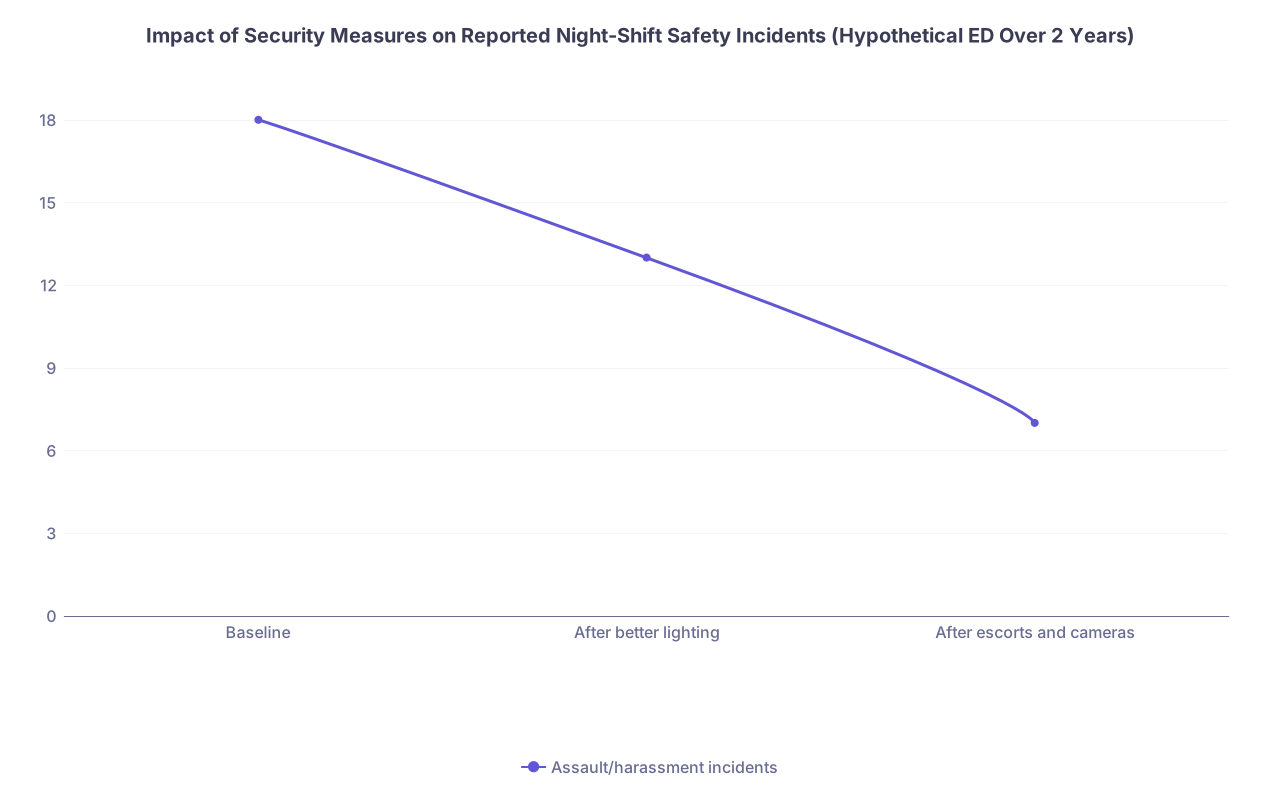
| Category | Assault/harassment incidents |
|---|---|
| Baseline | 18 |
| After better lighting | 13 |
| After escorts and cameras | 7 |
Does this cost money? Absolutely. Does not doing it cost you female physicians, lawsuits, and reputational harm? Also yes.
Culture: policies that are more than paper
Good policy in this space looks like:
- Clear, written, widely known zero-tolerance policy on harassment—by staff, patients, or families.
- Simple reporting pathways that do not require going through the person who may be part of the problem.
- Documented, consistent consequences for violations. Empty threats are worse than none.
And crucially:
- Leadership that visibly backs women who report issues instead of labeling them “not a team player.”
- Charge nurses and security trained to treat physician safety concerns as legitimate, not hysterical overreactions.
Departments that do this well have a very different retention profile for women. You see women staying into mid and late career, not just bailing for urgent care or telemedicine in year five.
7. Practical Playbook: How Individual Female EM Physicians Navigate This
Let me pull this together into something usable if you are in the trenches right now.
Before the shift
- Park smart. Closest safe spot, even if it means an awkward conversation with parking later.
- Check who else is on. Identify at least one colleague (physician or nurse) you trust for backup on difficult cases.
- Mentally pre-commit to your boundary lines: what you will confront, when you will call security, when you will walk out of a room.
During the shift
- Use your title consistently: “Dr.” is not vanity; it is a boundary.
- Pay attention to “small” comments that feel off. Document patterns; bring another staff member in early.
- Position yourself physically for an easy exit. Keep distance when you can, especially if you feel unease.

| Step | Description |
|---|---|
| Step 1 | Uneasy feeling or boundary crossing |
| Step 2 | Set verbal boundary |
| Step 3 | Call security to bedside |
| Step 4 | Continue care with caution |
| Step 5 | Proceed with modified exam |
| Step 6 | Step out and re-evaluate plan with team |
| Step 7 | Safety risk increasing? |
| Step 8 | Behavior improves? |
| Step 9 | Still unsafe with security? |
After the shift
- Do not walk out alone if you can avoid it. Coordinate departures when possible.
- If something crossed a line, write it down. Short, factual, while it is still fresh.
- Debrief with someone you trust. Suppressing it does not make you “tougher”; it just pushes the cost downstream.
FAQs
1. Is it ethical for female EM physicians to refuse certain patients because of safety concerns?
Ethically, you cannot abandon a patient in need, but you are not required to expose yourself to unreasonable risk when safer alternatives exist. You can insist on security presence, request a chaperone, and in some circumstances ask a colleague to be the primary face-to-face provider while you still oversee decision-making. The duty is to ensure appropriate care is delivered, not to personally walk into every unsafe situation without conditions.
2. How do I push my department to improve night-shift safety without being labeled “high maintenance”?
You frame it as a systems and liability issue, not a personal comfort issue. Use specific incidents, documented patterns, and tie requests to patient safety and staff retention. “We have had three staff assaulted in the parking lot in 18 months; here are reasonable measures other level I centers use: escorts, cameras, lighting. What is our timeline?” You are not asking for a favor; you are pointing out a risk management failure.
3. What if security minimizes my concerns or refuses to stay in the room?
You escalate. Calm, factual, documented. “On [date] at [time], I requested security at bedside for a patient making explicit threats; request denied. I will be documenting this in the chart and notifying the ED director.” Then you actually follow through with written documentation. Security services change behavior much faster when there is a paper trail that can reach administration and legal.
4. Are women justified in asking for fewer night shifts because of safety concerns?
Justified emotionally, yes. Structurally, I think the primary solution should not be to offload risk to male colleagues, but to fix the system so nights are not disproportionately dangerous to women. That said, temporary schedule adjustments for someone who has experienced a serious incident or stalking can be reasonable accommodations. Those should be framed as transitional measures, not permanent “women do fewer nights” policies.
5. How do I teach residents (especially women) to protect themselves without scaring them away from EM?
You normalize risk management as part of professional competence, not a personal failing. You say, “Part of being an emergency physician is learning how to handle unsafe situations. Here is how I position myself in the room. Here is when I call security. Here is what I do when a patient crosses a line.” You model boundaries in front of them, back them up when patients or staff behave inappropriately, and make it clear that safety concerns are a legitimate clinical consideration, not an inconvenience.
Key points: Night shifts magnify safety risks for women in EM in very specific, predictable ways. Individual tactics help, but they do not replace institutional responsibility for physical security and culture. You are allowed to treat your own safety as a clinical variable, not an afterthought.