
The system often punishes women doctors more for reporting misconduct than it punishes the people who commit it.
That is the ethical dilemma. Not a philosophy seminar question. A career-defining, sometimes life-altering decision that women physicians face repeatedly:
Do I report what I know is wrong and risk my reputation, my safety, my future in this institution? Or do I stay silent and become complicit?
Let me break this down specifically.
The Unique Ethical Double Bind for Women Physicians
A male physician who reports misconduct is often labeled “principled” or “a strong advocate for patient safety.”
A woman physician reporting the same issue is too often labeled “difficult,” “emotional,” “not a team player,” or—my personal favorite—“disruptive.”
Same facts. Different consequences.
Women in medicine face a double bind that reshapes ordinary professional ethics into something far more treacherous:
- They are socialized and professionally trained to protect patients, uphold justice, and report wrongdoing.
- They are simultaneously punished—sometimes subtly, sometimes brutally—when they actually do it.
That tension creates an ethical landscape that looks very different for women than for their male colleagues, especially when the misconduct involves:
- Harassment or gender-based discrimination
- Patient safety violations by powerful colleagues
- Financial or research fraud in male-dominated departments
- Boundary violations or abuse by high-earning “rainmakers”
The truth: most formal ethics training never addresses these specifics. It pretends gender is irrelevant. It is not.
What “Misconduct” Actually Looks Like in Real Life
Forget the sanitized textbook scenarios. In practice, women doctors usually encounter a few recurrent patterns of misconduct. I will be explicit, because vagueness protects perpetrators.
1. Patient Safety Violations Brushed Off as “Style Differences”
Examples I have seen or heard about directly:
- A senior surgeon repeatedly operating while clearly impaired (post-call, sedated, or after drinking) and the OR staff saying, “He’s just old-school. This is how he has always done it.”
- An attending signing off on chemotherapy orders without reviewing labs, with pharmacy quietly “fixing” things downstream.
- A high-volume interventionalist cutting corners on informed consent and documentation to maintain throughput metrics.
When a woman resident or junior attending flags this, the response often is:
- “Are you sure you are not overreacting?”
- “You need to work on your interpersonal skills.”
- “This is a personality conflict, not a safety issue.”
That reframing—from safety to “your attitude”—is not an accident. It is how ethical concerns get neutralized.
2. Sexual Harassment and Gender-Based Abuse
This is where the ethical and personal become inseparable.
You are not just deciding whether to report. You are deciding whether to re-live, document, and publicly expose what happened to you (or someone like you), under systems that are historically terrible at protecting victims.
Misconduct here ranges from:
- Explicit quid pro quo (“If you want this fellowship…”)
- Serial inappropriate comments, touching, or “jokes”
- Predatory behavior toward students, patients, or staff
- Retaliation for refusing advances
Women doctors in these situations are wrestling with multiple layers of duty:
- Duty to their own safety and dignity
- Duty to current patients (if the clinician abuses patients or staff)
- Duty to future trainees who will work under this person
- Duty to truth and professional integrity
And yet, institutional processes often treat them like the problem.
3. Bullying, Gaslighting, and Psychological Abuse Framed as “High Expectations”
This one is under-discussed, especially in surgery, anesthesiology, EM, and high-intensity services.
Patterns:
- Public humiliation in front of staff and patients
- Undermining competence (“She is not ready” used as a blunt weapon)
- Removing cases, referrals, or teaching opportunities after someone speaks up
- Threats about letters of recommendation or promotion
Ethically, this matters because it directly harms patient care and education. An intimidated team underperforms. A silenced trainee does not ask for help. But the culture calls it “tough love” or “rigorous training.”
And women who name it as abuse? Branded “thin-skinned” or “not resilient enough for this specialty.”
Why Women Face Distinct Ethical Dilemmas
This is not just about feelings or anecdotes. There are structural reasons women face a different calculus when deciding whether to report.
Power, Precarity, and Retaliation Risk
Women are overrepresented in the most vulnerable roles: medical students, residents, fellows, junior attendings, part-time physicians, physicians on soft money or temporary contracts.
They are underrepresented where decisions get made: department chairs, deans, C-suite, large-group leadership.
So the power imbalance is built-in. Reporting misconduct by someone above you in that hierarchy is categorically different when:
- Your visa status depends on your job
- Your fellowship or future letters of recommendation depend on this person
- Your childcare, insurance, and housing rely on your current institution
- You are already one of very few women (or the only woman of color) in the division
Ethically, you are trying to uphold professional standards while knowing that the cost to you for doing so is higher than for others.
Gendered Stereotypes Amplify the Risk
There are a few stereotypes that surface in almost every case:
- The “angry woman” label: Once you are perceived as “angry,” every future interaction is filtered through that lens. Clinical disagreements, safety concerns, scheduling issues—everything.
- The “ungrateful” junior: Especially when the perpetrator is a supposed mentor or “supporter of women.”
- The “weak” or “too sensitive” physician: A favorite move in male-dominated specialties is to redefine abuse as a resilience test.
All this changes the ethical equation. It should not, but it does. Because the ethical ideal (report wrongdoing because it is the right thing to do) collides with the professional reality (report, and you may be quietly frozen out of opportunities).
Intersectionality: It Gets Worse for Some Women
Layer race, ethnicity, immigration status, sexual orientation, or disability on top of gender and the dilemma intensifies.
A Black woman resident reporting racist comments from an attending is not just making a complaint. She is gambling against a stereotype of being “angry,” “aggressive,” or “not a good fit” for the culture.
An international medical graduate on a visa who reports harassment from a program director knows exactly what losing “support” can mean. It is not theoretical.
Ethics frameworks that ignore this are useless for real decision-making.
The Core Ethical Conflicts: Duties in Collision
Medical ethics loves simple quadrants and clean principles. Reporting misconduct forces those principles into open conflict.
Duty to Patients vs. Duty to Self
The classic framing: patient welfare trumps everything else.
The reality: If you lose your job, your career, or your ability to practice in your field, your long-term ability to help future patients takes a hit.
You are also a person with moral worth, not a disposable instrument for patient care.
Women physicians are often told, sometimes directly: “If you really cared about patients, you would speak up no matter the cost.” That is moral blackmail, especially from systems that have done nothing to make it safe to speak.
A more honest framing acknowledges:
- You owe patients honest, competent care and protection from foreseeable harm.
- You owe yourself protection from avoidable, disproportionate harm when the system is failing its basic obligations to protect reporters.
Holding those together is the hard work. Anyone who acts like it is simple has never been on the receiving end of retaliation.
Loyalty to Colleagues vs. Loyalty to Professional Standards
There is an unspoken code in many departments: “We handle things internally,” which usually means “We do not handle them at all, but we smooth things over.”
Women are often socialized toward relational loyalty, and that gets leveraged against them:
- “He has a family; do you want to destroy his career?”
- “She is under a lot of stress; just cut her some slack.”
- “We can manage this informally.”
But professional ethics are not based on personal loyalty. They are based on standards of practice, safety, and justice.
When those collide, you have to decide: am I primarily loyal to my in-group, or to the profession and the public?
This is where the “whistleblower” stigma hits hardest. Women who uphold professional standards over social loyalty are framed as traitors. Men sometimes are too, but the gendered component is unmistakable.
Confidentiality vs. Transparency
When the misconduct involves patients, trainees, or staff who confide in you, you face another tension:
- Respect their autonomy and confidentiality
- Protect them and others from ongoing harm
A resident quietly tells you that a senior faculty member assaulted her at a conference. She explicitly says: “Do not report this; I cannot afford the backlash.”
What is your ethical duty?
In many cases:
- You cannot unilaterally override her wishes without causing further harm.
- But you also cannot pretend you never heard it, especially if the perpetrator has a pattern of abuse.
There is no tidy solution. But you can:
- Clarify what she wants, short-term and long-term
- Offer to document the conversation confidentially with date/time, in case she chooses to act later
- Explore options that minimize risk to her (e.g., anonymous pattern reporting, seeking advice from an ombudsperson or confidential advisor)
Note: this is not about grooming you to stay silent. It is about shared decision-making in an environment structurally hostile to reporters.
How Systems Actually Respond to Reports (Not the Policy Version)
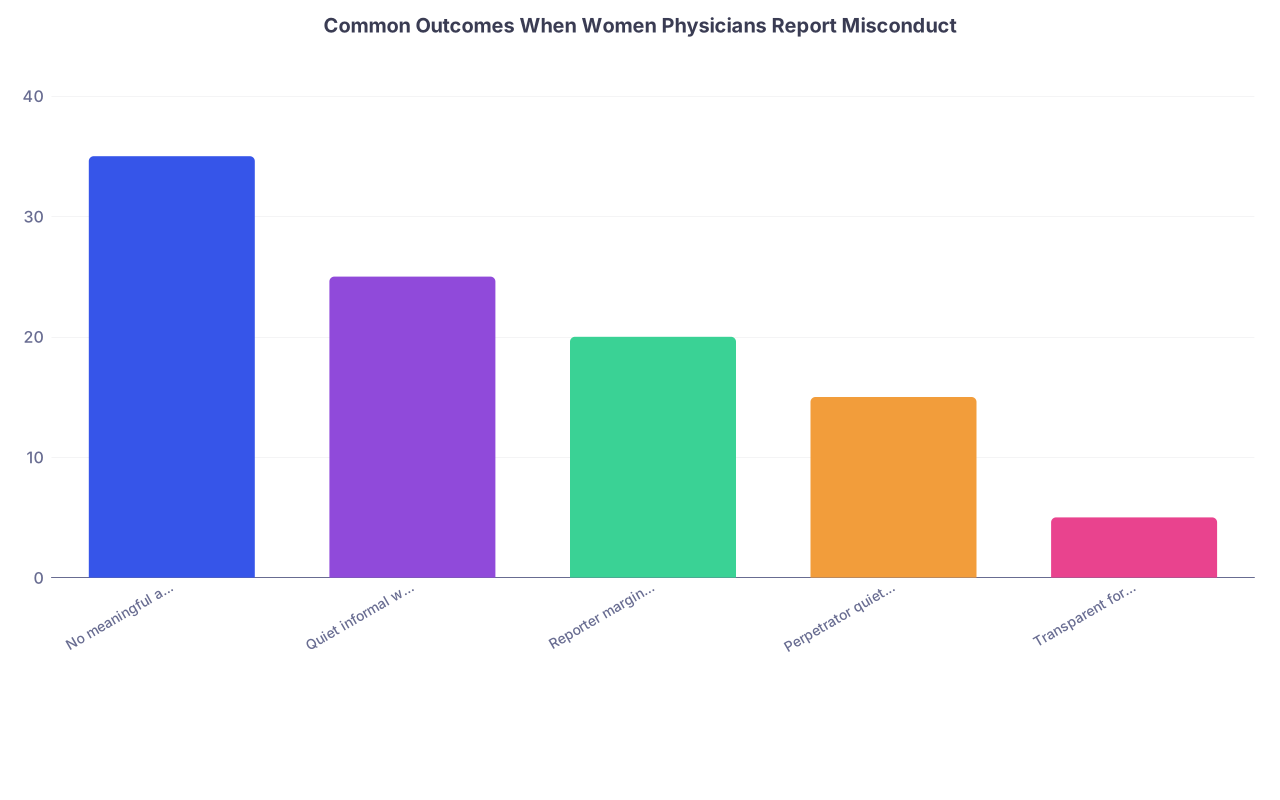
Policies say: zero tolerance, protection from retaliation, thorough investigation.
Reality often looks like this:
| Category | Value |
|---|---|
| No meaningful action | 35 |
| Quiet informal warning | 25 |
| Reporter marginalized | 20 |
| Perpetrator quietly relocated | 15 |
| Transparent formal discipline | 5 |
You do not have to like those numbers. But they are consistent with what many women doctors describe.
Typical institutional responses:
- Reframing as a “communication issue” or “misunderstanding”
- Offering “mediation” between you and the perpetrator, as if this were a conflict between equals
- Focusing on the reporter’s tone, timing, or documentation instead of the substance
- Encouraging you to “move on” for the good of the team
And sometimes, more overt forms of retaliation:
- Loss of committee roles, leadership endorsements, or key cases
- Negative or ambiguous comments in informal reference checks
- Increased scrutiny of your charting, RVU productivity, or punctuality
- Social exclusion: fewer invitations, less collaboration, being left off group emails
Ethically, you are no longer just reporting an event. You are entering a hostile process. That is the true dilemma.
A Practical Ethical Framework Women Doctors Can Actually Use
Theory is nice. You need something usable at 11:30 pm after a call shift when you have just seen something you know is wrong.
Here is a realistic decision structure, tailored to the realities women physicians face:

| Step | Description |
|---|---|
| Step 1 | Witness or learn of misconduct |
| Step 2 | Act to protect patient now |
| Step 3 | Document facts objectively |
| Step 4 | Assess severity and pattern |
| Step 5 | Consult trusted advisor or mentor |
| Step 6 | Consider anonymous or indirect reporting |
| Step 7 | Choose reporting channel |
| Step 8 | Formal institutional report |
| Step 9 | External or regulatory report |
| Step 10 | Monitor for retaliation |
| Step 11 | Seek support and legal advice if needed |
| Step 12 | Immediate patient safety at risk |
| Step 13 | Risk to self is extreme |
Let me unpack that in plain language.
Step 1: Separate Immediate Safety from Reporting
First question: Is someone in danger right now?
- If yes: you act. You call a rapid response, override an unsafe order, get a sober clinician to take over a case, remove a trainee from a dangerous situation. You do not debate institutional politics in the moment of crisis.
- If no immediate danger: you slow down and shift into documentation and strategy mode.
Step 2: Document the Facts Like a Prosecutor, Not a Storyteller
You need a record. Not a diary entry.
Key elements to document, privately and securely:
- Date, time, location
- Who was present (names and roles)
- Exact words or actions as close to verbatim as possible
- Objective impact: patient harm risk, deviation from standard of care, institutional policy violations
- Your own actions and who you informed, if anyone
This is not just for a future complaint. It is for your own clarity. Stories drift. Facts anchored early are harder to dismiss later as “misremembered.”
Step 3: Gauge Severity, Pattern, and Vulnerability
Ethically, not every minor lapse requires formal reporting. But patterns and serious harms do.
Ask yourself:
- Is this a one-time lapse, or part of a pattern?
- Does it involve power over vulnerable people (patients, trainees, staff)?
- Is there foreseeable risk of significant harm if nothing changes?
- Is this clearly outside professional norms, or is it debatable judgment?
The bar for formal reporting should be lower when:
- There is already a known pattern
- The target is particularly vulnerable
- The misconduct is severe (abuse, assault, serious fraud, dangerous impairment)
Step 4: Do Not Decide Alone If You Can Avoid It
Before you formally report, talk confidentially with:
- A trusted senior woman physician not in the direct chain of command
- An ombudsperson or confidential institutional resource (if they genuinely exist and are independent)
- A physician union representative or professional association advisor (if applicable)
- In more serious or high-risk cases, an employment lawyer experienced in health care
You are not asking them to decide for you. You are reality-testing your options.
| Advisor Type | Key Benefit |
|---|---|
| Senior woman physician | Practical institutional intel |
| Ombudsperson/confidential office | Process explanation and options |
| Physician union rep | Protection, collective support |
| Employment lawyer | Legal risk analysis |
Step 5: Be Strategic About Reporting Channels
You usually have more than one route. Each has different ethics and risks.
Internal:
- Program director, division chief, department chair
- GME office or faculty affairs
- HR or Title IX / equity office
- Compliance or patient safety reporting systems
External:
- State medical board
- Accreditation bodies (ACGME, Joint Commission)
- Professional societies’ ethics committees
- Legal channels (in extreme, rights-violating cases)
Internal channels are faster and feel safer initially, but can be more controlled and more prone to institutional self-protection.
External channels are slower, higher-stakes, and can end careers—yours or theirs.
Ethically: you start as close to the problem and as low-risk as you reasonably can without colluding in silence.
Step 6: Plan for Retaliation as Part of the Ethical Process
This is the part nobody teaches, but every woman who has gone through it understands.
Before you file anything:
- Secure your evaluations, letters, and prior feedback in personal copies.
- Clarify your performance record: ask for written summaries if they are usually verbal.
- Keep your own log of interactions with key players going forward.
Then assume:
- Every subsequent complaint about you might be framed as “evidence” that you are difficult.
- Your emails may eventually be scrutinized; write accordingly.
- Some colleagues will quietly distance themselves.
Is that cynical? No. It is pattern recognition.
Ethically, this is about informed consent—for yourself. You deserve to know the actual risks before you act.
The Emotional and Moral Aftermath
Reporting is not a single decision. It is a long process with psychological fallout.
Common experiences women describe:
- Moral injury: feeling that the institution you trusted has betrayed its own stated values.
- Self-doubt: “Did I misinterpret? Am I the problem?”—even when the facts are clear.
- Isolation: colleagues stop confiding in you or including you “to avoid drama.”
- Secondary shame: not about what happened, but about how the process handled it.
You will be tempted to rewrite the story in your own mind: “Maybe I should have just kept quiet.” That is a trauma response to institutional betrayal, not a sign you did the wrong thing.
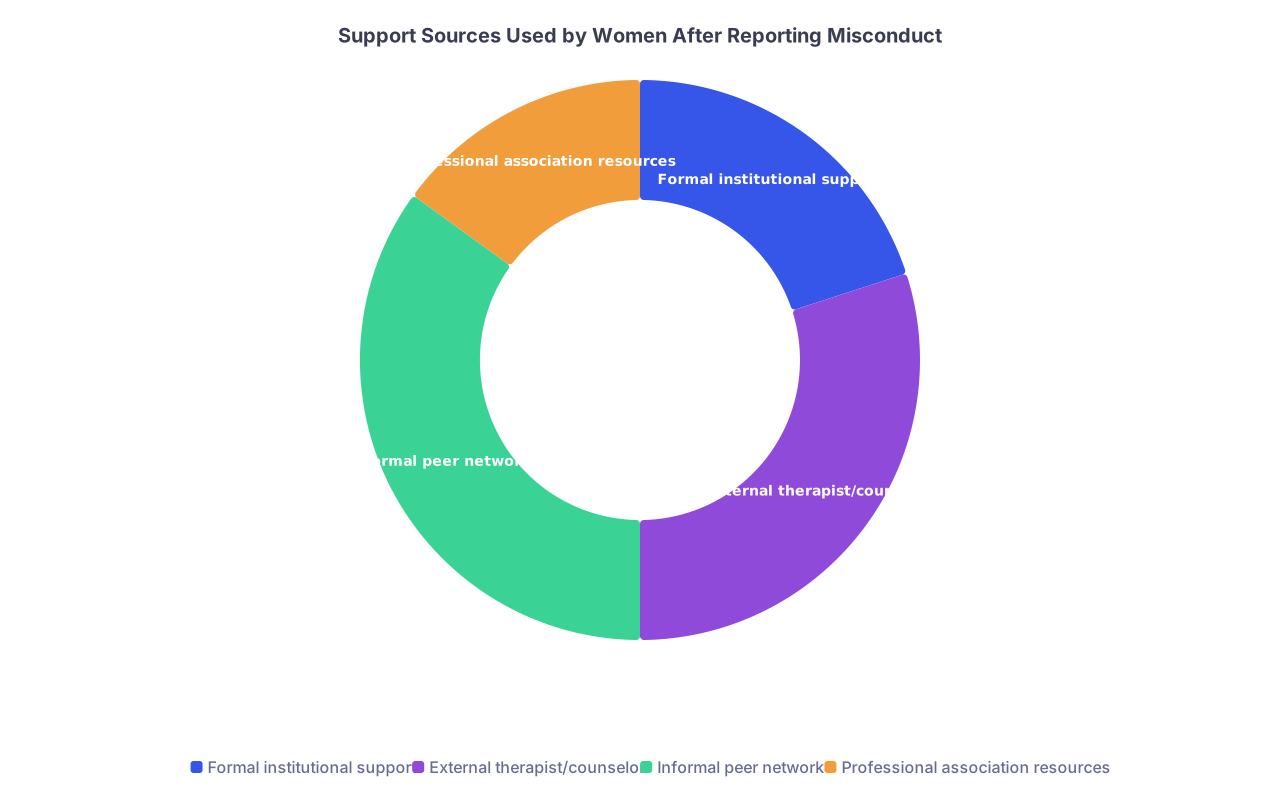
Support here is not optional. It is essential:
- A therapist experienced with workplace trauma or harassment
- Peer groups of women physicians (sometimes online is safer than local)
- Mentors outside your institution who can help you plan next steps if you need to leave
| Category | Value |
|---|---|
| Formal institutional support | 20 |
| External therapist/counselor | 30 |
| Informal peer network | 35 |
| Professional association resources | 15 |
Do not wait until you are in crisis to build these supports. Start early.
When Silence Is Also an Ethical Decision
Here is the uncomfortable truth: sometimes women decide not to report, fully informed, for now. And that decision can still be ethically coherent, given the system they are trapped in.
You might reasonably choose not to report if:
- The event was clearly wrong but unlikely to recur, and there is no ongoing safety risk.
- You are in an extremely vulnerable position (visa, probation, new baby, no financial buffer) and the anticipated retaliation would be catastrophic.
- You are prioritizing your capacity to stay in the system long enough to gain power that will let you enact more effective change later.
That is not cowardice. It is triage.
You can still:
- Document thoroughly and securely.
- Support others who may be safer to report.
- Work quietly to steer students and trainees away from the worst perpetrators.
- Use indirect mechanisms: anonymous climate surveys, pattern reporting, external audits.
Is it ideal? No. But ethics is not about martyrs only. It is also about sustainable resistance.
What Needs to Change (And What You Can Actually Influence)
Systemic change is a collective project, but individual women physicians can push specific levers.
Push for Structural Protections, Not “Bravery Training”
The worst response to all this is another workshop telling women to be more “assertive” in reporting. The problem is not insufficient courage. It is lack of protection.
Concrete structural changes worth fighting for:
- Transparent, time-bound investigation procedures with written outcomes
- Truly independent investigative bodies, not run by the same leadership protecting revenue-generating clinicians
- Strict, enforced anti-retaliation policies with real penalties
- Anonymous pattern-tracking systems for serial offenders
- Standardized, external reference-check formats that limit back-channel smearing
These are boring, policy-level things. But they change the ethical landscape more than any motivational talk.
Build Parallel Power Structures
Women physicians often underestimate the power of informal coalitions.
- A women’s faculty group that tracks patterns quietly, shares intel, and collectively approaches leadership is harder to dismiss than one voice.
- Cross-institution groups via professional societies can surface serial abusers who move between hospitals.
- Resident and fellow unions, where present, can hardwire reporting protections into contracts.
You are not just an individual deciding whether to report. You can be part of a network changing what reporting means.

The Ethical Bottom Line
Here is where I land, after seeing too many women physicians burned by doing the “right” thing in the wrong system.
- You do have a professional and moral duty to address serious misconduct, especially when patients or vulnerable colleagues are at risk.
- You do not have a duty to destroy yourself in the process while institutions protect perpetrators. Self-preservation is not unethical.
- Silence is never neutral. But there are more and less harmful forms of partial silence, and sometimes deferred action is the only survivable option.
- The real ethical failure is not individual women hesitating to report. It is institutions that systematically punish those who do.
Your job, in this moment of your career, is not to single-handedly purify a flawed system. It is to:
- See clearly what is happening
- Make a conscious, informed choice about how and when to act
- Protect your integrity without sacrificing your entire future to an institution that has not earned that sacrifice
Over time, as you gain seniority and power, your calculus will shift. You will be able to take different risks, shape policies, and shield others in ways you cannot right now.
You are not done with this topic. Not by a long shot. But with this ethical scaffolding in place—realistic, not idealized—you are better positioned for the next decision point that will come, often without warning, in the middle of a normal clinic day or a routine call night.
What you build from here—your own boundaries, your alliances, your strategy for pushing back—that is the next phase of your development as a woman in medicine. And that is a conversation we will have another time.