
The way academic medicine “thanks” women is broken. We reward them with more committee seats instead of actual power.
Let me be very clear: the service tax on women in medicine is real, measurable, and career‑distorting. If you do not quantify it and manage it deliberately, it will quietly steal your research productivity, your sleep, and eventually your promotion.
You are not imagining it. You are not “bad at saying no.” You are sitting in a system that structurally routes committee work, DEI tasks, and “representative” duties to women, especially women of color. And that system counts on you feeling guilty about pushing back.
Let’s go through this like adults: how to quantify it, how it affects your career metrics, and how to aggressively manage it without burning bridges or burning out.
What the “Service Tax” Actually Is
The service tax is the disproportionate assignment of non-promotable, low‑visibility, or low‑reward service tasks to women relative to men of similar rank and role. In medicine, that usually shows up as:
- Committee work (curriculum, wellness, DEI, professionalism, admissions).
- “Representation” roles (“We need a woman on this panel,” “We need more diversity on this task force”).
- Pastoral work: mentoring, “difficult learner” meetings, patient complaint resolution.
- Emotional labor: organizing team events, mediating conflicts, “helping the group feel heard.”
The key point: most of this is necessary work for institutions. But it is not evenly distributed, and promotion systems rarely credit it at the same level as grants, publications, RVUs, or formal leadership titles.
Why women get tapped more
I have heard the same lines on repeat in promotion and department meetings:
- “She is so organized; she would be great on this curriculum committee.”
- “We need a woman on this search committee so it does not look bad.”
- “She has such good rapport with students; could she take over this program?”
- “Let’s ask her, she always says yes and gets things done.”
This is the trifecta:
- Stereotypes about women being more communal and nurturing.
- Diversity optics—women and underrepresented faculty are asked to be “the face” of inclusivity.
- A small pool of women at senior ranks, so the same people get hit with 10x the asks.
And then the kicker: the promotion criteria remain centered on traditional “hard” outputs.
Quantifying the Service Tax: Put Numbers on the Problem
You cannot manage what you do not measure. Feelings of overwhelm are real, but they do not convince division chiefs, chairs, or promotion committees. Numbers do.
Step 1: Build a service inventory
Sit down and list every single committee, task force, and recurring obligation for the last 12–24 months. Include:
- Departmental committees (e.g., residency selection, morbidity and mortality, quality).
- School‑level committees (curriculum, admissions, promotions, professionalism).
- Hospital committees (safety, EMR optimization, throughput, etc.).
- Task forces and working groups (DEI, wellness, faculty development).
- Informal but recurring roles:
- “Go‑to” for student issues.
- Regularly asked to review “one more” dossier, paper, or grant.
- Standing presence on interview days or recruitment events.
For each, add:
- Start and end dates.
- Frequency (weekly / monthly / quarterly / ad hoc).
- Typical duration per meeting.
- Preparation time (reading, emails).
- Extra tasks (report writing, sub‑meetings, follow‑up).
Now convert this into an estimated monthly time cost.
| Activity Type | # Involved | Hours per Month |
|---|---|---|
| Department committees | 3 | 6 |
| School-level committees | 2 | 5 |
| Task forces / work groups | 2 | 4 |
| Informal mentoring / issues | - | 4 |
| Ad hoc reviews / extras | - | 3 |
Suddenly you see: 22 hours a month. Almost three full working days. That is not invisible; it is a part‑time job.
Step 2: Convert hours to opportunity cost
Now translate those hours into what they could have been:
- 22 hours = 2–3 half‑day clinics.
- 22 hours = data analysis for a paper.
- 22 hours = drafting a K‑ or R‑level grant section.
- 22 hours = 10–15 in‑depth mentorship meetings with residents or students you choose.
This is where you start to see the promotion gap. That monthly service load, kept up for 5–10 years, becomes:
- Fewer publications.
- Slower completion of degrees (MPH, MS, PhD).
- Fewer grants as PI.
- Less time to prep for leadership roles that are actually credited (division director, program director, etc.).
Step 3: Benchmark yourself—how do your numbers compare?
If you have even a moderate amount of trust with colleagues, you can do a quick informal survey. Ask 3–5 peers at your rank:
- How many standing committees are you on?
- Average committee hours per month?
- Any major task forces right now?
You do not need a full IRB-approved study. A back‑of‑the‑envelope comparison is enough to reveal the pattern:
- Women associate professors with 5–8 standing committees.
- Male associate professors with 2–4.
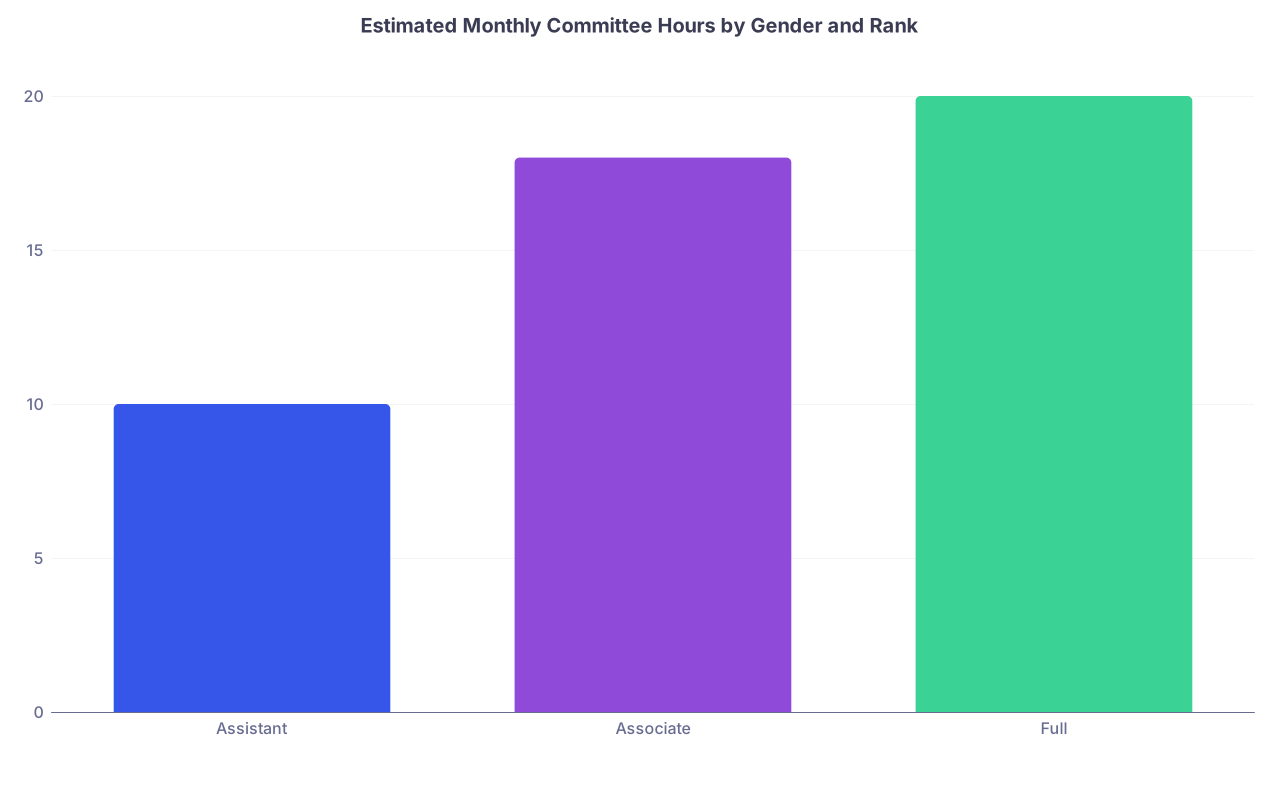
Let me illustrate with a rough comparison.
| Category | Value |
|---|---|
| Assistant | 10 |
| Associate | 18 |
| Full | 20 |
You and I both know that in many departments, the women’s bars would be almost double the men’s if we plotted them separately. That is the tax.
Why Committee Work Hurts Women’s Academic Trajectory
Service is not bad. Over‑indexed, uncredited service is bad.
Promotion criteria vs. service reality
Most academic promotion guidelines will show some version of the classic triad:
- Research / scholarship.
- Teaching.
- Service / citizenship.
On paper, they look balanced. In real decisions, they are not.
I have sat in promotion discussions where someone says, essentially: “She is amazing. Carries the residency program, leads multiple committees. But she only has X first‑author papers; I am not sure she meets the bar for promotion to full professor.”
The same group that loaded her with service duties then penalizes her for the predictable outcome: slower scholarship.
The visibility trap
Some committee work is genuinely high yield:
- Core curriculum committees where your name attaches to major reforms.
- Chair‑level search committees.
- Promotion and tenure committees.
- National guideline groups in your subspecialty.
Those can build your CV, your internal currency, and your external reputation.
The problem is that women are overrepresented on:
- Wellness committees.
- “Culture” and “engagement” groups.
- Morale, professionalism, and remediation panels.
- DEI committees with no budget and no real power.
These have low citation value and limited recognition in promotion letters. Yet they are time‑intensive and emotionally draining.
The “only woman in the room” effect
When you are one of few women, you get:
- Overbooking: the same two or three women are asked for every search, every panel, every “representative” seat.
- Split focus: instead of concentrating your influence in one or two highly strategic roles, you are peppered across multiple minor committees.
- Missed stretch roles: you are “used up” on service, so when a real leadership opportunity comes up, you are either too burned out or your dossier looks too “service heavy” and “research light.”
This is not accidental. It is a structural imbalance hidden behind words like “representation” and “inclusion.”
Strategies to Manage the Service Tax Without Torching Your Reputation
You cannot simply stop doing service. That is not realistic, and frankly, not desirable. Departments need functioning committees, and representation does matter.
The trick is to:
- Cap total service load.
- Be ruthless about which roles you accept.
- Convert service into visible leadership and promotable outcomes.
- Make your boundaries explicit and numeric, so it does not become personal or emotional.
1. Set a service “budget” in writing
Decide what is realistic for your role and career stage. For example:
- Assistant professor on research track:
- 1 departmental committee + 1 school‑level committee.
- Assistant professor on clinician‑educator track:
- 2–3 institution committees aligned with education + 1 external.
- Associate professor:
- 2–3 high‑impact internal roles + 1–2 external/national.
Now phrase that as a policy for yourself:
“I commit to no more than 3 standing committees at a time, with a maximum service time of 10 hours per month.”
This is your internal contract. You can then translate it externally: “I am currently at my service capacity for this academic year.”

| Step | Description |
|---|---|
| Step 1 | Service Request Arrives |
| Step 2 | Check Current Inventory |
| Step 3 | Decline with Explanation |
| Step 4 | Negotiate Role and Term |
| Step 5 | Update Service Inventory |
| Step 6 | Within Service Budget? |
| Step 7 | Aligned with Career Goals? |
2. Filter: is this promotable, strategic, or replaceable?
For each new request, ask yourself three explicit questions:
- Does this align with my main career narrative? (e.g., med ed, quality improvement, health equity)
- Will this lead to one or more of:
- Named leadership role.
- First/senior authorship on a paper, curriculum, or guideline.
- National visibility (conference presentations, society roles).
- Can this be done by someone one rank below me who actually needs experience?
If the answer is “no / no / yes,” that is a decline. Full stop.
3. Use structured language to say no
Here is where many women get trapped—they over‑explain or apologize. You do not need to be rude. You do need to be direct and consistent.
Templates you can adapt:
Capacity + strategic alignment:
- “Thank you for thinking of me. I am at full committee capacity this year and have committed to focus my service on roles that are directly tied to X (e.g., residency education / clinical operations / outcomes research). I will need to decline.”
Offering alternatives without doing the emotional labor:
- “I cannot take this on, but I encourage you to consider someone at the assistant professor level who might benefit from this opportunity. I am happy to suggest a couple of names if that would be useful.”
Deflecting repeat asks:
- “I have served on multiple committees of this type over the past few years and need to rebalance my portfolio toward scholarship. I will not be joining new committees this cycle.”
Notice: no apology, no detailed justification, no drama. Just capacity and priorities.
Turning Service into Real Capital: How to Make It Count
If you are going to pay the service tax, at least get receipts. Some committee roles can be leveraged into serious career capital if you handle them strategically.
1. Demand role clarity and deliverables
Before accepting:
- Ask for a written description of:
- Term length.
- Expected hours per month.
- Specific goals for the year.
- Ask: “Will there be opportunities for authorship, policy writing, or external presentation coming out of this work?”
If the answer is vague—“We will see how it goes”—this is often a red flag for endless, amorphous service.
2. Aim for roles that create output you can cite
Examples of high‑leverage service:
- Leading the development of a new required curriculum with evaluation data → educational scholarship, med ed publications.
- Chairing a quality improvement committee that standardizes protocols → abstracts, QI papers, institutional recognition.
- Co‑chairing an admissions or promotions committee → strong internal reputation, influence, and leadership title.
You want roles that naturally generate:
- Published guidelines / protocols.
- Curricula, evaluation tools, or educational research.
- Institutional policies where your name is on the cover page.
| Category | Value |
|---|---|
| DEI Task Force (no budget) | 1 |
| Wellness Committee | 2 |
| Admissions Committee | 4 |
| Curriculum Reform Group | 7 |
| National Guideline Panel | 9 |
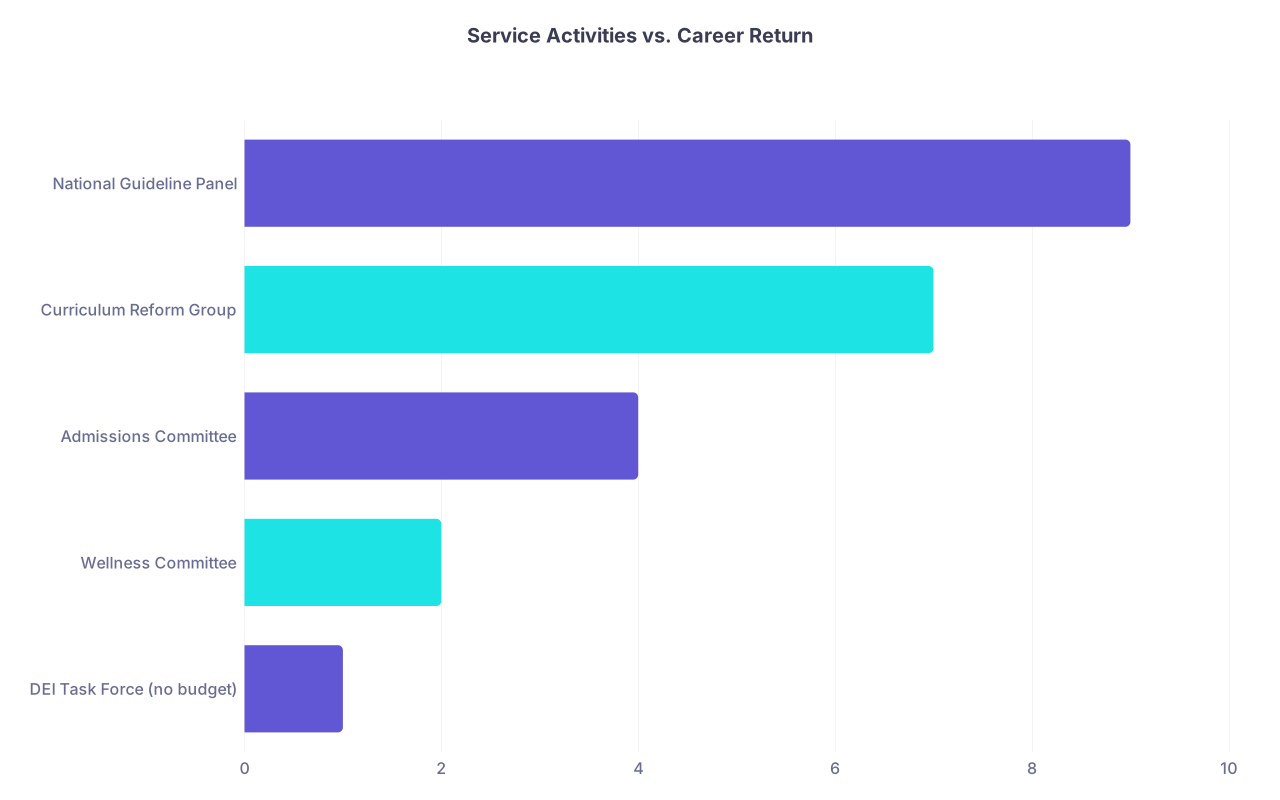
Think of that 1–10 scale roughly as: “How much does this move the needle for promotion, leadership, and external visibility?”
3. Document service aggressively on your CV and in your narrative
Do not bury service as a bland list. For each major role, include:
- Your title (chair, co‑chair, key member).
- Scope (institutional vs. departmental, number of people impacted).
- Tangible outcomes:
- “Co‑led redesign of third‑year internal medicine clerkship affecting 140 students per year; resulted in 15% improvement in exam scores and high satisfaction metrics.”
- “Chaired institutional sepsis QI group; implemented protocol that reduced time‑to‑antibiotics by 25%.”
When you write your promotion packet narrative, quantify:
- Number of committees.
- Major leadership positions.
- Outcomes and products (publications, presentations, policies).
Most faculty underestimate how much they need to spell this out.
Department‑Level Responsibility: This Is Not Just an Individual Problem
You can manage your load, but the system also has to stop dumping its dysfunction on individual women. If you are a leader—or aspire to be one—you should start pushing for structural fixes.
1. Track service distribution by gender and rank
At the department or school level, someone needs to do a basic audit:
- Number of committee seats by:
- Gender.
- Rank.
- Track (tenure, clinician educator, research).
- Total approximate hours for major committees.
Then examine who is overloaded. Often you will see:
- The same women on multiple overlapping committees.
- Women of color on every DEI‑adjacent group.
- Junior faculty on “service treadmill” with no clear benefit.
| Category | Min | Q1 | Median | Q3 | Max |
|---|---|---|---|---|---|
| Men | 1 | 2 | 3 | 4 | 5 |
| Women | 2 | 4 | 6 | 8 | 10 |
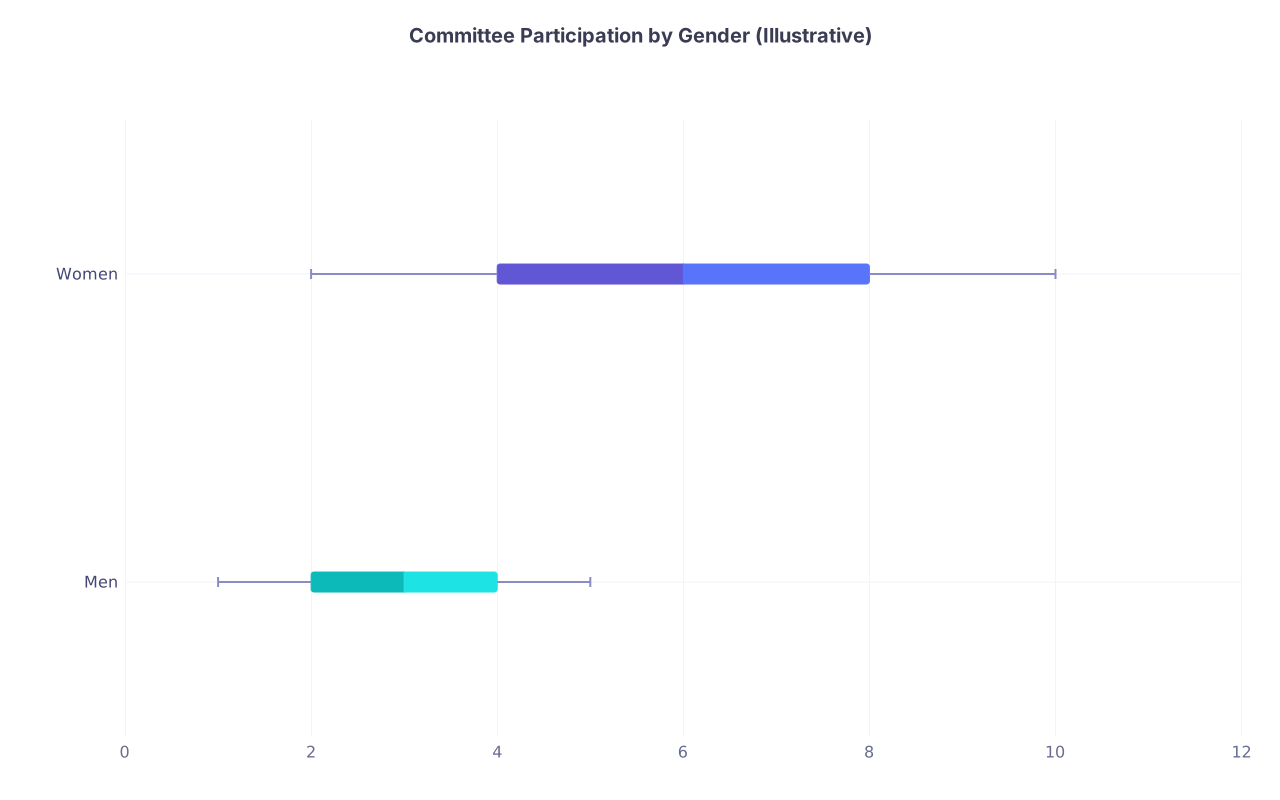
When the data look like that, you stop saying, “She has trouble saying no.” You start saying, “We have a distribution problem.”
2. Formal caps and rotation policies
Departments can:
- Cap the number of standing committees per faculty member by rank.
- Require term limits and rotation for high‑demand committees.
- Restrict the number of “representation” roles any one person can hold simultaneously.
For example:
- No faculty member may serve on more than 3 standing institutional committees at one time.
- Membership on the promotions committee cycles every 3 years, with explicit attention to not overburdening underrepresented faculty.
This does not magically solve equity. It does give women something to point to: “Our department policy is X; taking this on would exceed it.”
3. Recognize and reward service in real ways
If your institution claims service matters, demand that it is treated accordingly:
- Explicit credit in annual RVU‑like formulas (e.g., teaching / service points that actually influence compensation).
- Protected time for high‑intensity service roles (0.05–0.2 FTE).
- Promotion criteria that give serious weight to major leadership and institutional impact.
When women see visible compensation and promotion tied to high‑yield service, some of the “tax” becomes an investment instead of a drain.
Personal Tactics: Day‑to‑Day Management of the Ask Avalanche
You are not going to change institutional policy overnight. You still have to survive the next email from the dean’s office.
1. Build a one‑page “Service and Leadership Plan”
Have a short document for yourself that says:
- My career focus for the next 3 years:
- Example: “Medical education with focus on assessment and remediation.”
- My target service involvement:
- “1–2 roles at the institution level directly tied to med ed.”
- “1 national role in a relevant professional society.”
- My non‑negotiables:
- “I do not accept roles with no clear leadership title or output.”
- “I do not accept more than one general purpose ‘culture / wellness’ style committee at a time.”
This plan becomes your script when people ask.
2. Institute a 24‑hour rule on new requests
Do not respond to committee invitation emails immediately. Default reply:
“Thank you for the invitation. I need to review my current commitments and will get back to you within the next few days.”
Then:
- Check your inventory and service budget.
- Run the alignment filter (strategic? promotable? replaceable?).
- Decide based on your plan, not on guilt or flattery.
3. Use your chair or mentor strategically
If you have even a moderately supportive chair or section chief, use them:
- Share your service inventory and your concerns.
- Ask explicitly: “Given my promotion timeline, what service roles do you think would be most strategic? Where do you think I should say no?”
Sometimes leadership is not fully aware how much you are doing. Put it in front of them with numbers. Ask for their backing when you decline.
4. Protect your prime time
Committee work tends to colonize your best brain hours if you are not careful. Fight that.
Practical rules that work:
- No committee prep or emails during your designated research / writing block.
- Cluster committee meetings into specific parts of the week where possible.
- Use a 30‑minute “hard stop” for most meetings—state it up front.
Yes, you will sound more rigid. That is fine. The default is that your time is infinitely elastic. It is not.
Special Case: Women of Color and the “Minority Tax”
The service tax is worse for women of color. They get hit with the combination of:
- Gender tax (need a woman).
- Minority tax (need “diversity” on this group).
- Mentoring tax (students and trainees of color naturally gravitate toward them).
Their committee work is often explicitly framed as:
- “We need your voice at this table.”
- “We cannot do this without your perspective.”
- “Students really value seeing you there.”
Those statements are partially true. Representation matters. It is also manipulative when there is no corresponding effort to:
- Distribute service fairly among all faculty.
- Provide FTE and promotion credit for DEI and mentorship work.
- Create a pipeline of multiple faculty of color so the same 2–3 are not on every single committee.
If you are in this group, you need even more aggressive boundaries:
- A lower service cap, not higher.
- Clear specification: “I will participate in X number of DEI initiatives per year; beyond that, I will need others to step up.”
- Demanding FTE or explicit compensation for major DEI leadership roles.
And if you are in leadership and not in this group, your job is to stop hiding behind them as the institution’s conscience while they pay the career price.
What You Can Do This Month
Let me make this brutally practical. In the next 30 days:
- Build your service inventory for the last 12 months.
- Estimate monthly hours and write down the number.
- Draft your 1‑page service and leadership plan.
- Have a 20‑minute conversation with a mentor or chair where you show them:
- Your inventory.
- Your service budget.
- The roles you want to keep vs. exit over the next cycle.
- For every new request, use the 24‑hour rule and decide against your plan, not your guilt.
You will not fix the system in a month. But you can stop bleeding out from a thousand cuts.
Looking Ahead
The service tax on women in medicine is not going away on its own. Committee invitations will keep coming. DEI and wellness needs will keep growing. Institutions will keep looking for “the reliable women” to plug the gaps.
The difference will be whether you treat your time as a finite, high‑value resource or as a communal well everyone can dip into.
You now have the tools to measure your service load, to recognize when it has tipped from contribution to exploitation, and to push it back toward strategic, promotable work.
The next step is harder, and more interesting: turning the roles you do choose into visible, published, promotable leadership—so that committee work becomes a launchpad instead of a trap. That is where we go from surviving the service tax to using it, deliberately, to build real power. But that is a conversation for another day.