
The myth that “your work will speak for itself” is professionally lethal for women on grand rounds.
Authority in that room is not neutral. It is gendered, hierarchical, and heavily biased toward whoever looks most like the senior white male attendings in the front row. If you walk into grand rounds assuming everyone will evaluate you purely on content, you will get interrupted more, credited less, and remembered only vaguely as “that female fellow who talked about sepsis”.
Let me break down exactly how to flip that script.
You are not just “giving a talk”. You are staging an authority performance in a hostile architecture: long rows, dim lights, late arrivals, people on laptops, senior people sitting in a social cluster. Your job is to bend that environment so that by the end, the room accepts you as a clinical and intellectual authority they want to quote, invite, and follow.
This is brutally practical. Scripts, slide choices, room choreography, how to handle condescending questions, and how to use ethics and professionalism to your advantage rather than as weaponized expectations against you.
1. Understand the Authority Gap in Grand Rounds
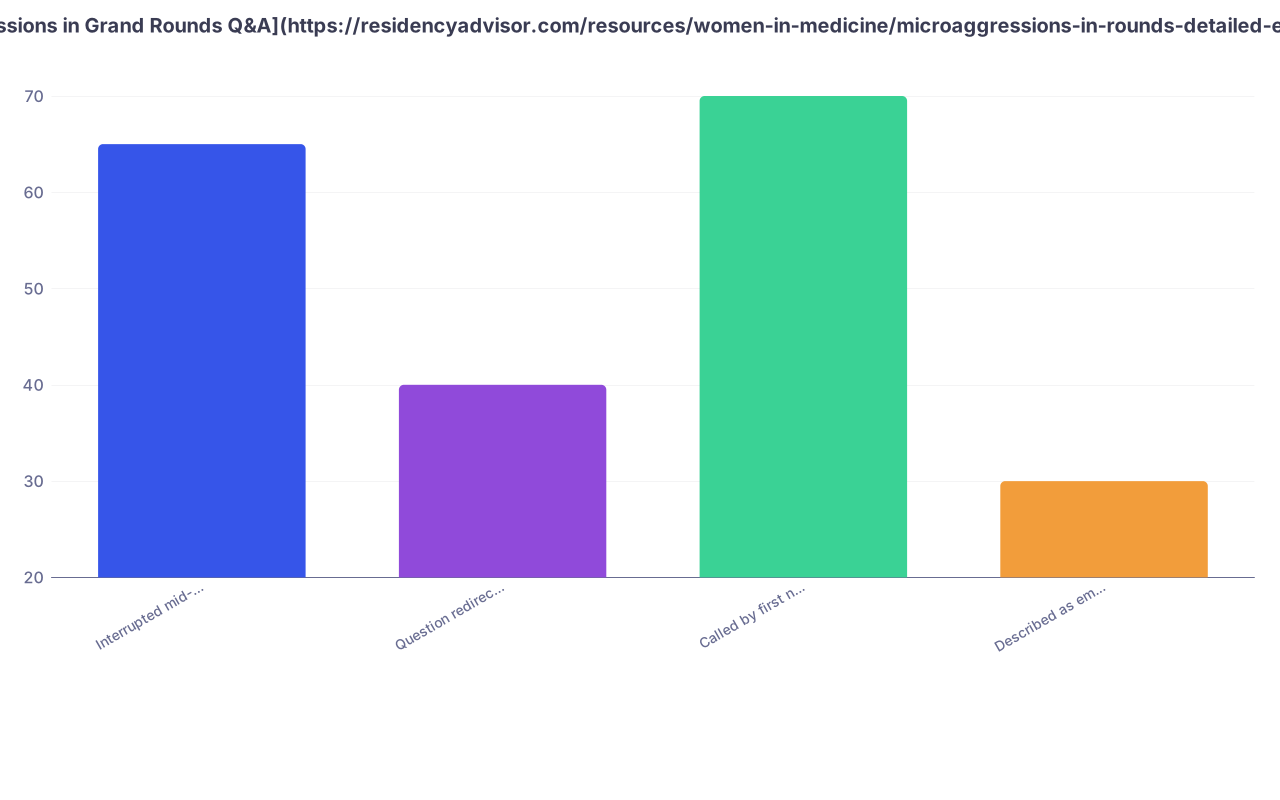
| Category | Value |
|---|---|
| Interrupted mid-answer | 65 |
| Question redirected to male colleague | 40 |
| Called by first name vs. Dr | 70 |
| Described as emotional/defensive | 30 |
Before tactics, name the battlefield.
Grand rounds is not just an educational session. It is where people silently decide:
- Who is “faculty material”
- Who is safe to send referrals to
- Who should lead a new initiative or guideline committee
- Who to invite to other institutions
Women, especially women of color, walk into that room with:
- Lower presumed competence until proven otherwise
- Higher penalties for visible confidence (“aggressive”, “abrasive”)
- More frequent status undermining: first-name address, interruptions, “whose patient was this?” questions implying you are support staff, not the lead
I have watched a female cardiology fellow present elegant data on anticoagulation, only to have a senior man end the Q&A with, “That was… very nice. Maybe next time talk slower.” Two months later, a male fellow presented worse data with sloppy slides. Feedback: “Strong work. We should get you on the regional circuit.”
So no, this is not fair. But you can stack the deck.
Your goal is not to become “likable.” Your goal is to become non‑negotiably authoritative while staying within professional and ethical bounds.
2. Architect Your Talk for Authority, Not Just Education
Most speakers design grand rounds as if it were a board review: dense, linear, content-heavy. That is a mistake if you are trying to build authority.
You want three things:
- To sound like the person who writes guidelines, not the person who memorizes them
- To control the story of your expertise
- To make it clear you own this topic clinically, academically, and ethically
2.1 Open like a senior attending, not a nervous trainee
Weak openings kill authority. The classic weak start:
“Hi, um, I’m Sarah, I’m one of the third-year residents, and today I’ll be talking about…”
Compare that with:
“I am Dr. Sarah Malik, third-year internal medicine resident. Today I will argue that our current approach to inpatient hyponatremia is causing preventable harm—and show you exactly how to fix it in this hospital.”
You are signaling four things quickly:
- Formal title (Dr., not first name)
- Clear role (resident/fellow/faculty – no apology in it)
- A strong claim or thesis
- Direct relevance to them (“in this hospital”)
Script you can adapt:
“Good morning. I am Dr. [Last Name], [position] in [department]. I work clinically on [specific unit/population] and my research focuses on [brief domain]. Today I want to challenge how we [do X] here and make the case for [key change / key principle].”
No jokes about being nervous. No “I’ll try to keep this short.” Those are invitations to devalue you.
2.2 Frame the talk as leadership, not a literature dump
Residents and junior faculty regurgitate data. Leaders synthesize and decide.
Structure your talk like this:
- A specific, local problem or tension
- The stakes (patient outcomes, moral distress, legal risk, equity impact)
- A curated, not exhaustive, evidence narrative
- A clear recommendation or practice framework
Example in palliative care:
- Problem: Fragmented code status discussions in the ICU
- Stakes: Overtreatment, family trauma, staff moral injury
- Evidence: 4–5 key trials, guidelines, and ethical positions, not every paper ever
- Recommendation: A 3‑step conversation model, an order set, a documentation template
You sound like someone they should follow, not just “a good researcher.”
2.3 Use slides that look like you expect to be taken seriously
If your slides scream “junior trainee project”, your authority drops before you speak.
Non‑negotiables:
- No busy backgrounds, no clip art
- Consistent, institutional or simple professional color palette
- Max 1–2 fonts, large enough to read from the back
- Every slide has one clear purpose: describe, argue, or direct action
Authority‑building slide types:
- “Key Question” slide in the first 3 minutes: “What is an ethically defensible threshold for ECMO in patients with [X]?”
- “Our Data” slide, even if tiny: “In our MICU, over the past 12 months…” – shows local ownership
- “Practice Change” slide: bulleting explicit actions: “Stop doing / Start doing / Consider doing”
Avoid:
- Apology slides like “Sorry, this is busy”
- Overly cutesy images to “lighten the mood” in a serious ethics/clinical talk
You can absolutely use one short, sharp clinical anecdote. But your overall visual impression should say: I write consensus statements, not infographics.
3. Vocal and Physical Authority: How You Occupy the Room
This is where many talented women lose 80% of their impact.

3.1 Stand like you belong at the podium
Bad habits I see constantly:
- Death grip on the sides of the lectern
- Feet crossed or shifting
- Leaning away from the mic
Do this instead:
- Both feet grounded, hip-width apart, weight balanced
- One hand free; the other can rest lightly near the laptop or clicker
- Body facing the audience, not the screen
When you advance a slide, pause, look at the audience, then speak. If you spin to look at your own slide, you signal you are following, not leading.
3.2 Use an attending voice, not a case-presentation voice
You already know how to do this. It is the voice you use when you call a rapid response or give sign-out on a crashing patient.
Key points:
- Volume: louder than you think, especially in the back
- Pace: slightly slower than your natural speed, with deliberate pauses after key lines
- Intonation: avoid uptalk (ending statements as questions) when giving conclusions
Practice reading these as flat, confident statements:
- “This approach is no longer acceptable.”
- “These are the criteria we should adopt.”
- “There is no ethical justification for that practice.”
Record yourself. If your voice climbs at the end, fix it. It matters.
3.3 Use the room layout strategically
Do not underestimate simple choreography.
- If there is a stage, step fully onto it; do not hover at the edge
- If possible, step out from behind the podium for at least part of the talk
- Sweep your gaze to the corners of the room periodically; not just the front row
You are telling the room: “This is my space for the next 45 minutes.”
4. Pre‑empt Gendered Undermining: Names, Credits, and Introductions
You can gain or lose authority before you even speak.
| Risk | Common Scenario | Countermove Script |
|---|---|---|
| First-name only introduction | "This is Sarah, one of our fellows" | Send scripted bio; correct once at podium |
| Expertise minimized | "She'll give us a quick overview" | Reframe: "I will focus on X where I specialize" |
| Others' work foregrounded | "This came from Dr X's group" | Clarify your role: "In my analysis of that data..." |
| Title stripping in Q&A | “Sarah, what about…” | Answer as “Dr [Last]” in self-references |
4.1 Control your introduction in advance
Do not rely on the moderator to do their job well.
Email them a 2–3 sentence introduction you want used:
“Please feel free to use this brief intro: ‘Dr. Aisha Khan is an assistant professor of emergency medicine and the director of sepsis quality improvement at [Institution]. Her work focuses on equity in sepsis recognition and management. Today she will present…’”
Most will be relieved. And it solves:
- Title omission
- Your role understated (“visiting doctor”)
- Your expertise framed as derivative (“worked with Dr. Big Name”)
If you are still introduced by first name only:
At the podium, calmly reassert:
“Thank you, Dr. Smith. I am Dr. Aisha Khan, emergency medicine faculty and sepsis QI director.”
Then go straight into your opening. No awkwardness. Just correction.
4.2 Claim your contributions explicitly and ethically
Women are socialized to over-credit others. Ethically, you must acknowledge collaborators. But you also must not erase yourself.
Bad pattern:
“I was lucky to work on this with Dr. X’s group. They really did most of the heavy lifting…”
Better:
“This work comes from our sepsis QI collaborative, led by Dr. X and myself. I designed the intervention, and I will walk you through the outcomes we achieved.”
That is not arrogance. That is accurate authorship. Ethically proper.
If you are presenting others’ data (e.g., journal club style):
“Today I will analyze and critique the trial conducted by Dr. Y’s team, and discuss what it should change in our practice.”
You own the analysis, even when you do not own the dataset.
5. Handling Q&A Like an Attending, Not a Target
Q&A is where authority for women often gets shredded: mansplaining, hijacking, performative “questions” that are actually mini-lectures.

| Step | Description |
|---|---|
| Step 1 | Question asked |
| Step 2 | Answer directly and concisely |
| Step 3 | Restate question with framing |
| Step 4 | Validate brief then redirect |
| Step 5 | Set boundary and reclaim authority |
| Step 6 | Offer takeaway |
| Step 7 | Type of question |
5.1 Restate the question on your terms
Before you answer, translate.
Example:
Questioner: “So we have always done it this way and had good outcomes. I’m not convinced any of this is necessary. Why change?”
You:
“Your question is: given apparently acceptable outcomes, what justifies changing our current practice? The answer is twofold…”
You just:
- Stripped the emotional charge
- Framed it as a legitimate intellectual question
- Took control of the narrative
5.2 Deal with the “I’ll answer my own question” guy
You know him. He stands up, says “Great talk,” then spends 2–3 minutes lecturing.
Your move:
- Let him finish the first long sentence
- Interject at a natural pause with a short summary
- Tie it to your content and move on
Example:
“Thank you. So you are highlighting that mortality is not the only outcome that matters; family experience and staff burnout are critical too. I agree completely—that is why our second intervention focused on… [brief link].”
Then immediately say: “Other questions?” and look away from him to another part of the room.
You have:
- Validated the non-offensive kernel
- Declined to let him steer the session
- Signaled to the room that you, not he, are curating the discussion
5.3 Neutralize the undermining or hostile question
Classic patterns:
- “Have you considered that your sample is too small to draw any real conclusions?”
- “But the [famous trial] already showed this; what is actually new here?”
- “Isn’t this a bit idealistic for our patient population?”
Your default structure:
- Acknowledge the kernel of legitimacy, if any
- State your position clearly and calmly
- Re-anchor to your expertise or data
- End with a forward-looking or practice-oriented line
Example:
“You are right that the sample is relatively small. We were limited by [constraint]. That said, the effect size is large and consistent with larger multi-center data, and it directly reflects our own patients. For changing practice in this hospital, that local signal is exactly what we need.”
Tone: firm, not apologetic. No nervous laughing.
If someone explicitly mischaracterizes your data:
“I want to correct one point there. We did not show that early palliative consults increase LOS; we showed that when they occur after day five, LOS increases. That distinction is key to our recommendation.”
You are safeguarding intellectual honesty—an ethical obligation—not “being defensive.”
6. Ethical and Professional Dimensions: Authority Without Self-Sabotage
You operate under stricter unspoken rules than many of your male colleagues. The ethics piece is not abstract; it shapes how much you can “push” without backlash.

6.1 Use ethics language to strengthen, not soften, your authority
If your talk has ethical content (end-of-life, resource allocation, equity), do not frame ethical analysis as a “soft” add-on to the “real” evidence. Integrate it as co-equal.
For example:
- “Evidence alone does not settle this question; we must also confront our ethical obligation to respect patient values and avoid non-beneficial interventions.”
- “From an equity standpoint, continuing this pattern is indefensible. We are systematically disadvantaging patients who… [briefly specify].”
This shows you can reason in both clinical and ethical dimensions. It elevates you beyond algorithm recitation.
Avoid self-undermining qualifiers like:
- “I’m not an ethicist, but…” (if you are giving an ethics-heavy grand rounds, you are doing applied ethics. Own that role.)
Better:
“My perspective is grounded in daily ICU practice and institutional ethics committee work. From that vantage point, three principles matter here…”
6.2 Do not over-index on being “nice”
Women are punished for perceived coldness. That is real. But many overcompensate with excessive smiling, over-thanking, self-deprecation. It reads as subordinate.
Professional warmth is enough:
- Warm greeting
- One genuine, brief acknowledgment of support or mentorship
- Neutral facial expression while presenting complex or serious material
Save smiles for relational moments (thanking a team, acknowledging a resident’s contribution), not as your baseline mask.
Calling out problematic practices:
“Continuing current transfusion thresholds in our sickle cell patients is not just suboptimal care; it perpetuates inequity. We have the data and the means to change this. We should.”
Clear. Unapologetic. Ethically grounded.
7. Specific Tactics Before, During, and After the Talk
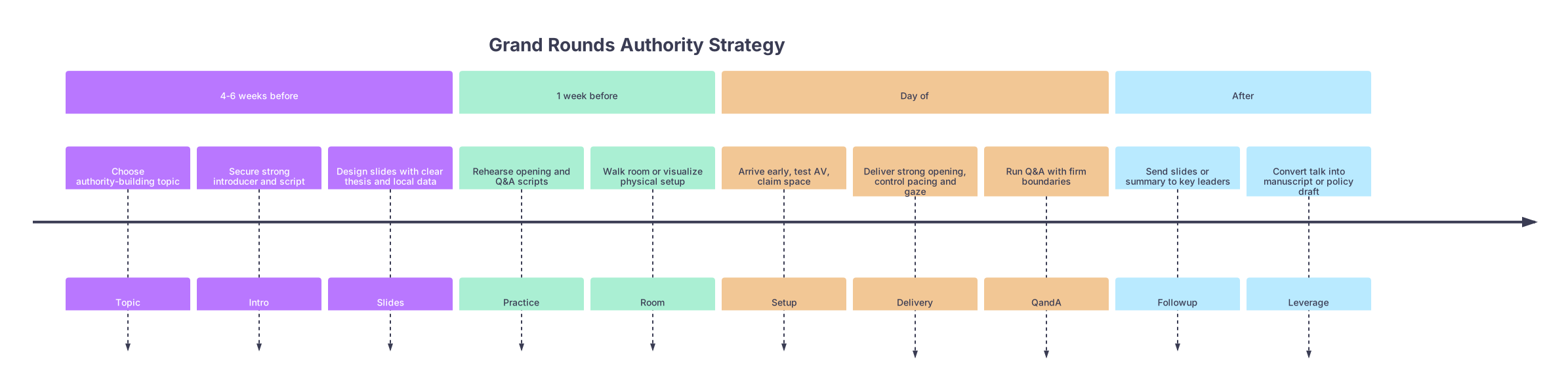
| Period | Event |
|---|---|
| 4-6 weeks before - Choose authority-building topic | Topic |
| 4-6 weeks before - Secure strong introducer and script | Intro |
| 4-6 weeks before - Design slides with clear thesis and local data | Slides |
| 1 week before - Rehearse opening and Q&A scripts | Practice |
| 1 week before - Walk room or visualize physical setup | Room |
| Day of - Arrive early, test AV, claim space | Setup |
| Day of - Deliver strong opening, control pacing and gaze | Delivery |
| Day of - Run Q&A with firm boundaries | QandA |
| After - Send slides or summary to key leaders | Followup |
| After - Convert talk into manuscript or policy draft | Leverage |
7.1 Before the talk: topic, sponsor, and optics
Pick topics that naturally position you as an authority, not a messenger. Good:
- Your own research or QI work
- A practice domain where you are the de facto institutional expert
- Cross-cutting ethics or equity issues in your clinical area
Not ideal for authority-building (though sometimes necessary):
- Generic “update on hypertension guidelines” if you are not a known HTN person
- “Overview of X specialty” if your role is junior and nonspecific
Secure a senior sponsor who will show up and sit visibly supportive. Not to “vouch” for you verbally, but so the room sees you as someone senior colleagues invest in. That has real signaling power.
Outfit: I am not going to pretend looks do not change how your authority is perceived. They do. The goal is simple: look like someone who could be tenured faculty tomorrow. That usually means:
- Structured, not floppy (blazer, tailored dress, or well-fitted professional attire)
- Shoes you can stand and move in without distracting yourself
- Badges and lanyards neat, not swinging
You are building a visual narrative: “This is what leadership looks like here.”
7.2 During the talk: micro-choices that add up
Several small behaviors telegraph seniority:
When you do not know an answer:
“I do not know” followed by “Here is how I would approach finding out…” is far more authoritative than scrambling or apologizing.When you reference your own work:
“In our 2023 cohort analysis, we found…” instead of “I did this little project…”When tech glitches happen:
“We will proceed without that slide. The key point is…” Keep talking. People remember how you handled disruption more than the glitch itself.
7.3 After the talk: leverage and follow-through
Authority is not just in the room. It is what the room does with you afterward.
Have a concrete follow-up ready:
- A one-page summary or algorithm you can send to the chief, QI lead, or ethics committee
- An offer: “If anyone is interested in implementing this protocol on your service, I am happy to meet.”
Send the slides or a brief “key recommendations” email to a short, targeted list: your division chief, relevant committee chairs, maybe the residency program director. Not the whole department listserv. Targeted.
You are quietly saying: “This was not a one-off performance. This is part of my work of shaping this department.”
8. Special Considerations for Women of Color and Non‑Majority Identities

If you are a woman of color, queer, non‑native English speaker, or otherwise visibly “nonstandard” in your institution, some of this becomes even more charged.
A few hard truths:
- You will sometimes be read as “junior” no matter your title
- You may experience more overt questioning of your data, methodology, or right to speak on certain topics
- Your emotional bandwidth will be lower because you are managing bias on top of the normal stress of presenting
Tactics I have seen work:
Over-clarity about your role and expertise in the first 2 minutes. Not as braggadocio, but matter-of-fact. “As director of our stroke program, I…” shuts down some category errors quickly.
Strategic ally placement. Have one or two colleagues primed to ask substantive, not softball, questions early in the Q&A. It signals to the room that serious people take you seriously.
Refusing the “diversity-only” talk trap. If you are asked to speak only on diversity, equity, or “women’s issues” but your actual scholarly work is in heart failure or neuroimaging, insist on splitting:
“I am happy to speak on equity in stroke care, and I would also like to present our new stroke pathway data at a future grand rounds.”
That keeps you from being pigeonholed as “the DEI talker” rather than a clinical authority.
Ethically, none of this is your responsibility to fix. But strategically, using grand rounds to establish that you are both a domain expert and someone who can speak to equity makes you harder to ignore when decisions are made.
FAQ: Grand Rounds Authority for Women Speakers
1. Should I correct someone who calls me by my first name while using “Dr.” for male colleagues?
Yes. Once per interaction, calmly and clearly.
Example: “Dr. Johnson, to your question…” then later, if needed: “And just to clarify, I prefer Dr. [Last Name] in professional settings.” You are enforcing a professional norm, not asking for a favor.
2. How do I handle it if my mentor or senior sponsor dominates the Q&A answering for me?
Preempt it. Before the talk: “I would really value handling the questions myself; if I miss anything crucial, please add at the end.” If they still jump in, you can occasionally say after they finish: “Thank you, and I would add…” and reclaim the last word.
3. What if I am legitimately nervous and feel my voice shaking?
Normalize it for yourself, not the room. Do not announce “I’m nervous.” Instead, slow down your breathing, plant your feet, and focus on speaking to one person in the back row. The shake usually settles after the first 2–3 minutes. Your content and structure matter more than a slight tremor.
4. Is it arrogant to present mostly my own work rather than a broad review?
No. It is strategic and appropriate, provided you are transparent about limitations and properly credit collaborators. Grand rounds should showcase local expertise. Presenting your own data is how you become the go‑to person for that topic.
5. How can I practice handling hostile or undermining questions without an audience?
Do a mock Q&A with colleagues you trust. Ask them to throw the worst at you: “Isn’t this naive?”, “This is not how real medicine works”, “Your data are meaningless.” Practice your three-step response: validate kernel (if any), state your position, re-anchor to data/principles. Record and refine until your tone is steady and not apologetic.
6. What if my institution has a very “casual” culture where people use first names and joke around?
Culture is not an excuse to erase hierarchy selectively. You can be warm and still insist on professional respect. Use “Dr.” in introductions and formal settings like grand rounds, even if halls are on a first-name basis. You can always relax later; it is very hard to tighten back up once you start casual.
Key points to carry into your next grand rounds:
- Design your talk as an authority performance: clear thesis, local ownership, and practice-changing recommendations.
- Control the framing—introduction, language, body, and Q&A—so you are treated as a senior voice, not a trainee doing a school project.
- Use ethics and professionalism as tools to strengthen your authority, not as excuses to self-shrink.