
The biggest mistake women researchers make about protected time is assuming it will be “understood” rather than explicitly negotiated and enforced.
You do not “earn” protected time by being productive. You get protected time by defining, quantifying, and guarding it like a limited grant you award to yourself.
Let me break this down specifically.
1. What “Protected Time” Actually Means (And What It Does Not)
Most people use “protected time” like a vague feel‑good phrase. Chairs smile and nod, everyone agrees research is important, and then your “protected” time quietly evaporates into “urgent” clinical needs.
You cannot negotiate what you have not defined.
At a minimum, protected time has five technical attributes:
- A numerical fraction of FTE (e.g., 0.4 FTE = 2 days/week).
- Named activities that are allowed in that time (e.g., grant writing, data analysis, mentoring research staff, manuscript preparation).
- Activities that are explicitly excluded (e.g., clinical care, routine teaching, routine admin).
- A time horizon (e.g., 3 years, aligned with K award years 1–3).
- An accountability and review structure (who can change it, how, and when).
If any one of those is missing, your “protected time” is optional time. Optional time gets cannibalized.
Here is how you see it written clearly in a contract versus uselessly in an offer letter.
| Aspect | Weak Language | Strong Language |
|---|---|---|
| FTE | "Substantial time for research" | "0.5 FTE (20 hours/week) research effort" |
| Allowed Uses | "Academic pursuits" | "Grant preparation, manuscript writing, data analysis, supervision of research personnel, research-related meetings" |
| Exclusions | None mentioned | "No scheduled clinical duties, administrative meetings, or routine teaching during research FTE without written mutual agreement" |
| Duration | "Subject to annual review" | "Guaranteed for 3 years, contingent only on continued employment and maintenance of minimum extramural effort requirements" |
| Changes | "May be adjusted based on departmental needs" | "Changes require written agreement by both parties and cannot be made unilaterally except under institution-wide clinical emergency policy" |
If your document reads more like the left column than the right, you are not actually protected.
2. Power, Gender, and Why Women Get Less Real Protection
This is where ethics and power dynamics matter.
In most academic medical centers:
- Women are more likely to be over-assigned “citizenship” work: extra teaching, committees, emotional labor with trainees.
- They receive more requests phrased as “could you just…” and “you’re so good with…” that quietly eat their calendar.
- Saying “no” is socially more costly for women. They are judged as less “team-oriented” or “difficult” much faster than male colleagues.
I have watched this play out in real time:
Two junior faculty, both with K awards, both “50% protected time” on paper, same division.
- He: “My K time is locked. I don’t take clinic on my K days.”
- She: “They needed someone to cover Wednesdays, and I do not want to be seen as not helping the team.”
Three years later, his CV shows 4 first-author manuscripts and a successful R01. Hers shows 2 papers, several extra teaching awards, and a politely worded “development plan” suggesting she needs more high-impact publications.
The ethical issue: institutions often talk about gender equity while structurally relying on women’s willingness to “help” at the expense of their own research trajectories.
So you are not just negotiating protected time. You are negotiating your resistance to being the default problem-solver.
3. Before You Negotiate: Your Numbers and Non‑Negotiables
Walking into a negotiation without your own numbers is how you get steamrolled.
You need three specific data sets.
3.1. Your Funding and Effort Math
You should know:
- Your current and projected effort support from grants (K, R, foundation awards, internal pilot funds).
- The institutional effort commitments you have made in those grants.
For example, a K08 might require 75% effort. If your department is “counting” 0.20 FTE of that as covered by clinical revenue, you need to know that. Because those numbers will come up when they claim they “already support” your protected time.
Write it out:
- K award: 75% effort, sponsor pays 50%; department covers 25%.
- Your goal: maintain at least 60–70% total research/protected time for years 1–3.
Then craft a clear statement: “Given my federal commitment of 75% effort, I am requesting 0.6–0.7 FTE explicitly protected, with clinical effort capped at 0.3–0.4 FTE for the duration of the award.”
3.2. Your Realistic Time-to-Output Model
Protected time has to tie to outcomes in their language:
- Grants submitted and funded.
- Publications in journals they recognize.
- Programmatic contributions (e.g., building a clinical database, starting a lab).
Rough rule of thumb I see work:
- 0.2–0.3 FTE research: you can be a serious collaborator, not a PI building an R-series portfolio.
- 0.4–0.5 FTE: you can maintain a PI profile with focused questions and strong team.
- 0.6–0.8 FTE: you can grow a robust research program.
If they want “independent funding” but are only offering 20% true protected time, you must say: “That staffing model does not match the outcomes you are expecting. To be on a credible path to R01-level funding, I need at least 40–50% protected time for the next 3 years.”
You are not whining. You are doing capacity planning.
3.3. Your Non‑Negotiable Boundaries
You need 2–3 hard lines you will not cross. Examples:
- “No scheduled clinics on my K days. Period.”
- “No standing committee assignments on research days.”
- “I do not take on new student mentorships that require weekly standing meetings during protected time.”
If you do not decide these in advance, you will accept every “one-off exception” until your calendar looks like everyone else’s.
4. The Actual Negotiation: Scripts, Tactics, and Leverage
Let’s walk through the meeting. Because it is not theoretical. This is where women get edged out by politeness.

| Step | Description |
|---|---|
| Step 1 | Prepare data and goals |
| Step 2 | Initial meeting with chair |
| Step 3 | Confirm in writing |
| Step 4 | Clarify misalignment |
| Step 5 | Revise proposal |
| Step 6 | Decide on escalation or exit |
| Step 7 | Monitor and enforce boundaries |
| Step 8 | Clear commitment offered? |
| Step 9 | Can expectations or time adjust? |
4.1. Opening Position: Framing Around Institutional Goals
You do not start with “I need.” You start with “Here is what you said you want from me.”
Example:
“You have described a vision where I develop into an independently funded investigator in X, and help elevate our division’s research profile. To achieve that, I need to make sure my effort allocation supports that goal. I have mapped out what that realistically requires in terms of protected time and outputs over the next 3 years.”
Then show them a very simple table.
| Year | Protected Research FTE | Key Outputs |
|---|---|---|
| 1 | 0.7 | 2 major grant submissions, 2 manuscripts |
| 2 | 0.6 | 1–2 resubmissions, 2–3 manuscripts, build database/cohort |
| 3 | 0.5 | 1 large grant, 3+ manuscripts, mentoring 1–2 trainees |
Now the ask sounds like logistics, not personal preference.
4.2. Explicit Ask Language
Here is language that works:
“I am requesting a guaranteed minimum of 0.6 FTE protected for research for the next 3 years, aligned with my K-award commitment. That means two full days each week without scheduled clinics, standing meetings, or non-research teaching.”
You want “guaranteed,” “minimum,” and a time horizon. Avoid “hope,” “aim,” “try,” and “flexible.”
If they respond with, “We value flexibility,” your answer can be:
“I value flexibility too. The question is: flexible around what fixed core? For my research to succeed, the fixed core has to be at least 0.6 FTE genuinely protected. We can be flexible above that.”
4.3. When They Push Back with “Clinical Needs”
This is the classic move.
You will hear:
- “Clinic volumes are high; we really need everyone pitching in.”
- “We can commit to 40% and then see how things go.”
- “Your grant only covers X%, so we cannot justify more.”
You respond with structure, not emotion.
“Let me translate that to impact on the research goals you outlined. With 0.4 FTE, the realistic timeline to independent R01-level funding shifts from approximately 5 years to 8–10 years, and the risk of not reaching that level rises significantly. Are you comfortable with that trade‑off for this role?”
You are forcing them to own the impact. Many will back off when the consequence is that explicit.
If they appeal to fairness (“Others at your level have 40%”), you can say:
“I understand the historical pattern. I was recruited specifically with the expectation of building an externally funded program. The effort model that worked for faculty whose primary role was clinical with secondary scholarship is not the right comparator. The appropriate comparison is other faculty on a research‑intensive track with similar external commitments.”
You are not asking for a favor. You are aligning with the role they claim they want you in.
4.4. Written Confirmation and Contract Language
Verbal promises are vapor.
You follow up with an email:
“Thank you for meeting today. To confirm my understanding:
- My effort allocation for the next 3 years will include 0.6 FTE protected for research.
- Protected research time consists of grant writing, data analysis, manuscript preparation, research-related meetings, and supervision of research staff.
- No routine clinical sessions or standing non-research meetings will be scheduled during this protected time without our mutual written agreement.
- This arrangement will be in place through June 30, 2028, contingent on my continued employment and maintenance of my K award or equivalent research funding.
Please let me know if this does not reflect your understanding.”
Then you push for that language in the offer letter, contract addendum, or K-support letter. Do not accept “too detailed for the letter” as an excuse. Details are what protect you.
5. After the Deal: Protecting the Protection
The real erosion happens after year 1. Especially for women who are seen as “reliable” and “team players.”
Let’s talk boundaries and scripts.
5.1. Calendar Discipline
If your Thursday and Friday are research days, they are research days.
Common failure modes I see:
- “Just one clinic a month” on a research day.
- “It is only a 30-minute committee call.”
- “The trainee could only meet then.”
Each one by itself seems trivial. The aggregate destroys the uninterrupted blocks that deep work needs.
Use a rule: 80–90% of your protected days are blocked in 2–4 hour chunks for defined tasks: specific analyses, specific aims, manuscript sections. Not “catch up.”
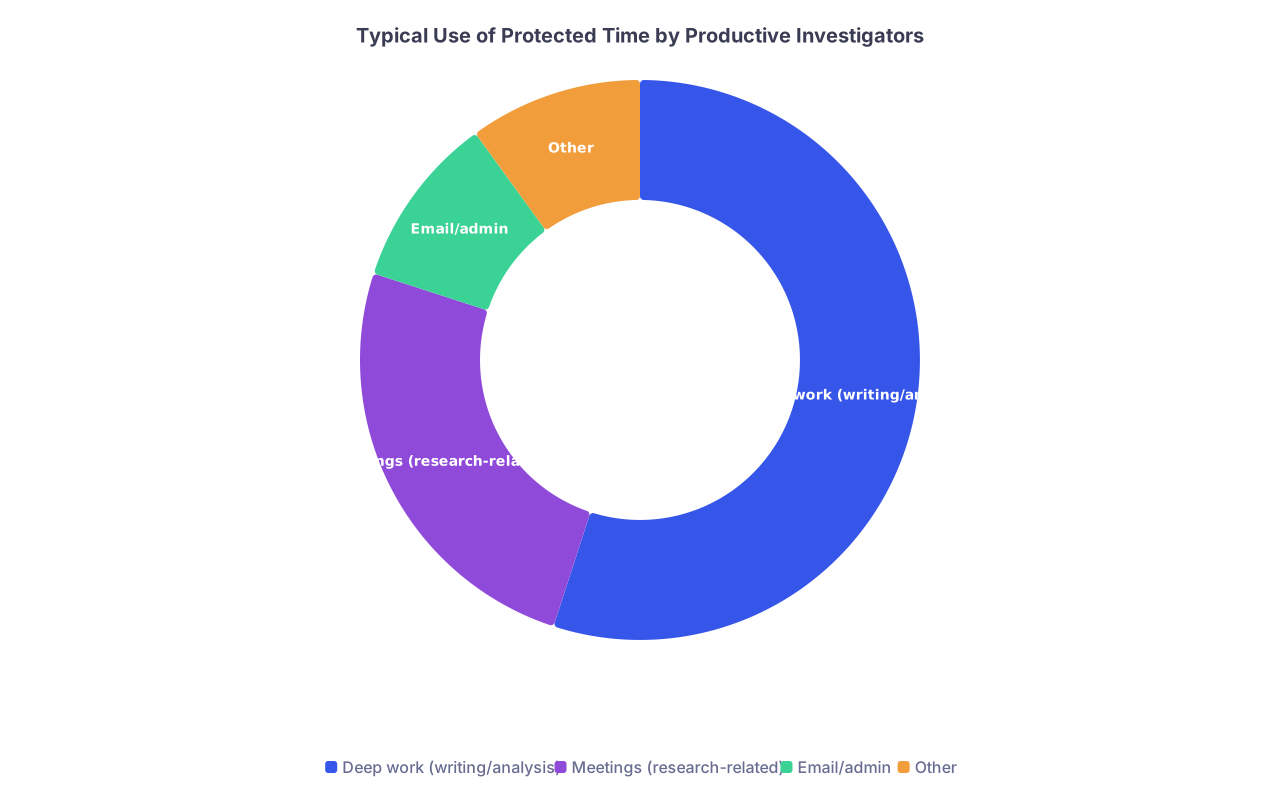
| Category | Value |
|---|---|
| Deep work (writing/analysis) | 55 |
| Meetings (research-related) | 25 |
| Email/admin | 10 |
| Other | 10 |
If your pattern looks more like 30% deep work and 70% everything else, your “protection” is performative.
5.2. Saying No Without Setting Yourself on Fire
Women pay more for “no.” So you need crafted language that is firm but not self-sabotaging.
When asked to cover clinic on a research day:
“I am not available on Thursdays; that is my protected research time committed in my K award and departmental plan. If coverage is needed, I am happy to flex within my clinical days, but I cannot compromise my protected effort.”
When asked to join a new committee that meets during research blocks:
“I appreciate the invitation. Right now my research time is fully committed under my grant, and I am not able to take on additional standing meetings. If there is a short‑term, time‑limited task force that aligns with my research, I could consider that on a defined timeline.”
Notice: you reference your grant and departmental commitments, not your personal preference. You make it an institutional obligation.
5.3. Handling “Emergency” Erosion
There will be real emergencies. Flu season surges. A partner leaves unexpectedly. The hospital opens new beds ahead of staffing.
You need a pre‑defined approach:
- Emergency coverage can be temporary.
- There must be a rebalancing after the crisis.
- Your research outputs should not be evaluated as if nothing changed.
So when you agree to step up, send an email:
“I understand we are in a temporary surge situation. I am willing to increase clinical effort to X for the next 6 weeks. Given my grant and promotion timelines, I want to document that this represents a temporary reduction in protected research time, and that we will revisit my effort distribution by [date] to return to our agreed 0.6 FTE research.”
If you do this politely and consistently, you train the system not to see your research time as “optional” every time there is a crunch.
6. Gender-Specific Landmines and How To Step Around Them
Let’s be blunt about what I see derail women’s protected time the most.
6.1. Mentorship Black Hole
Women faculty are disproportionately asked to mentor:
- “Can you be a role model for our women medical students?”
- “This resident really looks up to you…”
- “We need more women on the T32 mentorship roster.”
Mentorship is valuable. In excess, it is death to early-career research.
Two strategies:
Batch and bound
“I can take on up to 2 new formal mentees this year, preferably whose projects align closely with my funded work. Beyond that I am happy to meet with trainees once for career advice and then direct them to other mentors.”Create group structures
Monthly group mentoring sessions instead of 10 individual one‑offs. Efficient and still high impact.
6.2. Service and “Representation”
You will hear, “We really need women on this committee.”
Translation: “We need your time, and we will frame it as a diversity imperative so it is harder to refuse.”
Your ethically sound response can be:
“I agree representation matters. My primary institutional value right now is through building a successful research program that will also lift women in this field. I can serve on one major committee at a time without compromising that. Currently I am on X. When that term ends, I would be happy to consider Y.”
You are not rejecting the equity argument. You are refusing to let it be wielded against you.
6.3. Being Labeled “Not a Team Player”
This is the subtle punishment for enforcing boundaries. Women feel it sooner.
The antidote is strategic visibility:
- Over‑communicate your collaborative behavior in research spaces: multi‑PI grants, shared publications, cross‑department projects.
- Be visibly generous within the zone you have defined (e.g., superb mentoring on the projects you do accept, reliable coverage on your assigned clinics).
- Avoid appearing disengaged from the department; show up for key meetings, grand rounds, and events that matter. Just not on your research blocks.
Colleagues will still gripe. That is fine. Your metric is: Are you meeting your written expectations and producing what you promised? Not: Does everyone like that you said no?
7. Institutional Ethics: What Departments Owe Women Researchers
This is not just about individual negotiation skill. Ethically responsible departments should:
- Avoid using women faculty as “equity shields” while overloading them with service.
- Ensure that written protected time is honored in scheduling and evaluation.
- Align promotion criteria with actual effort distributions, not fantasy CVs.
You can push this from the inside in small, pointed ways.
For example, in annual reviews:
- Ask that your effort distribution be explicitly printed and attached to your evaluation.
- When given feedback about insufficient publications or grants, calmly re-link to your documented FTE for research and ask: “Given my 0.3 FTE research allocation, is my productivity aligned with expectations? If not, which parameter should change?”
That question forces the system to either adjust expectations or admit they are under-resourcing research, which is an ethical problem, not your personal failing.
For departments that are at least trying, this kind of feedback can actually move policy.
8. A Concrete Walkthrough: K-Awarded Woman, Division of Cardiology
Let me give you a realistic example.
Dr. A, early-career woman cardiologist, just received a K23. Her initial draft contract says:
- 0.7 FTE research, 0.3 FTE clinical.
- “Substantial time protected for research and academic work.”
- “Clinical duties may be adjusted to meet division needs.”
Problems:
- “Substantial” is undefined.
- “Academic work” may be interpreted as committee meetings, non-research teaching.
- The “adjusted to meet division needs” clause completely undermines the 0.7 guarantee.
Here is how she should respond.
Email with proposed revisions:
“To align my effort with NIH K23 requirements and our shared goal of independent funding, I propose clarifying the protected time language as follows:
- 0.7 FTE (28 hours/week) protected for research activities including grant preparation, data analysis, manuscript writing, and research-related meetings.
- No standing clinical sessions, administrative committee meetings, or routine teaching activities will be scheduled during this protected time without written mutual agreement.
- This 0.7 FTE research commitment will be maintained for the 5-year duration of the K23 award, contingent on my continued employment and maintenance of the award.
- Temporary changes due to documented institutional emergencies (e.g., system-wide clinical surge) will be time-limited and followed by rebalancing of effort to restore 0.7 FTE research.”
In person, she uses language like:
“The NIH will be monitoring my effort closely. If I cannot maintain 0.7 FTE research, I risk losing the award. That would be a loss for me and the institution. Clear language protects all of us.”
When told, “We need flexibility to adjust clinics if others are out,” she replies:
“I understand the need for coverage. What I can offer is flexibility within my 0.3 FTE clinical days and help planning coverage models. What I cannot offer is ad hoc encroachment on my K-protected time; that would put the award at risk.”
If they refuse to put any of this in writing, that is a data point. Not a small one. It tells her exactly how they will behave when there is pressure. That is when she should seriously consider whether this is the right institution.
9. Data and Reality Check: Who Actually Gets Protected Time
Protected time is not distributed equitably, and pretending otherwise is dishonest.
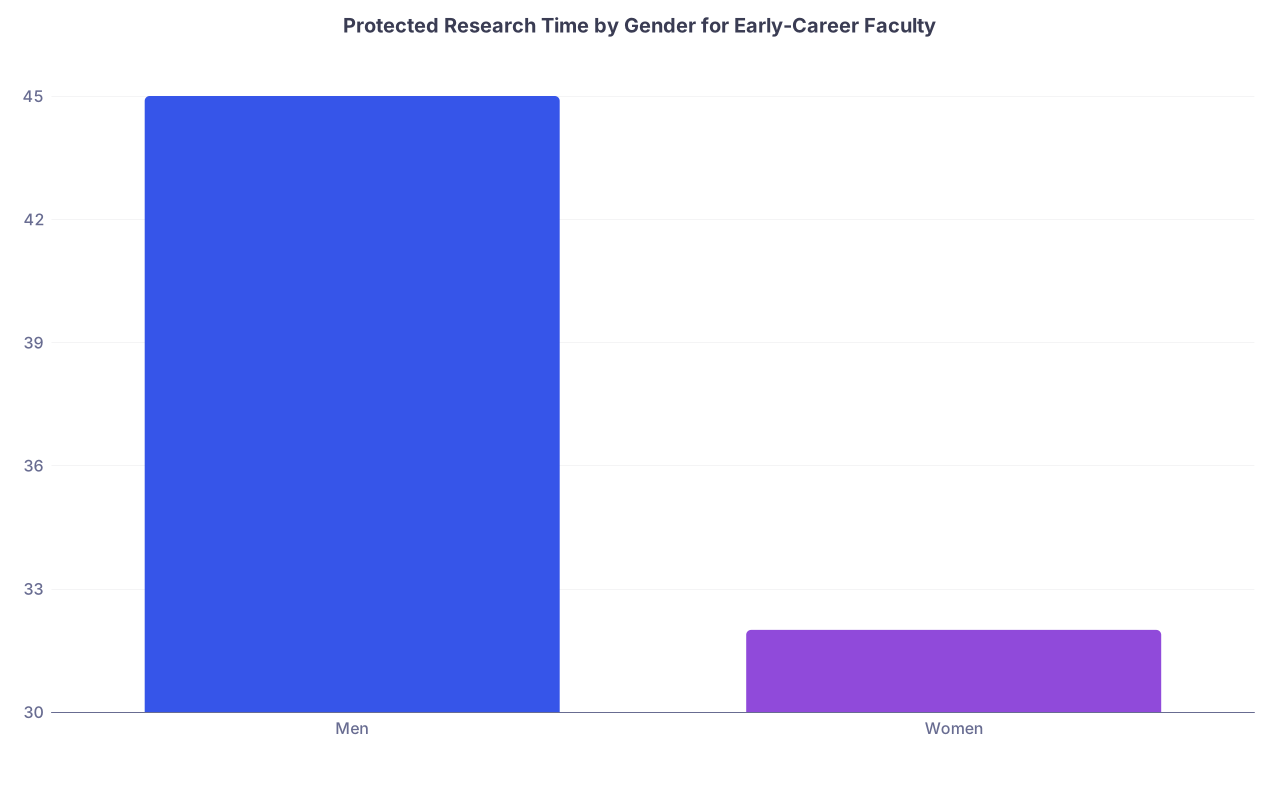
| Category | Value |
|---|---|
| Men | 45 |
| Women | 32 |
Imagine those bars as average percent FTE protected for early-career physician‑scientists in a typical department. Men at 45%, women at 32%. I have seen numbers in that range more often than I care to.
The gap is not usually written in contracts. It shows up in:
- “Just one more half‑day clinic.”
- “Can you mentor this student? She really needs a woman role model.”
- “We need diversity on this committee.”
You close that 13‑point gap not with inspirational quotes, but with technical negotiation and enforcement.
FAQ (exactly 4 questions)
1. Should I ever take a job that does not offer formal protected time if I want a research career?
If your primary identity is as a researcher, taking a job with no formal protected time is almost always a mistake. You can do some scholarship off the side of your desk, but you will not build an R01-level portfolio. There are rare exceptions where a chair has a consistent history of informally shielding people and later converting to formal research tracks. Even then, you should get at least an email trail spelling out expected effort. If they refuse even that, they are not investing in your research future.
2. How much protected time do I need to be competitive for an R01?
Most successful physician‑scientists building to an R01 have 50–80% research effort in the early years, especially if they are running a lab or complex clinical studies. If you are at 20–30%, you can contribute meaningfully as co‑I or site PI, but leading and sustaining a robust program will be extremely difficult. For women who are disproportionately pulled into service work, I usually recommend aiming for no less than 0.5 FTE true, enforced protected time in the first 5–7 years if the institution is serious about R-level funding.
3. What if my chair is supportive verbally but says the “system” (billing, scheduling) makes more protected time impossible?
That is a structural problem, not a personal one, and you should treat it that way. Ask for a written statement of your research role and effort to be placed in your file and reflected in promotion criteria. Then decide whether the mismatch between goals and structure is acceptable. Sometimes the honest answer is that the department is clinically dominated and will not change. In that case, your long‑term decision is whether to accept a more hybrid career or to move to an environment where the “system” is built for researchers rather than against them.
4. How do I involve mentors or sponsors in negotiating my protected time without seeming unable to advocate for myself?
Use them strategically as amplifiers, not proxies. You can say to your mentor: “Here is the protected time structure I think I need, here is my draft language. Does this look realistic in this department? Would you be willing to echo this framework with the chair or division chief?” Senior people carrying the same message normalizes it. You still do the primary negotiation, but your mentor’s quiet comment—“This is the effort she needs if you actually want her to get an R01”—has more weight than you saying it alone.