
Most women in academic medicine are under-promoted not because they lack achievement, but because their dossiers are written like apologies instead of evidence.
Let me be blunt. The promotion system in academic medicine was built by and for people who assumed a stay-at-home spouse, no career interruptions, and a straight-line trajectory. You are being evaluated in that system. You cannot “work hard and hope they notice.” They will not. The only thing the committee sees is: your dossier.
So we are going to walk line by line through the promotion packet the way a seasoned promotions chair reads it. Not the way HR workshops describe it. The way it is actually read in that tired 7 pm committee meeting when half the room is checking email and three people are quietly gatekeeping the next decade of your career.
This is how you stop underselling yourself and start presenting your record like the full professor you are trying to become.
1. First Principles: How Promotion Committees Really Think
Promotion committees are not asking “Is she good?” They are asking three specific questions:
- Has she clearly met the written criteria for this track and rank?
- Can we defend this promotion to skeptics using her dossier alone?
- Does her package look as strong (or stronger) than recent successful cases at this level?
You are not competing with some abstract standard of excellence. You are being silently compared to:
- The last person promoted in your department.
- The committee members themselves at the time they advanced.
- The archetype of a “serious academic” they have in their heads (which is still, too often, male, uninterrupted career, no caregiving gaps).
This matters because vague “I contribute a lot” language gets demolished in that room. Specific, quantifiable, well-framed evidence survives.
You need two things before you start writing a single line:
- Your institution’s official promotion criteria for your track (clinician-educator, research, clinician-scholar, etc.).
- At least two successful dossiers at your institution in your track and rank from the past 3–5 years (preferably at least one from a woman, ideally in a similar discipline).
If you do not have both of these, stop. Email your faculty affairs office and your division chief. Phrase it this way: “To ensure my dossier aligns with institutional expectations, I’d like access to at least two recent successful promotion packets in my track at the Associate/Professor level.” This is not a favor. It is baseline transparency.
2. The Core Documents: What Actually Gets Read
Let’s map the battlefield.
A typical promotion dossier in academic medicine has:
- Curriculum Vitae (CV) – structured, institutional template.
- Personal Statement / Narrative (usually 3–5 pages).
- Teaching Portfolio.
- Clinical Portfolio (for clinical tracks).
- Research / Scholarship Portfolio (for research or hybrid tracks).
- Service and Leadership Summary.
- External Letters of Evaluation.
- Chair’s Letter and Departmental Vote Summary.
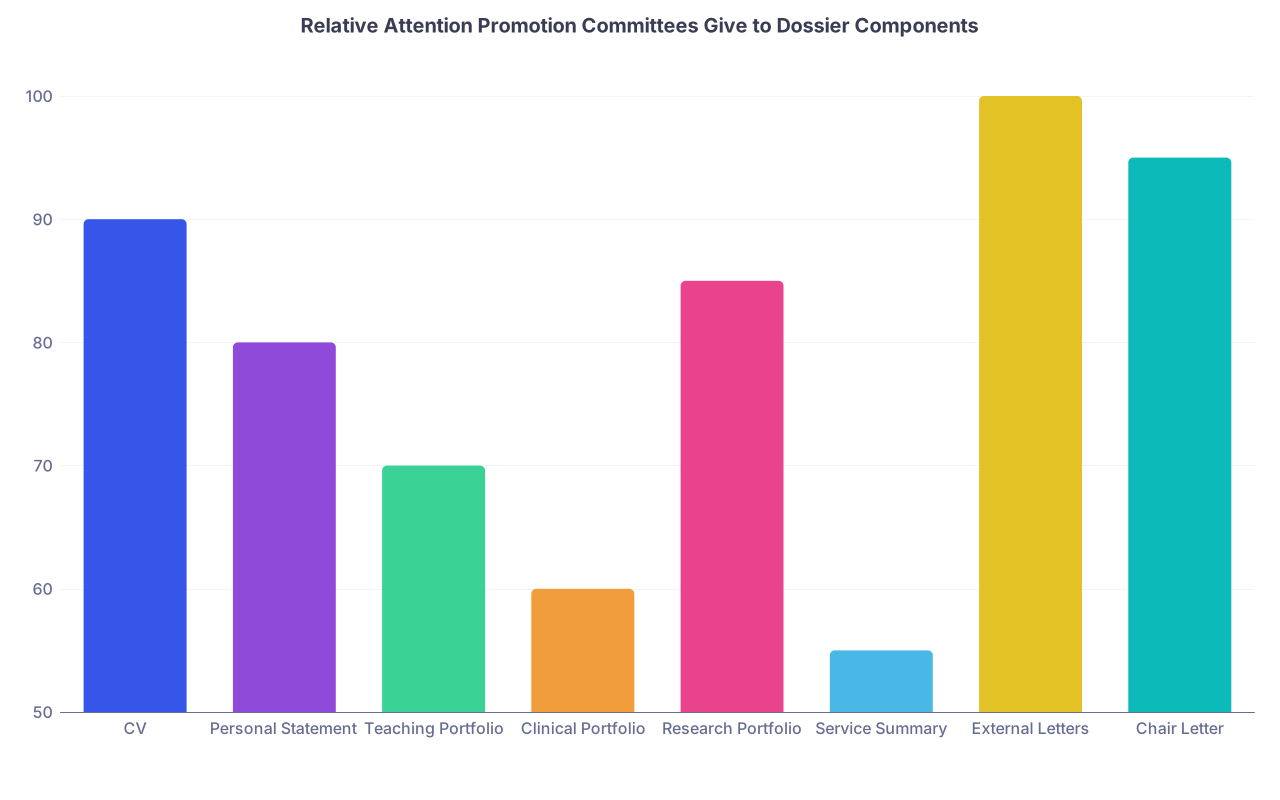
You control 1–6 directly. You influence 7–8 by how clearly you write 1–6.
| Category | Value |
|---|---|
| CV | 90 |
| Personal Statement | 80 |
| Teaching Portfolio | 70 |
| Clinical Portfolio | 60 |
| Research Portfolio | 85 |
| Service Summary | 55 |
| External Letters | 100 |
| Chair Letter | 95 |
No one reads every word of everything. They skim strategically. What they see first:
- Chair’s letter.
- External letters.
- The first page or two of your CV.
- The first page of your personal statement.
Your job is to make those four elements completely aligned: same story, same emphasis, same evidence.
3. The CV: Where Women Quietly Lose Ground
I have sat in too many rooms where someone said, “Her CV just does not look that impressive,” and when you actually looked, she had the same or better output than the man they just approved. His was formatted and framed aggressively. Hers looked like a cluttered log of “helpful” activities.
3.1 General Rules Before Line-by-Line
- Use your institution’s template. No creative layouts. Committees hate “cute.”
- Reverse chronological order within each section.
- Ruthlessly separate outputs (products) from roles (titles, responsibilities).
- Quantify wherever possible.
Now line by line through key sections.
3.2 Education and Training
Most people phone this in. Women, in particular, often understate competitive achievements.
Weak:
- “Residency, Internal Medicine, University X”
Stronger:
- “Internal Medicine Residency, University X – Chief Resident, PGY-4 (selected by program leadership from cohort of 36 residents)”
If you had:
- A chief role
- A teaching award
- A research honor
- A named fellowship
…spell it out here. Committees scan this section to set a “caliber” baseline in their minds. Do not leave that on the table.
3.3 Academic Appointments
You must make the trajectory obvious.
Bad:
- “Assistant Professor, 2014–present”
Better:
- “Assistant Professor of Medicine, tenure-eligible Clinician-Educator Track, 2014–present”
If your title changed mid-rank (e.g., promoted within track), clarify that. If you had a period at reduced FTE for caregiving or health, do not hide it; it contextualizes output. You can use a simple note, for example:
- “0.6 FTE from 2017–2019 during approved caregiver leave.”
That one line prevents a silent “productivity drop” narrative being written in that room without your input.
3.4 Grants and Funding
Women commonly bury crucial details here. The committee wants to know:
- Total funding.
- Your role.
- Whether the grant is competitive and peer-reviewed.
You should separate:
- Federal vs foundation vs internal.
- Current vs completed.
- PI/Co-PI vs Co-I vs “other.”
Instead of:
- “Co-investigator, R01, 2020–2025”
Write:
- “R01 HL123456 (Smith, PI). 2020–2025. Role: Co-Investigator. Percent effort: 20%. Focus: Development and evaluation of X. Total direct costs: $1.8M.”
If you wrote the science and the male PI “fronted” the grant title, your narrative and personal statement must say so explicitly (politely, without drama), for example:
- “I led the conceptual design and drafting of the funded R01 HL123456; as Co-I, I have primary responsibility for Aim 2 and serve as scientific lead for the X sub-study.”
You are not “being difficult.” You are providing the factual record.
3.5 Publications
This section is where bias shows up starkly. Women are more often:
- Middle authors while doing heavy lifting.
- On “collaborative” projects where attribution is murky.
- Under-cited relative to impact.
You cannot fix authorship politics retroactively, but you can present your publication list intelligently.
Rules:
- Separate peer-reviewed original research from reviews, chapters, editorials.
- Indicate senior author clearly (underline your name or asterisk with key).
- If your name changes (marriage/divorce) explain once in a footnote.
Then add a short “Selected Major Publications” subsection (10–15 max) where you can:
- Bold your name.
- Add a one-line impact note in your narrative, not in the CV. Example for the narrative: “Our 2017 JAMA paper (Smith, Jones) has been cited 240 times and informed the 2019 ACC/AHA guidelines on X.”
Do not write impact commentary within the CV itself if your institution forbids it; use the personal statement and research portfolio to highlight impact.
3.6 Teaching Activities
Most women are over-teaching and under-documenting.
Your teaching section categories should be:
- Formal didactics (courses, lectures).
- Clinical teaching (precepting, ward attending).
- Mentorship and advising (with concrete outcomes).
- Curriculum development.
For each recurring teaching activity, provide:
- Title.
- Audience level (UME, GME, faculty).
- Frequency.
- Your role (course director vs “speaker #4”).
Weak entry:
- “Lecturer, second-year renal physiology course.”
Better:
- “Renal Physiology Course – Core Faculty, 2016–present. Developed and deliver 3 of 10 sessions annually (120 second-year medical students); redesigned assessment structure in 2019, resulting in 18% improvement in NBME renal subscore.”
That last clause is where you quietly shift from “I talk” to “I improve outcomes.”
3.7 Service and Leadership
This is where women get buried under committee work that does not move the promotion needle.
Divide into:
- Institutional committees.
- Professional societies.
- Community / outreach.
- Equity / diversity / inclusion leadership.
Then prioritize:
- Leadership roles (chair, director, co-chair).
- Work that produced policies, guidelines, or measurable change.
If you were “just a member” on five low-impact committees and chair of one major DEI task force that changed recruitment practices, highlight the latter. Use verbs with teeth: “led,” “oversaw,” “implemented,” “designed,” not “participated in,” “attended,” “helped with.”
4. The Personal Statement: This Is Not Your Diary
Women consistently undermine themselves in the personal statement. Too much apologizing. Too much backstory. Not enough evidence.
The personal statement has one job: articulate a coherent narrative of impact across your chosen domains (teaching, research, clinical, leadership) that matches the institutional criteria for the rank.
You are not writing about “what this journey means to me.” You are writing a prosecutorial brief for why this committee must check the “approve” box.
4.1 Structure That Works
For most mid-career women going for Associate or Full Professor on a clinician-educator or clinician-scholar track, the structure should be:
- One short paragraph: who you are now (title, track, main domains).
- 1–2 pages: Teaching – philosophy + concrete contributions + outcomes.
- 1–2 pages: Scholarship – focus, key contributions, trajectory, impact.
- 1 page: Clinical excellence – scope, innovations, quality metrics where available.
- 1 page: Service and leadership – emphasizing organizational impact, especially if in DEI, mentoring, or systems redesign.
- Optional brief contextual note about career interruptions or non-linear path.
4.2 Language to Eliminate
You need to surgically remove the following patterns from your draft:
- “I was fortunate to be invited to…”
- “I have been lucky to…”
- “I try to…”
- “I hope to continue…”
- Excessive self-deprecation: “Although I am not a researcher, I…”
Replace with:
- “I was selected to…”
- “I lead…”
- “I have established…”
- “My work has resulted in…”
Example of a weak opening paragraph:
“Over the course of my career, I have been privileged to care for a diverse group of patients and to teach many outstanding trainees. Although my research output is modest, I strive to contribute meaningfully to our division’s educational mission.”
Strong version:
“I am a clinician-educator in General Internal Medicine whose work focuses on equitable care transitions for older adults. I lead a portfolio of educational and quality-improvement initiatives that have reduced 30-day readmissions by 12% on our teaching service and informed national curricula on safe discharge practices.”
Same person. Completely different perception in a committee room.

| Step | Description |
|---|---|
| Step 1 | Collect Criteria and Sample Dossiers |
| Step 2 | Audit CV Against Criteria |
| Step 3 | Draft Personal Statement Focused on Impact |
| Step 4 | Construct Teaching and Clinical Portfolios |
| Step 5 | Align Chair Letter Talking Points |
| Step 6 | Identify and Prep External Evaluators |
| Step 7 | Final Coherence Review of Entire Packet |
5. Teaching Portfolio: Turn Invisible Labor Into Evidence
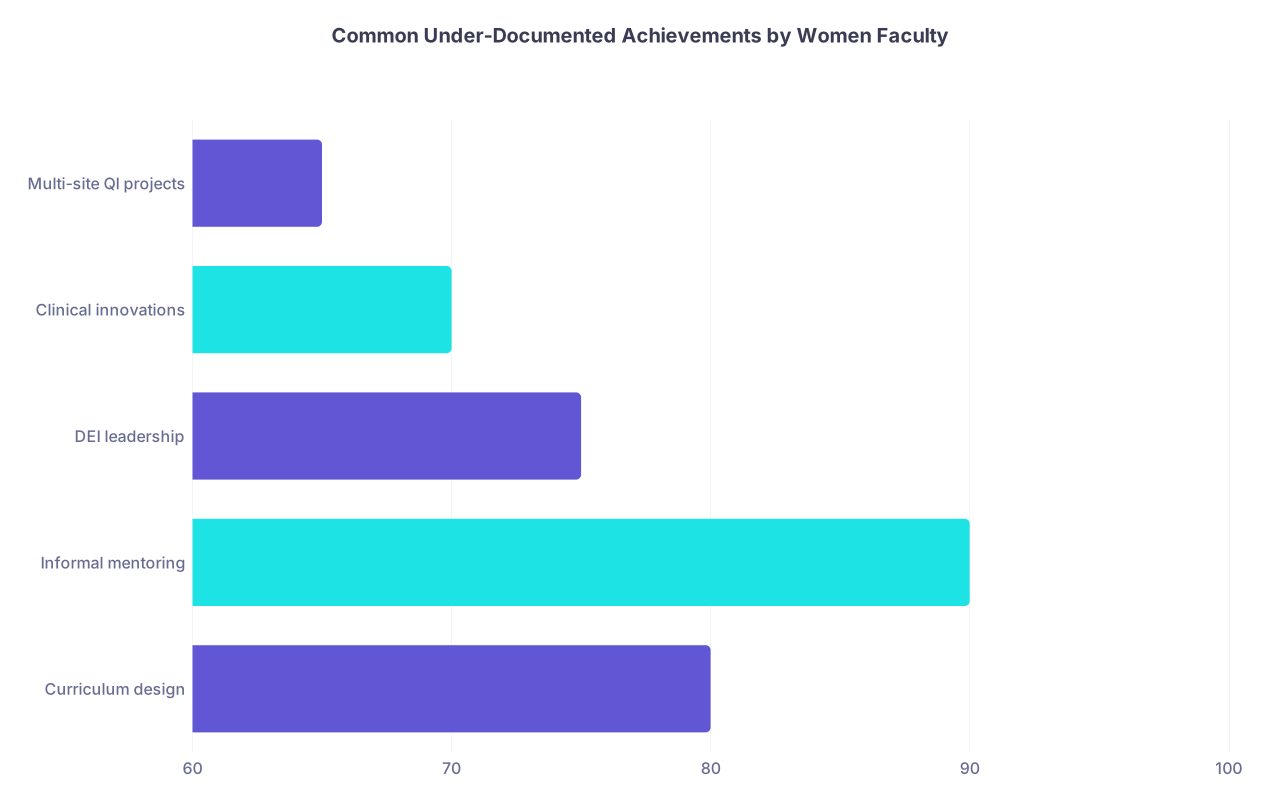
Women do enormous amounts of invisible educational work: “informal” mentoring, picking up last-minute teaching, redesigning rotations quietly. If it is not in your teaching portfolio, it does not exist.
5.1 Core Elements
Your teaching portfolio should have:
- Teaching philosophy (1–2 pages, max).
- Summary table of teaching activities.
- Selected evaluations.
- Evidence of curriculum design / innovation.
- Evidence of educational leadership.
- Outcomes where available (learner performance, program growth, dissemination).
5.2 The Summary Table – Make It Easy to Skim
You want a one- or two-page table that lets a busy committee member see, at a glance, that you are a serious educator.
| Activity | Role | Audience | Frequency | Years |
|---|---|---|---|---|
| Renal Physiology Course | Core Faculty | 120 MS2 students | 3 lectures/yr | 2016–present |
| Inpatient Ward Teaching Service | Attending | 18 residents, 4 MS3 | 16 weeks/yr | 2014–present |
| Teaching Skills Workshop | Course Director | 30 fellows | 4 sessions/yr | 2018–present |
| Med Ed Journal Club | Founder/Leader | 15 faculty | Monthly | 2019–present |
Committee members scan this and think: substantial, consistent, multi-level, leadership roles present. Good.
5.3 Evaluations: Curate, Do Not Dump
Do not upload every raw eval you have ever received. Curate.
- Provide summary statistics (means, ranges, comparison to department average if possible).
- Include a small set of representative comments, especially those reflecting your stated teaching philosophy.
Frame them. For example:
“In end-of-rotation evaluations from 2018–2023 (n=214 residents), my mean overall teaching rating was 4.7/5.0 (department mean 4.3). Residents consistently highlighted my focus on diagnostic reasoning and psychological safety in feedback sessions.”
Then 4–6 quotes that match that claim. You are building a coherent story, not a scrapbook.
6. Clinical Portfolio: Stop Treating Clinical Excellence as “Just Doing My Job”
On clinician-educator and clinician-scholar tracks, your clinical excellence is not “assumed.” It needs documentation.
6.1 Scope of Practice
Define clearly:
- Clinical settings (inpatient, outpatient, OR, etc.).
- Patient population complexity.
- Volume.
Example:
“I practice general cardiology with a focus on women with ischemic heart disease. My clinical time is 60% FTE, including two half-day continuity clinics, one half-day women’s heart clinic, and 8 weeks of inpatient cardiology consult service annually, caring for approximately 900 unique outpatients and 250 hospitalized patients per year.”
Those numbers matter. They preempt the subtle “Is she really full-time clinical?” question that women physicians hear more often.
6.2 Quality and Innovation
List concrete measures and projects:
- Quality metrics (readmission, infection, time-to-antibiotic).
- Patient satisfaction.
- Program-building (new clinics, pathways, consult services).
Most women under-claim innovations. If you:
- Built a new clinic template that cut wait times.
- Designed an order set.
- Created a patient education tool.
That is scholarly-able clinical innovation. Put it in.
7. Research / Scholarship Portfolio: Claim Your Territory
Even on education-heavy tracks, the committee wants to know: What is her distinctive contribution?
Your research/scholarship portfolio should answer three questions:
- What is the throughline of your work? (Not: “I have done six unrelated things.”)
- What are your most influential products? (Not necessarily the highest IF journals.)
- Where is your work going in the next 3–5 years?
7.1 The Throughline
You need a one-paragraph “thesis statement” of your scholarship.
Examples:
- “My scholarship examines how to design and evaluate competency-based curricula in inpatient medicine.”
- “My work focuses on implementation of evidence-based care for adolescents with type 1 diabetes in resource-limited settings.”
Then you group your outputs under that umbrella even if they evolved over time.
7.2 Highlight 3–5 Major Contributions
Do not trust the full publication list to tell the story.
For each major contribution, give:
- The problem.
- What you did.
- What changed.
Example:
“Addressing unsafe discharge transitions: In 2016, I led a multidisciplinary team that developed a structured discharge checklist for older adults. We piloted the intervention on two hospitalist teams and demonstrated a 17% relative reduction in 30-day readmissions (Journal of Hospital Medicine, 2018; cited 85 times). Elements of this checklist were incorporated into our system-wide electronic discharge template in 2019 and have since been adopted at three regional hospitals.”
Notice the verbs: led, developed, demonstrated, incorporated, adopted. That is the language of promotable impact.
| Category | Value |
|---|---|
| Curriculum design | 80 |
| Informal mentoring | 90 |
| DEI leadership | 75 |
| Clinical innovations | 70 |
| Multi-site QI projects | 65 |
8. Service, DEI, and the “Citizenship Trap”
Women are over-represented on:
- Diversity committees.
- Wellness initiatives.
- “Fix the culture” task forces.
These are crucial. But the promotion system often treats them as “nice extras” unless you frame them properly.
8.1 Convert Service to Leadership and Scholarship
The move is:
Committee work → Leadership → Measurable change → Dissemination.
Example transformation:
Weak:
- “Member, Department Diversity Committee, 2017–present.”
Stronger:
- “Co-chair, Department Diversity Committee, 2019–present. Led redesign of faculty search process, including structured interviews and equity advocate training; under this model, the percentage of women among interviewed candidates increased from 34% (2016–2018) to 52% (2020–2023). Presented our model at the 2022 AAMC annual meeting.”
Now your DEI work is:
- Leadership.
- Measurable outcomes.
- Nationally disseminated.
That counts.
9. External Letters: Set Your Evaluators Up to See You Clearly
You do not write your external letters, but your dossier heavily shapes them.
9.1 Who Gets Asked
Most institutions require arm’s-length evaluators: people who:
- Are at or above the rank you are seeking.
- Are in your field or related subfield.
- Do not have direct conflicts (not your mentor, not a co-author on every paper, not a close collaborator).
You should provide a short list of suggested reviewers. Here is where many women make a strategic error: they suggest kindly senior women who like them, rather than leaders who can credibly say, “Her work is on par with Dr. X and Dr. Y at our institution.”
You want evaluators who:
- Hold positions of visible authority (division chiefs, national committee chairs).
- Understand your track (so a basic scientist-only evaluator reading a clinician-educator case is a mismatch).
- Have seen your work (even if only through your publications and presentations).
9.2 What They See
External reviewers typically receive:
- Your CV.
- Your personal statement.
- A selection of key publications.
- The formal institutional criteria for promotion at your rank/track.
So every vague line you write is a missed chance. You want them reading your dossier thinking, “I can lift entire sentences from this into my letter.”
If you frame your contributions as:
“I have helped with several clinical initiatives.”
You will rarely see an external letter saying:
“She has led multiple high-impact quality improvement initiatives that have transformed clinical care regionally.”
They copy your verbs and structure more than you think.
10. Chair’s Letter and Departmental Vote: Influence Without Begging
You will not write the chair’s letter, but you absolutely should discuss:
- How you see your main strengths.
- What you want emphasized.
- Any contextual issues (part-time periods, non-traditional paths, heavy institutional service).
Bring a one-page bullet summary to the chair meeting, aligned with your dossier:
- Top 3 teaching contributions (with outcomes).
- Top 3 scholarship contributions.
- Clinical highlights.
- Leadership / DEI impact.
You are not “telling them what to write.” You are making their job easier and reducing the chance they omit half your record because they remember you only as “the person who runs X clinic.”
11. Gendered Pitfalls and How to Explicitly Avoid Them
Let me be specific about the patterns I have seen too many times in women’s dossiers:
Overuse of communal language without owning leadership
“Our team led…” with no clarity on your personal role. Fix: “I led a multidisciplinary team…”Under-credit for conceptual leadership
When a male PI is listed first, women write like they “assisted.” If you conceptualized or drove the work, say so: “I conceived and led…”Silence around caregiving and part-time work
Committees will invent explanations. A simple, factual note like “0.7 FTE between 2016–2018 during approved parental leave” prevents deficit narratives.Apologizing for scholarly identity
Phrases like “Although I am not a traditional researcher…” undermine you. You are a clinical educator, implementation scientist, QI scholar, or something with an actual name. Use it.Absence of self-comparison to rank expectations
Men are more likely to write: “My record aligns with institutional criteria for promotion to Associate Professor on the clinician-educator track.” You should, too. It signals you understand the bar and meet it.
12. Line-by-Line Checklist Before You Submit
Go through your whole dossier with this ruthless lens:
- Every role described with a strong active verb (led, directed, developed, implemented, evaluated).
- Every major activity has at least one outcome or impact statement (improved X by Y%, reached N learners, adopted at 3 sites, cited 80 times, referenced in guideline Z).
- All service / DEI work is framed as leadership with outcomes, not generic “citizenship.”
- Periods of lower output are briefly contextualized, not left for others to interpret.
- Your personal statement, CV, and portfolios tell the same story about your main identity (e.g., “I am a national educator in women’s cardiovascular health”).
- Your language passes the “swap test”: if you swap your name with a male colleague’s, does it sound like how men describe themselves? If not, tighten.
If you want a brutal but useful exercise: give your draft to a trusted colleague with this instruction—“Underline every place I downplay or apologize. Circle where I should quantify or specify impact.” Then fix all of it.
FAQ (Exactly 4 Questions)
1. How early in my career should I start building my promotion dossier?
Start in your first faculty year. Not because you are applying immediately, but because retroactive reconstruction is terrible. Maintain a “living CV” and a simple document tracking:
- Talks given (with audience size).
- Curriculum work.
- QI projects and outcomes.
- Grants submitted (funded and unfunded).
By year 3, you should also know which track you are on and have read the promotion criteria at least once.
2. Should I mention maternity leave or part-time work explicitly, or will that hurt me?
You should mention it briefly and factually. The committee already sees gaps or dips; giving the accurate explanation prevents far worse assumptions. One sentence in the CV or personal statement is enough, such as: “I worked at 0.7 FTE from 2019–2021 during approved parental leave.” Then let the strength of your record do the rest.
3. What if I have no R01 or major grants—can I still be promoted?
On many clinician-educator or non-tenure tracks, yes. The key is that your scholarship aligns with your track: educational research, curricular products, clinical innovation with dissemination. You must demonstrate a coherent body of work with impact, not just random QI posters. If you are on a traditional research/tenure track, major external funding is often expected, and you may need a strategic discussion about track alignment.
4. How do I push back if my chair says “you’re not ready” but my record matches the criteria?
Bring the written criteria to the conversation, plus 1–2 recent successful dossiers. Walk through them side by side. Ask concretely: “Which specific criteria do you feel I do not meet yet, and what additional evidence would address that?” Document the discussion via follow-up email. If the discrepancies are large and gendered (e.g., men with similar or weaker records are being advanced), seek advice from faculty affairs or a trusted senior mentor outside your department.
Three things I want you to remember:
- Promotion is not a personality judgment. It is a document-driven decision.
- Your dossier must read like a precise, evidence-based argument—not a modest autobiography.
- No one will advocate for your impact as clearly as you can, line by line, if you are willing to write like your career actually matters. Because it does.