
The usual “be collaborative and flexible” advice for female chiefs dealing with difficult colleagues is useless.
You are not running a book club. You are running a clinical service, often while walking a tightrope of gender bias, power dynamics, and patient safety. So you need something more practical than vague leadership platitudes: you need exact words, said in a specific order, that hold boundaries without feeding the stereotype of the “emotional” or “overly assertive” woman.
That is what I am going to give you: concrete conflict resolution scripts built for female chiefs who have to manage difficult colleagues and still get through morning sign-out on time.
Core Principles You Use Before Any Script
Let me get the groundwork out of the way. Scripts fail when you skip these basics.
1. You own the frame of the conversation
If you let a difficult colleague define the problem (“You are overreacting,” “This is just how surgery is”), you have already lost.
You define:
- What the conversation is about
- Why it matters (usually patient care, team functioning, or professionalism)
- What outcome is needed
You do that explicitly and early. Example phrase you will see repeatedly:
“Let me be clear about why we are talking: this is about X, because it affects Y, and we need Z going forward.”
That framing line is power.
2. You separate “relationship” from “behavior”
You are not saying, “You are a bad person.” You are saying, “This specific behavior is not acceptable because of its impact.”
The structure you want:
- Acknowledge their value / role (if appropriate)
- Describe the concrete behavior
- Describe impact
- State the required change / boundary
That keeps it clean, defensible, and much harder to spin as “she just doesn’t like me.”
3. You assume you may be stereotyped the second you push back
You are doing conflict as a woman in medicine, not as a theoretical genderless leader. Which means:
- If you raise your voice, it will be noticed more
- If you show anger, it will be remembered longer
- If you hedge too much, you will not be taken seriously
So the tight target is: calm, low, slow voice; precise language; no apologizing for having standards.
You are allowed to be firm. You are allowed to be direct. You just do not feed their narrative by getting pulled into emotional escalation.

| Step | Description |
|---|---|
| Step 1 | Notice Problem |
| Step 2 | Prepare Key Facts |
| Step 3 | Open Conversation |
| Step 4 | Boundary and Refocus |
| Step 5 | Collaborative Problem Solving |
| Step 6 | Reinforce and Monitor |
| Step 7 | Escalate or Formalize |
| Step 8 | Colleague Defensive |
| Step 9 | Behavior Changes? |
Script Set 1: The Chronically Undermining Colleague
You know this person. Introduces you by first name and the male attendings as “Dr. X.” Corrects you in front of residents with a smug “Actually…” on things they are wrong about, or at best, marginal.
There are two levels: real-time response and formal sit-down.
1A. Real-time correction in rounds or conference
Goal: Stop the behavior in the moment without starting a public fight.
Scenario: You present a plan on rounds. He interrupts: “No, that’s not how we do it. We always start with ceftriaxone.”
You know:
- That is not aligned with the current guideline, and
- The residents are watching.
Script:
“Dr. Patel, let me clarify the rationale for my recommendation. Current ID guidelines for this scenario favor piperacillin-tazobactam because of [brief reason]. We will go with zosyn for this patient.”
If he keeps going:
“I hear your point. For this service, my expectation is that we follow current ID guidelines. Let’s move on to the next patient.”
Two key moves:
- You use “for this service, my expectation is…” which clearly asserts leadership
- You close the topic: “Let’s move on” signals the discussion is over, not up for public debate
1B. Private sit-down: pattern of undermining
You do this if you see a repeated pattern.
Structure:
- Set the frame
- Describe the pattern
- Describe the impact
- Set the standard
- Invite a response without ceding the standard
Script:
“Thanks for making time. I want to talk about how we are interacting on the service.
I have noticed a pattern the last several weeks. For example, on Monday’s rounds and again in Thursday’s case conference, you corrected my management plans in front of the team in ways that were either marginal disagreements or factually incorrect. You also introduced me by my first name while using formal titles for our male colleagues.
That kind of dynamic undercuts my role as chief and confuses the team about leadership. It also raises concerns about differential respect between colleagues.
Going forward, my expectation is:
- If you have concerns about my management plans, we discuss them privately after rounds unless there is an immediate patient safety issue.
- We use consistent professional titles for all attendings in front of trainees.
Is there any reason that expectation would be a problem for you?”
If he says, “You are being too sensitive” or “I do this to everyone”:
“I am not questioning your intent. I am addressing the impact. The impact is that my leadership is undermined in front of trainees. That is not acceptable on this service. Can you commit to the expectations I outlined?”
You are not debating feelings. You are setting terms.
Script Set 2: The Disrespectful or Aggressive Surgeon / Consultant
Classic dynamic: You are the female chief on medicine, and a surgeon or ED doc is barking at you on the phone, interrupting, talking over you, or using condescending language.
You have three tools here:
- Real-time boundary
- Reset the tone
- Escalation version
2A. Real-time boundary when they are raising their voice / interrupting
Script:
“Dr. Lee, I want to help with this patient, but I need you to stop interrupting so I can give you the information. If you are not able to have this conversation respectfully right now, we can pause and I will call you back.”
Then stop talking. Silence is leverage.
If they say, “I am just trying to take care of the patient” in a heated tone:
“So am I. That is exactly why we need a clear, respectful exchange. Let me finish presenting, then I will listen to your concerns.”
You say it calmly, slowly. You do not match their intensity. That contrast alone often resets the tone.
2B. When they use gendered or belittling language
This is the “Listen, sweetheart” or “You’re being emotional about this” moment.
Script:
“Calling me ‘sweetheart’ / ‘emotional’ is inappropriate and unprofessional. I am the chief of this service. We are going to keep this discussion focused on the patient and the clinical issue.”
If they double down or mock that:
“I am documenting this interaction and will be addressing it formally if it continues. Are you able to proceed professionally, or should we pause this call?”
You are not bluffing. If they keep going, you write a brief factual note or email documenting the unprofessional behavior and, if needed, go through your institution’s professionalism channels.
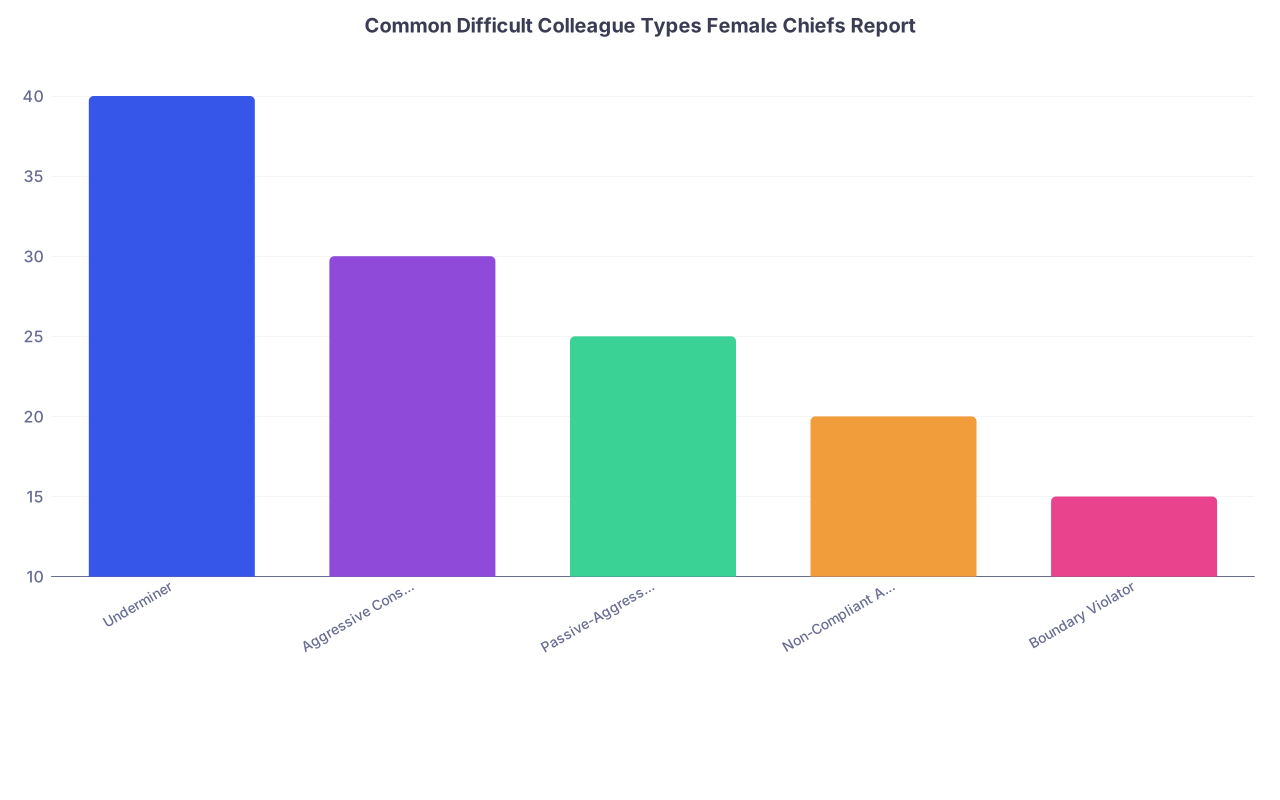
| Category | Value |
|---|---|
| Underminer | 40 |
| Aggressive Consultant | 30 |
| Passive-Aggressive Peer | 25 |
| Non-Compliant Attending | 20 |
| Boundary Violator | 15 |
Script Set 3: The Passive‑Aggressive Peer Chief
This is the co-chief or senior colleague who sighs, makes side comments, “forgets” to include you on important emails, or adopts the “I am just joking” snark.
You are not going to chase every eye-roll. You pick meaningful patterns and address them clearly.
3A. The side comment in a meeting
Scenario: You propose a change to the rotation schedule. He mutters, “Here we go again,” just loud enough.
Script in the room (short version):
“Tom, do you have a specific concern with the proposal you would like to share with the group?”
You just pulled the passive-aggressive into the sunlight. They either name the concern, or they back down. Either way, you interrupted the pattern without a long speech.
3B. The “forgetting to include you” pattern
Frame it as a systems issue that you are not letting slide.
Script (email or in person):
“I have noticed that on several recent emails about [X committee / Y initiative], I was not included, despite being co-chief on this service. For example, the emails on [date 1] and [date 2].
As co-chiefs, we need to be aligned and informed on service decisions. Going forward, my expectation is that I am included on all communications related to [relevant area].
Is there any process issue that is making that difficult, or can we agree this will happen?”
If they say, “It was just an oversight, you are overreacting”:
“I am not interested in assigning intent. I am interested in fixing the pattern. You have heard my expectation. I will assume we are aligned moving forward.”
You do not get pulled into defending your “feelings.” You stay on the observable pattern and your role.
Script Set 4: The Non‑Compliant Attending / Senior Who Ignores Protocol
This is where your leadership is really tested because power and risk are both high. Often older, sometimes male, sometimes “institutional legends” who think rules are for others.
Think: refuses to use the sepsis protocol, blows off duty hour limits for residents, or regularly starts cases without documenting consent properly.
You need a very clean structure:
- Anchor in patient safety / regulatory requirements
- Be specific about the behavior
- Tie it to risk (for patients, residents, institution, themselves)
- Define the required behavior and consequences
4A. Script for patient safety / protocol non-compliance
Scenario: Senior attending repeatedly refuses to follow the stroke code pathway, delaying imaging and tPA decisions.
Script:
“Dr. Nguyen, I want to discuss our stroke code process. On three recent cases—June 3, June 7, and June 15—the standardized stroke code pathway was not followed. Imaging and treatment decisions were delayed outside the expected time windows.
This deviation from protocol increases risk for patients and for the institution, and it places me, as chief, in a position where I am accountable for those outcomes.
Going forward, my expectation is that for all stroke codes:
- The stroke pathway is initiated immediately when criteria are met.
- Imaging and treatment decisions follow the established protocol, or deviations are clearly documented with clinical rationale.
Are you able to commit to that process?”
If they say, “I have been doing this for 25 years; your protocol is rigid”:
“I respect your experience. The protocols exist because of current evidence and regulatory expectations. As chief, I am responsible for ensuring they are followed. If there is evidence-based concern about the protocol, we can bring that to the stroke committee. Until then, adherence is not optional.”
If behavior continues:
- You document specific incidents
- You bring it formally to the department chair / quality committee
- Your language shifts from “expectation” to “requirement”
| Situation Severity | Response Level | Documentation Needed |
|---|---|---|
| Mild undermining | Real-time script + informal follow-up | Brief personal notes |
| Repeated disrespect | Formal meeting with script | Email summary to self/HR |
| Patient safety risk | Escalated script + leadership involvement | Incident report / formal memo |
| Harassment / slurs | Stop + document + institutional report | Detailed factual account |
Script Set 5: The Colleague Who Makes Sexist or Inappropriate Comments
You will hear this at some point. Sometimes overt (“Women are too emotional for this specialty”), sometimes disguised as a joke, sometimes aimed at you in front of trainees.
You are not overreacting by shutting it down. You are doing your job.
5A. In-the-moment shutdown in front of others
Scenario: At sign-out, someone says, “Well, the patient might listen to you. You know how old men love young female doctors.”
Script:
“That comment is inappropriate and not acceptable in this setting. Let’s keep the focus on the patient and clinical issues.”
Short. Clear. You do not laugh it off. You do not explain why it is sexist. You label it and redirect. Trainees hear everything.
If they say, “Relax, it was just a joke”:
“Jokes that sexualize colleagues are not acceptable on this service. We are done with this topic.”
Notice the phrase “on this service.” You are invoking your authority, not debating humor theory.
5B. Private follow-up when it is repeated or particularly bad
Script:
“I want to follow up on something from sign-out yesterday. Your comment about old men loving young female doctors was inappropriate and unprofessional.
Comments like that create a hostile environment, especially for female trainees, and undermine my authority as chief. There is no place for that language on our service.
I expect that going forward, you will not make sexualized or gender-based comments about colleagues, patients, or staff. Can you agree to that?”
If they try the “You are too sensitive / no one else complained” route:
“I am responsible for the climate of this service. I am telling you clearly that this behavior is not acceptable. Future incidents will be documented and addressed formally.”
You say “documented” once. Calmly. It lands.

Script Set 6: The Resident / Fellow Who Disrespects You Because You Are Female
This one stings more than it should, especially when you have logged more 2 a.m. consults than they have nights on call.
You treat it exactly like any other professionalism issue.
6A. Real-time in front of team
Scenario: Resident rolls eyes, counters you with “Well, Dr. Smith says we do it this way” in a sharp tone, clearly trying to side-step you.
Script:
“Right now, I am the attending responsible for this patient. We will proceed with the plan I outlined. If you would like to discuss the reasoning further, we can do that after rounds.”
Short. Clear hierarchy. You do not let it turn into a back-and-forth debate in front of the patient.
6B. Private feedback conversation
Script:
“I want to talk about how you spoke to me on rounds this morning when you said, ‘Well, Dr. Smith says we do it this way,’ in a dismissive tone and with eye-rolling.
That behavior is unprofessional and undermines my role as the attending in front of the team and patients. It also sets a poor example for the interns and students.
My expectation is that you:
- Raise clinical concerns in a respectful tone.
- Avoid eye-rolling, sighing, or side comments in front of patients and team members.
- If you disagree, you ask for clarification or bring it up after rounds.
Do you understand that expectation?”
If they say, “I did not mean it that way”:
“I am telling you how it came across and why it is a problem. I am asking you to change the behavior. I will be monitoring this going forward.”
Then you document briefly in your own file or feedback form. It is much easier to defend later if patterns repeat.

| Step | Description |
|---|---|
| Step 1 | Behavior Occurs |
| Step 2 | Real Time Script |
| Step 3 | Monitor |
| Step 4 | Formal Meeting |
| Step 5 | Document and Escalate |
| Step 6 | Chair/HR/Professionalism Office |
| Step 7 | Stops? |
| Step 8 | Improves? |
How to Say Hard Things Without Being Labeled “Difficult”
This is the quiet fear in the background: you do what a male chief would do, but you get tagged as “abrasive” or “hard to work with.”
You cannot control other people’s biases. You can control your tactics.
Three practical adjustments that protect you:
1. Use neutral, behavior-focused language
Instead of:
“You were rude to me.”
Use:
“When you interrupted me three times and raised your voice, that was unprofessional and interfered with clear communication.”
No adjectives about their personality. Just observable behaviors.
2. Keep your voice low and slow
Not soft. Slow.
Fast speech plus firm content gets tagged as “emotional.” Slow, even speech plus firm content gets tagged as “serious.”
Before a hard conversation, force yourself to breathe out completely. It drops your voice half an octave and slows your rate.
3. Bookend with role and purpose
You anchor in why you are speaking and on whose authority.
Start with:
“As chief of this service, I am responsible for [X]. I need to address a pattern I am seeing.”
End with:
“My goal here is a safe, respectful, and effective environment for patients and staff. What we discussed today is part of that.”
You are not doing this because of personal irritation. You are doing your job. Say that explicitly.

Short “Plug-and-Play” Phrases You Can Keep in Your Back Pocket
You will not remember long scripts in the moment, but you can remember some anchor phrases.
Use these as Lego blocks.
- “I am going to stop you there. That comment is not appropriate for this setting.”
- “Let me finish my thought, then I will listen to your perspective.”
- “For this service, my expectation is that we [state behavior].”
- “I am not questioning your intent. I am describing the impact.”
- “If this continues, I will need to document and address it formally.”
- “We can disagree about the plan; we cannot undermine each other in front of trainees.”
- “As chief, I am responsible for [patient safety / team climate / adherence to protocol]. That is why I am raising this.”
- “We are done with this topic. Let’s move on to [next item].”
You combine a few of those, add the specific behavior, and you have a conflict resolution script tailored to your situation.
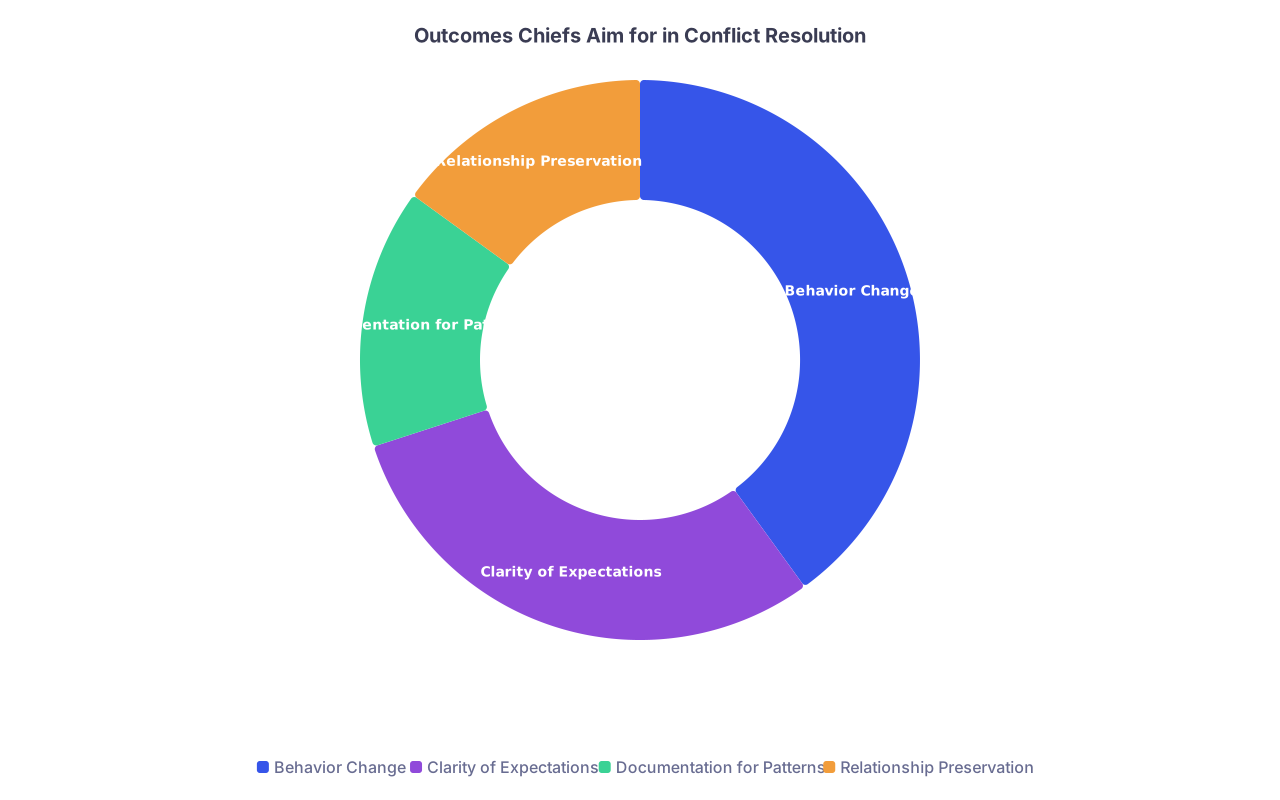
| Category | Value |
|---|---|
| Behavior Change | 40 |
| Clarity of Expectations | 30 |
| Documentation for Patterns | 15 |
| Relationship Preservation | 15 |

FAQs
1. How do I handle a difficult colleague who is also my close friend?
You do not get to outsource leadership because someone is your friend. Start with:
“As your friend and as chief, I need to talk about something that is affecting the team.”
Then follow the same structure: describe behavior, impact, expectation. The friendship gives you more context, not a free pass.
2. What if I am a new chief and the difficult colleague has been there 20 years?
You still have the role. Do your homework first: know the policies, protocols, and your chair’s backing. Then lead with role and responsibility:
“As the new chief, I am responsible for aligning our practice with [current protocols / departmental expectations].”
You respect their experience, but you do not surrender your authority.
3. How much should I document these conflicts?
More than you think, but briefly. For anything recurring or serious, jot:
- Date
- Specific behavior
- Your response / script used
- Any follow-up or outcome
Email to yourself or secure note. It is insurance if patterns escalate or you face pushback later.
4. How do I avoid sounding “robotic” when using scripts?
Practice them enough that you own the structure but not the exact words. You can shift phrasing to match how you naturally talk while keeping the core moves: frame → behavior → impact → expectation → consequence. The power is in that sequence, not perfect wording.
5. What if the difficult colleague outranks me (e.g., department chair, program director)?
You adjust the frame but not your right to address impact. You might say:
“I know you oversee this department, and I respect that. I also have a responsibility for [residents / patients / service climate], and I need to raise a concern about how [specific behavior] is affecting that.”
You may not “direct” them, but you can still name impact, set boundaries for your own participation, and, if needed, use institutional channels.
6. How do I know when to stop talking in a conflict conversation?
As soon as you have:
- Named the specific behavior
- Described the impact
- Stated your expectation
- Clarified potential consequences
Then you stop. Silence forces them to respond. Over-explaining is where chiefs—especially women—get talked in circles, emotional, or manipulated. Say what you came to say, and then be quiet.
Key points: You are allowed to be direct. You define the frame, the standard, and the consequence. And you do it in clean, specific language that focuses on behavior and impact, not personality or intent.