
Gender bias in the OR is not subtle, and pretending it is “just personality differences” is dishonest.
If you are a woman surgeon, you already know this. The scrub tech who double‑checks every one of your requests but jumps when your male co‑resident speaks. The anesthesiologist who discusses the plan with the male intern instead of you, the attending of record. The circulating nurse who calls you “sweetie” but calls your male colleague “Doctor.” This is not imagination. It is pattern.
What you actually need is not another abstract lecture on “implicit bias.” You need specific, practiced strategies that you can deploy mid‑case, mid‑fellowship, mid‑career—without compromising patient safety or burning every bridge in the room.
Let me break this down specifically.
The Reality of Gender Bias in the OR (And Why It Feels So Relentless)
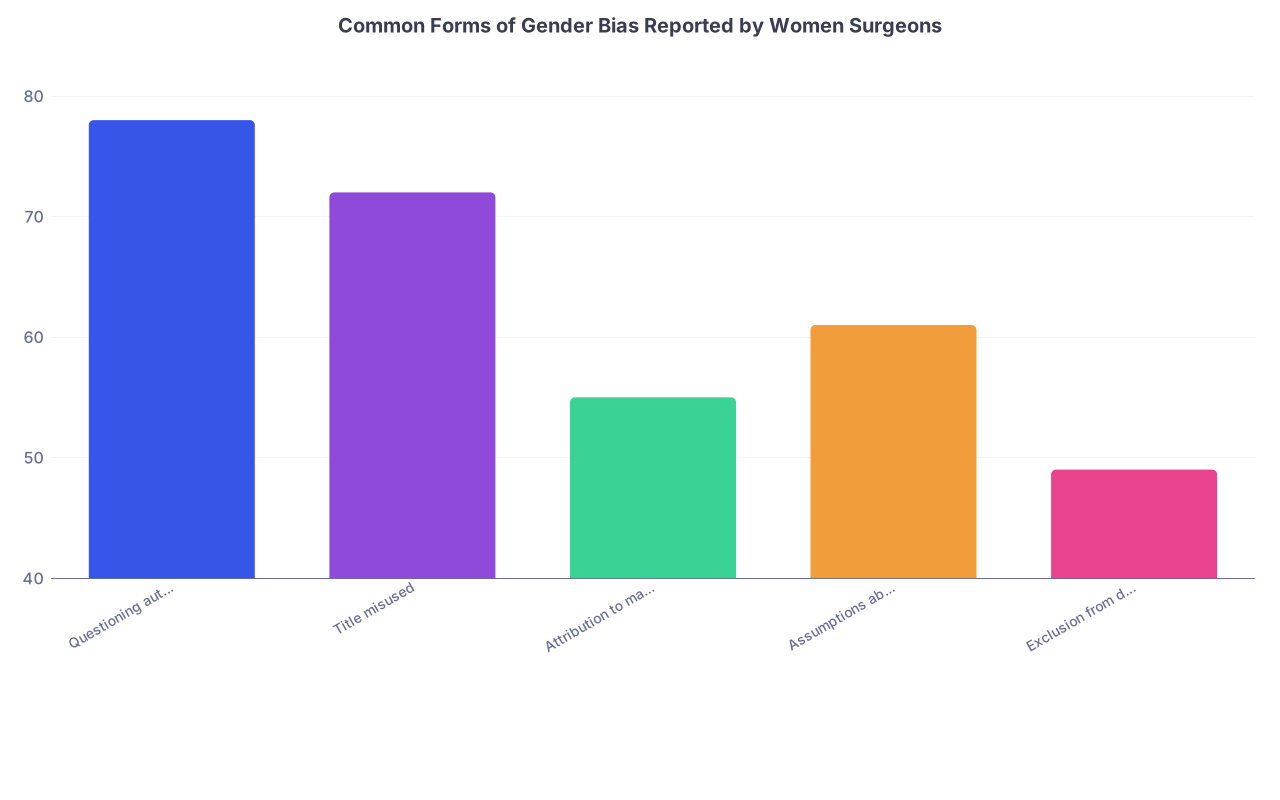
| Category | Value |
|---|---|
| Questioning authority | 78 |
| Title misused | 72 |
| Attribution to male colleague | 55 |
| Assumptions about pregnancy/family | 61 |
| Exclusion from decisions | 49 |
The OR is a high‑stakes, hierarchical, time‑pressured ecosystem. That combination magnifies bias.
Bias in the OR tends to cluster in a few predictable domains:
- Authority: Who is “in charge,” whose voice carries, whose orders are followed quickly.
- Competence: Who is assumed to be technically strong vs “still learning” regardless of PGY year.
- Role assumptions: Who is assumed to be the surgeon vs the nurse, rep, or student.
- Emotional framing: Who is called “difficult,” “emotional,” “cold,” when they behave exactly like male colleagues.
I have seen this play out across training levels:
- Female MS3 in surgery: Introduces herself as “the medical student with Dr. X,” gets handed the phone to “take family updates.” Her male classmate is escorted to scrub.
- Female PGY‑4: Leads a laparoscopic cholecystectomy. The scrub tech hands a clip applier directly to the male PGY‑2 observing at the field and then looks confused when she says “I will take that.”
- Female attending: The anesthesiologist discusses extubation plan with the male CA‑1 while she stands at the head of the bed, chart open, clearly the one responsible.
None of this is rare. It is systemic. And you are not going to fix the entire culture during a partial nephrectomy. What you can do is control:
- How you assert your role.
- How you correct inappropriate behavior in real time without derailing care.
- How you document and escalate when needed.
- How you protect your own psychological and ethical boundaries.
Core Principles: Your Anchor When the Room Gets Hostile
Before tactics, you need a framework. Otherwise you will try to improvise in the moment, and in the OR, that is when people either say nothing—or explode.
Principle 1: The patient’s safety and dignity come first
This is non‑negotiable. It also gives you ethical cover.
If someone undermines your authority in a way that risks confusion—conflicting instructions, ignoring your orders, back‑channeling through a male junior—you are absolutely justified in intervening firmly because ambiguity in the OR is a patient safety hazard.
You can literally say: “We need one clear chain of command for patient safety. I am the operating surgeon; please direct questions and updates to me.”
That is not “being difficult.” That is good practice.
Principle 2: You are not responsible for other people’s comfort with your authority
You are not there to reassure everyone that the woman running the case is “nice” and “not scary.” If people experience basic direction as “sharp,” that is their gender bias talking. Not your problem to fix.
Your responsibility is:
- Clarity.
- Consistency.
- Professionalism.
Not soothing fragile egos.
Principle 3: Not every battle belongs in the middle of the case
Some things must be addressed immediately: safety issues, overt disrespect that destabilizes the team.
Other things are better handled:
- After the case (debrief, closed‑door discussion).
- Through formal channels (program director, chair, OR leadership).
- Through pattern documentation (emails, incident reports).
You pick your timing. That is strategic, not avoidance.
Concrete Language: Scripts That Actually Work in the OR
Most people freeze because they do not know what to say without either sounding apologetic or starting a brawl. So let’s get very literal.
1. Misidentification and titles
Scenario: The circulating nurse calls you by your first name, but calls your male colleague “Doctor.”
Use firm, neutral correction the first time:
- “Please call me Dr. [Last Name] in the OR.”
- If it repeats: “I have asked to be called Dr. [Last Name] like my colleagues. I expect that consistently.”
If someone responds with “Oh, I call everyone by their first name,” and you know that is not true:
- “You are calling Dr. Smith ‘Doctor’ right now. I expect the same professional address.”
Short, factual, not a debate.
2. Authority being bypassed
Scenario: Anesthesiologist discusses blood pressure management with the male fellow, not you, the attending. Or the scrub tech repeatedly looks to your male junior for confirmation instead of you.
You cut through that. Directly.
- “To avoid confusion, I want all intraoperative questions directed to me as the operating surgeon.”
- “I am leading this case. Please confirm all changes with me first.”
If they argue—yes, it happens:
- “This is not optional. For patient safety, there needs to be one point of decision‑making. That is my role.”
You are not “asking.” You are stating the structure of the room.
3. Orders questioned or delayed only when they come from you
Common pattern: You request an instrument, medication, or change, and it is questioned or stalled. A male colleague says the exact same thing and it happens instantly.
In the moment:
- “You have questioned my last three orders. That is affecting efficiency and potentially safety. Please carry out the request now; if you have concerns, we can discuss them after the case.”
If the scrub tech or nurse claims concern about safety:
- “If you believe the request is unsafe, say so explicitly so we can clarify. Otherwise, I need you to proceed.”
For chronic patterns, you document and escalate afterward.
4. Sexist comments, nicknames, and “jokes”
You are not there to entertain misogyny disguised as humor. You do not have to laugh along to “keep the peace.”
You can shut it down with very little drama:
- “That comment is not appropriate for the OR.”
- “We are not doing jokes like that while we are caring for a patient.”
- “Referring to me as ‘sweetheart’ is disrespectful in a professional setting. Use my name or my title.”
If someone doubles down—“Oh, can nobody take a joke anymore?”:
- “This is not about jokes. This is a professional environment. Let’s keep it that way.”
You are drawing a boundary, not negotiating.
Running the Room: Strategic Leadership Behaviors That Blunt Bias
Bias thrives in ambiguity. You reduce ambiguity by being extremely deliberate in how you run your room.
Pre‑op: Establishing authority before you cut
You should not just drift into the OR and hope people figure out who is in charge. You own it.
Before wheels are in:
- Introduce yourself clearly: “Good morning, I am Dr. [Last Name], I will be the operating surgeon.”
- To anesthesia: “Let’s quickly review the plan—induction, positioning, lines, analgesia, extubation criteria.”
- To the team: “I will lead the time‑out and call all critical steps. If anyone sees something concerning, say it out loud—patient safety first.”
You are framing the culture for that case. That reduces the space for people to sidestep you without revealing their bias.
Intra‑op: Voice, body position, and micro‑behaviors
The non‑verbal piece matters more than people like to admit.
- Where you stand: At the head of the field, where the main screens are, not tucked behind the med student.
- How you speak: Calm, measured, audible. You do not need to shout. You do need to be clearly heard.
- How you give instructions: Direct, specific, and time‑framed. “Nurse, please call for an extra suction now,” not “Could we maybe get another suction in here at some point?”
People unconsciously associate authority with physical presence + decisiveness. You leverage that. You do not shrink to avoid being called “bossy.”
Post‑op: Debriefing as a leadership tool
After the case, two targets:
- The team: “Anything we could improve next time?” You listen, incorporate, build credibility.
- The individual who crossed a line: Short, private, specific.
Example, with a scrub tech who kept looking to your male junior:
- “During that case, you repeatedly checked with Dr. Lee after I gave instructions. I am the attending; that behavior is not acceptable. In future cases, I expect you to direct questions and confirm orders with me. If something is unclear, ask me directly.”
You are labeling the behavior, not attacking their character.
When You Are Still in Training: Power Asymmetry and Survival
Residents and fellows are in the most vulnerable position: least power, highest exposure, most evaluated.
So you have to be more tactical. But you still have options.

Your basic toolkit as a trainee
- Strategic attending allies
You need at least one attending who:
- Believes you.
- Has observed you in the OR.
- Is willing to intervene or advise on how to escalate.
You do not complain to everyone. You choose the ones with actual institutional leverage.
- Concrete, not vague, reports
When you speak to a program director or mentor, you do not say “The OR feels sexist.” You say:
- “On three separate cases with Dr. X, the scrub tech has refused to follow my direct instrument requests until the male intern repeats them.”
- “The circulating nurse calls me by my first name repeatedly despite my corrections, but calls male residents ‘Doctor’.”
Patterns with dates and witnesses get traction. Vibes do not.
- Safety vs politics
If something undermines patient safety, you address it in real time, regardless of hierarchy.
- “This confusion over who is directing the case is unsafe. I need to clarify the chain of command now.”
For non‑safety disrespect where retaliation risk is high, you may choose delayed escalation: mentor, PD, anonymous report, etc. That is not weakness. That is survival.
When the attending is the problem
Different category. Higher stakes.
Patterns you might see:
- Public belittling: “She is too emotional to be a good surgeon,” said in front of staff.
- Talent minimized: Rare praise, skills attributed to “luck.”
- Gendered assumptions: “You will probably cut back when you have kids; why are you going into trauma?”
You have a few lines of defense:
Real‑time micro‑pushback (if safe)
- “Comments about my future family plans are not relevant to my evaluation as a resident.”
- “If you have feedback on my performance, I am happy to hear it privately and specifically.”
Documentation
Keep a simple log: date, time, location, exact words, witnesses. You are building a record in case you later need to go to the PD or HR.Third‑party elevation
Sometimes it is more effective to have a mentor or chief resident report a pattern than to do it yourself, especially in malignant programs. Use that channel if available.
Escalation: When and How to Go Formal
Not everything requires a committee. Some things absolutely do.
| Situation Type | Recommended First Step |
|---|---|
| Single minor slight (title misuse) | Direct, in-the-moment correction |
| Repeated undermining by staff | Post-op discussion + email summary |
| Pattern across multiple ORs/teams | Meeting with OR director or chief of service |
| Harassment or discriminatory comments | Report to PD, HR, or institutional office |
| Safety-compromising insubordination | Incident report + direct notification to leadership |
Informal but documented: The “quiet paper trail”
For recurrent issues with a specific person:
Speak with them privately after the case.
Then send a short, factual follow‑up email:
“As discussed after today’s case in OR 4, there was confusion when my instrument requests were repeatedly checked with Dr. Lee rather than with me. For future cases, I will expect direct communication and confirmation of my orders as the attending surgeon. Please let me know if any part of that is unclear.”
You have now:
- Tried to resolve at the lowest level.
- Created contemporaneous documentation.
- Shown professionalism.
If it escalates, you forward this chain to leadership.
Formal: Incident reports, HR, program leadership
You use formal channels when there is:
- Clear discriminatory language (“Women should not do trauma; you are too weak”).
- Retaliation for asserting your role (“After I corrected him, he refused to assist my cases”).
- Safety issues tied to bias (ignoring your orders because you are a woman).
You do not have to decide alone. You can:
- Ask a trusted attending, “At what point would you file an incident report in this situation?”
- Use anonymous reporting systems if retaliation risk is real.
And yes, there is always some risk. That is the reality. You balance that against your own line: what you are not willing to tolerate.
Ethical Self‑Protection: Avoiding the Slow Burn of Internalized Bias
The danger is not just that people treat you differently. It is that you start to believe the story.
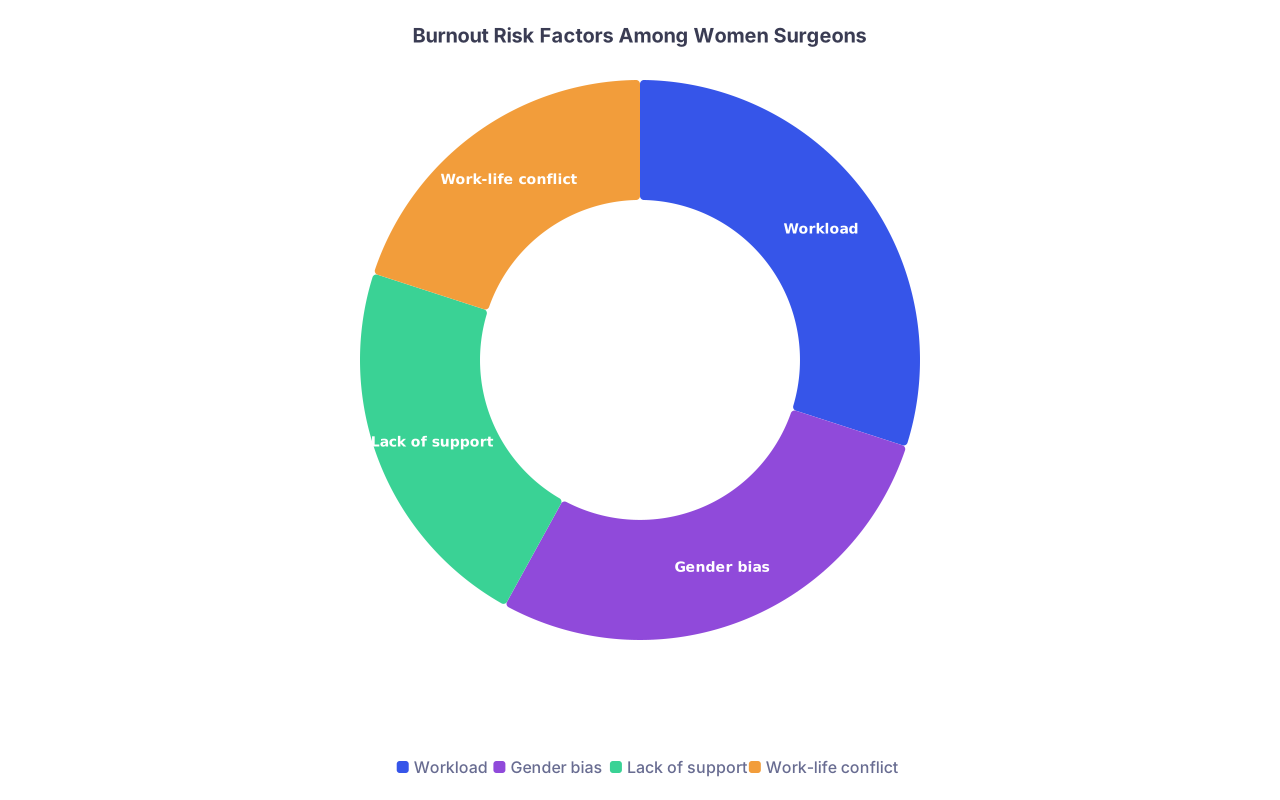
| Category | Value |
|---|---|
| Workload | 30 |
| Gender bias | 28 |
| Lack of support | 22 |
| Work-life conflict | 20 |
Over years, even small slights accumulate:
- You start over‑preparing everything because you expect to be questioned.
- You downplay your achievements to avoid being called “arrogant.”
- You accept unequal treatment as “just the way it is here.”
That is corrosive. So you have to be aggressive about guarding your own internal story.
Three non‑negotiables for your own sanity
- Counter‑narratives
You collect evidence against the bias:
- Cases you ran efficiently.
- Compliments from patients.
- Times when your judgment prevented a complication.
Write them down if you have to. This is not vanity. It is antidote.
You need other women surgeons. Not optional.
- Local: women faculty, fellows, residents.
- National: AWS, SAGES, ACOG, subspecialty women’s groups.
You need people who say, “Yes, that is bias” instead of “Are you sure you are not overreacting?” That validation is protective.
- Personal red lines
Know in advance what you will not normalize:
- Direct sexual comments in the OR.
- Open hostility after boundary‑setting.
- Being consistently diverted away from complex cases “for your own good.”
When those lines are crossed, your internal script is not “Maybe I should try harder to fit in.” It is “This is now an institutional problem, not a personal adjustment problem.”
Advanced Tactics: Turning Bias into Structural Change
Once you are an established attending—or an influential chief resident—you can do more than survive. You can fix some of the plumbing.

Normalizing clear OR roles and expectations
You push for:
- Standardized pre‑op briefings where the attending surgeon explicitly states roles.
- Time‑outs that include: “Operating surgeon is Dr. [Name]; questions should be directed to her.”
- OR policies stating that all physicians are addressed by title unless they request otherwise.
This reduces the “but I did not know” excuse.
Training and feedback for staff that has teeth
Lip‑service diversity workshops change nothing without consequences.
You work with OR leadership to:
- Include “respectful communication” and “adherence to chain of command” in staff evaluations.
- Create a clear process for surgeons to report recurrent undermining or disrespect, with feedback going into performance reviews.
- Ensure new hires get explicit training on titles, roles, and appropriate address.
Bias becomes not just “unfortunate,” but professionally risky.
Role‑modeling and sponsorship
You become the attending who:
- Introduces your female resident as “the surgeon on this case” when appropriate.
- Corrects others who misidentify: “No, she is the senior resident; direct your questions to her.”
- Backs your trainees when they assert boundaries respectfully.
One sentence from you in the OR—“Dr. Patel is leading this case; defer to her”—can undercut years of biased habit for that team.
Practical Scenarios and How to Handle Them
Let’s walk through a few very common ones and what I would actually say or do.

| Step | Description |
|---|---|
| Step 1 | Bias event occurs |
| Step 2 | Address immediately in OR |
| Step 3 | Clear, firm statement |
| Step 4 | Document after case |
| Step 5 | Note details, seek mentor |
| Step 6 | Private conversation post-op |
| Step 7 | Email summary if recurrent |
| Step 8 | Decide on formal report |
| Step 9 | Safety risk? |
| Step 10 | Power imbalance high? |
Scenario 1: The “Are you sure, doctor?” scrub tech
You: “Knife, please.”
Scrub tech: “Are you sure you want to start with that? Dr. Miller usually uses the [X].”
Response, calm but clear:
- “Yes, I am sure. Knife, please.”
- If repeated later: “I appreciate your experience with different surgeons. During my cases, I expect instruments provided as requested. We can discuss preferences before the next case.”
If this keeps happening: Quiet email to OR manager describing pattern + request for reinforcement of surgeon preference respect.
Scenario 2: Anesthesia ignores you, responds to male junior
You: “Let us keep systolic above 100 for this portion.”
Anesthesia (to male resident): “We will see, I will tell you what I am doing.”
You, directly:
- “Please address hemodynamic management to me. I am the attending surgeon. Let us agree on targets now.”
If they say, “I am just talking to the resident”:
- “You can certainly teach the resident, but decisions need to be aligned between you and me. That means talking to me about the plan.”
If pattern persists, that is a candidate for a serious conversation with anesthesia leadership.
Scenario 3: “You are too aggressive when you speak up”
Feedback from a male colleague: “People find you intimidating in the OR.”
You: “Give me a specific example.”
They usually cannot. Or they mention you giving direct instructions the same way your male peers do.
You push:
- “If the concern is my tone, I am open to specific feedback, but I am not going to soften necessary directions at the expense of clarity. Are there any concrete behaviors you recommend I change that would not undermine my authority as the surgeon?”
You force them to admit whether this is style or bias. Often, the conversation ends with vague “well, just be aware” because there is nothing real to change. You can ignore that.
You Are Not the Problem. But You Do Have Power.
I am not going to pretend this is easy. It is not. Some institutions are five years behind; some are fifty. You will meet techs who have “always done it this way.” You will deal with attendings who still believe women should not do trauma call.
But here is the truth: You are not a guest in the OR. You are not an exception who needs to be especially charming so they let you stay. You are the surgeon.
Use that. Explicitly.

FAQ: Handling Gender Bias in the OR
1. How do I know if it is “real” bias or if I am just being sensitive?
Pattern and asymmetry. If behaviors consistently change depending on whether the surgeon is male or female—same PGY level, same case complexity—that is bias. When your male colleague gives the same instruction and gets immediate compliance that you did not, you are not “sensitive.” You are observant.
2. What if speaking up will hurt my evaluations or career?
There is always some risk in confronting power. That is why you choose your timing and method strategically: real‑time for safety issues, private conversation or mentor involvement for others, documented escalation for patterns. Also remember: programs and departments increasingly know that ignoring gender bias is a liability. You are not asking for a favor; you are flagging a risk.
3. How do I handle a sexist patient in the OR or pre‑op?
Pre‑op, you can say, “I am Dr. [Last Name], the surgeon performing your operation. If you prefer a different surgeon, we can arrange that, but I will not tolerate disrespectful language.” Intra‑op, the patient is anesthetized; your focus is safety. Address family comments later or through patient relations if they are egregious. You do not have to accept being called “nurse” repeatedly after you have introduced yourself as the surgeon.
4. Is it better to “prove them wrong” by outperforming or to confront bias directly?
False choice. You will already be working harder; that is the reality. You still need to confront patterns that undermine safety or your authority. Outperforming alone does not fix an OR culture that discounts your voice. Use both: excellence plus boundaries.
5. What if I am so exhausted by this that I am considering leaving surgery?
That is not weakness; that is a rational response to chronic hostility. Before you walk away, distinguish between surgery as a field and your current environment. A malignant program or department is not the whole specialty. Talk to women surgeons at other institutions. Many have moved and found dramatically better cultures. Your skill set is rare and valuable. Do not let a badly run OR convince you otherwise.
Key takeaways:
- You are ethically justified—and professionally obligated—to assert clear authority in the OR; bias that undermines that is a safety issue, not just a feelings issue.
- Short, direct scripts and consistent leadership behaviors blunt bias in real time and build your credibility over years.
- You are not responsible for fixing the entire culture, but you are responsible for protecting your own boundaries, documenting patterns, and using allies and structures when the line is crossed.