
The culture of “just be nice and de‑escalate” is exactly how women in outpatient medicine get hurt.
You are not a hostage negotiator. You are a physician. Your job is to care for patients, not to absorb harassment, threats, or violence as part of the service industry.
Let me break this down specifically: managing high‑risk encounters as a woman in outpatient settings is about three overlapping domains—clinical judgment, personal safety, and ethical clarity. If you ignore any one of those, you will feel trapped and unsafe. If you build all three deliberately, you will feel prepared instead of helpless.
1. What “High-Risk” Actually Looks Like in Clinic
People imagine dramatic scenarios: a patient waving a weapon, screaming threats. Those happen, but the real risk in outpatient clinics is usually more insidious and cumulative.
High‑risk encounters tend to fall into a few patterns I see over and over:
Escalating anger or agitation around boundaries
- Demands for early refills, controlled substances, work notes, disability forms.
- “If you don’t give me this, I’ll complain to admin / call my lawyer / write you up.”
- Volume slowly increasing, leaning forward, invading space.
Sexually inappropriate behavior, sometimes framed as “jokes”
- Comments on your body, clothes, age, marital status.
- Attempts at physical contact (hugging, touching shoulder, blocking door “playfully”).
- “You’re too pretty to be my doctor, I can’t concentrate” said with a smirk.
Paranoid, psychotic, or disorganized behavior with potential for unpredictability
- Fixed delusions involving staff or you personally.
- Accusations of conspiracies, poisons, cameras in the room.
- Rapid shifts from friendly to hostile.
Patients with known violence histories or criminal justice involvement
- Documented assaults in the EMR.
- Legal/housing reports referencing domestic violence, weapons, threats.
- Probation/parole status, restraining orders.
Domestic violence or stalking dynamics spilling into clinic
- Abusive partner shows up uninvited.
- Partner insists on staying in the room, answering for the patient, controlling phone.
- Repeated “coincident” visits of a non‑patient who hangs around your workspace.
Suicidal or homicidal ideation with poor impulse control or access to means
- Explicit threats directed toward specific people.
- “Nothing to lose” narratives from someone with substance use and impulsivity.
What makes these uniquely risky for women:
- You are more likely to be targeted with sexualized comments, touching, and boundary testing.
- Staff and colleagues sometimes downplay your concerns as “you’re overreacting” or “he’s harmless, he’s like that with everyone.”
- There is pressure to be “pleasant,” “non‑confrontational,” and “patient‑satisfaction oriented,” even when you are being harassed.
That combination is dangerous. So you need a structure that does not depend on everyone else taking you seriously.
2. Safety is Not Optional: Building Your Personal Safety Framework
Your first ethical duty is not customer service. It is safety—yours, your staff’s, and your patients’.
Clinic Layout and Physical Positioning
If you do nothing else, fix these:
You sit closest to the door. Always.
If your exam rooms are set up the opposite way, ask facilities to flip the furniture. If they say no, you sit on the side closest to exit anyway. Non‑negotiable.Know where the panic button or emergency line is.
Not abstractly. Literally put your hand there, once a week, and rehearse mentally: “If he stands up and blocks the door, I press this and step into the hallway.”Maintain clear sight lines.
Do not let a patient stand between you and the door. Do not stand with your back to a closed door with an agitated patient in front of you.Avoid being physically cornered.
If a patient stands up and moves closer, you stand as well and subtly shift so your exit path is unobstructed. You do not need permission to stand up.
Environmental and Procedural Safeguards
You want to build “default” mechanisms so your safety does not depend on you having a perfect day.
Flag high‑risk charts.
Your EMR should clearly indicate: history of violence, previous threats, prior code gray, weapons, sexual harassment of staff. If your system has no way to do this, that is a systems problem, and you should say so explicitly in writing.Set rooming rules for flagged patients.
- Front desk alerts clinical staff when the patient arrives.
- MA or nurse rooms the patient in the room closest to staff work area or exit.
- You do not see high‑risk patients alone if history is serious. Another staff member at least starts the visit with you, or sits just inside an open door.
Schedule strategically.
Put patients with known behavioral risk early in the session when staff is fully present, not at lunch, not at the very end of the day when you are alone in clinic.Use a discrete code phrase with staff.
Something pre‑agreed like:
“Can you bring me the blue folder for this patient?” = “Walk in and stay in the room.”
“Can you check on that fax for Dr. X?” = “Call security now.”
This is not paranoia. It is basic occupational safety.
3. Recognizing Escalation Early – And Moving First
Violence risk rarely appears out of nowhere. The problem is that many women are socialized to ignore early signs because they feel “rude” responding to them.
Watch for:
- Changes in voice: louder, faster, or suddenly very quiet.
- Body posture: leaning in, pacing, clenching fists or jaw, hovering near the door.
- Content: repeated demands, “you people,” “nobody listens,” personalized insults.
- Boundary testing: ignoring your requests to sit, touching objects on your desk, moving physically closer despite your cues.
When you see two or more of those, you do not “wait and see.” You adjust the plan.
Concrete Language You Can Use
If the volume or intensity is rising:
- “I want to help you, but I cannot do that while you are yelling. I need you to lower your voice so we can talk.”
- “We will stop this visit if you continue speaking to me like this.”
If they move closer or enter your space:
- “I need you to sit back down in the chair so we can continue.”
- “Please give me some space and stay over by the exam table.”
If they are making personal or sexual comments:
- “Comments about my body or appearance are not acceptable. We are here to talk about your health.”
- “If the comments continue, I will end this visit.”
If they refuse or escalate further, you do not argue. You act:
- Stand up.
- Open the door.
- Step into the hall and ask for staff / security.
- End the visit if needed: “This visit is over today. We will reschedule with specific expectations for behavior.”
You are not being “dramatic.” You are interrupting an escalation curve, which is exactly what you are ethically allowed—and expected—to do.
4. Ending a Visit and Terminating a Patient Safely and Ethically
Ending the visit and terminating the patient are different actions. You need clarity on both.
Ending a Single Visit
You can and should end a visit when:
- The patient becomes verbally abusive or threatening.
- You feel unsafe for any reason.
- The interaction is clearly non‑therapeutic and escalating.
Ethical approach:
- State the boundary breach clearly.
- Link it to your decision.
- Offer a safe path forward if possible.
Example:
“Mr. Smith, you are raising your voice and calling me names. That is not acceptable. I am going to end this visit now. You may schedule another appointment if you are able to speak respectfully in the future.”
If there is acute clinical risk (SI/HI, medical emergency), you pivot to emergency care:
“Your behavior is concerning and I am also concerned for your safety. I am calling the crisis team / EMS to help evaluate you now.”
Terminating a Patient from Your Panel
Termination is a bigger step and has legal and ethical obligations. But it is absolutely appropriate in certain situations:
- Threats of violence or documented menacing behavior.
- Sexual harassment after a clear warning.
- Repeated abusive behavior toward staff despite boundaries.
- Brandishing weapons or weapons found in the clinical area.
You are not “abandoning” a patient when:
- You provide written notice with reasonable time to find alternative care (often 30 days, but check state law and institutional policy).
- You offer emergency care during that period.
- You provide necessary records and information for transfer.
Do not make this personal. Keep it short and factual. Something like:
“Your behavior at recent visits, including yelling, using abusive language, and refusing to follow clinic rules, makes it impossible to maintain a therapeutic relationship. This letter serves as notice that our clinic will no longer be able to provide ongoing care after [date]. We will continue to provide urgent care for the next 30 days. Please contact [resource] to establish care with another provider.”
And document. Every single incident. Names of witnesses. Exact phrases. Actions taken.
| Behavior Type | Typical Threshold for Termination |
|---|---|
| Physical threat | Single serious incident |
| Weapon in clinic | Single confirmed incident |
| Sexual harassment | Repeated after one clear warning |
| Abusive language | Repeated, documented over multiple visits |
| Stalking behavior | Single serious incident with safety concerns |
5. The Gendered Layer: Harassment, Bias, and “Being Nice”
Here is the part most policies pretend does not exist: the way this plays out for women is different.
Common Gendered Scenarios
You have heard or experienced some version of these:
- The patient who only addresses the male medical student as “Doctor,” and calls you “sweetheart,” then gets angry when you correct him.
- The “joking” comments about your marital status, fertility, or appearance: “So when are you having kids?” “No way you are old enough, what are you, 22?”
- The patient who insists on hugging you every visit, even when you lean away, and tells staff “She’s my favorite little doctor.”
These are not harmless. They are early tests of whether you will enforce a boundary.
Ethically, professional boundaries are not optional. The AMA Code of Medical Ethics supports maintaining boundaries and prohibiting sexualized interactions. Your institution likely has explicit policies about harassment by patients. Use those policies, do not try to out‑nice the behavior.
How to Respond Without Undermining Yourself
You need set phrases that are calm, firm, and repeatable:
- Name the behavior.
- State the boundary.
- Redirect to the clinical agenda.
Examples:
“I prefer to be called Dr. [LastName], not sweetheart. Let us focus on your blood pressure today.”
“Comments about my body are not appropriate. This is a professional visit.”
“I do not hug my patients. A handshake is fine if you would like that.”
You will get pushback. Eye rolling. “Can’t you take a joke?” Accusations that you are “too sensitive” or “on a power trip.”
Your answer:
“This is not about a joke. It is about maintaining a professional environment so I can provide you with good medical care.”
If they keep going, you escalate exactly as you would for any boundary violation.
The Staff and Colleague Problem
Here is the harder part: sometimes other staff minimize your concerns.
- “He is just lonely.”
- “He’s old school, talks like that to everyone.”
- “We do not want to lose this patient, he has been here for years.”
You cannot control whether others want to be liked more than they want to be safe. But you can control your own behavior and your documentation.
- Be factual: “On 1/8/26, patient stated X, Y, Z. I asked him to stop. He continued.”
- Ask explicitly: “What is our clinic policy on patient harassment of staff?”
- Put it in email if verbal conversations go nowhere: “Following up on our discussion about patient X…”
You are doing two things: protecting yourself, and forcing the system to reckon with its own inconsistency.
6. Clinical and Ethical Complexity: Risk, Reporting, and Confidentiality
High‑risk encounters are not just “difficult people.” They often have mental illness, trauma, substance use, or serious social instability. You are still a physician with ethical duties beyond your own discomfort.
That does not mean you become a martyr. It means you use a structured approach.
Suicide, Homicide, and Duty to Protect
When a patient expresses suicidal or homicidal ideation, you are juggling:
- Immediate safety.
- Legal obligations (duty to warn / protect, depending on jurisdiction).
- Confidentiality.
A few principles:
- If a patient makes a specific and credible threat against an identifiable person, you escalate. This may mean calling the police, crisis services, or notifying the potential victim depending on local law and institutional policy.
- Document your risk assessment clearly: ideation, intent, plan, means, protective factors, your rationale for next steps.
- Err on the side of over‑documenting your thought process rather than under‑reacting to avoid “making a scene.”
You are not choosing between ethics and safety. Protecting plausible targets, including yourself and your staff, is part of your duty.
Substance Use, Diversion, and Controlled Substances
This is a classic outpatient battleground. Especially for women physicians, who often face more pushback when they say no.
Ethical, safe approach:
- Use a standardized controlled substance policy: treatment agreements, PDMP checks, urine drug screens, refill rules, one prescriber, one pharmacy.
- Make the policy “clinic‑based,” not “you‑based.” “Our clinic policy is X” invites less personal attack than “I will not do X.”
- If a patient responds with threats when you follow policy, that is clinically meaningful. It also justifies terminating the prescribing relationship and potentially the patient–physician relationship.
Be explicit:
“I cannot safely prescribe this medication today because [PDMP findings / missed appointments / inconsistent UDS]. I know this is frustrating. I am willing to discuss other options for pain management. I am not willing to prescribe something that I believe is unsafe or against clinic policy.”
If they escalate, you end the visit as above.
7. Training Yourself: Skills You Actually Need (that no one taught you)
Most medical training is absurdly naive about real-world outpatient risk. You learned a bit about codes, restraints, maybe inpatient psychiatry. But not how to get out of a tiny exam room with a 120‑kg angry man between you and the door.
You need to build three muscles: situational awareness, verbal de‑escalation, and post‑incident response.
Situational Awareness
Think of this as “clinical judgment for the room.”
- Before entering, scan the chart for behavioral flags.
- As you walk in, scan the person: smell of alcohol, psychomotor agitation, weapons (visible knives, heavy objects in hand, large bags).
- As you sit, mentally identify your exit route and panic button.
This takes 3 seconds, not 3 minutes. You make it a habit.
Verbal De-escalation – The Script-Level Skills
You do not need to become a hostage negotiator. You need a few reliable tools:
- Calm, lower voice. Slower speech.
- Use the patient’s name occasionally.
- Acknowledge emotion without conceding to demands:
“I hear that you are extremely frustrated about the medication change.” - Set clear, simple limits:
“We can talk about options as long as the conversation stays respectful.”
What you avoid:
- Debating the past. “But last time you said…” is gasoline.
- Threatening back. “If you talk to me like that again…” rarely helps unless you are actually about to end the visit.
- Over‑explaining. When someone is agitated, a 5‑minute pharmacology lecture will not calm them.
Post-Incident Response: Debrief and Documentation
After a high‑risk encounter, your brain will try to minimize it: “It was not that bad, I do not want to make trouble.”
Make a rule for yourself: if your heart rate spiked and you thought “this could go badly,” you document and debrief. Every time.
- Write a focused note: specific behaviors, statements, your interventions, outcome.
- Notify your supervisor or medical director, even if informally.
- Ask for a debrief with staff: “What did you notice? How did it feel at the front desk? Do we need a flag on this chart?”
This is not drama. It is risk management.
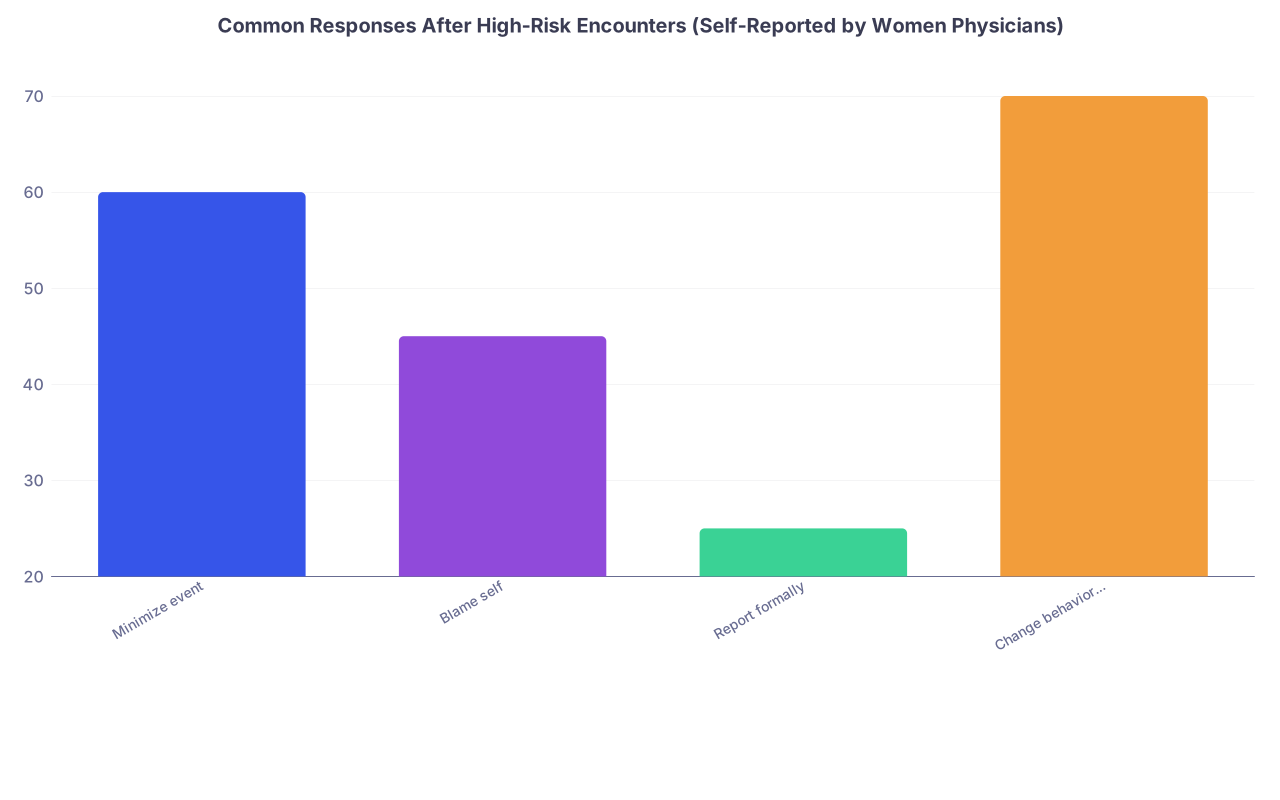
| Category | Value |
|---|---|
| Minimize event | 60 |
| Blame self | 45 |
| Report formally | 25 |
| Change behavior next time | 70 |
Most women I work with initially sit in the “minimize” and “self‑blame” columns. The goal is to move more into “report” and “change behavior.”
8. Systems-Level Protection: Shifting from Individual Heroics to Policy
You should not be solving this alone, clinic by clinic, shift by shift. Outpatient safety is a systems issue.
Here is what a minimally competent system has:
A clear, written policy for:
- Patient harassment and violence.
- When to call security or law enforcement.
- Criteria and process for terminating patients.
A real reporting pathway:
- Incident reporting that is easy to access and not buried.
- Explicit statement that reports will not affect your evaluation or promotion.
- Feedback loop: someone reviews and responds.
Physical infrastructure:
- Panic buttons or emergency lines in each room.
- Doors that open outward, not inward, where feasible.
- Escape routes not blocked by storage or equipment.
Training:
- Annual or semi‑annual de‑escalation and safety training that is not just a slide deck.
- Scenario‑based practice specific to outpatient rooms.
- Inclusion of gender‑based harassment scenarios explicitly.
If you are in a setting that lacks most of this, you are not imagining the risk. You are carrying a system failure on your shoulders.
You cannot fix all of it alone, but you can:
- Bring concrete proposals, not abstract complaints.
- Collect anonymized examples from colleagues.
- Link safety to liability. Risk managers listen when they hear “documented threat history” and “lack of panic buttons.”

| Step | Description |
|---|---|
| Step 1 | Notice escalation |
| Step 2 | Set clear boundary |
| Step 3 | Continue visit with caution |
| Step 4 | End visit and exit room |
| Step 5 | Notify staff and security |
| Step 6 | Document incident |
| Step 7 | Start termination process |
| Step 8 | Flag chart and plan next visit |
| Step 9 | Feeling unsafe? |
| Step 10 | Behavior improves? |
| Step 11 | Meets termination criteria? |
This is roughly what should be living in your head as a mental flowchart whenever you feel things turning.
9. Taking Care of Yourself Without Normalizing Abuse
There is a subtle trap here. If you work in a high‑risk outpatient environment long enough, you normalize too much.
“I only got cursed at twice today.”
“At least he did not throw anything.”
“He ‘just’ made a gross comment. Could have been worse.”
That mindset keeps you functioning day to day, but it quietly erodes your sense of what is actually acceptable.
You need two parallel moves:
Normalize your emotional response.
Being shaken, angry, or tearful after a threatening encounter is not weakness. It is a normal human stress response. Giving yourself 10 minutes to breathe, debrief with a colleague, or take a short walk is not indulgent. It is basic psychological hygiene.Refuse to normalize the behavior.
Saying “this is not part of the job” does not mean you cannot handle it. It means you are not willing to collude with a culture that hides abuse behind “patient satisfaction.”
If you find yourself dreading specific patients, altering your own behavior in unsafe ways (not setting boundaries, not documenting threats, seeing someone alone because you do not want to “make a fuss”), that is a sign your internal bar has been worn down. Reset it deliberately.
Three points to keep front and center:
Your safety is not negotiable. You are allowed to end a visit, call for help, and terminate a patient when behavior is threatening or abusive—regardless of gendered expectations to be “nice.”
Clear, practiced structures beat improvisation. Room layout, code phrases, scripted boundary statements, and a defined escalation pathway are what keep you from freezing when an encounter turns.
Saying “no” is ethical medicine. Refusing unsafe prescribing, sexualized behavior, or escalating aggression is not abandonment; it is part of your professional duty to yourself, your staff, and your other patients.