
Microaggressions in rounds do not “hurt feelings.” They quietly shape who gets heard, who gets credit, and who advances. That is why you cannot afford to ignore them.
You already know the word “microaggression.” What you probably do not have is a clear mental library of what they look like minute‑to‑minute on rounds, and realistic ways to respond that do not blow up your working relationships or your evaluations. That is the gap I am going to close.
This is about women in medicine specifically. The tone, patterns, and power dynamics are different from generic “DEI” examples. What you see on surgical rounds at 5:30 a.m. is not what HR puts in the PowerPoint.
Let me break this down precisely.
1. What Microaggressions on Rounds Actually Look Like
Forget the abstract definitions for a moment. On rounds, microaggressions are:
- Brief, patterned slights, comments, or behaviors
- Directed at you because of gender (and often intersecting with race, age, pregnancy, or ethnicity)
- Small enough that each one is “defensible,” but cumulative enough that they change the climate
They often hide inside “normal workflow”: how questions are directed, who is introduced as what, who is allowed to finish a sentence, who touches the computer.
Here is the key frame: microaggressions on rounds rarely look like someone yelling “Women don’t belong in surgery.” They look like someone handing the ultrasound probe to the male student standing behind you.
Core patterns you will see
- Assumptive hierarchy
- Role misidentification
- Competence discounting
- Appearance and demeanor policing
- Family, fertility, and commitment assumptions
- Physical space and body language dominance
We will walk through each, with concrete examples and response options.
2. Assumptive Hierarchy: Who Gets Treated as the “Real Doctor”
This is the most ubiquitous pattern. Same content, different variants depending on specialty and seniority.
Example 1: Questions bypass you to a male colleague
You are a PGY-2 in internal medicine. You have written all the notes and know every lab on the service. On rounds, the attending looks over your shoulder and says to the male intern:
“So, what do you want to do about his AFib?”
You stand there holding the list.
What is going on: The attending, consciously or not, is pattern‑matching “decision maker” with “male voice”. You become the “detail person,” he becomes the “thinker.”
Immediate options:
Low‑risk, low‑drama approach:
- “I can start. For Mr. Lopez, my plan is…”
You step directly into the question as if it had been addressed to you. You answer in a clinically solid, concise way. The message is: I am the primary owner here.
Slightly more direct:
- “I have been following him most closely. My plan is…”
There is no accusation, just a forced re‑alignment of who holds the cognitive work.
Later, one‑on‑one (if this is a recurring pattern):
- “Dr. Shah, on rounds this week, questions about our primary patients are often directed to [male intern] even when I am the one primarily managing them. I want to make sure I am being clear about my ownership. Is there anything in how I am presenting that is giving a different impression?”
You are naming the behavior, tying it to your learning, and opening a door the attending has to walk through. Most decent faculty will course‑correct once you make the implicit visible.
Example 2: You do the work, he presents the plan
Classic scenario: you and a male co-resident pre‑round. You see four patients, he sees four. You talk through plans together. On rounds, when the attending asks “What is the plan?” your colleague starts:
“We decided to increase her diuresis, get an echo, and consult nephrology…”
You become invisible. “We” is doing a lot of erasing here.
In the moment options:
Slide in with specifics that clearly demonstrate your authorship:
“And for her diuresis, I proposed switching to bumetanide because of her poor oral absorption yesterday.”If this is a chronic pattern, you pivot to explicit division:
“Why do I not take Ms. Chen and Mr. Patel, and [co‑resident] can present Mr. Ross and Ms. Vega?”
That forces individual ownership, which limits the “we” erasure.
Later with the colleague:
- “Hey, on rounds this morning with Ms. Chen, I noticed you said ‘we decided’ when that had been my plan. It keeps happening, and it makes my work less visible. Can you be more precise about whose plan it is going forward?”
If they get defensive, that tells you something. But you have at least drawn a clear line.
3. Role Misidentification: “Nurse?” “Student?” “Translator?”
Role misidentification is not harmless. It reinforces who “looks like” a doctor and who does not. It also affects how nurses and patients treat you over time.

Example 3: Patient assumes the man is the doctor
Team enters. You introduce yourself: “I am Dr. Alvarez, one of the residents.”
Patient looks at the male medical student in the back.
“Doctor, what do you think? Should I get the surgery?”
Or worse, to you: “Sweetie, will the doctor be in later?”
Immediate, clear correction (that you should not feel guilty about):
- “I am the doctor on your team today. This is our medical student, James.”
- “I will be the one managing your care today, along with Dr. Singh, our attending.”
You say it calmly, once, without over‑apologizing or smiling it away. If they do it again:
- “Just a reminder, I am your doctor, and James is the student. So I will walk you through the plan.”
You are not doing this just for yourself. You are training the room about what a doctor looks like.
Example 4: Nursing staff use first names for women, “Doctor” for men
You will hear this in the hallway more than you think:
“Dr. Patel, the family is on the phone. Sarah, can you put in these orders?”
Same level of training, different titles.
Options:
Real‑time micro‑adjustment:
- “Can you please page Dr. Kim about that? She is the resident covering.”
Refer to women colleagues as “doctor” consistently. You model it before you demand it.
More direct with a recurring offender (charge nurse, unit clerk):
- “I have noticed something and want to ask your help. Male residents usually get called ‘doctor’ and women are on first‑name basis. It affects how patients see our authority. Could we keep it consistent?”
Make it about patient care and unit consistency, not personal hurt.
4. Competence Discounting: Being Second‑Guessed by Default
You will see this from attendings, consultants, and occasionally from nurses who have never worked with you before.
Example 5: Your plan is double‑checked, his is accepted
Two interns, similar experience. He presents his plan:
“I am going to discharge her today with PO antibiotics.”
Attending: “That sounds good.”
You present:
“I am going to discharge him today with PO antibiotics.”
Attending: “Are you sure that is safe? Maybe he should stay another day. Did you review the latest culture?”
Same risk profile. Different treatment.
Tactical responses:
You cannot accuse bias every time someone asks a question. But you can sharpen the asymmetry.
In the room, brief correction:
- “To clarify, his culture pattern and vitals are similar to Ms. Roberts, whom we are discharging today on PO therapy. Based on [guideline / ID recommendations], I think this is reasonable.”
You are calling back to the precedent they just set with your male colleague.
Long game: document, then discuss with a trusted faculty mentor:
- “Over the last three weeks on wards, I have consistently had my plans questioned more rigorously than my male co‑intern, despite similar knowledge base. I have kept some examples. I would like your perspective on whether and how to address this with the attending or program leadership.”
Bring specifics. Not vibes. Write the quotes down the same day.
| Pattern | More Likely Bias | More Likely Legitimate |
|---|---|---|
| Questions asked | Only to women, consistently | Distributed across learners |
| Tone | Dismissive, sighing, eye-rolling | Curious, explanatory |
| Content | Basic concepts you have already demonstrated | Genuinely complex clinical gray zones |
| Comparison | Men with weaker knowledge get easier pass | Scrutiny aligned with performance |
If you see the left column repeatedly, you are not imagining it.
5. Appearance, Personality, and “Likeability” Policing
This is where gender microaggressions get more overt. Evaluations and throwaway comments about “tone” and “fit” hit women harder. Especially women who do not fit the stereotypical soft‑spoken, deferential mold.
Example 6: “You are a bit aggressive on rounds”
You asked two pointed questions about a consultant’s plan and corrected a dosing error. Later your attending pulls you aside:
“You are very capable, but you come off a bit aggressive. You might want to soften your style.”
Interestingly, your male co‑resident who interrupted the same consultant three times is labeled “confident.”
Options:
First, get curious, not compliant.
- “Can you give me a specific example from rounds today where I came across as aggressive rather than appropriately assertive? I want to calibrate.”
Make them do the work of defining the problem. Vague personality labels are harder to defend when you force specificity.
If the “example” is you calmly pointing out an error:
- “That is helpful. For me, patient safety comes first, so I will speak up in those situations. I am open to feedback on phrasing, but I do not want to under‑advocate out of fear of sounding assertive.”
You are drawing a boundary. You will modulate style but not substance.
Long‑term: compare narratives on your written evaluations versus male peers. This is data. Words like “abrasive,” “emotional,” “bossy,” “shrill,” “difficult” cluster strongly around women, especially women of color. Bring that pattern to a trusted program director or faculty ally with your examples highlighted.
6. Family, Fertility, and “Commitment” Comments
These are not small talk. They are microaggressions because they tie your gender to assumed lack of commitment, or judge your life choices in ways men never see.
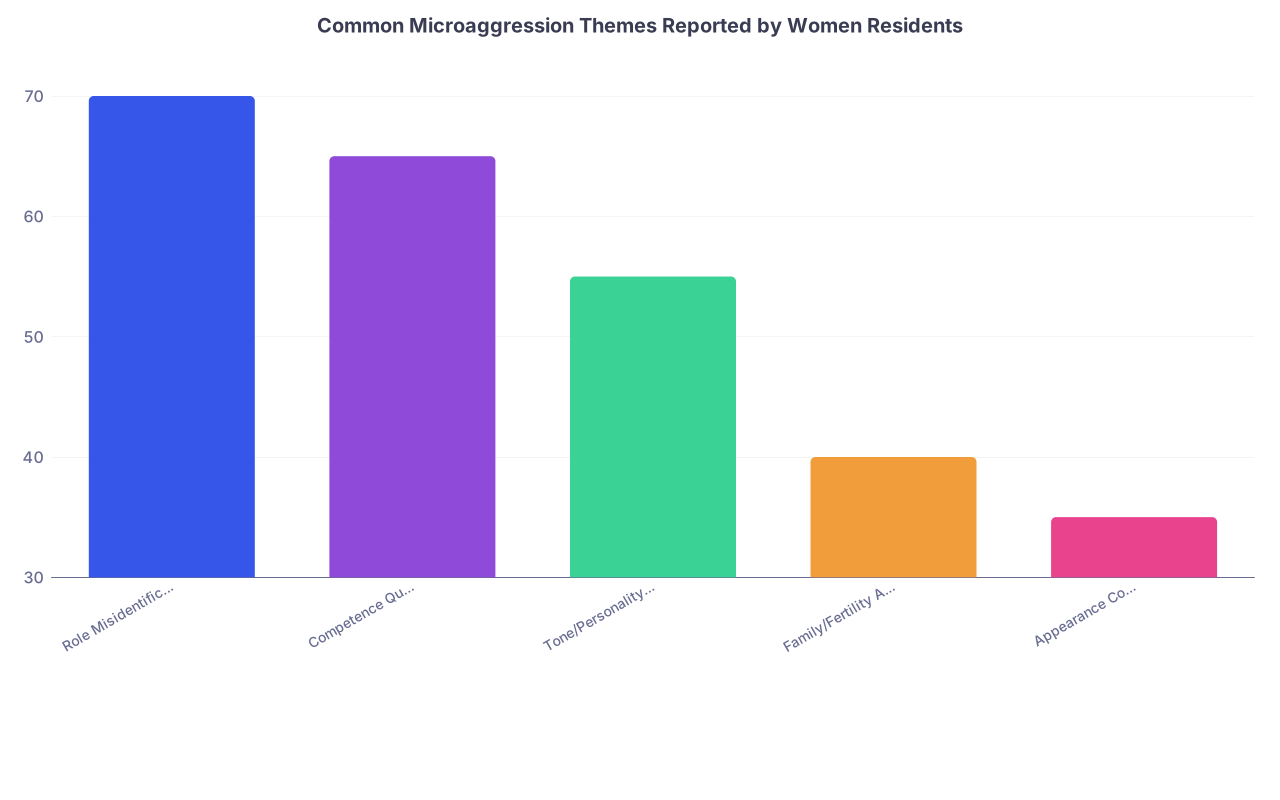
| Category | Value |
|---|---|
| Role Misidentification | 70 |
| Competence Questioned | 65 |
| Tone/Personality Critiques | 55 |
| Family/Fertility Assumptions | 40 |
| Appearance Comments | 35 |
Example 7: “Are you planning to have kids?” on rounds
You are a PGY-3, female, mid‑30s. During a lull, your attending, in front of the team:
“So, are you planning to have kids soon? That can be tough in fellowship.”
This is not neutral. This is a power‑differential, job‑relevant question that is inappropriate and potentially discriminatory.
Boundary‑setting responses:
Polite but firm deflection:
- “I keep my personal life separate from work, but I am fully committed to my training and future career.”
Sharper:
- “I prefer not to discuss my family planning at work. Can we get back to the patient list?”
If you feel safe enough, you can name the line:
- “That is a personal question and not appropriate in a professional evaluation context. I would rather focus on my clinical performance.”
If these comments accumulate or tie into promotions or fellowship letters, document each incident with date, approximate wording, and witnesses. Then talk to a GME ombudsperson, program leadership you trust, or institutional equity office. Fertility and pregnancy discrimination is real, and programs sometimes need a wake‑up call.
Example 8: “You are too young to be a doctor. Are you sure?”
This hits younger‑appearing women constantly. Patient looks dubious:
“You look like you are 18. Are you really a doctor?”
You do not owe them your CV. You owe them confidence.
Answer once, cleanly:
- “I completed medical school and I am a licensed physician in training. I am part of the team caring for you.”
If they persist:
- “If you are uncomfortable, I can step out and ask our attending physician to return, but the plan we are discussing is shared.”
You do not have to keep auditioning to meet their biased expectations.
7. Body Language, Space, and “Who Owns the Room”
Microaggressions are not just words. They are who stands closest to the attending, who controls the EMR, who interrupts whom, who gets to sit during long hallway discussions.

| Step | Description |
|---|---|
| Step 1 | Attending |
| Step 2 | Senior Resident |
| Step 3 | Male Trainee |
| Step 4 | Female Trainee |
Example 9: You are literally pushed off the computer
You are at the computer-on-wheels presenting labs. A male co‑resident or fellow walks up and physically reaches across you:
“Let me just drive for a sec.”
You instinctively step back. Now he owns the data.
Options:
- Do not step back. Say calmly, “I am almost done here, I will scroll down in a second.” Then you keep going.
If he insists:
- “I have got it. I will let you know when I am finished.”
People who are used to owning the physical space often back off when someone does not cede it automatically. You are training them that your body is not invisible.
Example 10: You are interrupted every third sentence
You start to present. The fellow cuts in:
“So basically he is septic. We are starting vanc and zosyn.”
You have not finished.
Next time, use the simple, non‑apologetic reclaim:
- “Let me finish the assessment, then we can discuss management.”
Or:
- “I have two more pertinent points, then happy to hear your thoughts.”
If they keep steamrolling, now it becomes a pattern you can name:
After rounds, one‑on‑one:
- “When I present, I am often interrupted before I complete my assessment and plan. It makes it harder for me to demonstrate my reasoning. Can we try letting me finish the full A/P next time?”
Again, you want specific behavior change, not an apology.
8. Choosing a Response Strategy: The Real Constraints
You are not operating in a vacuum. Every response is constrained by:
- Your role (MS3 vs intern vs chief vs junior faculty)
- The person’s role (nurse vs co‑resident vs PD vs patient vs chair)
- The setting (in front of patient vs team room vs evaluation meeting)
- Your identity intersections (race, accent, disability, sexual orientation)
There is no one “right” answer for each scenario. There is a toolbox. You pick based on risk, energy, and long‑term strategy.
Think of responses in four tiers:
- Micro‑corrections in the moment
- Private debriefs with the individual
- Escalation and documentation
- Protective withdrawal (choosing not to engage this time)
You are allowed to use any of them. Survival is not cowardice.
| Strategy Type | Relative Risk | Typical Impact |
|---|---|---|
| Micro-correction in moment | Low–moderate | Immediate behavior tweak, models boundary |
| Private feedback later | Moderate | Can shift pattern if person is reasonable |
| Formal report/escalation | High | Potential structural change, but political cost |
| Letting it go once | Low | Preserves energy, but no pattern change |
Practical scripts you can adapt
Short, neutral boundary phrases that work in many contexts:
- “I would like to finish my thought.”
- “To clarify, I am the resident on this patient.”
- “I prefer not to discuss that at work.”
- “Let us keep titles consistent; I am Dr. ___.”
- “I hear your concern about tone. My priority is advocating for patient safety.”
Deliver them with steady tone. No nervous laughter. Let the silence sit after, even if it is uncomfortable.
9. When You Are the Bystander, Not the Target
If you are a woman in medicine, you will be both target and witness. Some of the most powerful interventions come not from the direct target but from a peer who has less to lose in the moment.
Example 11: Attending calls male colleague “Dr.” and you, “Emily”
You are standing there when it happens, but it hits you later. Your male co‑resident can do something simple:
- “Just so everyone is clear, this is Dr. Smith, our senior resident.”
No lecture, just a correction.
Example 12: Patient ignores your female co‑resident, talks to you
You are the male trainee in this one. Your default might be to just answer. If you want to be an actual ally, you redirect:
- “Dr. Lee is the one primarily managing your care; I will defer to her plan.”
If the patient continues to resist, you can back your colleague explicitly:
- “We are on the same page. What Dr. Lee just explained is the plan I would recommend as well.”
In debriefs, you name what you saw:
- “The way the family kept looking to me instead of you in that room was not okay. How do you want me to respond next time?”
Ask her preference rather than assuming.
10. Ethical Framing: Why This Is Not “Just Sensitivity”
Some people roll their eyes at this entire topic. “Everyone is too sensitive. Focus on the medicine.” That is lazy thinking.
Microaggressions affect:
- Who speaks up about safety issues
- Who feels comfortable admitting uncertainty
- Who gets complex cases and procedures
- Whose growth is seen as “potential” versus “problematic”
This is not just about your feelings. It is about patient care, fairness, and the ethical obligation to create a learning environment where all trainees can reach their potential.

Programs that shrug off gendered microaggressions end up with women burning out, switching specialties, or leaving academic medicine altogether. That is a loss of talent the system cannot afford.
11. Building Your Personal Playbook
You will not reinvent the wheel every time something happens. It helps to build a simple, personalized playbook:
- Three “in‑the‑moment” phrases you are comfortable with
- One trusted person per rotation you can debrief with
- A way to document patterns (short notes app log, nothing fancy)
- A decision rule for escalation (e.g., repeated behavior after feedback, blatantly discriminatory comments, anything tied to evaluation or promotion)
Write your three phrases down before a new rotation starts. For example:
- “I actually managed that admission; I can present the plan.”
- “I am Dr. Rivera, one of the residents.”
- “Let me finish my assessment and then we can discuss.”
It sounds contrived until you are actually on the spot, cortisol spiking, and your brain blanks. Then having the language already loaded helps.
Finally, understand this: you do not have to be perfect at this. Some days you will miss opportunities to respond. Some days you will choose silence because you are exhausted. That is allowed. This is a long game.
With practice, you will get faster at recognizing patterns, calmer in your responses, and more strategic about when to fight and when to conserve energy. That is professional growth as much as any new procedure or exam score.

You are not just surviving rounds; you are quietly reshaping what “doctor” looks and sounds like for everyone coming behind you. With a clear eye on these microaggressions and a concrete response toolkit, you are better prepared to hold your ground.
The next layer is institutional: changing evaluation language, faculty development, and reporting structures so this burden is not always on the individual woman in the moment. That is coming—slowly. And that fight, program by program, is the next chapter in this story.