
How to Respond When Patients Refuse Care From You as a Woman Doctor
You walk into the room, white coat on, hands washed, chart in mind. You introduce yourself: “Hi, I’m Dr. Patel, I’ll be taking care of you today.”
The patient looks you up and down and says it.
“I’d rather see a male doctor.”
Or: “Are you the real doctor?”
Or the family member: “He is not comfortable with women doctors. Can we have a man?”
The air changes. You feel the sting in your chest, the anger in your jaw, the awkward glance at the nurse who suddenly looks fascinated by the floor.
You still have twenty more patients. You still have orders to place. You still have to function.
Here is how you handle it—clinically, ethically, and in a way that protects your sanity and your career.
1. First 60 Seconds: A Scripted Response You Can Actually Use
You do not have time to reinvent your reaction every time someone disrespects you. You need a default protocol. A script. Then you adapt.
Step 1: Pause and control your face
You have about two seconds before your expression sets the tone.
Micro-protocol:
- Inhale once through your nose.
- Soften your jaw.
- Neutral face. Not smiling, not scowling.
- Plant your feet. Shoulders back.
Say nothing for a beat. Let silence do some work.
Step 2: Clarify the request without apologizing
You respond calmly, with a matter‑of‑fact tone:
- “So you are asking to see a different doctor because I am a woman. Is that correct?”
You are doing three things here:
- Making the bias explicit. No softening language like “not comfortable.” Call it what it is.
- Forcing the patient or family to own the statement.
- Signaling to any staff in the room that you are aware, in control, and documenting mentally.
Most people will either double down (“Yes, I want a male doctor”) or start backpedaling (“No, no, just… I’d prefer…”).
Both are useful. You need clarity.
Step 3: Reassert your role and the standard
Then you state the professional reality:
- “I am the attending / resident / primary doctor on duty today.”
- “My role is to ensure you receive safe, appropriate medical care.”
Follow with a boundary:
- “We do not select physicians based on gender. We assign based on training, availability, and acuity.”
You are not negotiating your legitimacy. You are explaining the system.
Step 4: Offer what is ethically appropriate — and stop there
Now you pivot to options. This is where many people over‑give in an attempt to be “nice.” Stop doing that.
You can offer:
- A clinical alternative if there is a legitimate reason (e.g., intimate exam + religious reason + a feasible same‑gender colleague is available).
- A system alternative (e.g., transfer of care to another practice, change PCP at next visit).
You do not offer:
- Instant swaps just to appease discriminatory preferences when it compromises fairness or workflow.
- Apologies for being who you are.
Sample short script:
- “We do make accommodations when possible for religious or cultural reasons, especially for intimate exams. Right now, I am the physician available to manage your care safely. You are free to decline care from me, but that may mean a delay or transfer. What I cannot do is guarantee a male physician on demand.”
You say it once. Calm, clear, not defensive.

2. Sorting Legitimate Requests From Discriminatory Ones
Not every gender-related request is malicious or deserves the same response. If you treat them all as identical, you either burn out or start ignoring real ethical nuances.
Category A: Legitimate, ethically supportable preferences
Examples:
- Muslim woman requesting a female clinician for a pelvic exam.
- Orthodox Jewish man asking for a male examiner for genital issues.
- Patient with a trauma history asking for same‑gender examiner for intimate procedures.
These are about modesty, religious practice, or trauma safety, not about claiming you are less competent because you are a woman.
Ethically, these requests are generally:
- Reasonable if:
- There is no emergency.
- Accommodations are feasible without impacting others’ timely care.
- They are framed without demeaning you.
How to respond:
- “I respect that preference. For the exam of that area, we can try to arrange a female [or male] clinician if one is available without delaying urgent care. For the rest of your treatment, I will continue as your supervising physician.”
You separate the examiner from the physician of record when appropriate.
Category B: Straight-up discriminatory demands
Examples you know well:
- “No offense, but I don’t want a woman doctor. Get me a man.”
- “Women are too emotional for this surgery.”
- “Is there a real doctor? A guy?”
This is about status. About power. About bias.
Ethically:
- There is no obligation to honor discriminatory requests that:
- Undermine equal treatment of staff.
- Disrupt care teams.
- Are not tied to religious, cultural, or trauma-related modesty in a good-faith way.
You handle these differently. You do not start scrambling to find a male colleague to appease them.
3. A Clear Decision Flow You Can Run in Your Head
You need a mental algorithm that works at 2 a.m. on call when your brain is black coffee and pager alerts.

| Step | Description |
|---|---|
| Step 1 | Patient refuses care |
| Step 2 | Clarify reason |
| Step 3 | Likely discriminatory |
| Step 4 | Try to accommodate if safe |
| Step 5 | Explain role and limits |
| Step 6 | Document and inform team |
| Step 7 | Reassert role and boundaries |
| Step 8 | Explain emergency duty, proceed if possible |
| Step 9 | Offer system-level alternative, not instant swap |
| Step 10 | Religious or trauma-based modesty? |
| Step 11 | Intimate exam or procedure? |
| Step 12 | Emergency or urgent? |
Walk through it quickly:
Why are they refusing?
You ask directly: “Can you tell me why you are asking for a different doctor?”Is this truly about modesty/trauma and an intimate exam?
If yes, and it is clinically safe to accommodate → you try within reason.
If it is not an intimate exam or not time-sensitive → you explain your continuing role.If it is discriminatory:
- You reassert: “I am the physician responsible for your care now.”
- You consider urgency:
- Emergency? You have an ethical duty to treat.
- Non-emergency? You can offer alternative venues or scheduling, but no on-demand male swap.
That is the skeleton. You flesh it out with local policy and judgment.
4. Concrete Scripts for Common Scenarios
You need words ready. In the moment, your brain will be half-occupied with vitals, lab trends, and the fact that you still haven’t eaten. Scripts save you.
Scenario 1: ED – chest pain, patient wants “a man doctor”
Patient: “No offense, sweetheart, but I want a real doctor. A man. Get me a guy.”
You:
Neutral voice, eye contact:
- “So you are asking for a different doctor because I am a woman. That is what you are saying, correct?”
If they confirm:
- “I am the emergency physician on duty and I am responsible for your care right now. Chest pain can be serious, even life-threatening. I will not delay your evaluation while we try to match your gender preferences for the doctor.”
Then move:
- “I am going to order an EKG and labs now. If you choose to leave or refuse care from me, that is your decision, but I have advised you of the risk.”
Document the refusal or comment in the note. Brief, factual.
Scenario 2: Outpatient clinic – new patient refuses you, asks for male PCP
Patient: “I thought Dr. Chen was a man. I do not want a woman doctor as my primary.”
You:
- “I understand you had a different expectation. I am Dr. Chen, and I am the physician assigned to this clinic slot.”
- “Our clinic does not reassign physicians based on gender. You are welcome to establish care here with me, or you can choose a different practice outside this system if you prefer a male doctor.”
- “If you stay, I will provide the same level of care and attention I give all my patients. What would you like to do?”
You do not start pulling up the schedule to find your male colleague a home‑run new-patient visit while you fall behind.
Scenario 3: Inpatient – older patient’s family insists on male doctor
Family member: “My father is not comfortable with women doctors. Please have a male attending manage his care.”
You:
- “I hear your concern. I am the attending physician for this service this week. Your father’s medical issues are my responsibility.”
- “We do not reassign attendings based on gender. For any intimate exams, we can make sure there is appropriate chaperoning and, if needed, try to arrange a male clinician for specific parts of the exam if that can be done safely.”
- “If you prefer not to have me as the attending, you can discuss transfer of care with the hospital administration, but that will not be immediate and may disrupt his care. Right now, I am proceeding with what he needs medically.”
Stay calm. You are not asking for permission to do your job.
5. Documenting and Looping In Your Team
Quietly swallowing this and moving on is the fastest way to burnout and normalization of abuse.
You need a documentation habit and a team response plan.
Documentation: short, factual, protective
Example note snippet:
- “During encounter, patient stated preference for ‘male doctor’ and initially refused care from this provider due to provider gender. Provider explained role as attending and standard assignment process; patient informed that emergency evaluation would not be delayed to accommodate gender preference. Patient ultimately agreed to proceed with care. No further issues during encounter.”
Or if they persisted and you accommodated appropriately:
- “Patient requested female clinician for pelvic exam citing religious modesty. This provider remains primary physician. Arranged for female resident to perform pelvic exam with chaperone present. Care not delayed.”
Key:
No editorializing. No adjectives like “rude,” “sexist,” or “inappropriate.” That is for incident reports or debrief, not the chart.
Tell someone with actual authority
At minimum:
- Your charge nurse or clinic manager.
- Your chief resident or section lead.
- Risk management or patient relations if the behavior is extreme or repeated.

Why?
- Patterns matter. If you are the fifth woman in the department this patient has refused, leadership needs that data.
- Some systems have explicit anti-discrimination policies protecting staff; those policies are useless if incidents never reach them.
- You may need backup for boundary-setting next time (“Per policy, we do not honor discriminatory requests for different clinicians”).
6. Institutional Policies: Use Them or Push to Create Them
If your hospital or clinic has no clear stance on patients refusing care based on clinician gender, that is a problem. And it will keep being your problem unless someone forces the issue.
What a decent policy covers
The bare minimum:
| Element | What It Should Say Briefly |
|---|---|
| Equal Opportunity Statement | No discrimination against staff based on gender |
| Legitimate Accommodation Rules | How to handle religious/trauma modesty requests |
| Emergency Care Expectations | Duty to treat regardless of discriminatory demands |
| Non-Emergent Refusal Options | When patients can transfer or reschedule |
| Reporting Process | How staff log incidents and get support |
If your institution has this, get a copy. Keep it in your back pocket—figuratively or literally. You can reference it:
- “Per hospital policy, we do not change physicians based on gender.”
If they do not have one:
- Talk to your program director, department chair, or DEI/ethics office.
- Push for a written policy and training. Not a 30-minute “be nice” webinar. An actual, clear algorithm.
7. Protecting Your Head: Emotional and Professional Boundaries
Let me be blunt: repeated gender-based rejection is corrosive. You can be the most resilient person on the planet; if this happens enough and you pretend it does not bother you, it will leak out somewhere else.
Burnout. Cynicism. Avoidance. Self-doubt.
You need an internal protocol too.
Step 1: Name what it is — and what it is not
What it is:
- A biased, often ignorant, sometimes malicious behavior from a patient or family.
- A reflection of their worldview, not your competence.
What it is not:
- Proof that you are less skilled.
- A signal that you chose the wrong profession.
- Something you “caused” by how you look, talk, or dress.
Saying this explicitly to yourself after a bad encounter is not corny. It is maintenance.
Step 2: Debrief with the right people
Not everyone is safe to vent to.
Good options:
- A trusted senior woman physician who has absolutely heard it all.
- A male colleague who “gets it” and will back you publicly, not just nod sympathetically in private.
- Your program director or mentor when the impact is ongoing.
Tell them what was said. How you responded. What you want help with next time (script refinement, backing from leadership, policy escalation).
Bad option:
- Doing nothing and pretending you are “above it.”
You are not. No one is.
Step 3: Decide your line for future encounters
Some women choose to:
- Always stay with the patient in discriminatory cases unless there is a legitimate safety concern.
- Occasionally step out for egregious abuse and transfer care through official channels.
There is no single correct choice. What is wrong is making that choice in the heat of the moment without having thought through your boundaries.
Pre-decide your line:
- “I will tolerate one biased request, respond professionally, and proceed. If they escalate to slurs or threats, I step out and involve security / leadership.”
That way, when it happens, you know what you do.
8. Training Yourself: Reps, Not Perfection
You will not handle the first few of these perfectly. Or the tenth. That is fine. This is a skill set like any other.
A simple practice routine:
- Write down three things patients have actually said to you or your colleagues.
- For each, write a 2–3 sentence response that:
- Names the bias plainly.
- Reasserts your role.
- States what you can and cannot do.
- Say them out loud. In a normal speaking voice. In front of a mirror or your phone camera.
- Adjust until you sound like yourself, not a robot or a legal memo.
Then go one level harder:
- Role-play with a colleague. Have them be the difficult patient. Ask them to be worse than real life.
- Practice staying calm, short, and in control.
The goal is not to be perfect. The goal is to have a default response that protects both patient care and your self-respect.

9. Special Cases: Trainees, Supervisors, and Power Imbalance
If you are a medical student or junior resident, this hits differently. You do not control the schedule. You may not even be the one “in charge” in the room.
So adjust the protocol to your level of authority.
As a student
If a patient refuses to let you participate because you are a woman:
- Do not argue solo.
- Step out and tell your resident/attending exactly what was said.
- Let them decide whether to:
- Back you and re-enter together.
- Respect a modesty request if truly about intimate exams.
- Remove you from the case if they judge it is not the hill to die on clinically.
But also:
- Ask for feedback. “Next time this happens, what do you want me to say first before I step out?”
- Log patterns. If your clerkship has a case log, mention repeated exclusion.
As a resident with an attending who caves
You will see this:
Patient demands a male doctor, attending (male) shrugs and takes over, leaving you sidelined and humiliated.
You need to address this outside the room.
Later, quietly:
- “When the patient refused me because I am a woman, I felt unsupported when the solution was just for you to take over. In the future, can we first try reinforcing my role before we consider reassignment?”
If they brush it off, go up one level—to chief, PD, or another mentor. This is a culture issue, not just a single awkward encounter.
10. Quick Personal Checklist After Any Such Encounter
Right after the shift, or at least the same day, run through this in your head:
- Did I:
- Clarify the reason for refusal clearly?
- Reassert my role without apologizing for my gender?
- Avoid scrambling to accommodate discriminatory preferences?
- Did I:
- Document succinctly and accurately?
- Inform someone in leadership if it was serious or repetitive?
- Do I:
- Need to debrief with someone I trust?
- Want to tweak my script for next time?
If the answer to “Do I need help?” is yes—get it. Do not wait until the third or fourth time.
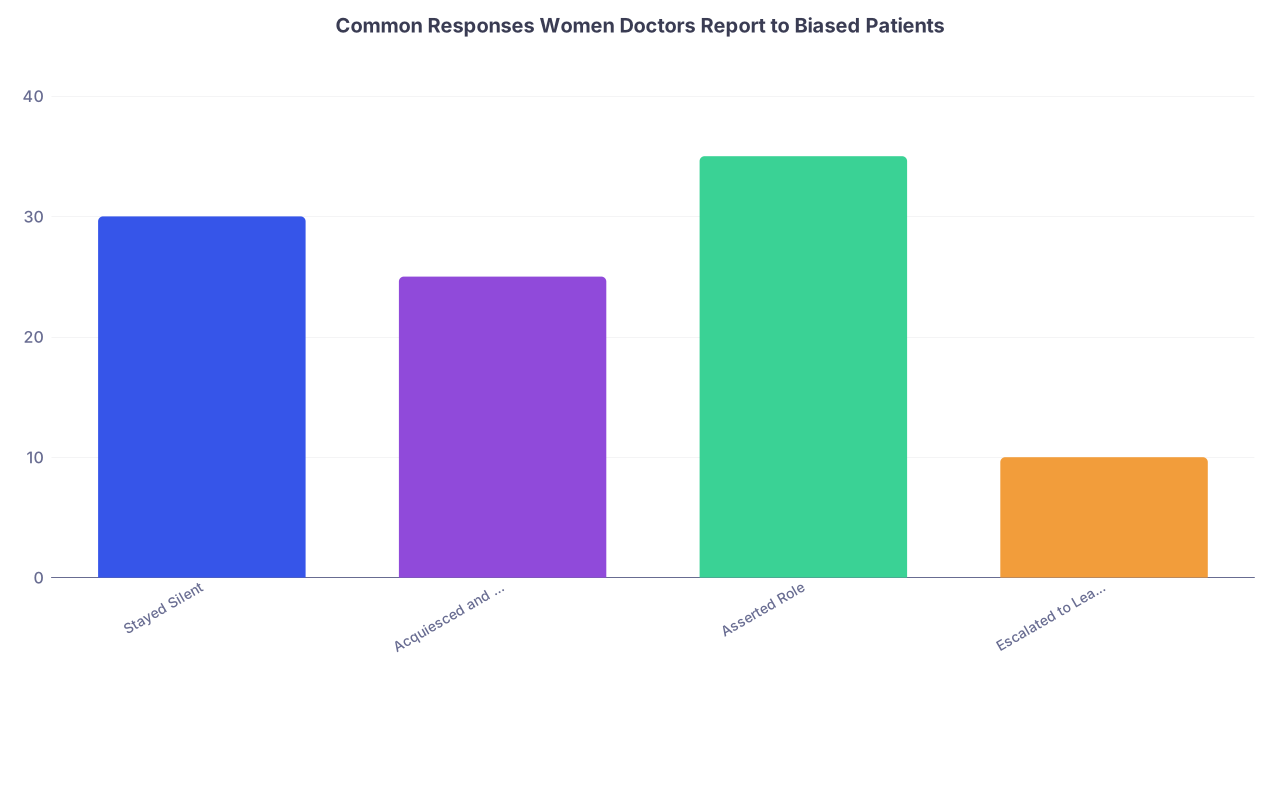
| Category | Value |
|---|---|
| Stayed Silent | 30 |
| Acquiesced and Swapped | 25 |
| Asserted Role | 35 |
| Escalated to Leadership | 10 |
Key Takeaways
- Have a default script: name the bias, reassert your role, state realistic options, and stop over‑accommodating discriminatory demands.
- Distinguish legitimate modesty/trauma requests from pure sexism, and respond accordingly—with limited accommodations only when clinically safe and ethically justified.
- Protect yourself: document factually, involve leadership, debrief with trusted colleagues, and pre‑decide your personal boundaries so the next time it happens, you are responding from a prepared position, not from shock.