
It is 9:20 a.m. in clinic. Second patient of the day.
You walk in, white coat, badge, stethoscope. Before you even finish, “Hi, I am Dr—” the patient cuts you off:
“I wanted to see the real doctor. The male doctor. The older one.”
You feel that immediate surge of heat in your chest. You smile tightly. You say something polite. You move on. You tell yourself, “Not worth it. I do not want to be ‘that’ resident / attending who complains.”
By 5 p.m. you are exhausted and strangely ashamed. You did not say what you wanted to say. You did not document it. You did not tell your program director. Again.
This is exactly how women physicians mishandle patient bias—and slowly lose institutional support they could have had.
Let me be blunt: the system is not automatically on your side. Institutions help the people who create a record, escalate patterns, and speak in the right language at the right time. If you respond to bias only with internal coping and quiet venting, you are setting yourself up to be unprotected when something serious finally happens.
This is the mistake I want you to avoid.
The First Mistake: Treating Bias as a “Personal Problem” Instead of a Patient Safety Issue
Here is the trap many women fall into: you experience a blatantly biased or demeaning interaction and you immediately frame it as:
- “My emotional reaction problem.”
- “My resilience issue.”
- “My need to grow thicker skin.”
So you “handle” it quietly. You self-soothe. Maybe you text a co-resident. You do not document it or formally report it because you think:
- “It will make me look weak.”
- “This will negatively affect my evaluations.”
- “No one will care; this is just how patients are.”
- “I do not have proof. It is my word only.”
That framing is wrong. Dangerous, actually.
Patient bias is not just about your feelings. It affects:
- Clinical decision-making (patients refusing appropriate care from you).
- Team dynamics (when biased patients demand staff changes).
- Safety (when behavior escalates to verbal abuse or threats).
- Equity (when biased requests get accommodated, reinforcing discrimination).
You are not just a target. You are a clinician in a safety-critical environment. And bias that affects care is a systems issue.
The women who get burned later are the ones who keep these episodes in the “personal” bucket instead of the “institutional risk and safety” bucket. When you keep it personal, you stay invisible in all the places where policies, data, and consequences live.
The Dangerous Ways Women Commonly Respond—and Why They Backfire
Let us walk through the classic mishandled responses. I have seen every one of these play out badly.
1. The Silent Absorber
You say nothing in real time. You do the visit, swallow the insult, finish your notes, go home.
Why it feels safer:
You avoid conflict. You avoid tears at work. You do not risk angering the patient or disrupting clinic flow. You do not trigger the “difficult woman” label.
How it backfires:
- The patient concludes their behavior is acceptable.
- Your colleagues never see the pattern, so they assume everything is fine.
- Your own threshold for “what I tolerate” keeps rising without you noticing.
- When something serious happens later, it looks like an isolated event instead of the tenth data point.
Institutions track what is documented. Not what is silently endured.
2. The Over-Accommodator
This is one of the most destructive patterns.
Patient: “I want a man doctor / white doctor / older doctor / someone without an accent.”
You, trying to be “patient-centered”: “I understand. Let me see if I can find someone else for you.”
You think you are being kind and flexible. You tell yourself, “They are anxious / from another generation / confused.”
What you are actually doing:
- You are operationalizing discrimination. You are the one literally implementing the biased request.
- You signal to staff and trainees that discriminatory preferences are negotiable.
- You make it harder for administration later to say “We have a zero-tolerance policy,” because, in practice, they do not. You have been the workaround.
Do not make this mistake. “Accommodating” discriminatory requests trains the system to abandon you.
3. The Emotional Explosion (with No Documentation)
At some point, after the fifth or fifteenth incident, you snap. You respond sharply in the room or afterwards with staff:
“This is racist / sexist / completely unacceptable!”
Then you cry in the bathroom. Maybe you send an angry email that is 90% raw emotion and 10% facts.
The content of your frustration is often justified. The problem is how it enters the institutional record:
- Disjointed, emotionally charged email.
- No objective description of patient statements or behavior.
- No clear ask: Do you want security? Formal note? Clinic policy?
- No follow-up documentation in the chart.
So when leadership finally sees the situation, they see you as upset, not the patient as problematic. You become “that resident who is always so sensitive about bias.” The pattern of patient behavior is never clearly outlined.
You lose credibility not because you are wrong—but because you did not translate your experience into the clinical and legal language your institution understands.
4. The “Savior of Harmony”
You see a biased incident happen to another woman colleague or trainee. You minimize it to “protect” them:
- “Let it go, you do not want to be that person here.”
- “This program is conservative, just power through.”
- “We all have stories like this. That is just residency.”
You think you are helping them survive. You are actually training them to replicate your silence. The cost: they are even less likely to get backed by the institution when something escalates.
The Institutional Reality: How Support Actually Gets Triggered
| Trigger Type | What Usually Happens |
|---|---|
| Vague complaints with no documentation | Sympathy emails, no real change |
| Patterned documentation in the chart | Risk/quality flags, leadership awareness |
| Formal incident reports | Policy review, security involvement, coaching of staff |
| Multiple reports tied to same clinic/patient | System-level interventions, behavior contracts |
Hospitals, clinics, and universities respond to risk and liability. They move when:
- There is documentation in the medical record.
- There are multiple incidents reported through official channels.
- The language clearly frames it as safety, quality, discrimination, or harassment.
They do not move based on:
- Group chat screenshots.
- Vague mentions in passing during your semi-annual evaluation.
- Suppressed tears at 7 p.m. sign-out.
If you want institutional support, you must align your actions with how systems detect and respond to problems.
This is where women doctors commonly fail—because you think like a human (“I am hurt / angry”), but institutions think like a risk management system (“What is documented? What is the liability? What policy applies?”).
What To Do Differently In the Room When Bias Happens
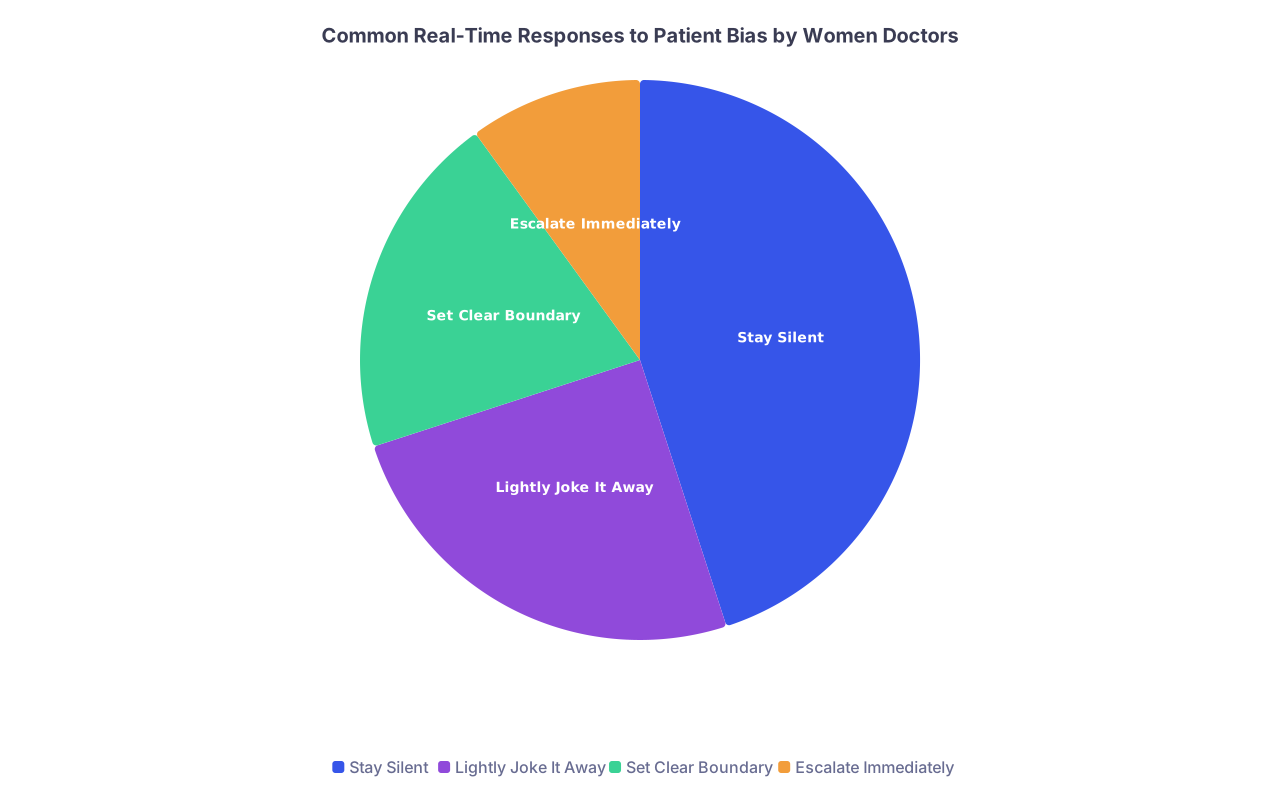
| Category | Value |
|---|---|
| Stay Silent | 45 |
| Lightly Joke It Away | 25 |
| Set Clear Boundary | 20 |
| Escalate Immediately | 10 |
You cannot control what your patient says. You can absolutely control how you respond and what record you create.
Here is where many women go wrong: they either over-personalize or avoid conflict so aggressively that nothing useful comes out of the encounter. The fix is not to turn every visit into a confrontation. It is to have a small set of practiced, neutral, boundary-setting phrases.
You want responses that:
- Name the behavior.
- Set a professional boundary.
- Tie it to care / safety.
- Are calm enough to be defensible if recorded or quoted.
Examples you should have ready:
When they question your role or legitimacy
“I am the physician taking care of you today. Our team expects all staff and clinicians to be treated with respect.”When they request a different doctor for discriminatory reasons
“We do not change clinicians based on a person’s gender / race / background. I am qualified and here to provide your care. If you choose not to work with me, we can discuss options for your care outside this clinic / hospital.”When patients use sexist or racist language
“Those comments are not appropriate in this setting. We need to keep our conversation focused on your health.”When it escalates to abuse or threats
“The way you are speaking right now is not acceptable. If it continues, I will need to end this visit and involve security / our clinic leadership.”
Notice what all of these do:
- They use “we” and “our” (institutional voice), not “I feel.”
- They emphasize standards and expectations.
- They are specific enough to document later.
The mistake is walking out of the room having said nothing clear, then trying to reconstruct later what “kind of” happened.
The Documentation Gap: Where Women Lose Their Case Before It Starts

After a biased encounter, your feelings are valid. They are also not enough.
What most women do: write a vague line or two in the note, or nothing at all.
What you should do: write a brief, objective, defensible description. Not an essay. Two to four clear sentences.
Structure:
- Behavior you observed (exact words when possible).
- Your response.
- Effect on care (if relevant).
- Any escalations (security, supervisor, early termination of visit).
Example:
“During today’s visit, patient stated that they preferred a ‘male doctor’ and questioned my role as their physician. I informed the patient that clinician assignment is not based on gender and that I am the physician responsible for their care today. Patient ultimately agreed to proceed with the visit. Will inform clinic leadership if similar concerns recur.”
Or, in a more serious case:
“Patient used derogatory language referencing my gender and race, including stating, ‘I do not want a [racial slur] taking care of me.’ I clearly stated this language was unacceptable and that I would end the visit if it continued. Due to escalating verbal aggression, I terminated the encounter, exited the room, and notified charge nurse and security.”
This is not about venting in the chart. It is about building a factual, contemporaneous record that:
- Justifies any deviation from usual care.
- Documents your professionalism and boundary setting.
- Creates data for quality and risk teams.
Women who skip this step lose institutional support later because there is “no record” of a pattern. You may remember every encounter. The system does not. It only remembers what is written.
The Reporting Mistakes That Quietly Erase Your Experience

| Step | Description |
|---|---|
| Step 1 | Biased incident |
| Step 2 | You respond in room |
| Step 3 | Document in chart |
| Step 4 | File formal report |
| Step 5 | Notify supervisor |
| Step 6 | Risk and leadership review |
| Step 7 | Policy or case level action |
| Step 8 | Severity or pattern? |
Even when women do document, they often stumble on the next steps.
Common mistakes:
Telling the wrong person, the wrong way
You emotionally unload on a sympathetic colleague who has zero structural power. You do not loop in the attending of record, the program director, or risk management.Waiting too long
You finally mention it in your evaluation meeting months later as an aside. By then, no one can act on it. It looks historical, not actionable.No clear ask
You write an emotional email that says, “This keeps happening and it is horrible,” but you do not say what you want:- A behavior flag in the chart?
- A clinic policy for discriminatory requests?
- Security escort for future visits?
- Reassignment so you do not see this patient again?
Institutions respond best to:
- “Here is what happened.”
- “Here is what I did.”
- “Here is the risk / pattern I am seeing.”
- “Here are 1–2 specific actions I am requesting.”
Without the last piece, your experience gets filed mentally as “sad, unfortunate,” not “we must act.”
How Institutions Quietly Withdraw Support—And Why Women Are Blindsided
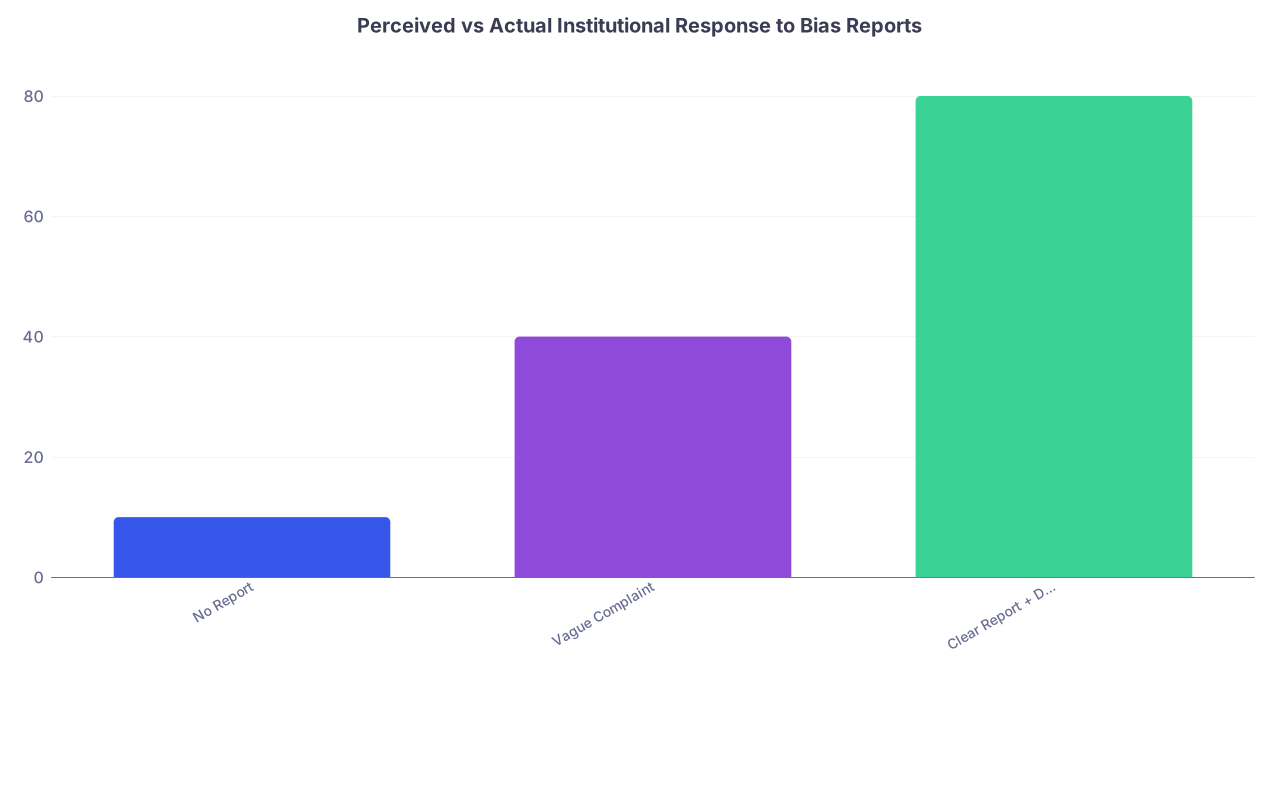
| Category | Value |
|---|---|
| No Report | 10 |
| Vague Complaint | 40 |
| Clear Report + Documentation | 80 |
Here is the part that hurts the most.
You endure multiple biased patient encounters. You finally blow up or have a visible breakdown. You then feel betrayed that your institution “did nothing” for years.
But from their vantage point, they see:
- A couple of unstructured comments in passing.
- Maybe one chart note with nonspecific “patient was difficult” language.
- No formal incident reports.
- No clear request for accommodation or safety changes.
So when there is a high-stakes event—patient files a complaint about you, or an encounter goes very badly—you expect them to have your back. They often do not.
Not because they think you are wrong. Because they do not have the institutional scaffolding to defend you:
- No established pattern of patient misconduct.
- No documented attempts by you to de-escalate.
- No prior risk flags to justify limiting or terminating the treatment relationship.
This is how women lose institutional support: not usually through overt malice. Through a long, quiet, mutual misalignment between what you live and what the system recognizes as “real.”
Concrete Do-This-Not-That Moves
| Situation | Common Wrong Move | Better Move |
|---|---|---|
| Patient requests male doctor | Reassign patient quietly | State non-discrimination standard, document request |
| Sexist comment about appearance | Nervous laughter, ignore | Neutral boundary statement, document briefly |
| Repeated bias from same patient | Vent to colleagues only | Patterned chart notes + formal incident report |
| Escalating aggression | Stay in room to be "nice" | End visit, leave room, notify charge/security |
And a crucial attitude shift:
Stop trying to prove how tough you are by how much abuse you can silently absorb. Toughness in medicine now includes how strategically you protect yourself and the people coming after you.
FAQs
1. What if I am a trainee and I am afraid reporting bias will hurt my evaluations?
The risk is real. Some attendings still see reporting as “complaining.” That does not mean you should stay silent. It means you need to be surgical.
When possible:
- Loop in an attending you trust and document together.
- Use neutral, professional language in the chart.
- Frame your communication up the chain as a safety / professionalism issue, not a personal grievance.
- Ask explicitly: “How do you recommend we handle discriminatory requests in this clinic going forward?”
If an evaluator punishes you for raising legitimate bias concerns in a professional way, that itself is an institutional problem—and the documentation you created becomes even more critical.
2. Should I ever accommodate a patient’s request for a different doctor?
You can accommodate for legitimate reasons: language concordance, specific clinical expertise, past trauma (e.g., a sexual assault survivor preferring a woman examiner). You should not accommodate explicitly discriminatory requests based on protected characteristics.
If a transfer is made, it must be framed and documented as:
- “Transfer of care for therapeutic alliance / patient comfort,”
not - “Provided different doctor to satisfy sexist / racist request.”
And you should still document the original biased request and your response, so there is a record that the behavior was identified as problematic.
3. What if leadership dismisses my reports or says “that is just how patients are”?
That is a red flag about your institution, not you. You still document. You still use formal reporting channels. You still create the paper trail.
If leadership explicitly minimizes or normalizes discrimination, summarize that conversation in writing and send a brief, factual follow-up email:
“Per our discussion today, I reported several instances of [specific behavior] from patient X. I understand that the current expectation is [their stated position]. I remain concerned about the impact on staff safety and equity.”
This is not about winning the argument today. It is about building a record that exposes the pattern over time. That is often what prompts change—especially when accreditation bodies and legal departments are involved.
4. How do I protect my own mental health without becoming numb?
You will not win by pretending this does not affect you. You also will not survive if you relive every slight on a loop.
Non-negotiables:
- Debrief with at least one trusted colleague after serious incidents.
- Have one or two stock phrases and documentation templates ready, so you are not reinventing language every time.
- Set a personal threshold: for example, “Anything involving slurs, physical intimidation, or refusal of care based on identity will be documented and reported the same day.”
- Get professional support if you notice dread, avoidance of certain patients, or persistent guilt for “not doing more.”
You cannot control every biased patient. You can absolutely control whether you are fighting alone and undocumented—or with the full weight of institutional structures behind you.
Key points:
- Stop treating patient bias as a private emotional burden; frame and handle it as a safety, professionalism, and equity issue.
- Replace silence and over-accommodation with clear boundary statements, objective documentation, and targeted reporting.
- Build patterns in the record early, so when you need institutional support, it actually exists on paper—not just in your memory.