
The biggest mistake people make when they want a women in medicine group is waiting for “the institution” to create it.
If you want it, you build it. And you can. Systematically.
Below is a concrete, step-by-step plan I have seen work at medical schools, community hospitals, and big academic centers. This is not theory. This is the actual order of operations that gets you from “someone should…” to a functioning, sustainable Women in Medicine group.
Step 1: Define the Mission Before You Send a Single Email
If you skip this step, everything else gets messy and political fast.
You need a one-page “What we are and what we are not” document. This is your north star when people try to turn your group into a social club, a grievance committee, or a resume-padding shell.
Answer four questions in writing:
Why are you starting this?
Be specific. “Support” is vague. Examples:- Improve mentorship for women medical students and residents.
- Address gender inequities in leadership and pay.
- Create safe spaces to discuss harassment, discrimination, and burnout.
- Build a pipeline of women into academic and administrative leadership.
Who is this for?
Decide your core membership:- Faculty only?
- Faculty + residents/fellows?
- Entire spectrum (students through attendings, plus non-physician clinicians)?
- Open to allies (men, non-binary colleagues)? If yes, in what capacity?
What are your first-year priorities?
Limit yourself to 2–3. You won’t fix systemic sexism in 12 months.- Example first-year priorities:
- Launch a quarterly mentorship dinner series.
- Host 2 institutional talks on salary negotiation and promotion.
- Create a report or listening session on pregnancy/parental leave experiences.
- Example first-year priorities:
How will you measure if it is working?
Keep it simple at first:- Attendance numbers.
- Short pre/post surveys about sense of belonging or support.
- Count of mentorship matches created.
- Number of concrete policy recommendations delivered to leadership.
Write this in plain language. One page. No fluff.
You will use this to:
- Recruit faculty champions.
- Pitch to administration for endorsement/funding.
- Set boundaries when the mission starts to drift.
Step 2: Map Your Institution and Choose the Right Home
You need a “home base” inside the institution. Drifting groups die when key students or residents graduate.
Here is the basic decision tree:
Medical school based (if you are a student):
Lives under:- Office of Student Affairs
- Office of Diversity, Equity, and Inclusion (DEI)
- Student government or interest group council
GME (residency) based:
Lives under:- Graduate Medical Education (GME) office
- Hospital staff wellness office
- House staff association
Hospital/health system based (often faculty-led):
Lives under:- Office of Faculty Affairs
- Office of Professional Development
- DEI office
- Chief Medical Officer’s office
Pick the home that:
- Already runs similar professional development or affinity groups.
- Has some budget and staff support.
- Has leadership that at least pretends to care about equity.
Then identify names, not just offices:
- Dean of Student Affairs
- GME Director
- DEI director
- Chief of Staff / CMO
- HR partner responsible for engagement or retention
You are not asking permission to exist. You are asking for alignment and support.
Step 3: Recruit 2–4 Core Co‑Founders (Not 20)
If you start with a 15-person planning committee, nothing will get done.
You need:
- 1–2 trainees (students / residents / fellows)
- 1–2 faculty or advanced practice clinicians
- Ideally 1 person with previous experience in:
- Wellness programming
- Diversity initiatives
- Medical education leadership
Look for:
- People who actually respond to email.
- Colleagues who have already informally organized things (“She organized the pumping room schedule and got extra fridges approved” – that kind of person).
- Someone who can talk to leadership without burning bridges.
Your first meeting agenda (60 minutes max):
- Review the draft one-page mission and refine it.
- Clarify who this group is for.
- Pick 2–3 first-year priorities (this matters more than wordsmithing the mission).
- Decide on a working name (you can rebrand later):
- “Women in Medicine at [Institution]”
- “[Hospital] Women Physician Network”
- “Women and Gender Equity in Medicine (WGEM)”
End this first meeting with:
- Agreed mission + first-year priorities.
- Volunteers for 3 roles:
- Interim Chair/Lead
- Institutional Liaison (talks to admin offices)
- Communications Lead (email list, flyers, basic branding)
Do not start by debating bylaws. That is how groups die in committee.
Step 4: Get Administrative Buy‑In the Smart Way
You want support, not control. The line is thin.
You will schedule short, focused meetings (20–30 minutes) with:
- A Dean or GME leader
- DEI or Faculty Affairs
- Anyone who controls small grants or programming funds
Bring:
- Your one-page mission/plan.
- A one-page “Year 1 Activities” draft (3–5 bullets, with estimated costs).
- A clear ask.
Your “ask” should be specific and modest:
- Formal recognition as an institutional group.
- Permission to use institutional logo on flyers.
- Email distribution rights to all trainees/faculty.
- $1,000–$3,000 starter budget (food for events, speaker honoraria, printing).
- Access to:
- Rooms / Zoom accounts
- Admin help to schedule events
- Data (aggregated gender representation, promotion rates, etc.)
This is roughly how the script sounds in real life:
“We are starting a Women in Medicine group to improve mentorship, leadership development, and retention of women clinicians and trainees. Year 1, we plan three programs: a mentorship mixer, two skill-building workshops, and a listening session on parental leave and flexibility. We are asking for formal recognition under your office, permission to use your branding, and a $2,000 annual budget to cover food and local speakers.”
You are framing this as:
- Supporting institutional goals: retention, wellbeing, DEI, leadership pipeline.
- Low risk: small cost, defined activities, educational focus.
- Data-friendly: you intend to track participation and outcomes.
If one leader is lukewarm, move sideways. Somewhere in your system there is a dean, CMO, or DEI director angry about losing women faculty or residents. That person is your ally.
Step 5: Build a Simple, Durable Structure
You need just enough structure to survive turnover. Nothing more.
The minimum:
Leadership roles for Year 1
- Chair / Co-Chairs
- Events Lead
- Mentorship Lead
- Communications Lead
- Optional: Advocacy/Policy Lead
Term lengths and continuity
- Faculty roles: 2-year terms, staggered.
- Trainee roles: 1-year terms with “co-leads” so M4s or PGY-3s can groom replacements.
Quarterly leadership meeting schedule
- Put 4 recurring meetings on the calendar immediately (even if you do not know every leader yet).
Succession plan At the start, write a half-page:
- How new leaders are selected (application, nomination, vote).
- Where you will store institutional memory:
- Shared drive (OneDrive, Google Drive, SharePoint).
- Folder with:
- Mission and bylaws (even if simple).
- Event templates (emails, flyers, sign-in).
- Budget history.
- Annual “what worked / what failed” summaries.
Skip elaborate constitutions in Year 1. You need something that can be read and understood in under 5 minutes.
Step 6: Design Year 1 Programming That Actually Attracts Busy Women
If your first event is a vague “kickoff social” with no clear purpose, your attendance will be mediocre and that energy will follow you.
Your Year 1 programming should hit three angles:
- Community
- Mentorship
- Concrete skills or advocacy
Think in terms of quarterly “anchor” events that people will remember.
| Quarter | Flagship Event | Secondary Activity |
|---|---|---|
| Q1 | Launch & Listening | Email survey on needs |
| Q2 | Mentorship Mixer | Small-group coffee chats |
| Q3 | Skills Workshop | Online resource library |
| Q4 | Policy / Advocacy Forum | Year-end reflection event |
Examples that work:
Launch + Listening Session
- 60–90 minutes.
- Brief introduction of the group (10 minutes).
- Small breakout groups by career stage:
- Students, residents/fellows, junior faculty, senior faculty.
- Prompt questions:
- “What is one barrier you face as a woman in medicine here?”
- “What support do you wish existed?”
- “What specific topic would make you show up to a session this year?”
- Collect themes on sticky notes / shared docs. Photograph and keep them.
Mentorship Mixer
- Speed-mentoring format:
- 5–6 tables, each with a faculty mentor.
- Participants rotate every 10–15 minutes.
- Stations by theme:
- Early career planning.
- Research & promotion.
- Parenthood / caregiving balance.
- Negotiation and contracts.
- Pair this with a year-long optional “mentorship match” sign-up form.
- Speed-mentoring format:
Skills Workshop Choose one high-value topic:
- Negotiating salary and resources.
- Navigating promotion criteria.
- Handling bias and microaggressions in real-time (role-play).
- Saying “no” strategically and managing invisible labor.
Invite:
- An internal expert (e.g., HR comp specialist, promotion committee member).
- Or a faculty member known for being blunt and practical. Not just inspirational.
Policy/Advocacy Forum Focus on one structural issue:
- Lactation space.
- Call schedule equity.
- Parental leave.
- Gender pay gap data.
Format:
- Brief overview of current policy.
- Panels with one admin leader + women affected.
- End with 3–5 concrete recommendations and a promise to follow up in writing.
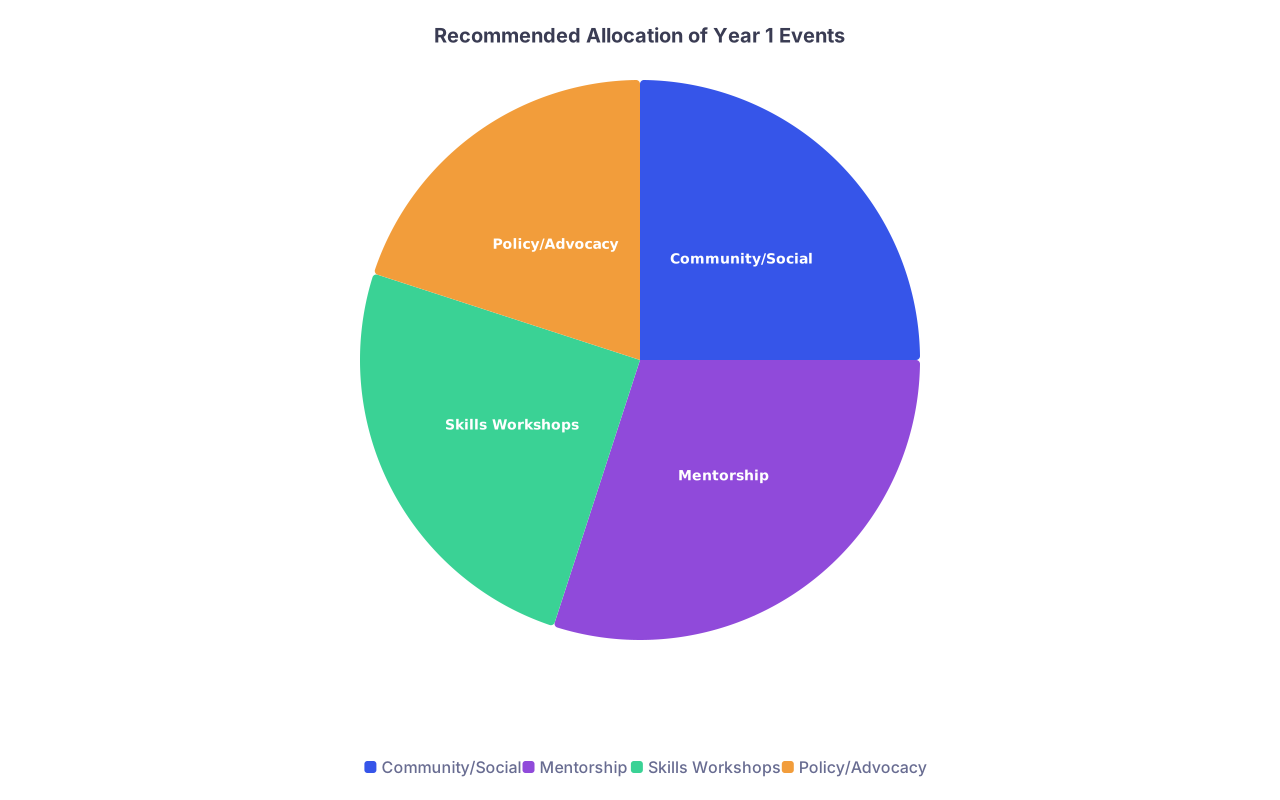
| Category | Value |
|---|---|
| Community/Social | 25 |
| Mentorship | 30 |
| Skills Workshops | 25 |
| Policy/Advocacy | 20 |
Do not overload the calendar. 4–6 substantial events in Year 1 is enough, plus smaller coffee chats.
Step 7: Create a Clean Communication Infrastructure
If your emails look chaotic and your branding is inconsistent, people assume the group is disorganized.
Minimum communication infrastructure:
Email list
- One master list:
womeninmedicine@[institution].edu - Ask IT or communications to set this up as a distribution list.
- Clarify who can send to it (usually 2–3 leaders).
- One master list:
Shared folder
- One institutional cloud folder with:
- Logos.
- Templates for:
- Event invitations.
- Agendas.
- Feedback surveys.
- Historical documents.
- One institutional cloud folder with:
Simple landing page
- Even a one-page intranet site works:
- Mission statement.
- Leadership names and contact emails.
- “How to join” instructions.
- Upcoming event list.
- Link to anonymous suggestion form.
- Even a one-page intranet site works:
Visual identity
- One logo (may be text-only).
- Two colors that align with your institution.
- Consistent subject lines, e.g.:
- “[WiM] Mentorship Mixer – March 5”
- “[WiM] Call for Stories – Parental Leave Experiences”
Introductory email
- Send to all potential members once you have admin buy-in.
- Contents:
- Who you are.
- Why the group exists.
- Year 1 goals.
- 1–2 clear calls to action: attend launch event, fill needs survey, join listserv.
Step 8: Run Meetings and Events Like a Professional, Not a Student Club
People are busy. If you waste their time once, they do not return.
Baseline rules:
- Start and end on time. Always.
- Have a clear agenda sent at least 24 hours before.
- Assign these roles for each event:
- Moderator/facilitator.
- Timekeeper.
- Tech host (for Zoom/hybrid, chat, recording).
- Greeter (at the door, especially for new members).
A 60-minute event structure that works:
- 0–5 min: Welcome, purpose, agenda.
- 5–35 min: Main content (talk, panel, breakout).
- 35–50 min: Q&A, discussion, small groups.
- 50–55 min: Feedback survey link + future events.
- 55–60 min: Informal networking.
Have a sign-in sheet or QR code for every event:
- Name, role (student/resident/faculty, etc.).
- Department.
- Email (optional if they are on the listserv).
- Consent to receive communications.
Collect a 3-question feedback survey:
- What was most useful?
- What should we change next time?
- What topic should we cover next?
You are building a dataset that justifies your existence.
Step 9: Pay Attention to Ethics, Inclusion, and Psychological Safety
You are not just starting a social group. You are creating a space where power, gender, harassment, and discrimination are going to be discussed. Possibly in very raw terms.
You need a basic ethical framework:
Confidentiality norms
- Start meetings with a simple statement:
- “Stories stay here, lessons leave here.”
- Remind people you are still mandatory reporters if you hold certain roles (faculty, program directors).
- Start meetings with a simple statement:
Clear boundaries with formal reporting
- Know your institutional policies:
- Title IX / HR reporting lines.
- Ombuds office.
- Anonymous reporting options.
- Script:
- “If you share something that involves current serious harm or safety, I may need to guide you to formal reporting. We can help you navigate that, but we cannot be the endpoint.”
- Know your institutional policies:
Inclusion beyond “women = cis female physicians”
- Be explicit that you welcome:
- Trans women.
- Non-binary folks affected by misogyny in medicine.
- Nursing, APPs, and other clinicians if relevant.
- Clarify ally role for men:
- Are men invited to all events, some events, or specific allyship trainings?
- You can have women-only spaces and mixed spaces.
- Be explicit that you welcome:
Guard against the “volunteer tax” on women
- Do not let the group become unpaid emotional labor for the entire institution.
- Say no to:
- Tokenistic requests (“Can someone from WiM come smile in this photo?”).
- Last-minute “diversity speaker” fillers.
- If you participate in official panels or task forces, negotiate:
- Protected time.
- Clear goals and deliverables.
- Credit in promotion dossiers.
Step 10: Document, Measure, and Report – or You Will Lose Support
If you do not show impact, budget and attention will evaporate.
Build a simple tracking system:
- Event log:
- Date, type, attendance number, audience type.
- Feedback summaries:
- One-paragraph per event: what worked, what did not, quotes.
- Membership data (even basic counts):
- Number of people on listserv.
- Representation across departments and levels.
Once a year, create a 2–3 page impact report:
Page 1:
- Mission and year’s priorities.
- At-a-glance stats (attendance, # events, satisfaction ratings).
Page 2:
- Highlights:
- Quotes from members.
- One or two stories (e.g., new mentorship program).
- Policy wins or concrete changes:
- Additional lactation rooms.
- Clarified parental leave guidelines.
- Changes to recruitment processes.
- Highlights:
Page 3:
- Needs and next steps.
- Specific asks for the coming year (budget, staff support, data access).
Share this report with:
- Senior leadership.
- Department chairs.
- Members.
- Potential donors or alumni offices.
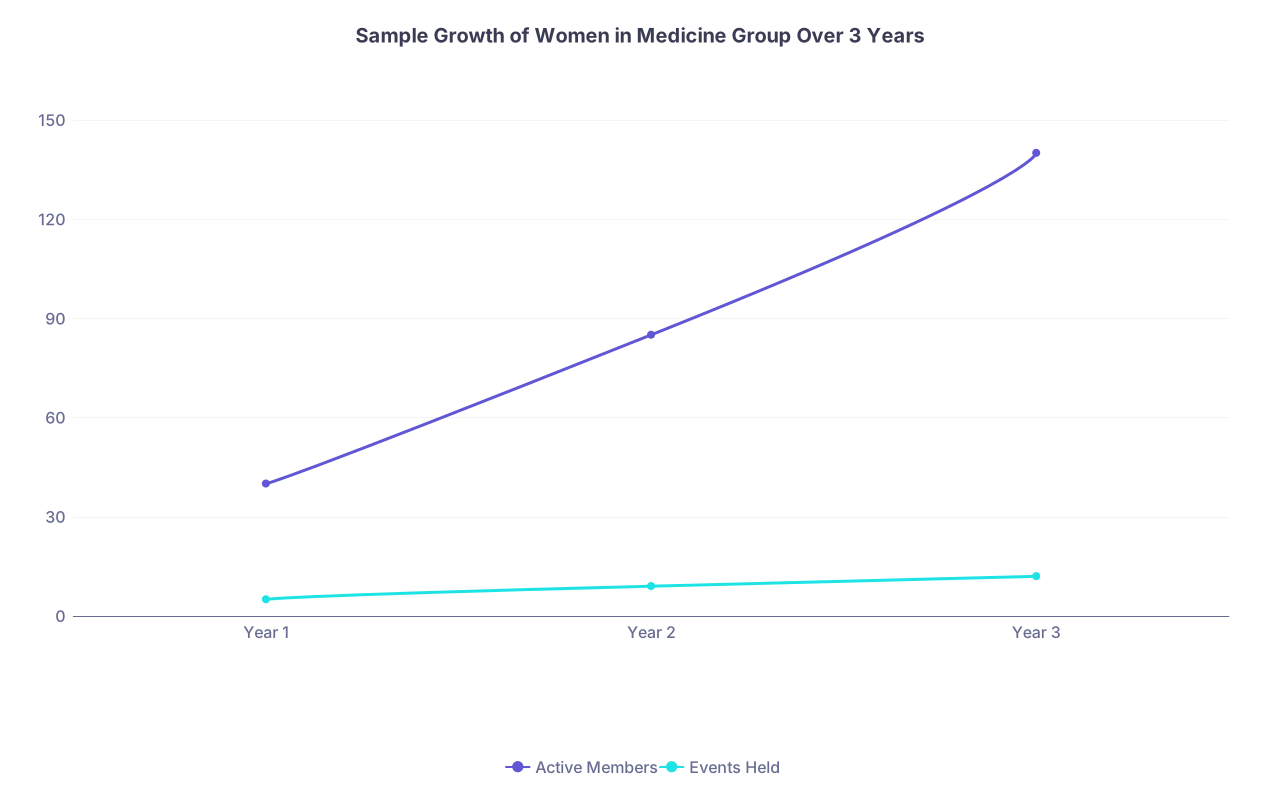
| Category | Active Members | Events Held |
|---|---|---|
| Year 1 | 40 | 5 |
| Year 2 | 85 | 9 |
| Year 3 | 140 | 12 |
This is how you convert “nice-to-have” into “strategic institutional asset.”
Step 11: Plan for Succession and Longevity From Day One
You will graduate. You will move. You will get promoted and overwhelmed. If the group depends on 1–2 heroic founders, it will collapse when they leave.
Build redundancy:
Co-leads at every level
- Student co-leads from different years.
- Resident co-leads from different PGY levels.
- At least two faculty in core leadership.
Annual leadership transition cycle
- Set fixed dates (e.g., March–May) for:
- Recruiting new leaders.
- Handing off folders and passwords.
- Shadowing meetings.
- Set fixed dates (e.g., March–May) for:
Written “How to Run This Group” guide
- 3–5 pages, max.
- Contents:
- Annual calendar.
- Checklists for:
- Planning events.
- Budget requests.
- Reporting.
- Contacts in admin offices.
Institutional anchoring
- Get your group listed:
- On the medical school or hospital website.
- In new faculty/trainee orientation materials.
- Ensure at least one senior leader has “liaison to Women in Medicine group” in their official duties.
- Get your group listed:

| Step | Description |
|---|---|
| Step 1 | Q1 - Launch & Listening |
| Step 2 | Q2 - Mentorship Events |
| Step 3 | Q3 - Skills Workshops |
| Step 4 | Q4 - Policy Forum |
| Step 5 | Annual Report |
| Step 6 | Leadership Recruitment |
This is how you turn a one-generation project into a permanent fixture.
Step 12: Anticipate and Handle the Pushback
If your group does anything meaningful, you will get resistance. Sometimes subtle, sometimes not.
Common patterns and how to respond:
“Why do we need a women-only group? That seems exclusionary.”
- Response:
- “Women remain underrepresented in leadership and overrepresented in burnout and attrition. This group addresses those inequities through mentorship and professional development. We also run allyship sessions open to everyone.”
- Response:
Tokenization
- Admins trying to use you as proof that “everything is fine now.”
- Response:
- Keep your own narrative. Your annual report should tell an honest story:
- Progress and remaining gaps.
- When leadership asks you to present, include data and challenges.
- Keep your own narrative. Your annual report should tell an honest story:
Overload of “Can you take this on too?”
- You get flooded with every women-related task.
- Response:
- Develop a simple intake process:
- The leadership team reviews requests monthly.
- You say yes to projects aligned with your mission and with realistic scope.
- You explicitly say no (or “not this year”) to everything else.
- Develop a simple intake process:
Internal conflict
- Differences between students vs. faculty priorities.
- Differences between specialties.
- Response:
- Use your mission and Year 1/Year 2 priorities as the filter.
- Create separate subgroups if needed:
- Student wing, resident/fellow wing, faculty wing.
Pulling It All Together
If you want a Women in Medicine group at your institution, here is your stripped-down protocol:
- Start with a one-page mission and 2–3 concrete Year 1 goals. Do not crowdsource this to 20 people.
- Anchor the group to an institutional office that has budget, visibility, and longevity. Secure specific support, not vague encouragement.
- Build lean structure and high-value, low-noise programming: a few strong events that deliver mentorship, skills, and real discussion of structural barriers.
You do not need permission to care about women in medicine. You need a plan. Now you have one.