
The unpaid “office mom” work you are doing is not invisible. It is subsidizing your colleagues’ careers and your institution’s metrics. And if you do not put a structure around it, it will quietly devour your time, your promotion prospects, and your sanity.
You do not have to stop caring. You do have to stop giving it away for free.
This is a playbook for turning “office mom” labor into:
- protected time
- formal roles
- promotion currency
- or direct compensation
And, when necessary, for saying “no” in a way that still protects learners and patients.
Step 1: Name the Work and Quantify It
You cannot negotiate what you have not defined. Start by turning the vague “I do so much random stuff for everyone” into hard data.
1. Run a two-week “service audit”
For the next 14 days, track every office-mom-type task. Every one.
Examples of what counts:
- Being the informal counselor for residents after a rough call
- Organizing birthday celebrations, farewell events, or team-building
- Taking notes in meetings “because you’re organized”
- Managing the residency morale committee that is not actually in your job description
- Fixing clinic workflows, unread messages, or scheduling chaos that “somebody had to handle”
- Diversity, equity, inclusion, or wellness work no one formally assigned you
- Mentoring “just one more” struggling trainee because “they open up to you”
- Smoothing interpersonal conflicts between colleagues
- Drafting emails, policies, or initiatives that a male colleague “came up with” but does not execute
- Being the default contact for angry families or distressed patients
Log it in a simple table or note app:
- Date
- Task
- Who asked (or if self-initiated)
- Time spent
- Outcome (what changed / who benefited)
After two weeks, extrapolate to a typical month.
| Category | Tasks Count | Total Hours | Extrapolated Hours/Month |
|---|---|---|---|
| Mentoring / Support | 8 | 4.5 | 9 |
| Admin Glue Work | 10 | 5 | 10 |
| Culture / Wellness | 6 | 3 | 6 |
| DEI / Advocacy | 3 | 2 | 4 |
| Conflict Smoothing | 2 | 1.5 | 3 |
This is no longer “just helping out.” This is a 30–40 hour per month unpaid role.
2. Map each task to institutional value
Your chair does not care that you are “nice.” They care about:
- Retention
- Patient satisfaction
- Learner outcomes
- Accreditation boxes
- Burnout metrics
- DEI dashboards
Translate your list into their language. For each item, ask: “What metric did this protect or improve?”
Example mapping:
- Resident support → lower burnout, fewer remediation cases, better ACGME survey scores
- Workflow fixes → improved clinic throughput, fewer safety events
- DEI work → helps meet LCME/ACGME/Joint Commission expectations
- Team cohesion → lower turnover, better engagement scores
Write that down explicitly. You’ll need it for the pitch.
Step 2: Triage Your “Office Mom” Portfolio
Not all of this work deserves the same future.
Split your list into three buckets:
- Keep and formalize – work aligned with your values and career trajectory
- Transition and share – work that matters but should not rest on you alone
- Drop or decline – work that exists only because leadership is lazy or colleagues are coasting
Be ruthless. This is where most women in medicine get stuck because they conflate “being a good person” with “never letting a ball drop.”
You are allowed to let balls drop. Especially the ones others threw at you without consent.
1. Keep and formalize
Ask yourself:
- Does this align with my promotion path? (education, quality, leadership, DEI)
- Would this look legitimate as a bullet point on my CV?
- Does this give me energy rather than only draining it?
- Is this work someone would pay a consultant to do?
Examples:
- Running a structured mentorship program for residents
- Chairing a wellness committee that produces actual deliverables
- Leading an initiative on gender equity, pay parity, or clinical process redesign
These are candidates for:
- Protected time
- Formal title
- Committee chair position
- Academic credit and promotion letters
- Stipend or leadership pay
2. Transition and share
These are things that need to happen, but not all by you:
- Birthday and social event planning
- Taking minutes for every meeting
- Being the only person who residents trust when things go bad
- Being the default for every family conflict
Plan to:
- Rotate these responsibilities
- Create simple processes others can follow
- Train successors or co-leads
- Build “coverage plans” so you’re not always on-call for emotional emergencies
3. Drop or decline
Examples:
- Cleaning up after every meeting
- Being the only person who checks in on “difficult” colleagues
- Unpaid “advisory” work for leadership that never gets acknowledged on paper
- Any “can you just” task that isn’t in anyone else’s job description either
These you will gradually stop doing. Some by quietly backing away. Some by explicit no.
Step 3: Turn Invisible Labor into a Defined Role
You do not walk into your chair’s office and say, “I feel like I do a lot.” That conversation goes nowhere.
You walk in with a short, structured memo that treats this as programmatic work.
1. Write a one-page “role brief”
Four sections. One page. No novel.
Title (proposed):
- Director of Resident Well-being
- Faculty Mentor for Underrepresented Trainees
- Clinic Culture and Team Development Lead
- Associate Director for Wellness and Professionalism
Purpose (1–2 sentences)
Example:
“Provide structured support to residents to reduce burnout, improve ACGME survey scores, and decrease remediation and attrition by formalizing the existing informal mentorship and support role currently occupied by Dr. X.”Key responsibilities (bullet list, 5–7 max)
Be specific, outcome-focused:- Monthly confidential check-in sessions for residents with high risk of burnout or remediation
- Design and implement two wellness or resilience workshops per year
- Serve as liaison between residents and program leadership for culture concerns
- Track and report quarterly on resident engagement and satisfaction indicators
Proposed resources / compensation
- X half-day per week of protected time
- Stipend of $Y per year (if norm at your institution)
- Administrative support for scheduling and data tracking
- Formal recognition of role in title and promotion letters
You’re essentially saying: “This thing I am doing? It is already a job. Let us call it what it is.”
Step 4: Convert to Protected Time or Compensation
You now have:
- A quantified time burden
- A mapping to institutional priorities
- A proposed formal role
Now you negotiate.
1. Know your department’s currency
Different places pay you in different ways:
| Currency Type | Examples |
|---|---|
| Time | Protected half-days, clinic reduction |
| Title | Director, Associate Program Director |
| Money | Stipend, leadership pay, bonus |
| Promotion Capital | Committee chair, letters, academic credit |
Decide your priority. For many women in medicine, protected time is more valuable than a tiny stipend.
2. Script the ask
Do not wing it. Use tight, neutral language.
Example for a division chief or chair:
“Over the past year I have been informally doing a significant amount of resident support, conflict mediation, and culture work. I tracked it over the last month. It is consistently 25–30 hours per month, which is about 0.2 FTE.
These activities have:
- Reduced the number of resident crises escalated to you or GME
- Helped improve ACGME survey items around well-being and leadership responsiveness
- Supported retention of two residents who were strongly considering leaving the program
I would like to align this work with department priorities and formalize it. I have drafted a one-page role description for a ‘Director of Resident Well-being’ position that reflects what is already happening, with clear responsibilities and outcomes.
To continue this work sustainably, I am requesting:
- 0.1 FTE protected time, and
- Formal recognition of this role in my title and promotion plan.”
Then stop talking. Let them sit with it.
3. Anticipate and counter the usual objections
You will hear some version of:
- “But everyone helps out in these ways.”
- “We do not have the budget this year.”
- “Let us wait and see after the next fiscal cycle.”
- “We need you to keep doing this, but we cannot formally acknowledge it yet.”
Prepare clear, non-apologetic responses.
Objection: “Everyone helps out this way.”
Response:
“I agree everyone contributes. The difference here is the systematic volume and the level of responsibility. I am being approached for resident crises, mediation, and ongoing support 3–4 times per week. That pattern is why I tracked it and proposed formalizing it, so that we can treat it as a defined role that supports our metrics rather than an invisible burden on one person.”
Objection: “We do not have budget.”
Response:
“Understood. We can structure this as protected time without a stipend. For example, a 0.1 FTE reduction in clinic or call, with my RVU targets adjusted accordingly. If we cannot adjust RVUs or call, then I would need to scale back this work to protect my current responsibilities.”
You are forcing them to confront the tradeoff: either support it, or lose it.
Objection: “Let us revisit this next year.”
Response:
“I am open to that if we can set a concrete plan. For the next 6 months, I would like written confirmation that this work will be recognized in my annual review and promotion letter, including my leadership in resident well-being and culture. I will also need to cap my time to 5 hours per week until we formalize protected time, to remain within my current FTE.”
You are not waiting passively. You are setting boundaries while the can gets kicked.
Step 5: Make Sure It Counts for Promotion
Too many people win the “nicest colleague” award and lose at promotion because none of this is on paper.
1. Translate tasks into CV language
Example before/after:
- Before: “I informally mentor residents and help with wellness.”
- After:
- “Developed and led a resident wellness and professional development initiative, including monthly small-group sessions and individual coaching, reaching 32 residents annually.”
- “Served as primary faculty mentor for 8 residents per year, focusing on burnout, remediation risk, and professional identity formation.”
2. Get formal letters and documentation
Ask your program director, GME office, or chair to:
- Mention your role in their annual letter for your file
- Include specific language on impact: decreased attrition, improved survey scores, resident feedback
- Name you explicitly in program documents (handbooks, websites)
If you are the one rewriting the handbook or onboarding docs (of course you are), make sure your role appears there with a title.
3. Tie to promotion criteria
Most medical schools have buckets for:
- Education
- Service
- Leadership
- Quality improvement
Your office mom work fits these. Align descriptions with those headings. Make it idiot-proof for promotion committees.
Step 6: Build Systems So It Is Not All on You
The trap is: you fix everything personally, and leadership shrugs because “it just seems to get handled.”
Break that pattern.
1. Replace ad-hoc helping with structured offerings
Instead of:
- Individual vent sessions every time a resident is upset
- Random last-minute event planning
- Constant “drop by my office anytime” emotional labor
Shift to:
- Scheduled office hours for mentorship (2–4 hours/month)
- A defined peer support or wellness group with clear dates
- A once-per-quarter facilitated debrief after hard rotations
- A resident-run social committee that you advise, not manage
You are still caring. You are just not running an informal 24/7 urgent care for everyone’s emotions.
2. Pull others into the work
Stop being the only emotional adult in the room.
Ways to distribute:
- Create a small “culture team” or “resident support team” with 3–5 faculty
- Rotate on-call for urgent issues weekly or monthly
- Establish a rotating “meeting scribe” instead of you always taking notes
- Pair junior faculty with you for shadowing, so they learn and later take on pieces
Spell this out in email or policy, so it becomes a default structure, not a one-off favor.

| Step | Description |
|---|---|
| Step 1 | Current State - One Person |
| Step 2 | Track and Quantify Work |
| Step 3 | Define Formal Role and Scope |
| Step 4 | Create Structures - Office Hours, Groups |
| Step 5 | Recruit Faculty Team |
| Step 6 | Set Rotations and Coverage |
| Step 7 | Negotiate Protected Time and Credit |
Step 7: Say “No” Without Burning Bridges
You will still get asked. Constantly. Being effective just makes them ask more.
You need canned responses that:
- Protect your time
- Keep relationships intact
- Sometimes push people toward a system instead of you
1. No, with redirection to a system
“I am not able to take on another standing mentee right now. The resident wellness group meets the first Thursday each month and is designed for exactly this kind of support. If they need urgent help, they should contact [X] from the resident support team.”
2. No, with boundary plus alternative
“I cannot organize this farewell event, but I am happy to share a simple template and vendor list the team can use. I will email it to you and you can decide who wants to lead.”
3. No, with institutional framing
“I have already committed my community and wellness work to our DEI committee and resident support role at 0.1 FTE. To maintain sustainable workload and meet my clinical and academic expectations, I am not taking on additional unpaid service this year.”
You do not need to apologize. You are literally protecting patient care by avoiding burnout.
Step 8: Use Data and Stories to Solidify Your Case
Numbers get attention. Stories create urgency. Use both.
1. Track simple outcome metrics
You do not need a randomized trial. Start basic:
- Number of residents you meet with per month
- Number of crises prevented or de-escalated (documented briefly in a confidential log)
- ACGME survey items related to program responsiveness, wellness, and support
- Turnover or remediation trends over 1–2 years
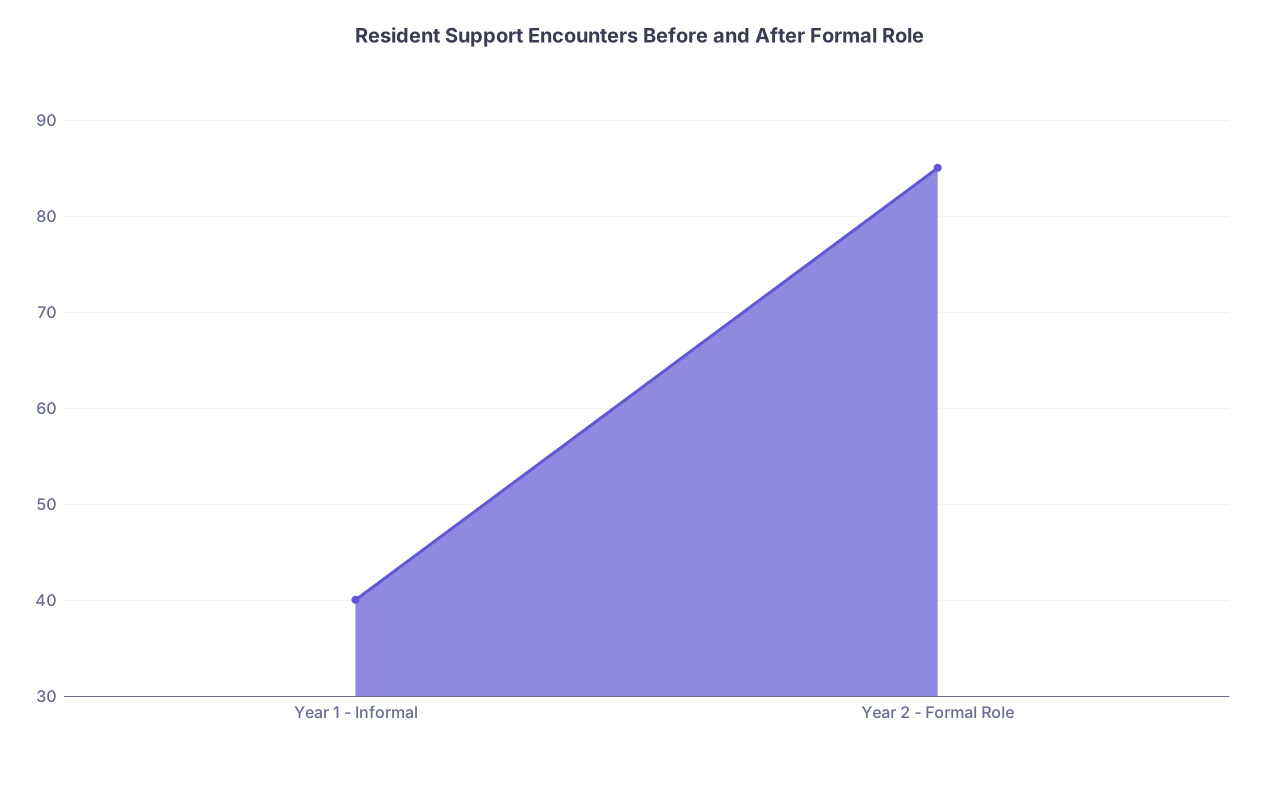
| Category | Value |
|---|---|
| Year 1 - Informal | 40 |
| Year 2 - Formal Role | 85 |
Then link the increased encounters to fewer escalated crises, fewer resignations, or improved surveys.
2. Collect qualitative feedback
Ask residents and colleagues for short written comments you can quote (de-identified in broader communications, named in your promotion packet with permission):
- “Having Dr. X as a designated person to talk to kept me from quitting mid-year.”
- “The wellness sessions changed how our class talked about mistakes and burnout.”
Keep these in a simple folder. They are gold.
Step 9: Protect Your Ethics While Protecting Yourself
There is an ethical tension here: you see suffering and dysfunction; you know you can help; the system exploits that. How do you live with that?
Here is the line I use:
You have an ethical obligation to patients and learners.
You do not have an ethical obligation to subsidize institutional failure with your unpaid labor indefinitely.
A few practical guardrails:
Safety first. Never withhold support that would prevent harm. If someone is acutely unsafe, you act. You also follow up by telling leadership that this was the third such incident and the system needs fixing. Not just you patching the leak.
Escalate patterns. If you see repeated issues (bullying attending, impossible workload, unsafe staffing), you document and escalate formally instead of only absorbing the emotional fallout.
Avoid becoming the institutional shock absorber. Your role is not to make a toxic environment “tolerable” without changing it. Use your position to push for systemic change, not endless individual coping.
Step 10: Recognize When the Answer Is to Leave
If your institution:
- Refuses to acknowledge the workload
- Uses your care as leverage against you (“but the residents need you”)
- Punishes you informally when you set boundaries
- Never converts this work into time, money, or promotion currency
You are not being valued. You are being used.
At that point, the “office mom” question becomes a broader one about your career and values. Many women I have worked with found:
- A different department that gave them real leadership roles
- A smaller institution that truly needed and protected this work
- Non-clinical roles in GME, wellness, or DEI with proper titles and FTE
There is nothing noble about burning yourself out to keep a dysfunctional system running.
Open your calendar for the next two weeks and block 10 minutes at the end of each workday. Use that time to log every office mom task you did that day. At the end of those two weeks, sit down with the list, highlight what you want to keep, and draft a one-page role brief for just one of those areas. That document is your first lever to turn invisible labor into protected time or pay.