
The biggest mistake female attendings make with salary is assuming the system will be fair if they “just work hard.” It will not. You have to engineer fairness. On purpose.
This is your playbook for doing exactly that.
You are not here for another vague pep talk about “knowing your worth.” You are here to walk into an office (or Zoom) with receipts, leverage, and a clear script that gets you paid closer to what you are actually generating.
Let us get concrete.
1. Understand the Game You Are Actually Playing
Negotiation in medicine is not a pure meritocracy. It is a power game wrapped in polite language and “budget constraints.”
Here is what you are up against as a female attending:
You are statistically more likely to:
- Be offered a lower starting salary.
- Be given vague compensation structures (“we’ll see after your first year”).
- Get less protected time and more service work.
- Be penalized socially for being “too assertive” in negotiations.
You are less likely to:
- Be told what male colleagues are actually earning.
- Be automatically slotted into leadership or high-RVU roles.
- Be volunteered for lucrative call or procedural work (unless it benefits the department more than you).
I am not saying this to discourage you. I am telling you where the traps are so you stop stepping in them.
Your leverage comes from three things:
- Market data – what comparable jobs are paying.
- Your measurable value – RVUs, downstream revenue, leadership, quality metrics.
- Your alternatives – other offers or credible exit options.
Everything in this playbook is about increasing one or more of these.
2. Do the Unsexy Work: Data, Not Feelings
Walking in saying “I feel I deserve more” is weak. Walking in saying “Here is how my current offer compares to MGMA 60th percentile for my specialty and region, and here is the net revenue I generate” is strong.
Step 1: Get Real Compensation Benchmarks
You need actual numbers, not rumors.
Sources:
- MGMA or AMGA data (often via:
- Your institution’s library.
- A friendly administrator.
- Specialty society summaries.)
- Specialty-specific surveys:
- ACEP, ACOG, AAN, ACR, ACC, etc. Most publish periodic compensation reports.
- Doximity Compensation Reports and Medscape Physician Compensation Report (crude, but directionally useful).
- State or public institution salary databases for public universities / state systems.
Capture at least:
- Base salary percentiles (25th, 50th, 75th) for:
- Your specialty.
- Your region.
- Your practice setting (academic vs community vs private).
Now organize that in a simple comparison.
| Metric | Your Offer | Specialty Median | Specialty 75th % |
|---|---|---|---|
| Base Salary | $245,000 | $270,000 | $310,000 |
| wRVUs Target | 6,000 | 5,500 | 6,000 |
| Call Stipend (per shift) | $350 | $600 | $800 |
| Signing Bonus | $10,000 | $20,000 | $30,000 |
Now you are not “complaining.” You are showing misalignment.
Step 2: Quantify Your Value to the Institution
Most attendings underestimate how much money they generate. Especially women.
You want:
- Your RVUs (past 12–24 months).
- Collection rates if available.
- Procedures you perform and their typical RVU values.
- Downstream value:
- Admissions you trigger.
- Imaging, procedures, referrals.
- Nonclinical value:
- Leadership roles.
- Committee work.
- Quality improvement that saved money or improved metrics (readmission reduction, throughput, etc).
- Teaching and program development.
If you are early-career, project based on average RVUs/volume per FTE at your site or compare to similar clinicians in your group.
If you can get a simple productivity report from billing or admin, do it. If not, keep your own log for 3–6 months.
Now you can say something like:
- “Over the last 12 months I generated 7,100 wRVUs. MGMA median for my specialty is 5,800. My current base places me below the 40th percentile while my productivity is above the 70th percentile.”
That sentence is money.
3. Pre-Negotiation: Fix Your Positioning Before You Talk Numbers
Most women start negotiating at the wrong time and in the wrong frame. You want to fix both.
When to Negotiate
- Best time: Before you sign your initial contract.
- Next best: At clear inflection points:
- Completion of probationary period (usually 1–3 years).
- New leadership role or program you started.
- Significant RVU overperformance.
- New board certification or marketable skill (e.g., new procedure).
- Competing offer.
Do not wait for “annual review season” if your leverage just changed now.
Decide Your Targets Before You Walk In
Three numbers:
- Your Ideal Number – Slightly aggressive but justifiable by data.
- Your Acceptable Number – You sign this and sleep fine.
- Your Walk-Away Point – Below this, you decline or start planning your exit.
Write them down. On paper. Women are more likely to cave under social pressure without a pre-committed floor.
Now convert salary into a package:
- Base salary.
- Bonus structure (RVU-based, quality-based).
- Call pay.
- Protected time.
- Nonclinical pay for admin / teaching.
- Signing bonus / relocation.
- CME money and time.
- Vacation / parental leave.
- Partnership track (if private practice).
Several of these are easier to move than base salary. You care about the sum.
4. Script the Conversation: Exact Phrases That Work
You should not “wing it.” That is how you get steamrolled by a seasoned department chair or CFO who negotiates every week.
Write a one-page negotiation script. Practice out loud.
Opening the Conversation
You can use a simple, neutral opener:
- “Thank you for the offer. I am very interested in this position and want to make it work. I have reviewed compensation benchmarks for my specialty and region and I would like to discuss a few adjustments to bring this closer to market.”
Now you have:
- Affirmed interest (reduces defensiveness).
- Placed the frame on “market alignment,” not personal preference.
Presenting Your Data
Think: short, clear, evidence-based.
- “Based on MGMA and Doximity data, the median base salary for a [specialty] in [region] is approximately $X–Y. The current offer of $Z places this below the 40th percentile. Given my fellowship training in [subspecialty] and my expected productivity, I would be more comfortable at $[target], which is in line with the 60th–70th percentile.”
Or if you are already there:
- “Over the past year I have consistently produced [X] wRVUs, which is [Y]% above our departmental target. My current compensation is aligned with the [30th–40th] percentile for my role, while my productivity is closer to the [70th] percentile. I am requesting an adjustment to bring my compensation in line with that performance.”
Notice what you are not saying:
- “I need more because daycare is expensive.”
- “I feel underpaid.”
- “I heard so-and-so makes more.”
You keep it professional and data-driven.
Handling Pushback: Common Lines and How to Respond
You will hear some version of these. Plan your responses now.
“We do not have the budget.”
Response:
- “I understand budget constraints are real. What I am asking for is alignment with market and my productivity. If base salary cannot move to that level, I would like to explore other levers—such as RVU rate, call stipend, or a structured bonus tied to productivity above target.”
Translation: You are flexible on mechanism, not on total value.
“This is what we pay all new hires.”
Response:
- “Consistency is important. At the same time, markets change quickly, and compensation benchmarks have shifted significantly in the last few years. My ask is based on current data and my specific skill set in [X]. How can we structure this so that I am not starting out below market for this role?”
If they really mean it, push for:
- Accelerated raise schedule.
- Guaranteed review at 12 months with specific metrics tied to a bump.
“If we pay you that, everyone will want more.”
Response:
- “If other physicians are performing at a similar level and are below market, then aligning them would help with both recruitment and retention. For my situation, I am basing my request on objective benchmarks and my performance data. I would like my compensation to reflect that.”
“We value you, but this is the best we can do.”
Response:
- “I appreciate that, and I value this team as well. Let me be transparent. At this number, I would be accepting a compensation package significantly below market and below what I have been offered elsewhere. If we can close the gap to [your acceptable number] through a combination of base, bonus, and call pay, I am prepared to commit here for the long term.”
You are signaling: I have options. I am reasonable. I am not desperate.
5. Protect Yourself from Gender Bias During Negotiation
You are not negotiating in a vacuum. You are negotiating in a system where women are often labeled “demanding” for behavior that gets men called “strong leaders.”
You cannot fix that entire system today. But you can reduce how much it hurts you in this conversation.
Calibrate Your Style: Firm + Warm
Research is very clear: women who negotiate for themselves get penalized more unless they frame it as aligned with group benefit.
So use that. Without groveling.
- “I want my compensation to be sustainable so I can stay here long term and continue building this program.”
- “Aligning my compensation with my productivity will make it easier for me to keep saying yes to new initiatives that support the department.”
But do not soften every sentence with apologies:
- Cut: “Sorry, I hate to ask, but…”
- Add: “One thing I would like to address is…”
Bring Receipts, Not Emotion
You reduce bias when you lean on:
- External benchmarks.
- Written reports.
- Specific metrics.
Not how “frustrated” you feel.
Bias thrives on subjectivity. Kill the subjectivity.
Consider an Advocate
If there is:
- A division chief who values you.
- A mentor in leadership.
- A senior woman (or man) who has already battled this system.
Loop them in before the negotiation.
Ask directly:
- “Can you review my ask and tell me if these numbers are reasonable?”
- “Would you be willing to support this with [Chair/HR] based on my performance?”
Sometimes the most effective sentence in the room is not uttered by you; it is spoken by the person two chairs up the hierarchy.
6. Use the Whole Package: Not Just Base Salary
Institutions sometimes have rigid base salary structures on paper but a lot more flexibility on the edges.
If they dig in on base, start slicing the package.
Areas to move:
RVU Rate / Productivity Bonus
- Higher dollars per wRVU.
- Lower threshold before bonus kicks in.
- Guaranteed minimum bonus in year 1–2.
Call Pay
- Higher per shift rate.
- Extra pay for holidays or short-notice coverage.
- Cap on mandatory unpaid call.
Protected Time
- Written, scheduled nonclinical time for admin / research / teaching.
- This protects you from the classic “Sure, you are research faculty—now cover these 14 extra clinics.”
Nonclinical Stipends
- Extra pay for:
- Program director roles.
- Committee chair roles.
- Quality improvement leadership.
- Extra pay for:
Upfront Money
- Signing bonus.
- Retention bonus structured over 2–3 years.
- Relocation reimbursement.
- Loan repayment contributions.
Schedule and Flexibility
- 4-day weeks for 1.0 FTE pay if your productivity supports it.
- Hybrid telehealth days.
- Tailored call schedule during pregnancy / new parenthood.
Think of your life, not just your paycheck. Money and time are both leverage.
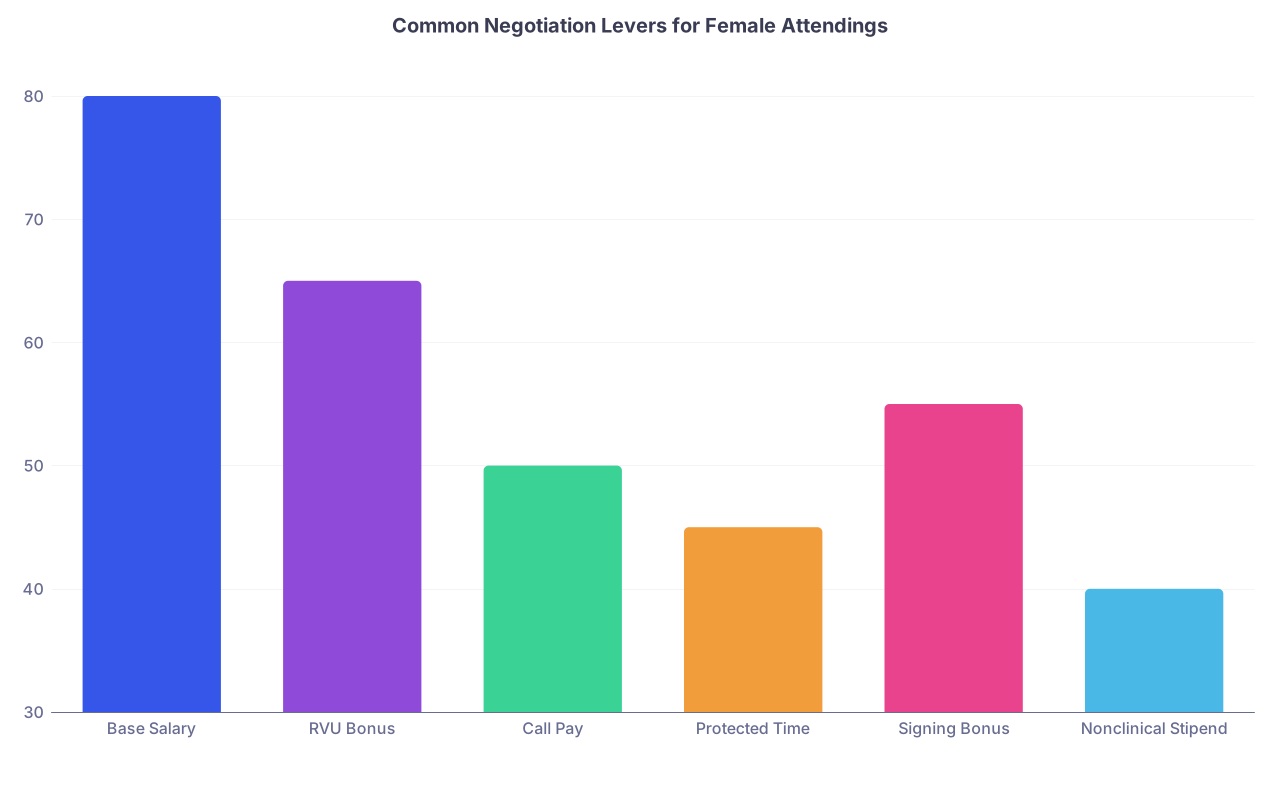
| Category | Value |
|---|---|
| Base Salary | 80 |
| RVU Bonus | 65 |
| Call Pay | 50 |
| Protected Time | 45 |
| Signing Bonus | 55 |
| Nonclinical Stipend | 40 |
(Values represent how often I see each lever successfully moved, as a rough percentage out of 100 negotiations.)
7. If You Already Signed a Bad Deal: How to Fix It
You may be reading this three years into a contract that underpays you by $50k. Fine. You start from where you are, not where you wish you were.
Step 1: Build a Performance Dossier (3–6 Months)
For the next few months, gather:
- Monthly RVUs and encounters.
- Call shifts worked.
- Quality metrics you influenced (LOS, readmissions, door-to-needle, etc).
- Teaching evaluations.
- Leadership tasks (with time spent).
Create a one-page summary like:
- “Past 12 Months: 7,200 wRVUs (Department target: 5,800).”
- “Average patient satisfaction: 4.7/5 vs department mean 4.3.”
- “Led [X] quality project resulting in [Y] outcome.”
- “Took [X]% more call than departmental average.”
Step 2: Time Your Ask
Pick:
- Contract renewal or anniversary.
- Annual review.
- Or right after a big win (grant, new program, external recognition).
Send a short email to set the meeting:
- “I would like to schedule time to review my compensation in light of my productivity and contributions over the last year. I have collected some data that I would appreciate discussing with you.”
Step 3: Present a Clear Proposal
Do not just say “I want more.” Ask for something specific.
- “Based on my productivity and current benchmarks, I am requesting:
- An increase in base salary from $X to $Y (aligned with MGMA 60th percentile).
- And a revised RVU bonus structure at $Z per wRVU over 6,000.”
If they say they cannot change the contract mid-term, push for:
- A written amendment or addendum.
- Or a guaranteed raise schedule for the next cycle tied to specific metrics you have already met.

| Step | Description |
|---|---|
| Step 1 | Collect 6 months data |
| Step 2 | Benchmark against market |
| Step 3 | Draft one page summary |
| Step 4 | Request meeting |
| Step 5 | Present data and proposal |
| Step 6 | Get changes in writing |
| Step 7 | Negotiate alternate levers |
| Step 8 | Decide stay with plan or seek offers |
| Step 9 | Admin response |
8. Ethics, Fairness, and Your Responsibility to Other Women
Let us talk ethics, because this is not just personal finance. It is professional integrity.
Under-Negotiating Has Collateral Damage
When you accept significantly below-market pay as a female attending:
- You become data that justifies low offers to the next woman.
- You undercut colleagues trying to raise standards.
- You signal that female labor is cheaper for the same work.
You are not obligated to burn your life down in the name of the sisterhood. But you are responsible for not quietly reinforcing inequity when you have the tools to resist it.
Negotiating fairly is not selfish. It is corrective.
Transparency Is an Ethical Tool
Secrecy keeps women underpaid.
You do not have to blast your salary on social media. But you should:
- Swap numbers with trusted colleagues, especially other women and underrepresented physicians.
- Be specific: “My base is $X, bonus structure is Y, call pay is Z.”
- Share your negotiation strategy with residents and fellows.
If you are senior and well-compensated, be explicit:
- “I negotiated hard for this, and you should too. Here is exactly what I did.”
This is how you build informal collective bargaining power in a profession that often resists formal unions.
Do Not Apologize for Wanting Fair Pay
There is nothing unethical about asking to be paid what your work is worth. There is something ethically questionable about institutions that rely on your reluctance to ask.
9. Concrete Prep Checklist Before Any Salary Meeting
Here is your pre-meeting checklist. Print it. Use it.
1–2 weeks before the meeting:
- Obtain last 12–24 months of:
- RVUs
- Clinic sessions / shifts
- Call shifts
- Gather performance metrics:
- Patient satisfaction
- Quality metrics
- Teaching scores
- Collect leadership / committee roles and time.
- Pull updated compensation benchmarks (MGMA, Doximity, specialty reports).
- Identify:
- Ideal number.
- Acceptable number.
- Walk-away threshold.
- Write a one-page summary:
- Brief intro.
- 3–5 bullets on value produced.
- 1–2 bullets on market benchmarks.
- Clear ask.
Practice:
- Rehearse your opening line and key sentences out loud 3–5 times.
- Role-play with a trusted colleague or mentor, including pushback scenarios.
- Decide in advance:
- Which levers you are open to (bonus, call pay, protected time).
- Which are non-negotiable.
Day of:
- Bring:
- Printed one-pager.
- Benchmark tables.
- Notebook to record responses.
- Start by expressing interest and commitment to the role.
- Present data calmly, slowly, and without apology.
- Ask for time-limited next steps if they need to “check with admin.”
- “When could we follow up on this? Would next week be reasonable?”
And afterward:
- Send a brief recap email:
- “To summarize our conversation today…” with your understanding of what was agreed to or what is being considered.
- Do not rely on verbal promises. Ask for updated contract language or written confirmation.
Key Takeaways
- Stop appealing to “fairness” in the abstract. Use hard data, clear benchmarks, and specific productivity numbers.
- Prepare like this is a procedure: script your lines, anticipate complications, and know your thresholds before you start.
- Remember that negotiating for fair pay is not just personal. It shifts the baseline for every woman who comes after you.