
The unspoken rule in academic medicine is brutal: if you wait for “them” to notice you deserve promotion, you will wait forever.
You are not being “overlooked.” You are being systemically under-advocated. That is fixable—but not by working harder and hoping. It is fixed by running a promotion campaign as deliberately as you would run a clinical trial.
Here is the structured way to do it.
1. Stop Treating Promotion as a Favor
Promotion is not a gift from the chair. It is a business decision based on evidence. Women in medicine are often socialized to be “grateful” for opportunities and to avoid being “pushy.” That mindset kills careers.
Reframe the entire thing:
- You are offering the department a documented record of value.
- You are asking them to apply their own written criteria consistently.
- You are not begging. You are making a case.
I have watched too many excellent women say, “My chair will tell me when I am ready.” That almost always translates to, “I will get promoted 3–5 years later than my male peers.”
You need a system.
2. Map the Actual Rules: Promotion Criteria and Politics
Before you do anything else, you need to understand both:
- The official rules (written criteria).
- The unofficial rules (how promotions actually happen in your shop).
2.1. Gather the Official Data
Go to your institution’s promotion and tenure (P&T) website and pull:
- Faculty handbook or P&T guidelines
- Track-specific criteria (clinician-educator, tenure, research, etc.)
- Examples of successful dossiers, if available
- Timelines and deadlines for the next promotion cycle
Then create a simple comparison map.
| Area | Written Requirement | Where You Stand (Now) |
|---|---|---|
| Rank Sought | Associate Professor | |
| Track | Clinician-Educator | |
| Teaching | Strong evaluations + portfolio | |
| Scholarship | 8–10 peer-reviewed pubs, some 1st/last | |
| Service | Institutional committees, leadership |
Fill that third column brutally honestly. No spin. No excuses.
2.2. Learn the Unwritten Rules
This is where women get blindsided. On paper, criteria look clean. In practice, they are bent, stretched, and selectively enforced.
You need intel from people who have:
- Been promoted in the last 3–5 years.
- Sat on P&T or departmental promotion committees.
- Seen multiple cases go through.
Ask them very specific questions:
- “For my track and department, what actually blocks promotion?”
- “What do they love to see in a file—what makes it easy to say yes?”
- “Who are the ‘no’ votes I need on my side early?”
- “How many publications / what kind of teaching documentation did you actually have when promoted?”
Do not ask, “Do you think I am ready?” People will dodge. Ask, “If I were on the committee right now, where would I see red flags in my file?”
3. Construct a Promotion Readiness Grid
You cannot advocate for what you have not measured. Build yourself a readiness grid that mirrors the formal criteria.
3.1. Build the Grid
Open a spreadsheet and create rows for each domain:
- Clinical work
- Teaching
- Scholarship / research
- Educational leadership (if applicable)
- Administrative leadership
- Service (local, regional, national)
- Reputation and impact
- Professionalism / citizenship
Then create columns:
- Required for rank
- Your current evidence
- Gaps
- Plan and timeline
It might look like this:
| Domain | Required for Associate Prof | Your Evidence Now | Gap | Action Plan |
|---|---|---|---|---|
| Teaching | Documented excellence, portfolio | High evals, no formal portfolio | Need structured portfolio | Build portfolio by Sept |
| Scholarship | 8–10 papers, some 1st/last | 6 papers, 2 first author | 2–4 more pubs, more senior role | Submit 2 manuscripts this year |
| Service | Department + national roles | 2 dept committees | No national involvement | Join 1 society committee |
Once you see it like this, the conversation with your chair stops being vague (“I think I am doing well?”) and becomes specific (“I meet 4/5 criteria; here is my documented evidence; let us talk timeline.”).
4. Pre-Game: Build the Evidence File
Promotion in academic medicine is paperwork warfare. The side with the better documentation wins. Women often underestimate their impact because:
- They do not track what they do.
- They do not translate work into “promotion language.”
- They minimize their role in multi-person efforts.
Fix that.
4.1. Convert Work into Evidence
For every activity, ask: “How would I prove this to a skeptical committee member who has never met me?”
Collect:
Teaching
- Aggregate student / resident evaluations.
- Emails requesting you to teach again.
- Teaching awards or nominations.
- Syllabi, curricula, sessions you created.
Clinical
- Letters from service chiefs about your volume/complexity.
- Data on RVUs, patient satisfaction, throughput, or quality metrics.
- Leadership roles (clinic lead, quality improvement work).
Scholarship
- Full publication list (PubMed verified).
- H-index or citation counts if relevant in your field.
- Grants (role, amount, duration).
- Educational scholarship: curricula that are disseminated, MedEdPORTAL, etc.
Leadership and Service
- Committee appointments and roles (not just membership—what you led).
- Program director, clerkship director, section head, etc.
- Regional/national society roles.
Organize everything in a simple digital filing system:
- /Promotion
- /Teaching
- /Clinical
- /Scholarship
- /Service
- /Leadership
- /Awards
4.2. Track Progress Over Time
You want to see your trajectory, not just a static snapshot.
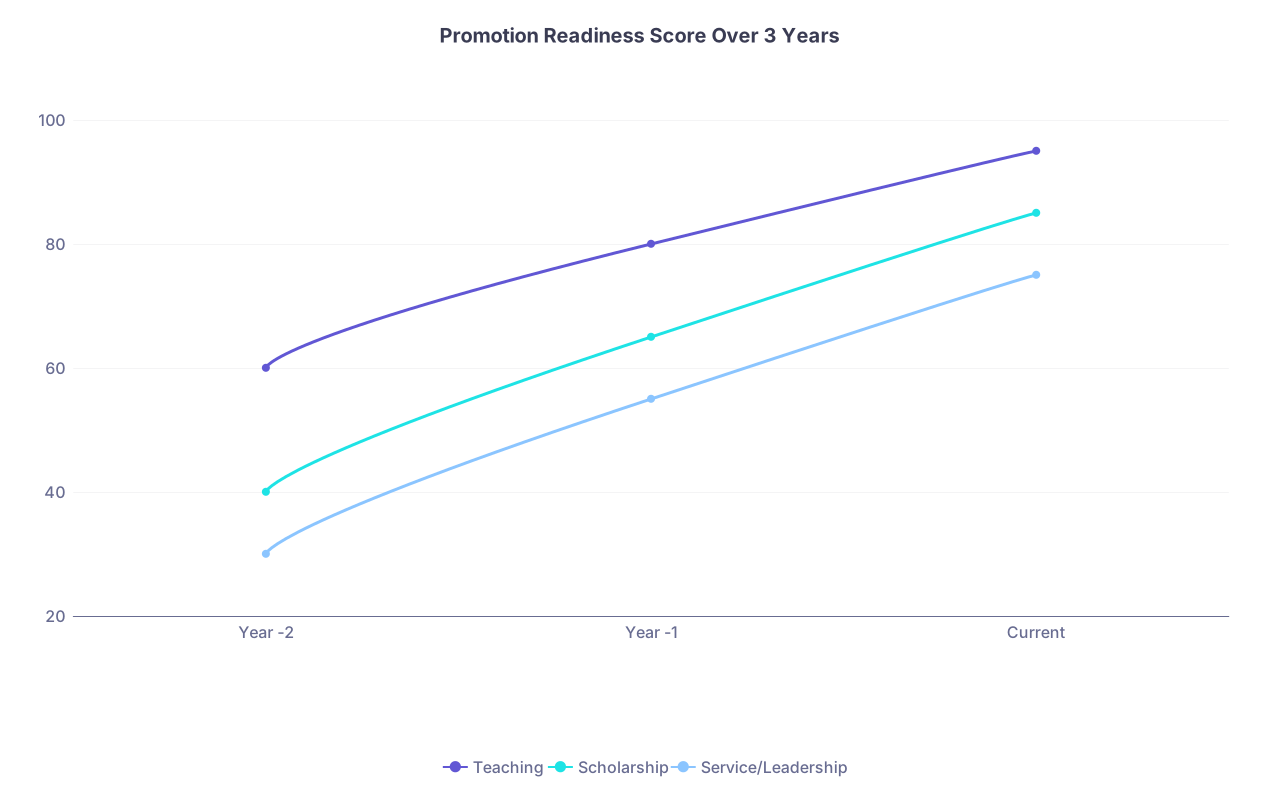
| Category | Teaching | Scholarship | Service/Leadership |
|---|---|---|---|
| Year -2 | 60 | 40 | 30 |
| Year -1 | 80 | 65 | 55 |
| Current | 95 | 85 | 75 |
You do not need a perfect scoring system—just a quick way to visualize, “Am I moving closer to clearly promotable?” When you sit down with your chair and can say, “Here is my year-over-year growth,” the conversation shifts.
5. Strategic Allies: Mentors, Sponsors, and Script Coaches
Women get told “find a mentor” from day one. Fine. But for promotion, you need more than “mentor for vibes.”
You need:
- A content mentor: someone who actually knows promotion rules.
- A sponsor: someone in the room when your case is discussed, willing to speak for you.
- A script coach: someone who will help you practice the actual phrases you will use.
5.1. Identify the Right People
Use a surgical approach:
- Look at colleagues recently promoted on your track.
- Note who shepherded their cases.
- Ask direct questions: “Who really drives promotion decisions here?”
You want at least:
- One senior woman who has survived this system.
- One person who sits on P&T regularly.
- One person with direct influence over your chair or section chief.
Then be explicit in what you ask:
- “I am planning to go up for promotion in the 202X–202Y cycle. I would like your honest assessment of my readiness and your advice on positioning my case.”
- “Would you be willing to review my CV and provide detailed feedback on gaps that the committee will care about?”
- “If you feel my case is strong, would you be comfortable speaking in support of my promotion when it comes before the committee?”
Do not assume people know you want them to advocate. Say it.
6. Timing and Framing: When and How to Ask
Most women wait too long and ask too softly. You need to treat this like submitting a grant: there is a cycle, a deadline, and prep work.
6.1. Know Your Institution’s Cycle
Promotion cycles usually run on a yearly or twice-yearly basis. Find out:
- Deadline for dossier submission.
- When departmental review happens.
- When central P&T meets.
- When decisions are announced.
Plan backward at least 12–18 months.
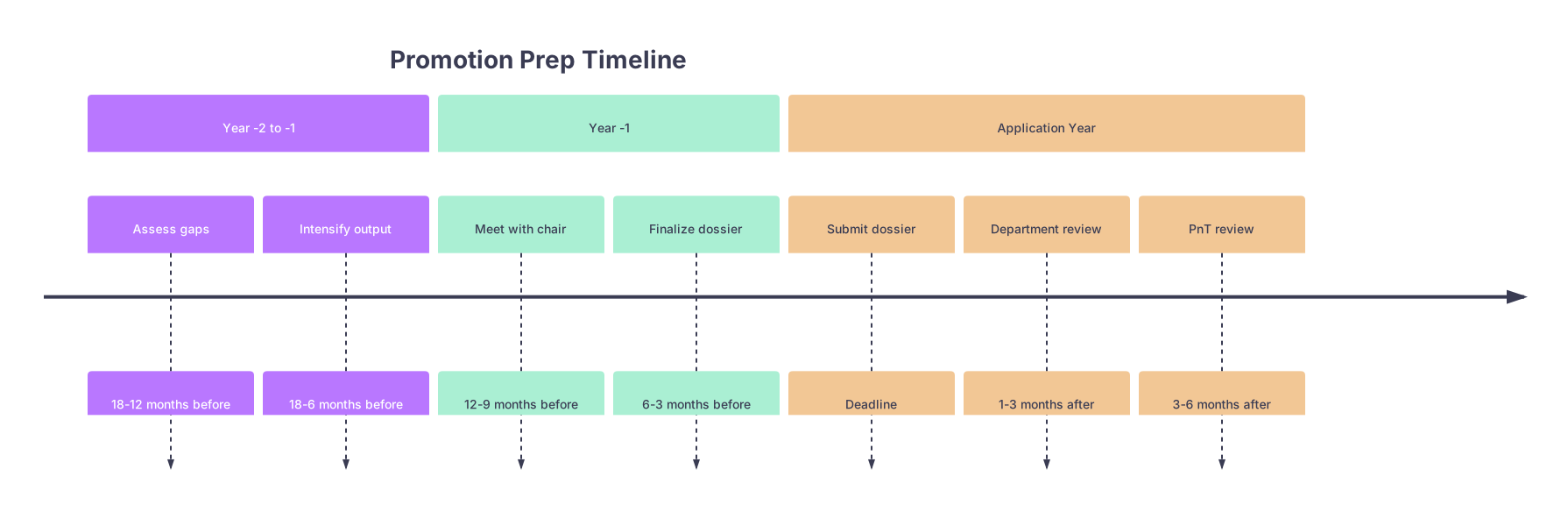
| Period | Event |
|---|---|
| Year -2 to -1 - Assess gaps | 18-12 months before |
| Year -2 to -1 - Intensify output | 18-6 months before |
| Year -1 - Meet with chair | 12-9 months before |
| Year -1 - Finalize dossier | 6-3 months before |
| Application Year - Submit dossier | Deadline |
| Application Year - Department review | 1-3 months after |
| Application Year - PnT review | 3-6 months after |
6.2. The First Conversation with Your Chair
Do not show up and say, “I was wondering if you think I might be ready for promotion?” That puts all power and framing with them.
Instead, have a structured ask. Script something like:
“I would like to discuss going up for promotion to Associate Professor on the clinician-educator track in the next cycle. I have mapped my CV against the published criteria and believe I meet or exceed expectations in teaching, clinical work, and service, and am very close on scholarship. I would value your perspective on my readiness and what else you would want to see in my dossier.”
Bring:
- Your updated CV, formatted in institutional style.
- A one-page summary of your readiness grid.
- A brief teaching/scholarship summary if applicable.
Your goals for this meeting:
- Get your chair to explicitly say “yes, I support this cycle” or “not yet.”
- If “not yet,” extract specific, measurable conditions and a date to reassess.
If your chair says, “Not yet,” push gently but firmly:
“Can we be concrete? Looking at the formal criteria, what exactly would you want to see added to move from ‘not yet’ to ‘yes’? For example, is it a certain number of senior-author papers, a national role, or something else?”
Then follow with:
“If I focus on those this year, can we plan to re-evaluate in 12 months with the goal of going up in the following cycle?”
Write down what they say. Email a brief summary afterward: “Thank you for meeting. My understanding is that to be ready for promotion by the 202X cycle, you would like to see X, Y, Z. I will work toward these and follow up in Month/Year.”
Paper trail.
7. Dealing with Gendered Pushback and Bias
Here is the part everyone pretends does not exist: women, especially women of color, get different feedback and different standards. It is not your imagination.
Common biased responses you might hear:
- “You are so valuable in your current role; I would hate to see you pulled into other things.”
- “You are still early in your career—there is no rush.”
- “Your work is excellent, but the committee likes to see more leadership / gravitas.”
- “You are a great team player, but we need more evidence of independence.”
7.1. Translate Vague Pushback into Concrete Criteria
When you get this kind of mushy feedback, your move is to force clarity.
Examples:
Chair: “The committee will want to see more leadership.”
You:
“In our criteria, leadership can mean course director roles, society positions, or leading research projects. Which of those would carry the most weight for my case? And at what level—local, regional, national?”
Chair: “You are incredibly valuable clinically; we do not want to overload you with other things yet.”
You:
“I appreciate that. I also know our institution values advancement and external visibility. I would like to work with you on a plan that protects my clinical contribution but still allows me to build the leadership and scholarship needed for promotion. That will likely require some redistribution of my clinical time.”
Do not accept “you are too valuable” as a reason to stagnate your career. That is exploitation dressed up as flattery.
7.2. Use Comparisons—Carefully
Sometimes you will discover that male colleagues with similar or weaker records were promoted faster. This is politically sensitive territory. Handle with precision, not anger in the meeting (vent later with trusted friends).
You might say:
“I reviewed recent promotion cases in our division to calibrate my expectations. Based on what I know of Dr. X and Dr. Y’s dossiers at the time of their promotions, my record seems comparable or stronger in teaching and scholarship. That is why I felt the next cycle was appropriate for me as well. Can you help me understand where you see differences that would justify a different timeline?”
You are not accusing. You are forcing them to articulate why you are being held to a different bar. That alone sometimes shifts the conversation.
8. Structuring the Dossier to Tell a Coherent Story
Most promotion dossiers are a random data dump. Do not do that. You want a narrative spine: “This is who I am as an academic physician and how I create value for this institution.”
8.1. Craft a Focused Personal Statement
Your personal statement is not a memoir. It is a tightly argued brief supporting promotion.
Three sections, max:
Academic identity and focus
- “I am a clinician-educator in pulmonary and critical care with a focus on simulation-based learning and trainee wellness.”
Impact and evidence
- Specific, quantified contributions: “I have directed X course, taught Y learners per year, developed Z curriculum disseminated to 10 institutions, published N peer-reviewed education papers.”
Future trajectory
- What promotion will enable: “As Associate Professor, I will expand our regional training network, take on leadership in society committees, and mentor junior faculty in education scholarship.”
Avoid the “I love teaching and caring for patients” fluff. They know that. They want evidence and trajectory.
8.2. Make Your CV Promotion-Friendly
Men are more likely to “optimize” their CVs; women often underplay. Fix your CV.
- Use institutional CV format, but:
- Carefully distinguish roles: “Course Director,” “PI,” “Senior Author.”
- Under each role, add 1–2 bullets that quantify impact: number of learners, outcome changes, grants, adoption elsewhere.
- Do not hide leadership inside long paragraphs. Make it scannable.
Think like a tired committee member at 10 pm. Could they spot your strengths in 2 minutes?
9. The Actual Ask: What to Say in the Key Meeting
When it is time to lock in the promotion attempt, you want a clear, direct ask and a short argument.
Here is a structure you can adapt.
Opening
“I would like to confirm that we are moving forward with my promotion to Associate Professor in the upcoming cycle and align on next steps.”
Brief case summary
“To summarize my case:
- Teaching: I have led X course for Y years, with consistently excellent evaluations, and received the Z teaching award.
- Scholarship: I have 11 peer-reviewed publications, including 4 first- or senior-author in our field’s main journals, and serve as co-investigator on a funded education grant.
- Service and leadership: I serve as associate program director, chair our residency curriculum committee, and hold a national committee role with Society A. These align with the posted criteria for Associate Professor on the clinician-educator track.”
Direct question
“Can I confirm that you support my going up in this cycle, and that you will recommend my promotion to the departmental committee?”
Then be quiet. Let them respond. Do not fill silence with more justification. If they hedge, go back to forcing specificity:
“What remaining concerns would you expect the committee to raise, and how can we address those in my dossier or through external letters?”
10. Protecting Yourself During the Process
Two final areas women often ignore until things go wrong: documentation and mental health.
10.1. Keep a Promotion Log
Track:
- Every formal conversation about promotion (date, who, main points).
- Any agreed-upon conditions and timelines.
- Any service or leadership roles you accept “for your promotion” that never materialize in your file.
If you end up needing to appeal, change departments, or negotiate an offer elsewhere, this log is gold.
10.2. Have a Parallel Plan B
Do not put your entire self-worth in the hands of one committee.
Plan B might be:
- Lateral move to a more supportive department or institution.
- Moving to a track that better matches your actual work.
- Using an external offer to force your current institution to take you seriously.
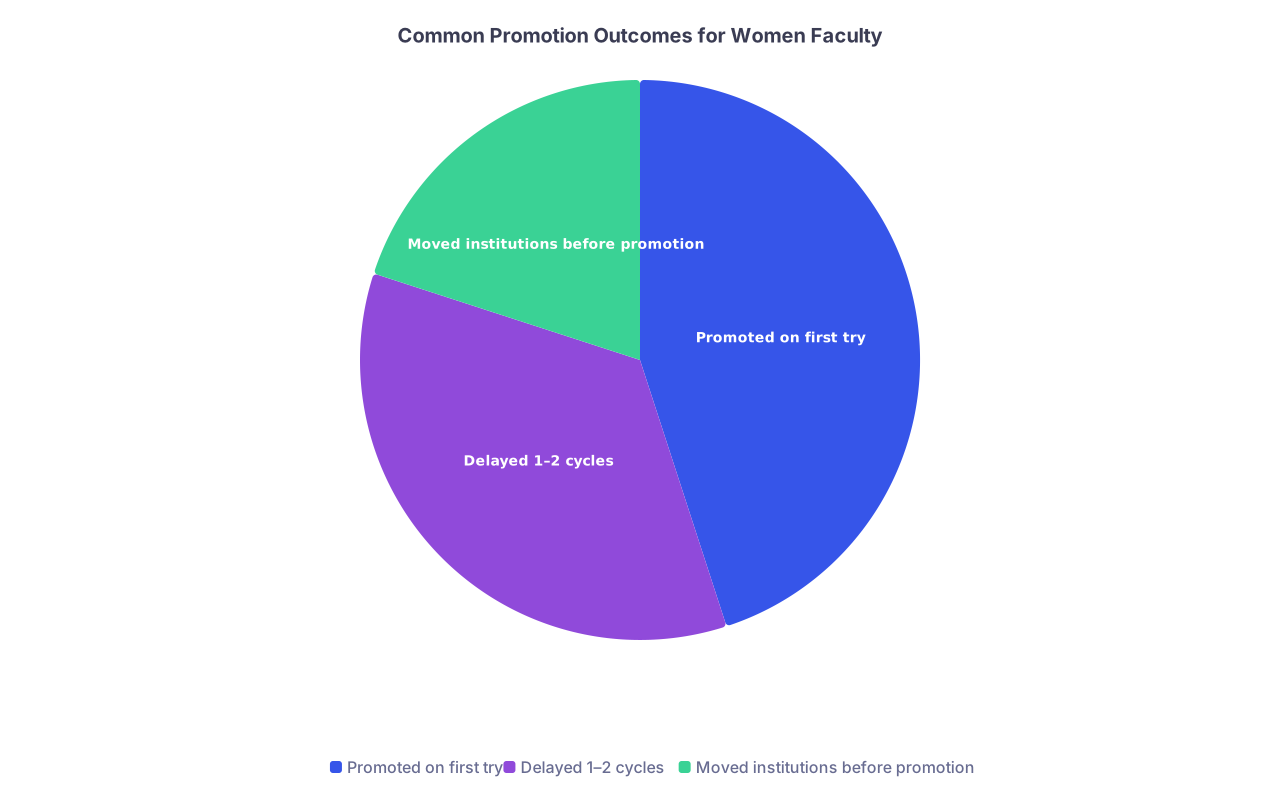
| Category | Value |
|---|---|
| Promoted on first try | 45 |
| Delayed 1–2 cycles | 35 |
| Moved institutions before promotion | 20 |
I have seen too many women finally get promoted the year after they announce they are leaving. Draw your own conclusions.
11. Ethical Considerations: Advocacy Without Self-Sabotage
You are in the “Personal Development and Medical Ethics” space, so let us be explicit: there is nothing unethical about advocating for your advancement when you meet criteria.
Unethical is:
- Underpaying and underpromoting women while exploiting their clinical labor.
- Using vague “professionalism” or “leadership style” language as a gendered filter.
- Expecting women to do disproportionate “service” work that is not recognized in promotion.
Your responsibility is to:
- Be accurate and honest in your dossier.
- Not take credit that is not yours.
- Not cut corners or fabricate contribution.
Beyond that, advocating for your promotion is not selfish. It increases your platform to mentor, to lead ethically, and to change the system for those coming behind you.
FAQ (Exactly 3 Questions)
1. How do I know if I am “ready enough” to ask for promotion, versus needing to wait?
You are ready to ask for a promotion timeline conversation when you can: (a) map your CV against the written criteria and see that you meet most domains, and (b) articulate concrete gaps, if any, with a plausible 1–2 year plan to close them. You do not need to be “overqualified” to start the discussion. Promotion committees rarely demand perfection; they look for clear alignment with expectations and a strong trajectory. If your record is similar to recently promoted peers on your track, you should not be waiting another five years.
2. What if my chair is unsupportive or keeps moving the goalposts?
Document every condition they state (“one more senior-author paper,” “a national role,” etc.) and the dates. If the target keeps shifting, escalate strategically. That may mean: (1) seeking guidance from a dean for faculty affairs or a diversity/equity office, (2) enlisting respected senior faculty as advocates, or (3) exploring options in other departments or institutions. Chronic moving of goalposts is not a coaching issue; it is a structural problem. Treat it as data about the environment, not about your worth.
3. How can I push for promotion without being labeled “aggressive” or “difficult”?
You cannot fully control other people’s biases, but you can control your strategy. Anchor everything in institutional criteria, data, and shared goals: “I want my advancement to reflect the work I am already doing for the department” rather than “I deserve more because I work hard.” Use calm, specific language, ask clear questions, and document agreements. If someone labels you “aggressive” for asking the institution to follow its own rules, that is a bias problem on their side. Do not let fear of that label keep you stuck.
Key takeaways:
(1) Promotion in academic medicine is built on criteria, documentation, and politics—not hope. Build a grid, gather evidence, and learn the unwritten rules.
(2) Ask directly and early, force vague feedback into specific criteria, and document every agreement. Your career is too important to outsource to other people’s memory or goodwill.