
The way people talk about “passion for medicine” sets you up to feel broken.
If you don’t wake up every day buzzing with purpose, you start wondering: “I feel numb about medicine—does that mean I picked the wrong life? And if it is wrong… what now?”
I’m going to be blunt: emotional numbness in medicine is common. Very common. But it’s not always harmless. Sometimes it’s a phase. Sometimes it’s your brain quietly pulling the emergency brake.
The terrifying part? From the inside, both can feel exactly the same.
Let’s untangle that.
The Lie You Were Sold About “Loving Medicine”
You were probably sold this story:
You’ll be endlessly fascinated. Grateful to serve. Deeply moved by every patient. Tired but fulfilled. Like some Instagram version of a doctor with a stethoscope and a soft smile.
Then real life hits.
You’re scrolling through Anki decks like a robot. Shadowing feels… meh. You hear about codes, death, errors, and instead of feeling horrified, you think, “Huh,” and then go back to whatever you were doing.
And then you think: “Normal people would be more affected. Why am I not?”
Here’s the contradiction nobody tells you about:
You have to blunt your emotions a bit to survive this work.
But if you blunt them too far, you stop feeling like a human being.
That tension—between needing emotional distance and fearing you’ve lost all feeling—that’s where your numbness lives.
Three Very Different Kinds of “Numb”
Let’s split this out, because not all numbness is the same monster.
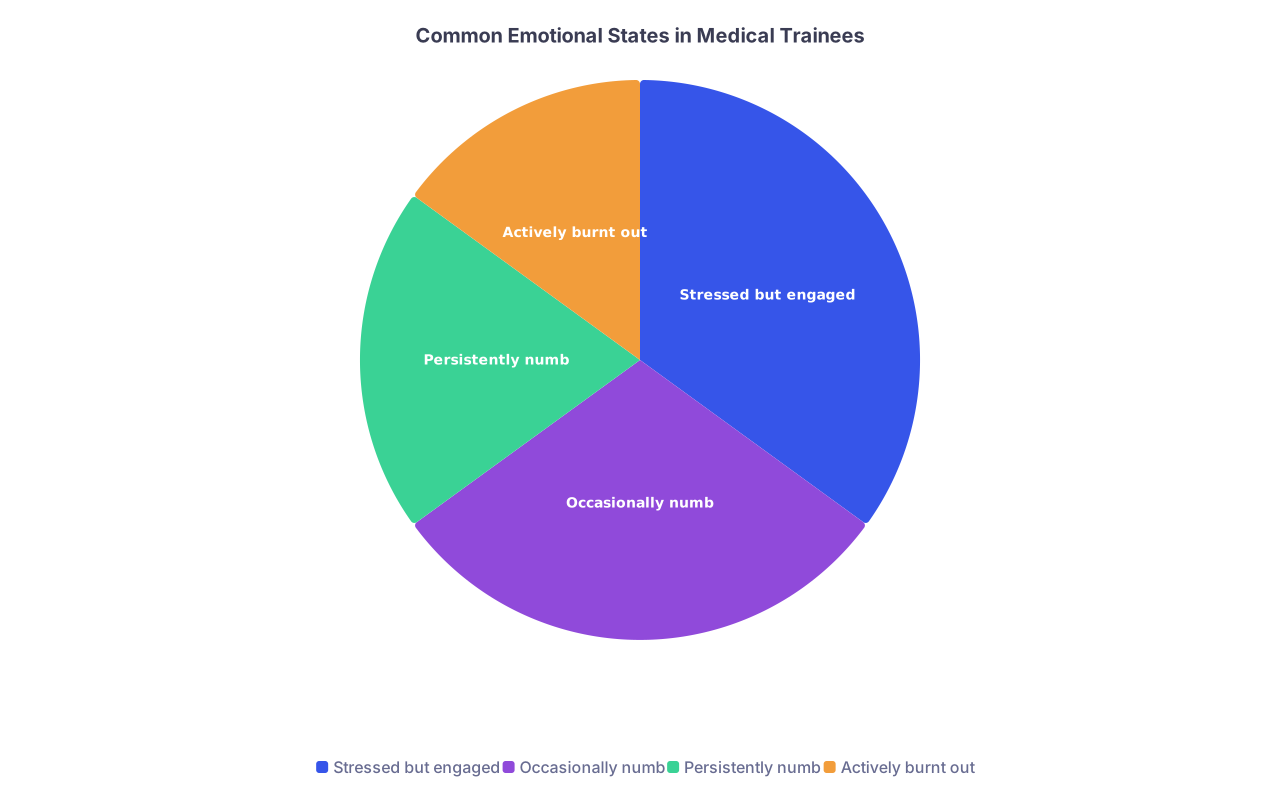
| Category | Value |
|---|---|
| Stressed but engaged | 35 |
| Occasionally numb | 30 |
| Persistently numb | 20 |
| Actively burnt out | 15 |
1. Functional Detachment (The “I Can Still Turn It Back On” Kind)
You’re in a high-stress environment—clinical, preclinical, or even just chronic application stress. Your brain learns: if I feel everything, I’ll shatter. So it dials things down.
This shows up like:
- You can still laugh with friends and enjoy non-medical stuff.
- You can feel emotional about patients or ethical issues… it just doesn’t hit every time.
- You still care about doing a good job, about not harming people, about improving.
This kind of numbness is basically emotional callus. It’s protective. If you had to feel at full volume for every sad case, every unethical policy, every unfair match outcome, you’d be on the floor.
Is this a problem?
Annoying and uncomfortable, yes. But usually not a five-alarm fire.
2. Warning-Sign Numbness (The “I Feel Flat Everywhere” Kind)
This one’s darker.
It’s not just medicine you feel numb about. It’s everything.
- Music you used to love? Just background noise.
- Friends’ good news? You say “Congrats” but feel nothing.
- You’re tired and wired but not exactly sad—just empty.
You can still move through your day, but it all feels like acting. You perform “interested,” “compassionate,” “enthusiastic,” but it’s hollow.
This can be depression. Or anxiety that’s burned so hot for so long the system shut down. Or the early-to-mid stages of burnout.
Is this normal?
Common, yes. But common doesn’t mean safe. This is “pay attention now” territory.
3. Ethical Deadening (The “I Don’t Care If I Harm Someone” Kind)
This is the one everyone fears, even if they don’t say it out loud.
You’re worried that your numbness means:
- You won’t care if a patient suffers.
- You’ll cut corners and not lose sleep over it.
- You’ll watch something unethical and shrug.
Let me be very clear: if you truly, genuinely stop caring whether you hurt people, that is a serious ethical problem. That needs intervention, not “wait and see.”
But here’s what I’ve consistently seen:
People who are terrified they might be becoming “monsters” are almost never the ones who actually are. The ones who are gone ethically? They’re not lying awake at 3 a.m. wondering if they still have a conscience.
Your anxiety about this? It’s evidence you’re still in there.
Why Medicine Makes You Feel This Way
You’re not feeling numb in a vacuum. The system practically engineers it.

| Step | Description |
|---|---|
| Step 1 | High workload |
| Step 2 | Chronic stress |
| Step 3 | Exposure to suffering |
| Step 4 | Perfection pressure |
| Step 5 | Emotional exhaustion |
| Step 6 | Detachment |
| Step 7 | Numbness |
A few big drivers:
You’re constantly around suffering you can’t fully fix.
You see dying patients. Families in denial. System failures. You get used to it because you have to. The first time you hear about a kid with leukemia, you freeze. The 40th time, you nod and move on. You hate that you’ve adapted, but adaptation is literally how humans work.
You’re under nonstop evaluation.
MCAT. Step. Shelf. OSCE. “How many pubs do you have?” “Where are you matching?” That pressure slowly trains you to focus on performance, not feeling. You stop noticing your inner state because everything’s about your output.
You’re taught, implicitly, that emotions are weakness.
How many times have you heard: “You’ll need a thick skin,” “Don’t take it personally,” “If you cry about every patient, you won’t last.” So your brain complies. It thickens. But there’s no slider that only reduces “sadness about medicine.” It drags everything down.
You don’t have recovery time.
Burnout isn’t just working hard. It’s working hard with no real off switch. If even your “breaks” are filled with guilt (“I should be studying,” “I should be more productive”), your nervous system never comes down. Eventually it gives up and numbs out.
So… Is My Numbness Normal or a Real Problem?
Here’s a rough gut-check. Not a formal diagnostic anything—just pattern-recognition from too many conversations like this.
| Type of Numbness | More Likely Normal Phase | More Likely Real Problem |
|---|---|---|
| Scope | Mostly about medicine | Spills into everything |
| Duration | Days to a few weeks | Months, keeps worsening |
| Function | Still enjoy some things | Joy feels basically gone |
| Values | Still care deeply, worry about caring less | Start thinking “Why care at all?” |
| Energy | Tired but motivated at times | Exhausted, stuck, hopeless |
If what you’re feeling is:
- Mostly related to medicine or school
- Comes and goes
- Coexists with real joy or interest in something (friends, hobbies, shows, even dumb memes)
- Paired with anxiety about “What if I don’t care enough?”
Then I’d call that a very human, very normal reaction to a system that is grinding you up.
If it’s more like:
- You feel blank about everything, not just medicine
- You can’t even remember the last time you felt truly happy or excited
- You’re starting to wonder what the point of any of this is
- You’re thinking about self-harm, not wanting to be here, or fantasizing about getting hit by a bus so you can stop
That’s not just a “med school mood.” That’s suffering that deserves actual support.
And if there’s even one tiny part of you that thinks, “Uh-oh, that second list is hitting a little too hard,” that’s your sign to talk to a real human professional, not just doomscroll or ask Reddit.
Where Ethics Fits Into This Mess
Here’s the ethical anxiety that eats people alive:
“If I feel numb now, am I going to become one of those jaded, cynical attendings who jokes about patients and doesn’t care anymore?”
I won’t sugarcoat it. That happens. I’ve heard the dark humor. I’ve seen the eye rolls when a “noncompliant” patient shows up again. I’ve heard, “Well, if they won’t help themselves, why should I care?”
But here’s what a lot of people miss:
Ethics isn’t a feeling. It’s a set of commitments and behaviors you choose even when your feelings are flat, messy, or absent.
You can feel numb and still:
- Double-check the med dose.
- Take an extra minute to explain something clearly.
- Speak up when a colleague crosses a line.
- Admit a mistake instead of covering it.
In fact, a ton of ethical behavior in medicine is completely unglamorous. It’s not some grand moment of heroism. It’s you, at 2 a.m., exhausted and emotionally dead inside, still following your training because you promised you would.
The danger isn’t “I don’t feel intense empathy every second.”
The danger is “I stop acting in accordance with my values because I’m too depleted to care what happens.”
That’s why your numbness matters. Not because it makes you a bad person. But because, if ignored, it can drag your behavior down with it.
Your job is not to force yourself to feel every feeling all the time. Your job is to protect your ability to live your ethics—in whatever emotional state you’re in.
How to Tell If You’re Still “In There”
Let me ask you a few brutal questions. Answer them honestly, just in your head:
When you hear about a patient being mistreated or dismissed, even if you feel flat, does some small part of you think, “That’s not okay”?
When you imagine yourself as an attending, do you care about not becoming “that doctor everyone hates working with”?
When you think about leaving medicine, do you feel more sad/afraid than relieved—or is it the opposite?
If you still have that little internal voice that says, “This matters. I don’t want to become cruel. I want to do this right,” you’re not ethically gone. You’re tired. You’re scared. You’re probably burnt to a crisp around the edges. But your core is intact.
The scariest thing about numbness is how it convinces you that empty equals permanent.
It doesn’t. But it also doesn’t fix itself just because you hope it will.
What You Can Actually Do About This (That Isn’t Cringe Self-Care Advice)
I know you’re expecting the usual: sleep more, drink water, gratitude journaling. Fine. Those help. But let’s be real—you already know that, and yet… here we are.
Here’s what actually seems to move the needle for people in your spot.
1. Admit Out Loud: “I’m Not Okay With Feeling This Numb”
Sounds small. It’s not.
As long as you pretend this is just “a busy phase,” you’ll keep pushing through it like it’s nothing. Say it to one person: a friend, a partner, a mentor, a therapist, even your notes app if you’ve got no one safe yet.
“I feel really numb about medicine. It scares me, and I don’t know what that means.”
Naming it is you refusing to go on autopilot.
2. Find One Tiny Corner of Medicine That Still Sparks Something
Not the whole giant concept of Being A Doctor. That’s too big and abstract.
Scan your world for any of these:
- A topic you could talk about for 20 minutes without forcing it (cardiology? psych? health policy?)
- A type of patient scenario that sticks with you more than others
- An ethical dilemma that really bothers you
Focus there for a bit. Read one article. Watch one talk. Ask one resident about their experience in that area.
You’re trying to find proof that you’re not fully dead inside. That there’s at least one thread you might want to follow.
3. Rebuild One Non-Medical Piece of Your Identity
A lot of the numbness comes from feeling like your entire personality is “future doctor” or “applicant” or “Step machine.”
Pick one thing that has nothing to do with medicine:
- Drawing badly in a sketchbook
- Lifting weights
- Baking something slightly chaotic
- Playing a game
- Going on walks while listening to a podcast about literally anything else
And here’s the rule: you’re not allowed to justify it as “this will make me a better applicant/physician.” It gets to exist purely because you are a person, not a productivity robot.
4. Get an Outside Brain Involved
Therapy. Counseling. A school mental health person. A physician wellness office. A trusted faculty member who’s not directly evaluating you.
Yes, I know the objections.
“What if they think I’m unfit?”
“What if it goes on my record?”
“What if they tell me I don’t belong in medicine?”
Here’s the alternative:
You white-knuckle it alone until things get so bad that either your health blows up or your performance does. Programs actually freak out when people implode out of nowhere, not when they reach out early.
And if some provider really does leap to “You shouldn’t be in medicine” from one disclosure of numbness? That’s not an evaluation, that’s a red flag about them.
You’re allowed to get a second opinion.
When Should You Be Worried Right Now?
If any of this is happening, don’t wait for it to “pass”:
- You’re thinking about self-harm or not wanting to be alive.
- You’re using alcohol, weed, or anything else just to feel something or to not feel at all, and it’s becoming a pattern.
- You’ve started making mistakes and you kind of… don’t care.
- You’re fantasizing a lot about disappearing, dropping out without telling anyone, or just never waking up.
That’s not just numbness. That’s danger. You deserve urgent help, not more stoic suffering.
Call someone. A hotline. A crisis text line. Your school’s emergency mental health number. A resident you trust. You are not the first person in medicine to feel this way, and you won’t be the last.
You’re Not Broken. But You Are At a Crossroads.
Here’s the hardest truth:
You can’t do this work long-term by sheer force of will while ignoring your own inner life. That’s how people become the horror stories you’re afraid of turning into.
Your numbness is not definitive proof you chose the wrong path.
But it is feedback that the way you’re walking this path right now is unsustainable.
You get to respond to that feedback.
Not by blowing up your life overnight. Not by dropping out tomorrow in a panic. But by taking it seriously enough to experiment with new ways of being in this field—or to slowly, thoughtfully consider whether another kind of life might fit you better.
You’re allowed to question. You’re allowed to not be “obsessed with medicine” 24/7. You’re allowed to protect your own humanity while still wanting to help others keep theirs.
Do one thing today:
Take 10 minutes, open a blank page (physical notebook, notes app, whatever), and answer this single prompt—no editing, no making it sound smart:
“If my numbness could talk honestly, what would it say about what I need right now?”
Write until you run out of words. That’s your starting point.