
The culture of medicine is lying to you about how “okay” you’re supposed to be.
“Not Okay” In Medicine Feels Like A Career-Ending Confession
Here’s the loop in my head:
If I say I’m not okay…
They’ll think I’m unstable.
If they think I’m unstable…
No one will trust me with patients.
If no one trusts me with patients…
There goes residency. There goes this entire decade of my life.
You’re probably somewhere in that same thought spiral, or you wouldn’t be reading this.
You’re not imagining it: the message we get in medicine is brutal and simple — be tireless, be fine, be resilient, or be replaceable. Everyone says “take care of yourself,” but then you watch the intern who cried on nights suddenly get labeled “fragile.” You see the M3 who took a LOA for mental health and people whisper: “Is she even coming back?”
So yeah, asking “Will anyone take me seriously if I admit I’m not okay?” isn’t dramatic. It’s logical. It’s self‑preservation.
But it’s also incomplete.
Because there are ways to be honest without lighting your career on fire. And there are people who will take you more seriously when you stop pretending you’re indestructible.
Let me walk through this the way my brain actually thinks about it — worst case first.
The Worst-Case Scenarios My Brain Won’t Shut Up About
Let me just name the monsters under the bed.
| Fear | What Your Brain Predicts |
|---|---|
| Programs finding out | Instant rejection |
| Faculty perception | “Unreliable, weak, unstable” |
| Peers talking | Permanent reputation damage |
| Licensing impact | Board denial or investigation |
| Patient safety | One bad day = career over |
I keep looping on some version of these:
“If I say I’m burned out or depressed, programs will reject me.”
This one is loud. We’ve all heard that mysterious “red flag” category on rank lists. My brain translates that to: any mention of struggle = automatic red flag.“If I tell my attending I’m overwhelmed, they’ll never trust me again.”
That fear that a single sentence — “I’m not okay” — permanently changes how they assign you tasks, evals, letters.“If I seek formal help, I’ll have to disclose it on licensing and they’ll think I’m unsafe.”
Cue horror stories about state medical boards asking “Have you EVER had a mental health diagnosis?” and using it like a weapon.“If I crack even once, when someone is watching, that’s it. I’m The Unstable One forever.”
You’ve seen it happen to other people. Or at least you’ve seen the gossip.
Let me be blunt: some of this fear is grounded in reality. Not in the cartoon-horror way our minds create, but in a colder, more annoying way.
There are still programs with old-school attitudes. There are attendings who confuse “never struggling” with “professionalism.” Some state boards still ask terrible, overbroad mental health questions (though they’re slowly being forced to stop).
So if your brain is saying, “I’m not crazy to be worried,” you’re right. You’re not.
But here’s the part our anxiety doesn’t factor in: there’s a huge difference between:
- admitting you’re not okay at all, and
- how, where, and to whom you admit it.
That’s where everything actually lives.
Who You Tell — And How Much — Changes Everything
The question isn’t just, “Can I admit I’m not okay?”
It’s: “To whom, in what context, and with what goal?”
That’s the part I wish someone had broken down for me clearly.
1. To yourself (and maybe your therapist): You can be fully, brutally honest
This is the one place you cannot afford to lie.
“I’m fine, just tired” becomes a trap. It’s how people end up face‑down on the bathroom floor on call, wondering how the hell they got there.
With yourself — and with a therapist, if you have one — you dump the whole truth out: the intrusive thoughts, the resentment, the dread, the “I fantasize about getting hit by a car so I don’t have to go to rounds” stuff. That’s not career-suicide material. That’s life-saving material.
And no, therapy doesn’t automatically become public record. Outpatient mental health care is not some bright red flag attached to your ERAS file. Most people who matter clinically would rather have a colleague who has actually dealt with their mental health than someone white-knuckling through denial.
2. To friends/peers: Semi-honest, but selectively
You don’t need to perform wellness for your classmates. But you also don’t need to trauma-dump on the person you barely know in your anatomy group.
Safe people here are the ones who:
- don’t weaponize other people’s vulnerability as gossip
- know when to just listen vs. jump into “fix it” mode
- don’t immediately make it about their own suffering contest
You can say things like:
“I’ve been having a really rough time mentally. I’m getting help, but I’m honestly not okay right now.”
That’s honest, without handing your entire psyche to someone who might not know what to do with it.
3. To faculty / supervisors: Professional, targeted honesty
This is the one that’s terrifying. Because they evaluate you. They write your letters. They could quietly decide, “This person is too much.”
Here’s the line I try to hold in my head:
You’re not asking them to be your therapist. You’re giving them just enough information to:
- keep patients safe
- adjust workload or expectations where necessary
- understand if something genuinely impacts your performance
That often sounds more like:
- “I’m going through some health issues and working with a professional. I’m safe to work and I’m committed to doing my best, but I may occasionally need some flexibility with scheduling/appointments.”
- “I’ve been struggling with burnout and I’m actively addressing it with counseling. I want to make sure it doesn’t compromise patient care, so I wanted to let you know in case I need to step back briefly.”
You don’t owe anyone your diagnosis. You don’t owe details about meds, hospitalizations, trauma history. You owe honesty about whether you can safely do the job right now.
And no, this doesn’t automatically make you That Person forever. A lot of attendings have quietly been in therapy themselves. You’d be surprised how many will say some version of: “Thanks for telling me. Let’s figure out what’s reasonable.”
4. On applications / personal statements: Surgical honesty, not a confessional
This is where the anxiety screams: “If they know I wasn’t okay, they’ll never rank me.”
Here’s my line:
I do not put fresh, unstable, still-bleeding wounds in an application. If I’m still in the middle of the tornado, that’s not personal statement content — it’s personal survival content.
But past, processed struggle? Especially where I can honestly say:
- here’s what happened
- here’s what I did about it
- here’s how I’m functioning now
- and here’s what I actually learned about being a physician
That can be powerful. Not everyone believes this, but I’ve watched applicants match well after disclosing depression, anxiety, even a mental health leave — because the framing made it clear they were safe, self-aware, and had support.
The line you never cross: anything that implies you’re currently unsafe to practice or unwilling to seek help.
The Ugly Reality: Stigma Exists. So Does Quiet Respect.
Let me say the part I keep circling back to: no, not everyone will take you seriously if you admit you’re not okay.
Some people will think less of you. Some will label you. A few will absolutely use it to justify not choosing you.
But a lot of people will do the opposite.
I’ve watched residents get more respect from:
- interns who felt safer asking for help
- attendings who trusted them to self-monitor
- PDs who appreciated that they had insight into their limits
A PGY-2 on psych told me once: “Honestly, the people I’m most worried about are the ones who insist they’re totally fine while clearly falling apart on nights.” That stuck.
The people you actually want to train under — the ones who care about physician well‑being and patient safety — are more reassured by, “I know when I’m not okay and I act on it,” than by, “I never struggle and I will never tell you if I do.”
Because the second person is a lawsuit waiting to happen.
Practical Ways To Say “I’m Not Okay” Without Imploding Your Life
Here’s what my anxious brain keeps asking for: scripts. Concrete words. So I’m not just staring at someone thinking, “Say something,” and saying nothing.
If you’re reaching out for help (therapy, counseling)
“I’ve noticed I’ve been struggling with sleep, mood, and feeling overwhelmed for a while. It’s starting to affect my functioning and I don’t want it to get worse. I’d like to talk about options for support.”
You don’t have to say “I’m a medical student” or “I’m an applicant,” but you can if context helps.
If you need to tell a faculty member you’re struggling
“I want to give you a heads up that I’ve been dealing with some health-related challenges, including mental health. I’m working with professionals and I’m safe to continue, but there might be times I’ll need some flexibility. My goal is to make sure patient care isn’t compromised.”
If you’re not safe to continue, the version is:
“I’m not in a state where I can safely give patients the care they deserve right now. I’m arranging urgent support and I need to step back from clinical duties for a bit so I can get to a place where I am safe.”
Is that terrifying? Yes. Is it better than making a serious error while dissociated on call? Also yes.
If someone casually asks “How are you?” and you’re not fine
You don’t owe everyone full honesty. You can keep it light but real:
- “Honestly, it’s been a rough stretch mentally. I’m working on getting support.”
- “Not my best week. I’m hanging in there though.”
- Or, if it’s not a safe person: “I’m tired, but okay.”
Not every interaction has to be a revelation.
The Ethics Piece: You’re Not Just Protecting Yourself
This is the part that actually scares me enough to push past my own secrecy.
Medicine wants you to put patients first. Always. But the hidden rule seems to be: sacrifice yourself in the process. That’s nonsense.
You can’t be ethically responsible for patients while pretending you’re fine when you’re actually unraveling. That’s not professionalism. That’s negligence dressed up as toughness.
If you’re:
- forgetting labs because you haven’t slept in 36 hours and you’re crying in stairwells
- having panic attacks so intense you can’t think straight on the wards
- thinking about suicide regularly and still taking overnight admits
…then “not telling anyone” stops being self‑protection and starts being a risk. For you and for patients.
The ethical move is not “suffer in silence.” It’s:
- recognize when you’re not okay
- seek appropriate help
- step back when you’re unsafe, with support to return
The physicians I actually respect? The ones who’ll quietly say, “I took a break during residency because I wasn’t okay. Best decision I made. I’m a better doctor now because of it.”
You Don’t Have To Broadcast It To Make It Real
There’s this weird all‑or‑nothing thinking: either I keep everything inside or I write a whole personal statement about my depression and tell my PD every detail.
No.
You can:
- tell a therapist everything
- tell one or two close friends a lot
- tell faculty a narrow, carefully framed version
- tell programs only what’s fully processed and relevant, if at all
- tell licensing only what you’re legally required to (and many boards now focus on current impairment, not past diagnosis or treatment)
You’re allowed to protect yourself and tell the truth. Those two things are not opposites.
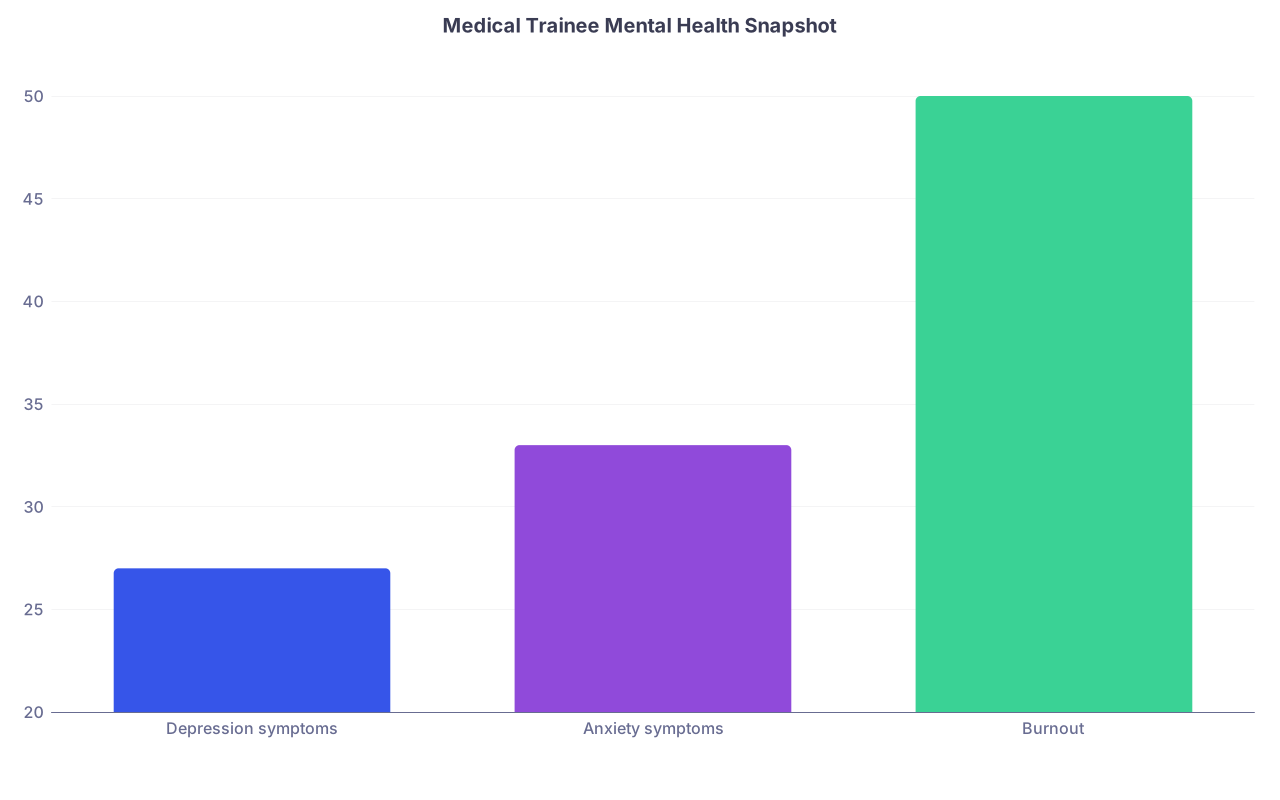
| Category | Value |
|---|---|
| Depression symptoms | 27 |
| Anxiety symptoms | 33 |
| Burnout | 50 |
(Those numbers are ballpark from multiple studies on med students/residents. Translation: you are very, very not alone.)

| Step | Description |
|---|---|
| Step 1 | Realize you are not okay |
| Step 2 | Urgent help - crisis line, ED, trusted clinician |
| Step 3 | Talk to trusted supervisor and seek formal help |
| Step 4 | Talk to therapist or trusted friend |
| Step 5 | Plan adjustments and follow up |
| Step 6 | Immediate safety risk? |
| Step 7 | Impacting performance or patient care? |
So… Will Anyone Take You Seriously?
Some people won’t. That’s the truth.
There will always be someone who thinks “real doctors just suck it up.” The ones who quietly drink themselves to sleep and call it resilience.
But here’s what I keep coming back to, even on the nights when my brain is screaming that I’ve ruined everything:
The people whose judgment actually matters long‑term — the ones I’d want as colleagues, mentors, program directors — are the ones who respect self-awareness, boundaries, and honesty about limits.
You can be careful and strategic about how you share without abandoning yourself to the toxic “never struggle” myth.
Admitting you’re not okay to the right people is not career weakness. It’s damage control — and sometimes, survival.
FAQ (Exactly 5 Questions)
1. Will disclosing mental health treatment automatically hurt my residency chances?
Not automatically. If you frame it as past, treated, and stable — with clear functioning now — many programs won’t see it as a negative. What will hurt more is unaddressed impairment: poor evaluations, professionalism concerns, repeated absences with no explanation. If something is impacting performance, controlled transparency is safer than pretending.
2. Should I ever mention a mental health leave of absence on applications?
If there’s a clear gap in your timeline, you’ll likely need some explanation. A concise, mature framing works best: that you faced health challenges (you don’t need to name diagnoses), sought help, recovered, and returned stronger and more self-aware. If it’s not visible on your record and you’re currently well, you’re not obligated to volunteer it.
3. Can talking to a therapist affect my licensing later?
Seeing a therapist alone is rarely the issue. Many states have shifted toward asking about current impairment rather than whether you’ve ever had treatment. It’s worth checking your state’s specific wording, but in general, proactive treatment is viewed better than untreated illness. Avoid delaying help out of fear of hypothetical future licensing questions.
4. How do I know if I’m “bad enough” to step back from clinical work?
Red flags: you’re having active suicidal thoughts with any intent/plan; you’re dissociating, blacking out, or unable to concentrate; others have expressed concern about your safety or performance; you dread patient contact to the point of paralysis. If you’re debating whether it’s “bad enough,” that’s usually your sign to at least talk urgently with a mental health professional and a trusted faculty member.
5. What if my program or school isn’t supportive when I admit I’m struggling?
That happens. If a direct supervisor reacts badly, look for alternate routes: student health, GME office, ombudsperson, counseling center, or a different faculty mentor. Document serious interactions. You’re allowed to escalate concerns or seek external support (e.g., external therapist, physician support lines). A bad response doesn’t mean you were wrong to ask for help — it means the system is still catching up, and you may need to be more strategic and seek allies.
Two things I’d want you to walk away with:
- You’re not weak or unprofessional for not being okay. You’re human in a system that breaks people and then blames them for breaking.
- You don’t have to choose between total silence and total exposure. There is a middle path where you get taken seriously, protect your career, and, most importantly, protect yourself.