
It’s 1:30 a.m. You’re sitting at your desk, half staring at Anki, half staring at that email you’ve drafted to your dean or program director: “I’m considering taking a leave of absence…”
Your chest feels tight. Your brain is doing this awful loop:
- “I’m burned out. I can’t keep going like this.”
- “If I step away, I’ll never match / never get a fellowship / everyone will think I’m weak.”
- “What if this one decision destroys everything I’ve worked for since I was 18?”
You’ve probably googled “gap in CV medicine bad?” at least ten times already. You’ve read horror stories on Reddit. You’ve heard that one attending casually say, “I’d never rank someone who took time off unless it was for something impressive like an MPH at Harvard.”
So now you’re stuck in this awful place: staying feels impossible, leaving feels career-ending.
Let’s talk about what actually happens when there’s a gap… and what’s just late-night anxiety talking.
First: Programs Don’t Automatically Hate Gaps
Let me be blunt: a gap is not an automatic death sentence for your career.
Is it invisible? No. People will see it. Some will ask about it. A few will be skeptical. But the catastrophic idea you have in your head — that every program director will instantly toss your file in the trash — is just not how this works.
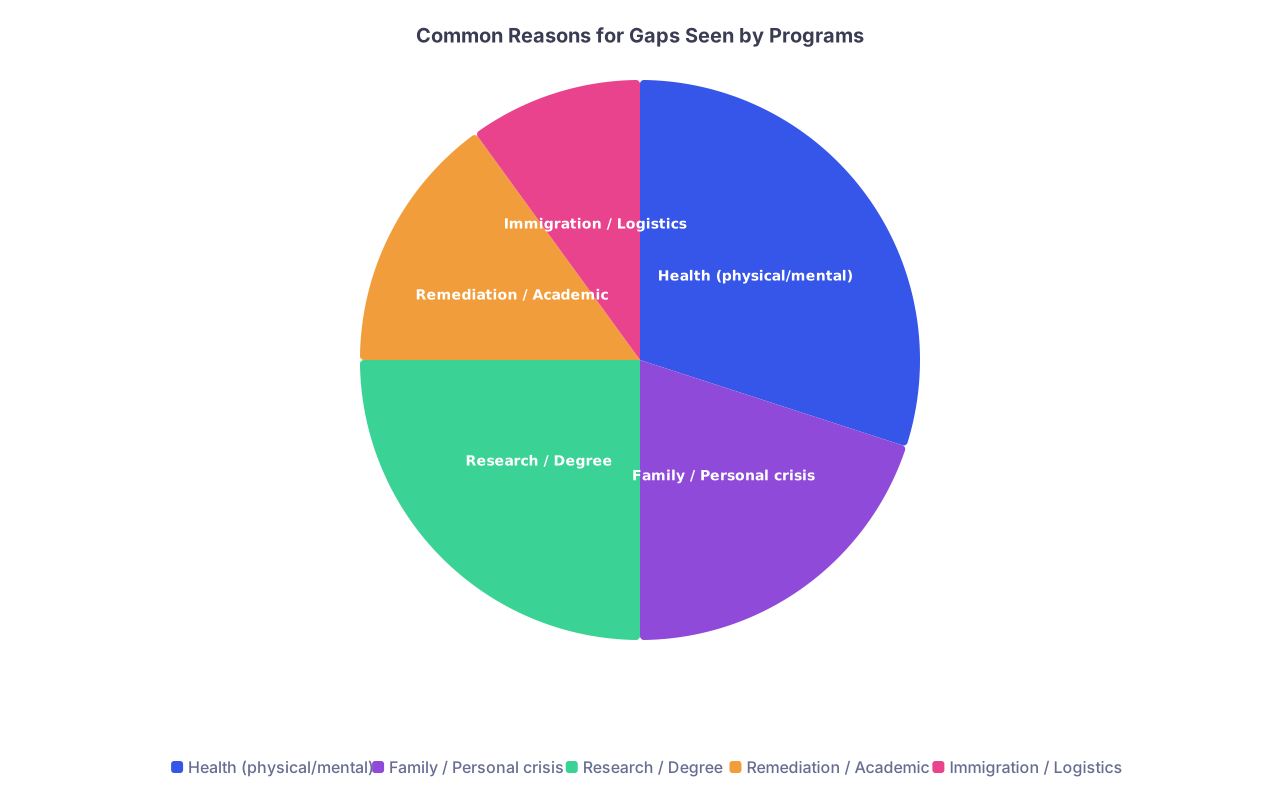
| Category | Value |
|---|---|
| Health (physical/mental) | 30 |
| Family / Personal crisis | 20 |
| Research / Degree | 25 |
| Remediation / Academic | 15 |
| Immigration / Logistics | 10 |
Most program directors who’ve been in medicine longer than five minutes have seen:
- Students taking a leave for depression, anxiety, or burnout
- Residents stepping away for a sick parent or child
- Trainees pausing for medical issues, surgeries, pregnancy
- People doing research years or extra degrees
- Visa issues that delay training
They are not shocked by gaps. They are, however, very interested in how you explain them and what you did with that time.
What freaks them out isn’t the gap itself; it’s:
- Confusing, vague, or evasive explanations
- Obvious inconsistencies between what you wrote and what letters say
- A pattern of disorganization without evidence you’ve grown
So yeah, the gap matters. But it’s not the villain in your story. The opaque, weirdly explained gap is.
The Gaps That Programs Quietly Respect vs. Quietly Worry About
You want the unfiltered version, so here it is.

Some kinds of gaps are actually neutral or even slightly positive in the eyes of many programs — if handled right.
Gaps that often land okay (or even positive)
Well-documented health or mental health leave, with a clean return
Example: “I took 6 months off during M3 for major depression. I worked with a therapist and psychiatrist, completed a treatment plan, and came back to finish rotations with strong evaluations.”
Programs see: “They burned out, did something about it, came back stronger, got help. They’re actually self-aware.”Family or caregiving responsibilities
Taking time for a dying parent, a sick child, or a complicated pregnancy… most humans recognize this as life, not a red flag. As long as you show you could re-enter and function well, people get it.Structured research year / extra degree / chief year / global health
This is the easiest kind. The story writes itself. “I did a research year in cardiology between M3 and M4, got two abstracts, realized I love X.” No one is mad at that.Military service or national service
Almost always respected, usually admired.
Gaps that can be trickier but survivable
Academic difficulty / remediation / repeating a year
This is not a career death either, but you can’t spin it into sunshine. Programs will want:- A clear reason (not “I just tried my best and failed everything”)
- Evidence of changed behavior (tutoring, new study systems, disability diagnosis and accommodations, etc.)
- A cleaner track record afterward
Unstructured time where nothing seems to have happened
A year “off” where you didn’t work, study, research, volunteer, or heal from something concrete — that’s harder. Not impossible. But you’ll need to explain it. Honestly. Without pretending you “did research” when there’s zero product.
| Type of Gap | Typical Reaction if Well-Explained |
|---|---|
| Mental health / burnout leave | Cautious but often accepting |
| Family / caregiving leave | Generally understanding |
| Research / extra degree | Often positive |
| Academic remediation / repeat year | Mixed, needs strong comeback story |
| Totally unstructured year | Skeptical, needs very clear explanation |
Notice what’s missing here: “You took a break so your career is over.” That’s not a real category.
How Programs Actually Judge You When They See a Gap
When a PD or faculty member sees your application and notices a gap, their brain runs a quick little algorithm. It’s not formal, but it’s pretty consistent.

| Step | Description |
|---|---|
| Step 1 | See gap on CV |
| Step 2 | Red flag - more questions |
| Step 3 | Neutral to mildly negative |
| Step 4 | Neutral to positive impression |
| Step 5 | Is it explained clearly? |
| Step 6 | Reason understandable? |
| Step 7 | Evidence of growth? |
They’re asking themselves:
Is the story coherent?
Does the timeline make sense? Do letters of rec line up with your explanation? Are you hiding something?Is the reason human and understandable?
Burnout, depression, parent died, had a baby, COVID chaos, visa mess, needed surgery — all recognizable. “I didn’t feel like working” with nothing else? That’s harder.Did this person actually use the time for recovery, growth, or something tangible?
Even if that “something” is therapy, stabilizing your health, or caring for a loved one. It doesn’t have to be 6 manuscripts.What did their performance look like after they came back?
This one matters a lot more than applicants realize. A clean track after the gap calms many fears.
You’re terrified they’re zooming in on the gap itself. In reality, they’re obsessing about the “after” part: Can you carry the load now?
The Ethics Spiral: “If I Can’t Handle This, Do I Even Deserve to Be a Doctor?”
This is the part that really eats at people. It’s not just “Will programs judge me?” It’s: “Am I failing some moral or professional standard if I step away?”
Here’s the hard truth: forcing yourself to grind through when you’re not safe, stable, or functioning is not “dedication.” It’s a liability.

If you:
- Can’t focus
- Are making repeated errors
- Feel numb or actively hopeless
- Have intrusive thoughts about self-harm
- Dread every single patient interaction
…then staying “for the sake of your CV” is actually less ethical than stepping back to stabilize.
Programs don’t want martyrs. They want residents and attendings who:
- Know their limits
- Ask for help before disaster
- Don’t collapse mid-year and hurt patients or themselves
We glorify suffering in medicine so much that people think taking a medically necessary leave is some kind of moral failing. It isn’t. It’s literally the same principle we use with patients: treat early, adjust the plan, protect long-term function.
From an ethics standpoint, taking a break before you crash and burn is responsible. Dragging yourself so far past your limit that you’re unsafe isn’t noble; it’s dangerous.
How to Take a Break Without Letting It Wreck Your Future
You can’t control that a gap will raise questions. You can control how much chaos it leaves behind.
1. Make it formal, not vague
If you’re in med school or residency, there’s usually a formal leave-of-absence or schedule-adjustment pathway. Yes, it’s bureaucratic. Yes, it’s annoying. Use it anyway.
Formal = documented, approved, with clear start and end points.
Informal = “I kinda disappeared for a while and some attendings covered for me.” That will haunt you.
2. Get at least one person in leadership on your side
Dean, advisor, program director, trusted attending — someone who:
- Knows why you’re leaving
- Believes you can come back
- Is willing to support you when you apply or return
Future programs will read between the lines of their letters. A good letter that says, “They faced significant personal/health challenges, approached them responsibly, and returned performing at a high level” is pure gold.
3. Have a loose plan for the time
Your brain is screaming, “I need to stop NOW,” not “I need to design an optimal, productivity-maximizing, CV-polishing gap year.” Fair.
But even something like:
- “First 2–3 months: focus on treatment/recovery and basic routine.”
- “Next months: gradual return to low-stress clinical or research involvement, part-time work, or structured volunteering as I’m able.”
…is enough. The plan will change. It just can’t be “blackout with no structure for 12 months.”
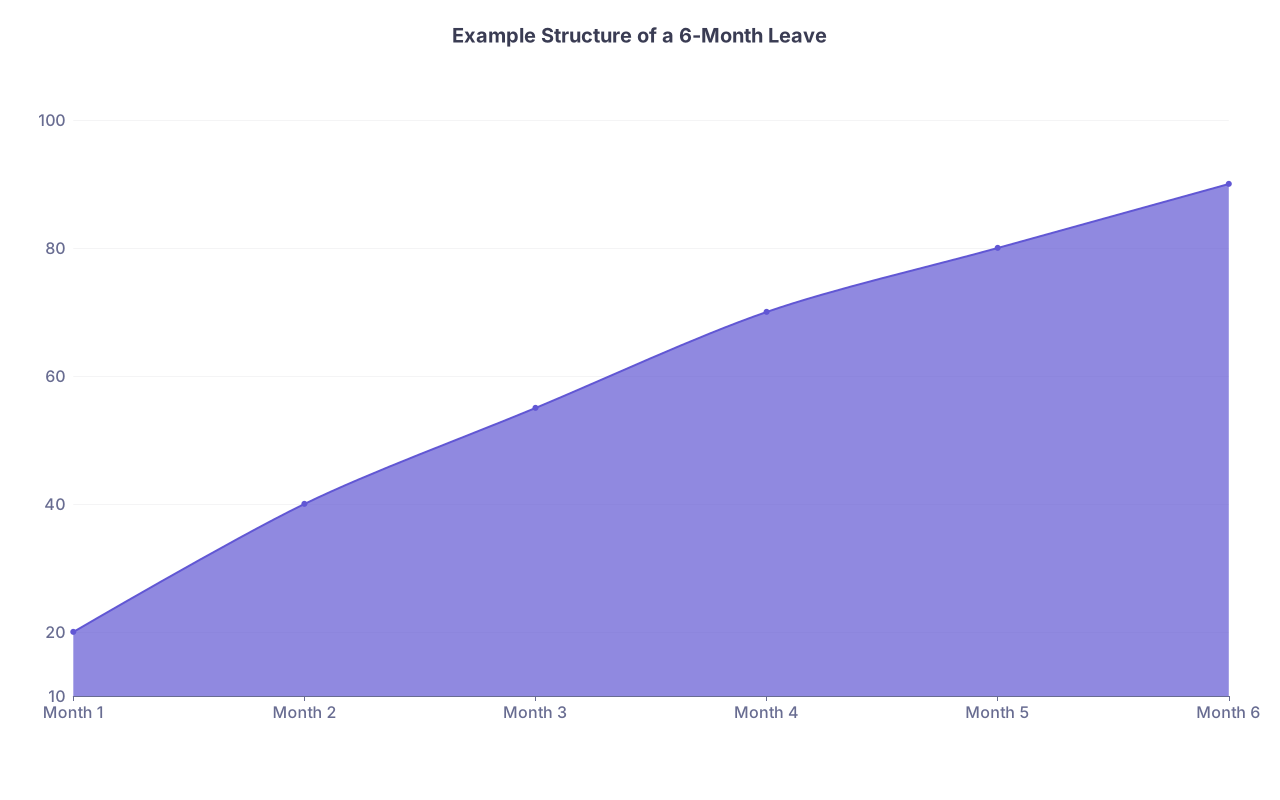
| Category | Value |
|---|---|
| Month 1 | 20 |
| Month 2 | 40 |
| Month 3 | 55 |
| Month 4 | 70 |
| Month 5 | 80 |
| Month 6 | 90 |
(Think of that as “percent of normal function / structure” gradually increasing.)
4. Be honest but contained when you explain it
You don’t have to pour your entire psychiatric history into ERAS. You also shouldn’t try to outsmart programs with some sanitized nonsense.
A good formula:
- Brief reason category (“for health reasons,” “to address depression and anxiety,” “to care for a critically ill parent”)
- Concrete actions (“I worked with a therapist / psychiatrist,” “I served as primary caregiver,” “I completed X”)
- Evidence of outcome (“I returned to complete my rotations with strong evaluations,” “Since returning, I’ve been consistently reliable on call,” “I now use X strategies to maintain my wellbeing.”)
You want them thinking: “Okay, I get it. They didn’t ghost the system. They actually did the work to get back to stable.”
Worst-Case Thinking vs. Reality: How Much Does a Gap Really Hurt?
Let’s name the fear: “If I step away, I’ll never get X.” X = match, fellowship, dream specialty.
Sometimes, yeah, a gap will limit some doors. Hyper-competitive fields love simple, clean timelines with no hiccups. An unstructured two-year gap where nothing tangible happened will absolutely hurt in, say, dermatology or plastic surgery.
But the question is: compared to what?
Compared to:
- Failing out because you tried to push through and ended up with repeated fails, professionalism issues, or serious clinical mistakes?
- Documented episodes that scare programs way more than a planned leave would?
- Needing emergency leave mid-year with no plan or support?

In most real trajectories I’ve seen, a planned, documented break with recovery beats a chaotic crash-and-burn every single time.
And long term? Most people don’t talk about their “gap year.” They talk about:
- The clinical win that made them feel like a real doctor
- The patient they’ll never forget
- The day they matched, or the first time they ran a code
The break becomes a paragraph, not the whole story.
How to Decide If You Actually Need a Break
You’re probably second-guessing yourself every five minutes. Normal.
Some signs that a break is not just reasonable but probably necessary:
- Your mental health providers are telling you directly, “You need time off.”
- You’re accumulating concerning feedback: missed pages, late notes, recurring patient safety concerns.
- You’ve tried scaling down other parts of life (social, extracurriculars, even research) and you’re still drowning.
- You’re having thoughts that scare you — about hurting yourself, about not wanting to wake up, about wishing something would “just take you out” so you don’t have to decide.
If you’re there, you are not weak for stepping back. You are in a dangerous place that medicine often romanticizes as “pushing through.” That’s not strength. That’s untreated crisis.
Bottom Line: Will a Break Ruin Everything?
No. It will complicate things. It will change the story you have to tell. It may close a few specific doors — or delay when you walk through them.
But ruin? No.
What ruins careers more often:
- Denial.
- Hiding.
- Letting shame push you into secrecy instead of support.
- Exploding mid-year in a way that forces others to scramble around you.
A gap is a data point. Not a verdict.
One day, you’ll be the person sitting across from a student or intern who’s burnt out, terrified, and asking these same questions. You’ll remember how this felt. And how you answered it — for yourself — will matter more than the fact that there was a break at all.
FAQ (Exactly 5 Questions)
1. Will taking a mental health leave during med school or residency automatically keep me from matching?
No. I’ve seen plenty of people match after a documented mental health leave. The key is: clear explanation, strong performance after returning, and at least one supportive letter from someone who can vouch that you’re stable and functioning well now. Some ultra-competitive specialties might be less forgiving, but a responsible, treated episode is rarely an automatic rejection.
2. Should I hide the true reason for my gap and just say it was “research” or “family reasons”?
Don’t lie. Programs can smell vague nonsense and inconsistencies, and that’s way more damaging than the truth. You don’t have to give graphic detail, but a simple, honest explanation (“I took 6 months to address depression and returned with full clearance”) is safer than a fake research story with no outputs or supporting letters.
3. Do I need some big achievement (publications, degree, etc.) to “justify” the gap?
No. If the gap is about survival, the “achievement” is being alive and stable and able to work again. That said, once you’re past the crisis phase, doing something structured — part-time research, volunteering, even consistent therapy and a daily routine — helps when you’re later explaining how you used that time.
4. How long is “too long” for a gap?
There’s no magic number, but once you’re at 1–2 years out of active clinical work, programs start worrying about skill decay and re-entry. That doesn’t mean you’re unemployable; it means they’ll care more about what you did during that time and how you’ll ramp back up. If your gap is long, finding ways to re-engage clinically (observerships, part-time work if allowed, courses) becomes more important.
5. What if my school or program discourages leave and makes me feel guilty for asking?
Sadly, this happens a lot. But their discomfort doesn’t change your reality. If you’re unsafe or nonfunctional, pushing through to keep them “happy” is not a good trade. Talk to multiple people: student affairs, a trusted attending, a therapist, maybe even an ombuds office. Get documentation from your mental health or medical providers. Programs can grumble, but formal leave pathways exist for a reason — and in the long run, you’re the one who has to live with the outcome of this decision, not them.
Years from now, you won’t define yourself by the months you stepped away. You’ll remember that you hit a wall, you didn’t pretend it wasn’t there, and you chose to protect your future instead of sacrificing it to fear.