
What If I Make a Serious Mistake Because I’m Exhausted?
It’s 4:17 a.m.
You’re on call, your eyes feel like sandpaper, and your brain is moving through molasses. You just signed an order—vancomycin instead of the cephalosporin you meant—because your fingers outran your thoughts. Or you almost gave the wrong dose. Or you discharged someone without rechecking that one lab.
And now you’re sitting there thinking:
What if I hurt someone?
What if I already did and don’t even know yet?
What if I’m the worst-case story people whisper about for years?
This is the nightmare version of medicine they don’t really prepare you for. Not the textbook ethics, but the 3 a.m., I-haven’t-slept-in-28-hours version, where your “professional responsibility” collides head-on with basic human physiology.
Let me say the thing you’re scared to say out loud: you will make mistakes when you’re tired. The real question is how serious, how often, and what you do about it.
Let’s talk about that.
The Ugly Truth: Exhaustion Makes You Dangerous
We act like being tired is a personality trait. “I’m fine, I function well on little sleep.” No. You don’t. None of us do.
There are actual data on this, not just vibes.
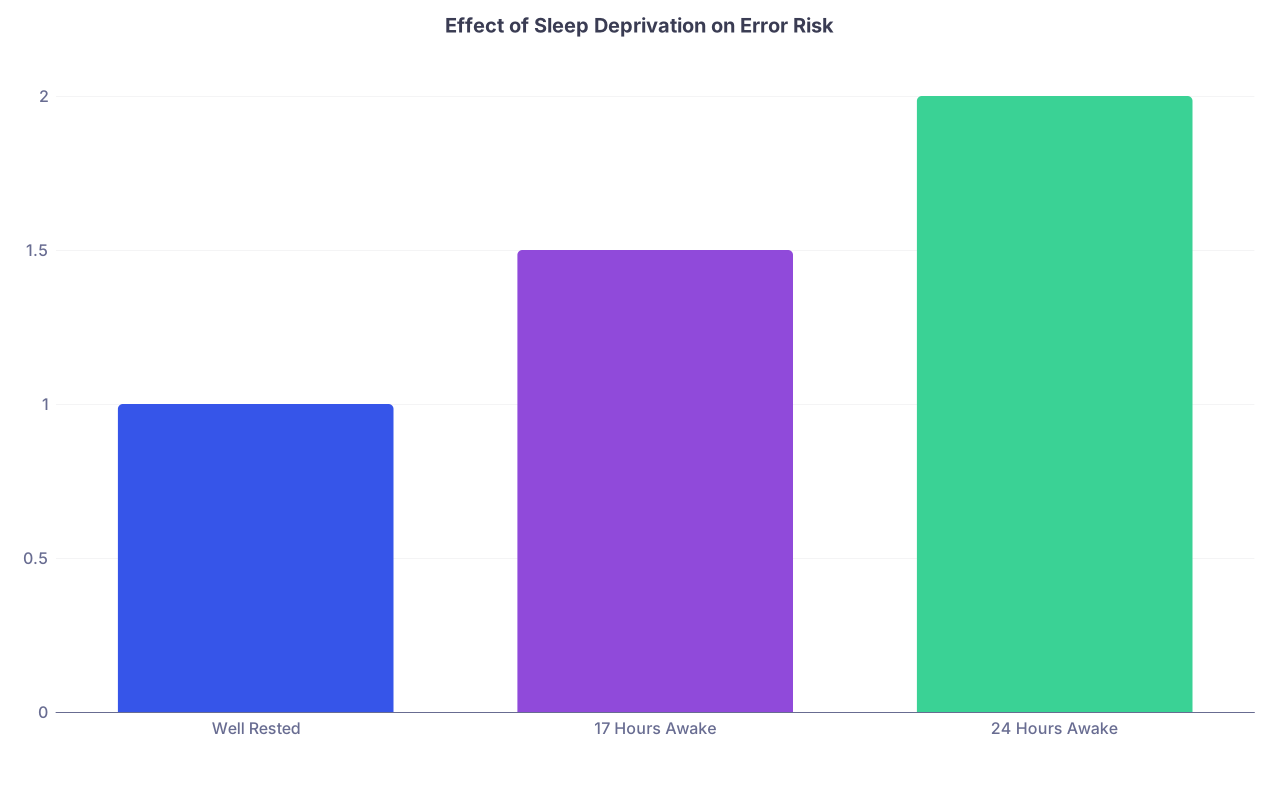
| Category | Value |
|---|---|
| Well Rested | 1 |
| 17 Hours Awake | 1.5 |
| 24 Hours Awake | 2 |
By the time you’ve been awake 17 hours, you’re performing like you’re legally drunk. At 24 hours, it’s worse. And yet we build entire hospital schedules on exactly that.
So your fear—“what if I make a serious mistake because I’m exhausted?”—isn’t paranoid. It’s logical. If anything, it’s more rational than the people bragging on rounds: “I’ve been up for 30 hours, let’s go see the list.”
Here’s the part that really messes with your head: you can feel mostly okay and still be impaired. You’re reading notes, placing orders, answering pages, and it all feels… fine. Until you realize you did something dumb you’d never do at 10 a.m. after coffee and sleep.
I’ve watched this play out:
- Resident puts in heparin for the wrong patient because Epic jumped back to the previous chart.
- Intern writes for 10x the morphine dose because they forgot the unit conversion.
- Discharge summary says “no allergies” while the chart screams “PENICILLIN ANAPHYLAXIS” in red.
None of them were bad doctors. They were just tired humans in a system that pretends that doesn’t matter.
So no, you’re not crazy for being scared.
Worst-Case Scenario Brain: What If I Actually Harm Someone?
This is the core panic, right? Not just “oops, I clicked the wrong thing,” but…
What if I cause permanent harm?
What if there’s a bad outcome and it’s my fault?
What if they die?
The horror story in your head probably sounds like:
You’re post-call, exhausted, you miss a subtle sign of sepsis, you send the patient to the floor, they crash, you get called at 6 a.m. to the code, and everyone later says, “How did they miss this?”
Here’s the part that hurts: versions of that do happen. To good people. Who care. Who were trying.
I’ve seen a resident fall asleep at the computer, wake up, click through several order sets half-conscious, and not double-check something they normally would. The patient ended up over-anticoagulated. No one died. But the resident spent months replaying it in their head.
What actually happens in most “serious mistake” situations is more nuanced than the catastrophic story your brain tells:
- There are layers of checks: pharmacy, nursing, lab values, sign-out, sign-in. Often someone else catches it.
- Most errors are caught early, or the patient never experiences harm, even if the potential was scary.
- When harm does occur, there are usually multiple contributing factors—system issues, unclear policies, ambiguous notes, fatigue, bad handoffs—not just “one tired intern destroyed everything.”
That doesn’t mean you’re “off the hook” morally. It means your brain’s “I alone will sink the ship” narrative isn’t accurate. It’s a whole leaky system held together by tired people catching each other’s mistakes at 2 a.m.
But here’s the ethical tension that’s probably eating at you:
You know you’re impaired when you’re exhausted. You know being impaired increases risk. So are you already unethical just by showing up while half-dead?
That’s the kind of question that keeps conscientious people up at night even more than the call schedule.
Where Ethics Meets Reality (And Why It Feels So Awful)
On paper, it’s simple: physicians have a duty to provide safe care, recognize impairment, and remove themselves from situations where they’re unsafe.
In reality? Try telling your senior at 3 a.m., “I’m too tired to be safe, I need to tap out.” Imagine that going over well in a place where people brag about how many hours they’ve stayed awake.
You’re stuck between:
- Ethical expectation: Don’t practice while impaired.
- Cultural expectation: Push through. Be tough. Don’t complain. Don’t be “that” resident or student.
- System reality: There is no backup resident materializing out of thin air if you admit you’re at your limit.
So yeah, you’re in a trap. And you feel it.
The anxious spiral usually goes like this:
“I’m exhausted → I’m unsafe → I’m here anyway → I’m complicit → If I hurt someone, I’m morally responsible → Maybe I shouldn’t be in medicine at all.”
I don’t think that’s fair to you.
Here’s my actual position:
The system that designs a schedule that predictably produces cognitive impairment carries massive moral responsibility. You still have responsibilities as an individual, but you are not the sole villain if you slip at 5 a.m. on hour 26.
Is that comforting? Not really. But it’s honest.
What You Can Actually Do When You’re That Tired
You can’t “mindset” your way out of sleep deprivation. You can’t ethically self-brainwash: “I’m fine, I’m fine,” while half-hallucinating from fatigue.
But there are things you can do to reduce the odds of a serious mistake when you’re exhausted. They’re not heroic. They’re small, boring, and sometimes feel annoying when you just want to be done.
You do them anyway.
First, when you notice your brain glitching—reading the same sentence 3 times, staring at the EMR and forgetting what you opened it for—treat that as a vital sign. That’s your mental hypotension.
At that point, you need to:
Move from memory to external checks.
Stop trusting your recall. Use order sets, dose calculators, weight-based dosing built into the EMR. Double- or triple-check meds, doses, and patient names like you’re new again.Create friction for high-risk stuff.
For anything that could seriously harm someone—anticoagulation, insulin, chemo, big electrolyte replacements—force yourself to slow down. Say the order out loud. Check it against the lab or note. Ask the nurse to read back the order.Use other humans on purpose.
This is not the time to prove you’re independent. Ask the senior, “Can I run this by you? I’m pretty tired and don’t fully trust my brain right now.” Is that vulnerable? Yes. Does a decent senior appreciate it? Also yes.Lean on structure when your brain is mush.
Checklists, sign-out templates, problem-based notes, your own little “discharge checklist” scribbled on a sticky note. When you’re tired, structure is safer than vibes.Don’t rush discharges and sign-outs.
Some of the worst stuff happens when people try to “clean up” at the end of a night. That’s exactly when your brain is fried. Slow is fast here. One fewer rushed discharge is better than one missed red flag.
If you’re thinking, “I know all this in theory, but in the moment I’m so tired I just want to get through,” yeah. Exactly. That’s why you pre-decide:
“When I notice I’m sliding, I automatically slow down on meds, orders, and discharges. No exceptions.”
It’s not foolproof. But it’s better than pretending fatigue doesn’t exist.
What If I Already Made a Serious Mistake?
This is the part no one likes to talk about, but you’re probably thinking it, so let’s go there.
Scenario in your head:
“I’m reading this because last night I might have screwed up. I’m terrified to check. I’m terrified not to check. I keep replaying it, but everything’s blurry.”
You’re not alone. I’ve watched people walk into work post-call silently panicking about one order, one conversation, one moment.
Here’s the reality of “I might have made a serious mistake”:
The not-knowing is torture, but you need to look.
Avoidance feels safer—“If I don’t check, maybe it wasn’t real.” But if something happened, you need to know fast. Pull the chart. Check the MAR. Look at the labs. Ask the nurse what actually happened.If you find an error, loop in someone senior immediately.
Not in six hours. Not “after rounds.” Now. “I just noticed I did X on patient Y last night and I’m concerned it might have caused harm. Can you look at this with me?” Will you feel exposed? Yes. Is that still the right move? Also yes.You’re going to want to deny, minimize, rationalize.
“I was tired, no one told me, the system is confusing…” All that might be true. But the patient is the center here. Step one is: “What do they need now?” Step two is: “What did I miss and how do I fix that pattern?”You’ll probably be harder on yourself than anyone else is.
Institutions will run morbidity and mortality conferences, root cause analyses, all that. But the thing that will haunt you isn’t the formal stuff. It’s the look on a patient’s face you remember, or the moment you hesitated. That’s the part that sits with you. That’s why people leave medicine.
And if you’re terrified about legal consequences, disciplinary action, “having a mark on your record”—yeah, that fear is real too. But trying to cover something up or “hope it goes away” is the fastest way to turn an error into a career-ending problem.
I’m not saying disclosure is emotionally easy. It’s brutal. But ethically, you already know which direction points north.
Balancing Your Own Limits With “Patient First” Without Destroying Yourself
One of the most dangerous beliefs in medicine is: “If I care about my own rest, I’m being selfish. Patients first, always.”
Sounds noble. In practice, it’s a recipe for exactly the fear you have: you, half-functional, making mistakes in the name of “sacrifice.”
Here’s the uncomfortable thing: “Do no harm” absolutely includes not turning yourself into a hollow, sleep-deprived risk.
Look at it this way:
| State | Error Risk | Judgment | Memory | Emotional Control |
|---|---|---|---|---|
| Well rested | Baseline | Normal | Normal | Stable |
| 17 hours awake | ~1.5x | Slowed | Worse | Irritable |
| 24 hours awake | ~2x | Impaired | Poor | Unstable |
You wouldn’t hand a resident two beers, then tell them to manage the ICU alone. But you’ll hand them a 28-hour call.
So where does that leave you, ethically, as a trainee who doesn’t control the schedule, but does care about doing the right thing?
A few hard truths:
- You are allowed to say, “I am at the limit of what I can safely do,” even if the culture hates that sentence.
- You won’t always get what you need. You might still be stuck on that night float block, that brutal call schedule. That’s real.
- Within that, your job is to reduce harm as much as you can without martyring yourself into a breakdown.
Sometimes that looks like grabbing a 15-minute nap instead of scrolling your phone. Sometimes it’s saying to your co-intern, “I am super fried—will you glance at these orders if I do X for you?” Sometimes it’s going to your program director later and saying, “This call structure is unsafe; we’re making errors at 5 a.m. and we all know it.”
None of that makes you weak. It makes you someone who actually takes patient safety seriously.
If You’re Reading This and Already Spiraling
If your stomach has been in a knot this whole time, and you’re thinking about a specific patient, a specific night, or a specific near-miss, here’s what I’d want you to walk away with:
You’re not broken for being scared of this. Honestly, the people who aren’t scared at all about hurting someone when they’re exhausted—that’s who I worry about.
You being anxious about causing harm means your moral compass is still working, even in a system that tries to grind it down.
So, three things to hold onto:
- You will make mistakes. Being exhausted raises that risk, yes, but you can still build safety nets: slower pace for dangerous stuff, more double-checks, more use of colleagues.
- If/when you do make a serious error, your responsibility is to face it, not run from it: check, disclose, learn, change how you work when you’re tired. That’s ethics in real life, not on a slide deck.
- Protecting your own sleep and limits is not selfish; it’s part of protecting patients. A wrecked, numb, chronically sleep-deprived version of you is not the hero in this story.
You’re allowed to care about both: the patient in front of you and the version of you who’s trying desperately not to screw up at 4 a.m.
Both matter.