
The feeling that you’re always behind is not a sign you’re failing. It’s a built-in feature of medicine’s culture, and it’s quietly wrecking people.
The Lie That Everyone Else Is Doing More
You know that sick drop in your stomach when someone casually says, “Oh yeah, I submitted three papers this year,” and you’re just trying to keep up with Anki and not cry in the shower? That’s not you being weak. That’s you comparing your entire messy life to someone else’s highlight reel plus whatever they’re exaggerating to look impressive.
In med land, people don’t just flex bench presses. They flex:
- Board scores
- Research
- Extra shifts
- Teaching
- Side projects
- Oh, and “I still have time to work out every day.”
Meanwhile you’re thinking:
“I barely made it through this week without forgetting to eat dinner.”
Here’s the ugly truth I’ve seen over and over: the people who look like they’re doing the most are usually either:
- Dropping entire parts of their life you can’t see (sleep, relationships, mental health), or
- Cherry-picking their good weeks and never telling you about the weeks they were the ones behind.
I’ve watched classmates brag about “working all weekend” and then learn later they:
- Skipped most of their lectures
- Haven’t talked to family in weeks
- Are on their third relationship meltdown of the semester
You only see what they want you to see. And it’s almost always the most extreme version.
So when your brain says, “Everyone is doing more,” what it actually means is, “I’m selectively noticing the people who are loudest about their productivity and ignoring all the invisible struggle.”
That doesn’t magically make your anxiety go away. But it does mean you’re building your self-worth on bad data.
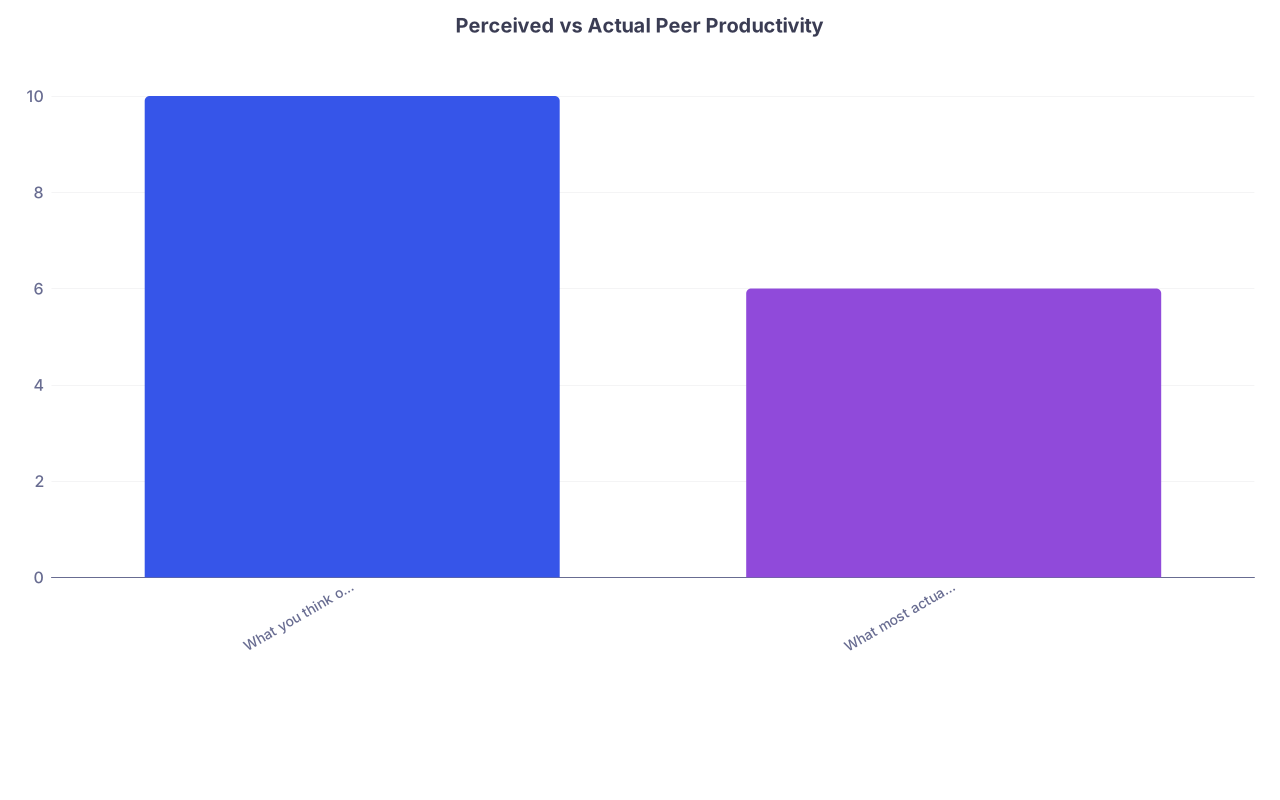
| Category | Value |
|---|---|
| What you think others do daily | 10 |
| What most actually do | 6 |
The Hidden Math of “Falling Behind”
There’s this constant whisper:
“If I don’t do more — now — I’ll ruin my chances. For residency. For fellowship. For ever being taken seriously.”
Let me be blunt: that’s how people get broken.
Residency program directors don’t sit in a dark room saying, “Let’s rank them by who looked the most miserable and overloaded.” They look at patterns, signals, and whether you look like someone who will function on their service without imploding.
Here’s what they actually pay attention to, roughly:
| Factor | Rough Importance |
|---|---|
| Clinical performance | High |
| Letters of rec | High |
| Step/board exams | High–Medium |
| Research/scholarly | Medium |
| Extracurriculars | Medium–Low |
| Being a decent human | Quietly huge |
Notice what’s not on that list:
“Did you match the most intense, most unsustainable, most online version of productivity your brain invented at 2 a.m.”
Falling behind at least some of the time is built into this path. Rotations pile up. Exams appear back-to-back. Expectations drift upward each year. Nobody is on top of everything all the time. The people who pretend they are just hide better.
The real math is this:
- Can you show up where it counts?
- Can you recover when you fall behind?
- Can you keep yourself functional over years, not days?
The crisis isn’t that you’re sometimes behind. The crisis is that you think being behind means you’re not cut out for medicine.
The Comparison Trap You Keep Walking Into
Let me guess some of your internal monologue:
“Everyone is doing research.”
“Everyone is getting better evals.”
“Everyone else seems more confident with patients.”
“Everyone has a plan. I’m just surviving.”
You’re not imagining the pressure. Medicine is set up as a ranking machine:
- Pre-meds are ranked.
- Med students are ranked.
- Residents are ranked.
You’ve been trained for years to ask, “Where am I relative to everyone else?” And now your brain does it automatically, all the time, in the worst possible ways.
The problem isn’t that you compare. It’s that you’re comparing completely different variables without knowing it.
You’re comparing:
- Your first time on wards
to someone on their third rotation. - Your honest self-report
to someone else’s curated persona. - Your baseline energy
to someone with different health, support, or neurotype.
It’s like comparing how fast you can run with a 40-pound backpack to someone jogging in shorts and saying, “Wow, I suck.” No. You’re just carrying more.

The Ethics of Self-Sacrifice (And Why It Backfires)
Medicine has this almost religious belief:
“If you sacrifice more, you are more worthy.”
Skip meals? Noble.
Work when sick? Dedicated.
Do 3 projects at once? Impressive.
Sleep 4 hours a night? Heroic.
It’s all garbage.
From a medical ethics standpoint, you are not just a worker. You’re a person and a future physician, and that comes with obligations to yourself too. You can’t talk about patient safety and then glorify trainee burnout like it’s a badge of honor. That’s hypocrisy, not professionalism.
You’ve probably heard some attending say, “You can sleep when you’re done with training” or “Back when I was a resident, we worked 120 hours a week.” Cool. Back when they were residents, we also had less understanding of fatigue, depression, and the actual effects of sleep deprivation on medical errors.
It’s not ethical to pretend:
- You’re a robot.
- You don’t have limits.
- Your health doesn’t matter as much as your exam scores.
If you routinely:
- Skip basic self-care (eating, peeing, sleeping enough to form a sentence),
- Say yes to everything because “otherwise I’ll fall behind,”
- Feel numb, checked out, or quietly resentful most days,
you’re not being more dedicated. You’re being pushed past safe operating conditions. No other high-risk field (aviation, nuclear, etc.) would look at someone operating that compromised and call it “commitment.”
Medicine does. And it’s wrong.
What “Enough” Actually Looks Like (Even If It Feels Like Too Little)
You want to know what’s realistically “enough” without destroying yourself. Not the fantasy version. The version that actually gets people through.
Think in layers, not everything-all-at-once.
Layer 1 – Bare minimum to stay functional as a human:
- Sleep most nights in a way that doesn’t make you feel physically ill.
- Eat actual food, not just coffee and vending machine candy.
- Move your body sometimes (walks count).
- Have at least one person in your life you’re honest with.
If you’re failing this layer, nothing else you “add” will fix the underlying problem. You’re building on quicksand.
Layer 2 – Bare minimum as a student/trainee:
- Show up (physically and mentally) enough that people can trust you.
- Do your core work: patient care, studying for boards, major assignments.
- Communicate when you’re in trouble instead of silently drowning.
Layer 3 – The extras that help but aren’t mandatory:
- Research
- Extra committees
- Multiple leadership roles
- Side teaching gigs
- Fancy passion projects
Here’s the part your anxiety hates: Layer 3 is optional. Genuinely. Plenty of good residents matched with solid Layer 2 and just one or two things from Layer 3 that they actually cared about.
You do not need:
- Three publications
- Ten leadership titles
- A perfectly curated CV “like everyone else”
You need some evidence that you’re engaged and responsible. Not that you’re a martyr.
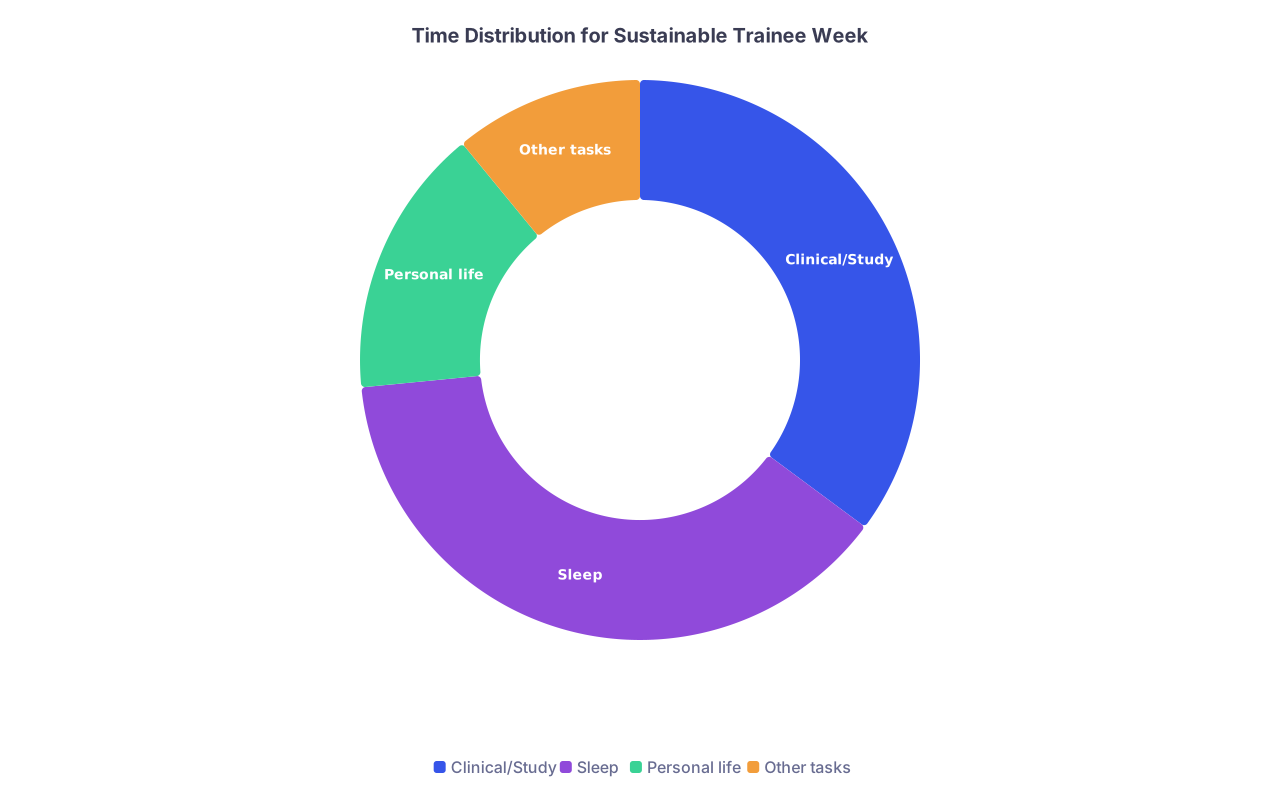
| Category | Value |
|---|---|
| Clinical/Study | 45 |
| Sleep | 49 |
| Personal life | 20 |
| Other tasks | 14 |
Micro-Wins When You Feel Chronically Behind
What do you actually do when you’re staring at the mountain, everyone else seems halfway up, and you’re frozen at the bottom?
You stop trying to “fix your whole life” and you go painfully small.
I’m talking:
- 15 focused minutes of one task.
- One email sent that you’ve been avoiding.
- Reading 3 pages, not 3 chapters.
Your brain will scream: “That’s nothing. It won’t matter.”
That’s the same brain that said, “You’ll start fresh Monday,” ten Mondays in a row.
Small, stupid-seeming actions are how you re-teach your nervous system that you can move even when you feel behind. Because the real paralysis comes from shame — the belief that you’ve already failed so badly that any tiny action is pointless.
It’s not.
Here’s a pattern I’ve seen repeatedly:
- Student feels catastrophically behind.
- They avoid emails, tasks, people.
- The hole deepens.
- They finally do one tiny thing — email a mentor, make a list, show up to office hours.
- Everything doesn’t magically fix itself, but suddenly there’s oxygen again.
You don’t have to like this strategy. You just have to try it when you’re stuck, instead of waiting for the mythical day you’ll “feel ready.”

When “I’m Behind” Is Actually Burnout
Sometimes the constant sense of being behind isn’t about time management at all. It’s burnout with a productivity costume on.
Red flags I’d pay attention to:
- You’re exhausted even after a decent night’s sleep.
- Stuff you used to care about (patients, learning, your future) feels…flat.
- You’re more cynical than usual, or everything irritates you.
- You catch yourself thinking, “I just need to get through this,” about everything.
I’ve watched people try to out-study, out-research, and out-hustle burnout. It doesn’t work. You can’t grind your way through an engine failure.
Ethically, this matters. A burnt-out future doctor isn’t just less happy. They’re at higher risk of making mistakes, being unkind, missing important details. Your well-being isn’t some selfish side quest. It’s tied to the kind of physician you’ll be.
If reading this you’re thinking, “Yeah, that’s uncomfortably accurate,” then your next “to-do” is not another project. It’s:
- Talking to someone with power and perspective: advisor, student affairs, trusted attending.
- Being more honest than feels comfortable. “I’m not okay” level honest.
- Considering actual adjustments: fewer extras, formal accommodations, therapy, time off if possible.
That doesn’t make you weak. It makes you a person who doesn’t confuse self-destruction with dedication.
The Quiet Moral Question Underneath All This
You’re not just wondering, “Am I doing enough?”
You’re quietly wondering, “Am I enough? For this career. For this world. For the responsibility I want.”
You worry that if you can’t keep up now, you won’t deserve to care for patients later. That’s the fear nobody says out loud.
Here’s where I land on that, after watching a lot of people:
- The ones obsessively asking, “Am I doing enough?” are almost never the ones who don’t care.
- The loud, overconfident, never-worried ones are way more concerning sometimes.
- Being thoughtful about your limits, your balance, your ethics — that’s not disqualifying. It’s exactly the kind of internal conflict that makes you safer, not riskier.
The system wants infinite productivity. Your patients don’t. They need you attentive, steady, and still human.
You will have seasons where you are behind. Crushingly, embarrassingly behind. You miss a deadline. You bomb a test. You watch someone else get the thing you wanted.
That doesn’t mean your story is over. It means your story is now more complicated and more honest. And honestly? That’s what this field actually needs.

| Step | Description |
|---|---|
| Step 1 | Feeling always behind |
| Step 2 | Talk to advisor or support |
| Step 3 | Choose one tiny next step |
| Step 4 | Adjust workload or seek help |
| Step 5 | 15 minutes focused work |
| Step 6 | Small win |
| Step 7 | Repeat small steps |
| Step 8 | Burnout signs? |
When You Close the Laptop Tonight
Three things I want you to walk away with:
- Feeling behind does not mean you’re failing; it means you’re human in a system that’s structurally unrealistic.
- You are allowed — ethically allowed — to protect your basic humanity, even if that means doing less than your anxiety demands.
- Progress in this world is built from small, unglamorous, repeated steps, not from matching the loudest person’s highlight reel.
You don’t have to catch up to some imaginary “everyone.” You just have to keep moving in a way that you can actually survive.