
The fear that “asking for help will follow me forever” is wildly overblown—and it’s keeping way too many of us quietly drowning.
You’re not crazy for worrying about this. I’ve watched students sit in front of a counseling intake form for 20 minutes, hovering over the “reason for visit” box, terrified to type the word “depression” or “burnout” because of one panicked thought:
“Is this going to go in my record? Will residency programs see this? Will the dean find out? Am I ruining my career by admitting I can’t handle this?”
Let’s pull this apart like an MSE on your own fear—because right now, the fear is running the show, not reality.
The Core Fear: “If I Say I’m Struggling, They’ll Think I Can’t Be a Doctor”
Let me say the blunt version you might not be telling anyone:
- You’re scared your school will secretly label you as “unstable.”
- You’re scared they’ll write something in some permanent file that will pop up when you apply for residency or a license.
- You’re scared that asking for help is proof you’re not cut out for medicine.
- And under all of that: you’re scared people will confirm the voice in your head that already says you’re failing.
Here’s the thing almost nobody tells us as students: schools are actually way more terrified of not supporting you than they are eager to punish you.
They’ve sat through the same wellness trainings. They’ve seen what happens when overwhelmed students don’t get help—LOA’s that could’ve been avoided, professionalism issues that started as burnout, worst-case scenarios involving harm to self.
Are there bad schools and clueless administrators? 100%. I’ve heard the horror stories too. But the default reality at most places is:
- Mental health and academic support live in separate systems.
- HIPAA and FERPA are not optional.
- No one is scribbling “had anxiety in M2” in red ink on your permanent record.
What Actually Goes in Your “Record” (Not the Urban Legend Version)
Let’s define what we’re even talking about when you say “record,” because that word is doing a lot of anxiety-heavy lifting.
There are really three different “records”:
| Type of Record | Who Sees It | Includes Struggle Details? |
|---|---|---|
| Academic Record / Dean's Letter | Admin, residency programs | Only if it impacts performance/LOA |
| Health / Counseling Record | Clinicians only | Yes, but protected (HIPAA) |
| Conduct / Professionalism File | Admin, sometimes dean | Only for formal violations |
1. Academic record / MSPE (Dean’s Letter)
This is what residency programs see.
What’s in there:
- Your grades, honors, pass/fail outcomes
- Narrative comments from rotations
- Whether you took a leave of absence or repeated a year/rotation
- Possibly a generic explanation if something major happened (“personal circumstances,” “medical reasons”) if you choose to share that with the dean when crafting it
What’s usually not in there:
- “Student sought counseling for anxiety in M2.”
- “Student was burned out and met with learning specialist.”
- Detailed mental health diagnoses.
What might show up:
- If your struggle leads to academic issues—failing multiple courses, professionalism concerns, a formal remediation plan, or a leave of absence—then the outcomes (not the therapy notes) can be referenced in general terms.
2. Health / counseling record
This is your therapy chart. Or your student health chart.
- Protected by HIPAA (health privacy law) or equivalent protections.
- Faculty, deans, and residency programs do not automatically get access.
- It doesn’t magically merge into your academic file.
- To share it, you’d have to sign a release. Explicitly.
So no, your psychiatrist note saying “panic attacks during exam season” is not getting beamed to ERAS.
3. Conduct / professionalism record
This is where really serious things go:
- Academic dishonesty
- Harassment, boundary violations
- Repeated unprofessional behavior
Struggling does not equal “conduct issue.” Skipping class because you’re depressed could become an attendance issue, but again, what’s documented is usually the behavior, not the DSM diagnosis behind it.
The Sneaky Ways Struggling Actually Shows Up—and Why Hiding It Backfires
Let me be brutally honest for a second: the thing that most hurts people isn’t that they told someone they were struggling.
It’s that they didn’t.
I’ve seen this pattern over and over:
- Student is drowning in Step studying, can’t sleep, brain feels like sludge.
- They’re terrified to ask for accommodations or talk to faculty.
- They fail the exam. Then a block. Then a remediation. Finally, administration has to get involved.
- Now there’s something definitely in the academic record: multiple failures, maybe a delayed graduation.
Residency programs care much more about:
- Consistent poor performance without explanation
- Unaddressed professionalism issues
- Big gaps with no context
than they do about: “I hit a wall, I got help, I improved.”
Sometimes the kindest thing you can do for your future record is to speak up early so this doesn’t snowball into multiple red flags.
“Will They Tell My Dean? My Advisor? My Future PD?”
This is the nightmare scenario we all invent: you walk into counseling, cry for 50 minutes, and the next day your dean pulls you aside like, “So I heard…”
In reality, it usually works like this:
- Counseling/mental health: totally separate. They don’t report to the dean. They don’t send weekly “who’s in therapy” updates. The exception: if you’re at imminent risk of hurting yourself/others or you give permission to coordinate care.
- Academic support / learning specialists: sometimes more connected to the school. They may have access to your grades and be in contact with the academic office. But again—what they talk about is academic planning, not “this student is broken.”
If you’re terrified, you can literally ask before you say anything:
- “Who, exactly, can see this record?”
- “Under what circumstances would anything I share be communicated to the dean?”
- “If I tell you I’m struggling mentally, does that go anywhere outside of this office?”
A good support person will answer you straight.
But What About Licensing Boards and Those Horrible “Mental Health” Questions?
Yeah. Those suck. And they make this worse.
The good news: a lot of states and boards are backing off the old, invasive questions.
Most are shifting from:
- “Have you ever in your life had a mental health diagnosis?”
to:
- “Do you currently have any condition that impairs your ability to safely practice, that you’re not being appropriately treated for?”
Notice the keywords: currently, impairs, not being treated.
They are way more concerned about:
- Untreated, unsafe impairment
than:
- “This person got therapy in M2 and passed second year just fine.”
You’re actually in a better position, if anything, to say:
- “I had X, I got treatment, it’s stable, I practice safely.”
Skipping help doesn’t make you invisible. It just makes you untreated.
Red Flags vs Normal Human Struggle: What Schools Actually Freak Out About
Your anxiety is probably telling you: “Any sign of weakness is catastrophic.”
Reality is more like: schools start to worry when patterns show risk they can’t ignore.
Things that raise institutional concern:
- Repeated exam failures or failed rotations
- Behavior that looks unsafe or severely impaired on rotations
- Written complaints from patients/staff about your conduct
- Totally disappearing without explanation
Things that do not automatically equal doom:
- Needing to talk to a counselor
- Asking for more time for assignments once in a while
- Meeting with a learning specialist to adjust your study plan
- Admitting to your advisor, “I’m really burned out and not okay right now.”
If you strike early—before everything collapses—support can stay quiet and targeted. When you wait until it’s a full-on disaster, everyone has to get involved and that creates more documentation.
Paradoxically, telling your school you’re struggling sooner can lead to less dramatic stuff ending up in your official record.
How to Ask for Help Without Feeling Like You’re Handing Over Your Career
Let’s be practical. You want help, but your brain’s screaming, “Don’t say too much.” Here’s how to do this in a way that feels safer.
Step 1: Choose the “safest” first person
Options, roughly from most private to more institutional:
- Completely external therapist / psychiatrist (not affiliated with the school)
- Campus counseling center (protected, but still feels scary)
- Peer support group / wellbeing coach
- Learning specialist / academic support office
- Trusted faculty mentor or advisor
- Dean or formal academic leadership
You don’t have to start at the top. You can start with someone who has zero role in evaluation (no grading power, no say in your promotions committee).
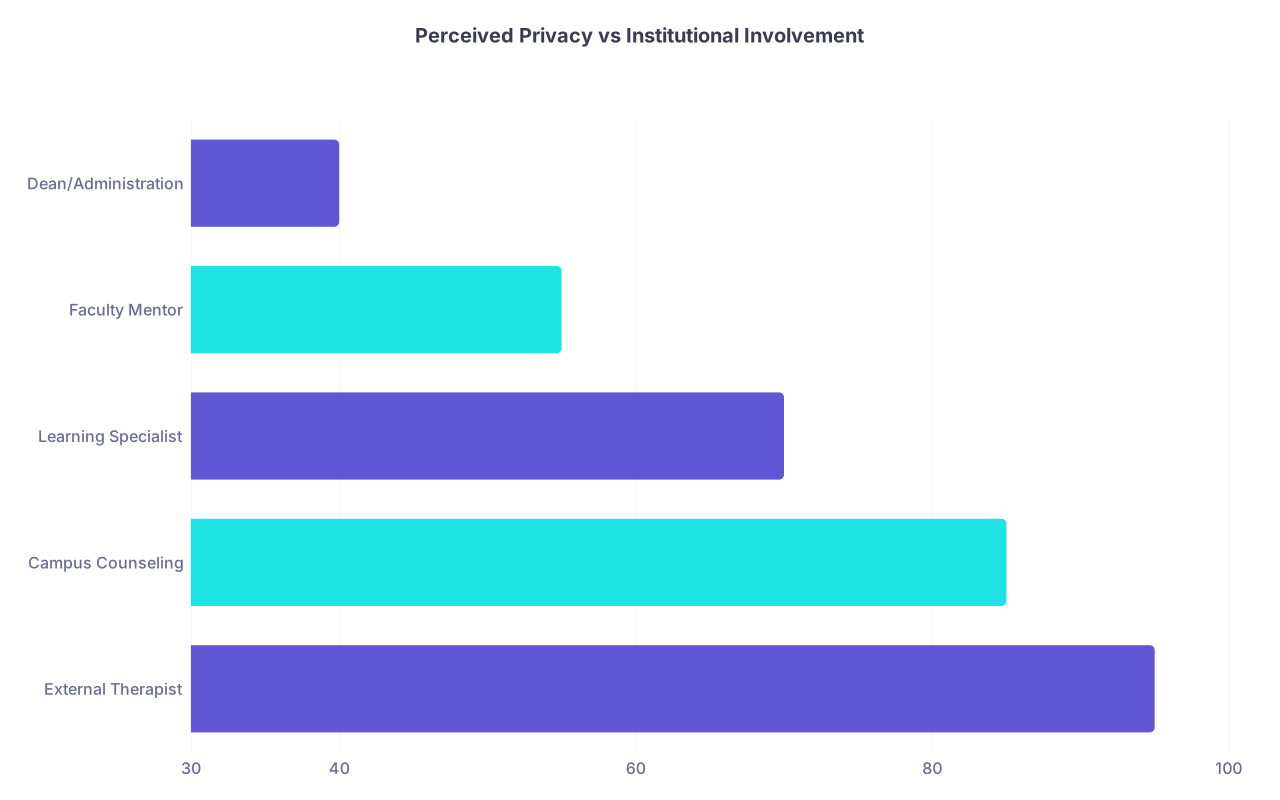
| Category | Value |
|---|---|
| External Therapist | 95 |
| Campus Counseling | 85 |
| Learning Specialist | 70 |
| Faculty Mentor | 55 |
| Dean/Administration | 40 |
(That’s not real data; it’s just how most students feel the privacy gradient.)
Step 2: Ask about confidentiality before you open up
Literally say:
- “Can you explain who has access to what I share with you?”
- “I’m scared of things ending up in my academic record—how does this actually work here?”
If they dodge? Big red flag. But usually they won’t.
Step 3: You can start with function, not diagnosis
You don’t have to sit down and announce, “Hi, I have major depressive disorder and anxiety and I cry daily.”
You can start with:
- “I’m not performing how I know I can.”
- “My concentration and sleep are wrecked, and it’s affecting exams.”
- “I’m getting close to a breaking point and I don’t want this to spiral.”
A good clinician will ask the rest.
The Hidden Cost of Staying Silent (That No One Puts on a Transcript)
There’s a piece of this nobody talks about in official meetings: what this silence does to you long-term.
When you stay in “I must never be seen as struggling” mode, a few ugly things happen:
- You confirm the toxic myth that real doctors never break.
- You train yourself to hide, not to problem-solve.
- You cut yourself off from the exact skill set you’ll need when your future patients are struggling—honest conversations, boundaries, asking for backup.
I’ve watched students white-knuckle it through M1 and M2, refuse help, scrape by, then hit the wall in residency when the stakes are higher and they have zero practice saying, “I’m not okay.”
You’re not just protecting your record. You’re also training your professional identity. And the “invincible robot” version burns out fast.
Quick Reality Check: Typical Outcomes When Students Ask for Help
Just to balance out the disaster stories your brain is replaying on loop, here’s what I’ve seen far more often than not:
- Student quietly starts therapy → grades stay steady or improve → no one outside therapy ever knows.
- Student tells advisor they’re burned out → gets a lighter elective, maybe helped to connect with counseling → graduates on time.
- Student hits serious depression → takes a planned leave of absence with clear re-entry plan → comes back, explains “personal/health reasons” in residency apps → matches just fine.
Yes, leaves and failures show up in the dean’s letter. No, that doesn’t equal automatic rejection. Context matters. Growth matters.
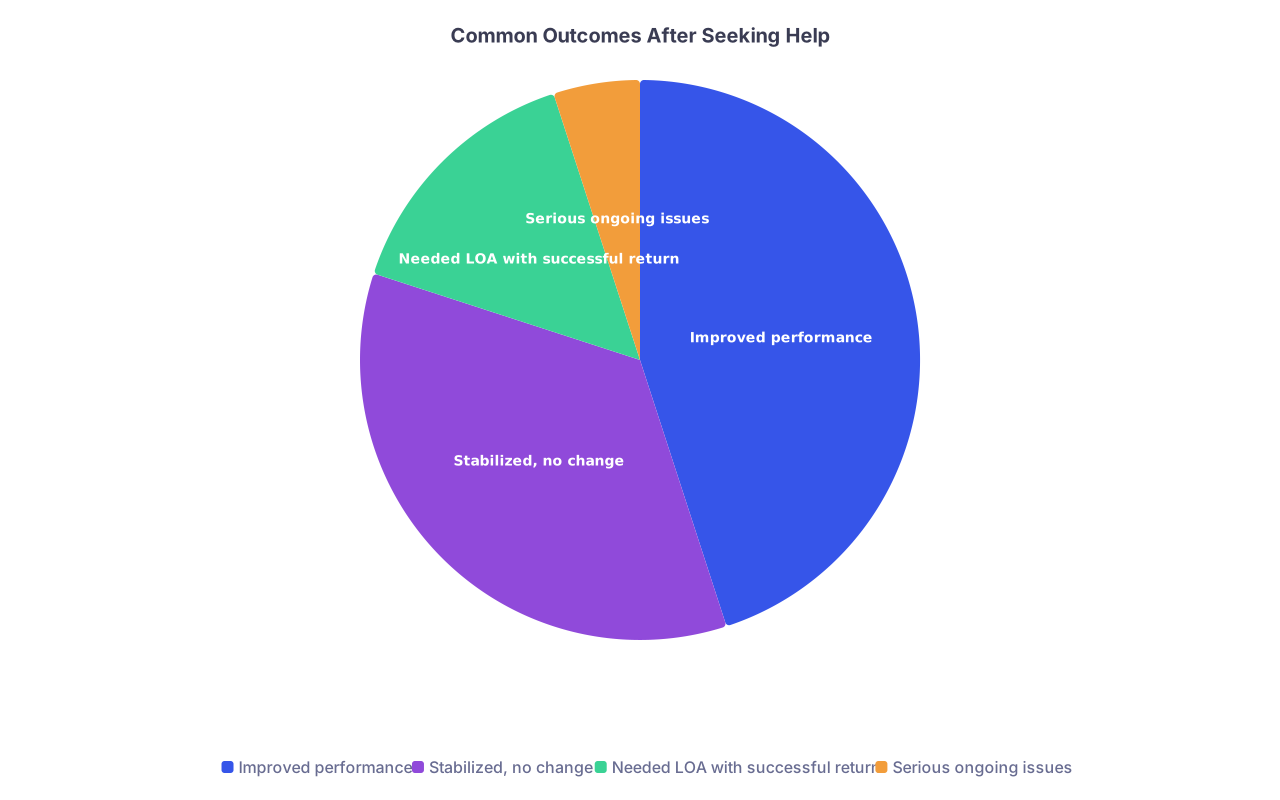
| Category | Value |
|---|---|
| Improved performance | 45 |
| Stabilized, no change | 35 |
| Needed LOA with successful return | 15 |
| Serious ongoing issues | 5 |
Again—not hard data, but very close to what I’ve watched informally over the years. Most people either get better or at least stop getting worse.
A Simple Script You Can Use Tomorrow
If you’re still stuck thinking, “OK, but what do I say?” steal this and tweak it:
Email to counseling / learning specialist:
Hi [Name],
I’m a [M1/M2/MS3] student and I’ve been having more trouble than usual keeping up and managing stress. I’m worried about how things might affect my performance if I don’t address it.
I’d like to schedule a time to talk about what resources or strategies might help.
Before we meet, could you let me know briefly how confidentiality works in your role and whether anything we discuss is shared with the academic office?
Thank you,
[Your First Name]
You’re being honest. You’re advocating for yourself. And you’re protecting your anxiety by asking directly about confidentiality instead of just assuming the worst.
Visualizing the “Tell Someone” Decision (Because Our Brains Love Flowcharts)

| Step | Description |
|---|---|
| Step 1 | Feeling overwhelmed |
| Step 2 | Consider external therapist |
| Step 3 | Schedule with campus counseling or learning support |
| Step 4 | Share details and accept help |
| Step 5 | Seek external support |
| Step 6 | Adjust plan early |
| Step 7 | Lower risk of failures |
| Step 8 | Is it affecting grades or safety |
| Step 9 | Ask about confidentiality |
This Isn’t About Being “Weak.” It’s About Being Safe.
You’re not weak for needing help. You’re a human in an inhuman system.
What you are doing, every time you ask for help, is using clinical judgment on yourself:
- Recognizing impairment
- Intervening early
- Reducing risk
That’s literally what we’re trained to do—just usually for other people.
You are not wrecking your record by saying “I’m struggling.” You’re reducing the chances that your struggle explodes into something that does show up in the record in a much louder, uglier way.
FAQ (Exactly 5 Questions)
1. If I tell my school I’m struggling with mental health, will it automatically go in my academic record?
Usually no. Mental health/counseling records are typically separate and protected. The only time struggle shows up in your academic record is when it affects things like: course failures, leaves of absence, professionalism actions. What’s documented there is the academic outcome, not the full story of your counseling sessions.
2. Can residency programs find out I was in therapy during med school?
Not from your school, unless you or your clinician explicitly sign a release to share that information. ERAS doesn’t have a “Did you go to therapy?” checkbox. Programs might see gaps, leaves, or a pattern of performance issues, and you can choose how much personal context to give in your application or interviews.
3. Should I avoid campus counseling and only see an outside therapist to be safe?
If your anxiety about privacy is so high that it’s stopping you from being honest, an external therapist can feel safer and still be totally valid support. But campus counseling is also usually very well protected. The key is asking, “How does confidentiality work here?” up front. You don’t have to declare every detail to your school just because you saw a campus counselor.
4. If I take a leave of absence for mental health, am I screwed for residency?
Not automatically. A leave will be noted, but lots of people match with LOAs on their record. Programs mostly care: did you come back successfully, show stability, and have a reasonable explanation? “I had a health issue, got treatment, and now I’m functioning well” is far better than silently crashing, failing multiple courses, and never addressing it.
5. What if my school has a bad culture and I genuinely don’t trust them?
Then be strategic. Use external supports (therapist, psychiatrist, peer groups) that are 100% outside their system. For academic issues, keep communication focused on performance and logistics, not intimate personal details. You’re allowed to protect yourself and still get help—those two things aren’t mutually exclusive.
Open one tab right now: either your school’s counseling/learning support page or Psychology Today (or another therapist directory) for your area. Don’t commit to pouring your soul out yet. Just read their confidentiality statement and send one short inquiry email asking about privacy and availability. That’s it. One email today. Let the reply show you that this doesn’t have to ruin you.