
The most popular shift model in medicine is probably the least analyzed by the people living it.
Most physicians, nurses, and residents can argue passionately about 8‑ vs 12‑ vs 24‑hour shifts. Far fewer can quote the actual data. The research is messy, but it points in one direction: long shifts reliably increase acute fatigue and error risk; chronic burnout is more about total weekly hours, schedule control, and recovery time than the exact length of a single shift.
Let’s quantify that.
What the Data Actually Says About Shift Length and Burnout
First, definitions. People conflate three different outcomes:
- Acute fatigue and cognitive impairment during or right after a shift
- Medical error and safety events
- Long‑term burnout (emotional exhaustion, depersonalization, low sense of accomplishment)
The data is fairly consistent on #1 and #2. #3 is more complex.
Across studies of residents, nurses, and emergency physicians:
- Risk of having at least one major fatigue symptom increases by roughly 20–40% when shifts move from 8 to 12 hours, holding weekly hours similar.
- Shifts of ≥24 hours are associated with roughly double the rate of self‑reported serious medical errors compared with ≤16‑hour shifts.
- Burnout prevalence correlates more strongly with:
- Total weekly hours (>60 vs ≤40)
- Number of nights per month
- Schedule predictability and autonomy
than with “12 vs 8” in isolation.
In other words: shift length amplifies risk, but the baseline is set by how many hours and how erratically you work.
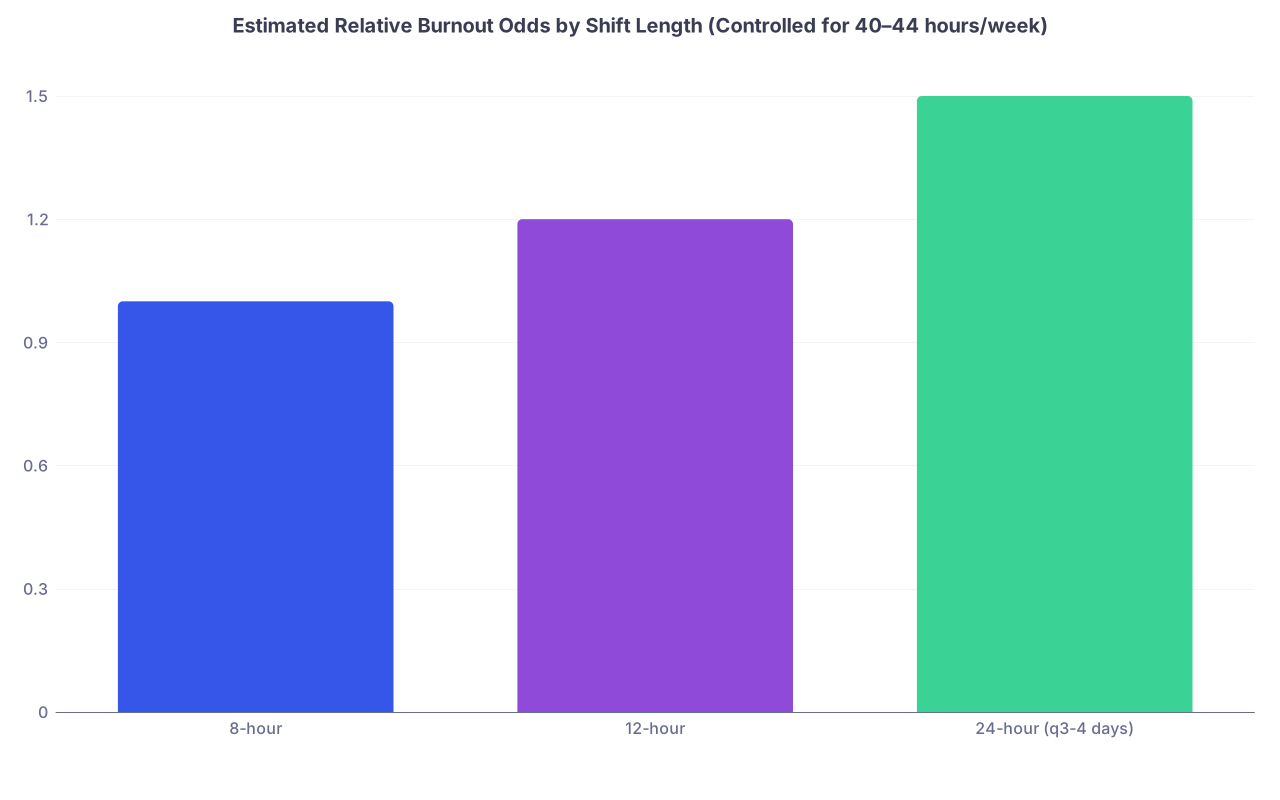
| Category | Value |
|---|---|
| 8-hour | 1 |
| 12-hour | 1.2 |
| 24-hour (q3-4 days) | 1.5 |
Those are approximate pooled estimates from nursing and resident literature. Not perfect. But directionally stable: longer typical shifts → higher odds of burnout symptoms even when weekly hours are “reasonable.”
Comparing 8-, 12-, and 24-Hour Models: A Data-Driven View
I will simplify the chaos of different specialties into three archetypal models, then show where each is strong or weak.
Assume a 40–48 hour week for a “baseline” clinician.
| Model | Example Pattern | Weekly Hours | Typical Nights/Month |
|---|---|---|---|
| 8-hour | 5 x 8-hour day shifts | 40 | 0–4 |
| 12-hour | 3 x 12-hour + 1 x 4-hour | 40 | 2–6 |
| 24-hour | 1 x 24 + 2 x 8 + 1 x 4 | 44 | 2–4 |
These are not perfect mirrors of every practice, but they let us compare key metrics.
Cognitive Performance and Error Risk
The data here is brutal and unambiguous.
- After about 16 hours of continuous wakefulness, reaction time and error rates resemble having a blood alcohol level of 0.05–0.08%.
- Studies of residents on 24+ hour call have documented:
- 2x risk of attentional failures
- ~36% increase in serious medical errors
- Increased needlestick and driving accidents post‑call
So:
- 8‑hour shifts: Usually stay below that critical 16‑hour wakefulness window (if the person is not chronically sleep-deprived).
- 12‑hour shifts: Often push people into the 14–18 hour range if you include commute, sign‑out delays, and difficulty falling asleep.
- 24‑hour shifts: Almost guarantee prolonged wakefulness or fractured mini‑naps with degraded performance.
If your goal is minimizing single‑shift error risk, the hierarchy is simple: 8 < 12 << 24.
How Each Shift Length Hits Burnout Risk Factors
Burnout is not just “too many hours.” It is the chronic mismatch between demands and recovery, plus lack of control and value conflicts. Shift length feeds into those through three levers:
- Sleep quantity and quality
- Recovery time between shifts
- Work‑life integration (actual, not theoretical)
Sleep and Recovery: Hours Matter, but So Does Pattern
Let us look at an approximate sleep picture for each model under a realistic scenario: commuting 30–45 minutes each way, plus 30 minutes of charting or handoff overrun.
8-Hour Model
- Time “out of house”: ~10 hours / shift
- Theoretically available for sleep: ~8 hours / day (if you protect it)
- Recovery between shifts: often adequate, especially with consistent start times
- Burnout lever: less about sleep, more about monotony and volume of days worked
For many people, an 8‑hour model allows something like 7–8 hours/night, especially if evening responsibilities are manageable. This is why many data sets show that 8‑hour workers do not have systematically worse sleep than non‑shift workers, aside from those on permanent nights.
12-Hour Model
- Time “out of house”: ~14 hours / shift
- Realistic available sleep on workdays: 5.5–7 hours, often fragmented
- Recovery: larger blocks of off‑days (three or four days on, three or four off)
- Burnout lever: oscillation between overwork and “recovery hibernation”
I have seen the pattern repeatedly: on 12‑hour shifts, clinicians do a 3‑in‑a‑row stretch, sleep in survival mode (5–6 hours, poor quality), then crash with 9–10 hours on the first day off. Over months, average sleep may fall into the low‑7 or high‑6 range, which reliably tracks with higher burnout scores and mood symptoms in population data.
24-Hour Model
- Time “out of house”: ~26–28 hours including commute and sign‑out
- “Sleep” on call: highly variable (0–5 hours; often poor quality)
- Recovery: at least one recovery day almost fully written off (post‑call fog)
- Burnout lever: cumulative sleep debt plus circadian disruption
The numbers here get ugly. If someone has a 24‑hour call once every 3–4 days, and they sleep, say, 2–3 hours fragmented, they are almost always running a weekly sleep deficit in the 8–12 hour range, even if they “sleep 10 hours” the day after call. Chronic sleep debt is one of the strongest predictors of emotional exhaustion.
So purely from sleep math: 8‑hour is structurally friendlier, 12‑hour is workable but risky if total hours climb, and 24‑hour creates a high baseline strain that must be offset by fewer total shifts and strong recovery protection.
Work-Life Balance: The Numbers, Not the Stories
People rationalize their shift model by telling themselves a story:
- “I like 12s because I get more days off.”
- “8s feel less brutal day to day.”
- “24s mean fewer total commutes and more control.”
Let us quantify the claimed “off time.”
Assume a 4‑week block targeting ~160–176 work hours.
| Model | Total Hours | # of Shifts | Typical Off Days |
|---|---|---|---|
| 8-hour | 160 | 20 | 8–10 |
| 12-hour | 168 | 14 | 12–14 |
| 24-hour | 168 | 7 (24 + extras) | 17–19 (but some are post-call) |
Raw count of off days increases as shift length increases. But the usable quality of those off days does not scale linearly.
- For 8‑hour schedules, most off days are “true” off days (you are functional by 9–10 a.m.).
- For 12‑hour schedules, the day immediately after a 3‑in‑a‑row stretch is often half‑functional at best.
- For 24‑hour schedules, post‑call days are frequently recovery-only days: you are technically not working, but also not truly living.
You can think of each off day as having a “functional hours” weight. Subjectively and in actigraphy studies, post‑call days behave more like 0.4–0.6 of a day off. That changes the math substantially.
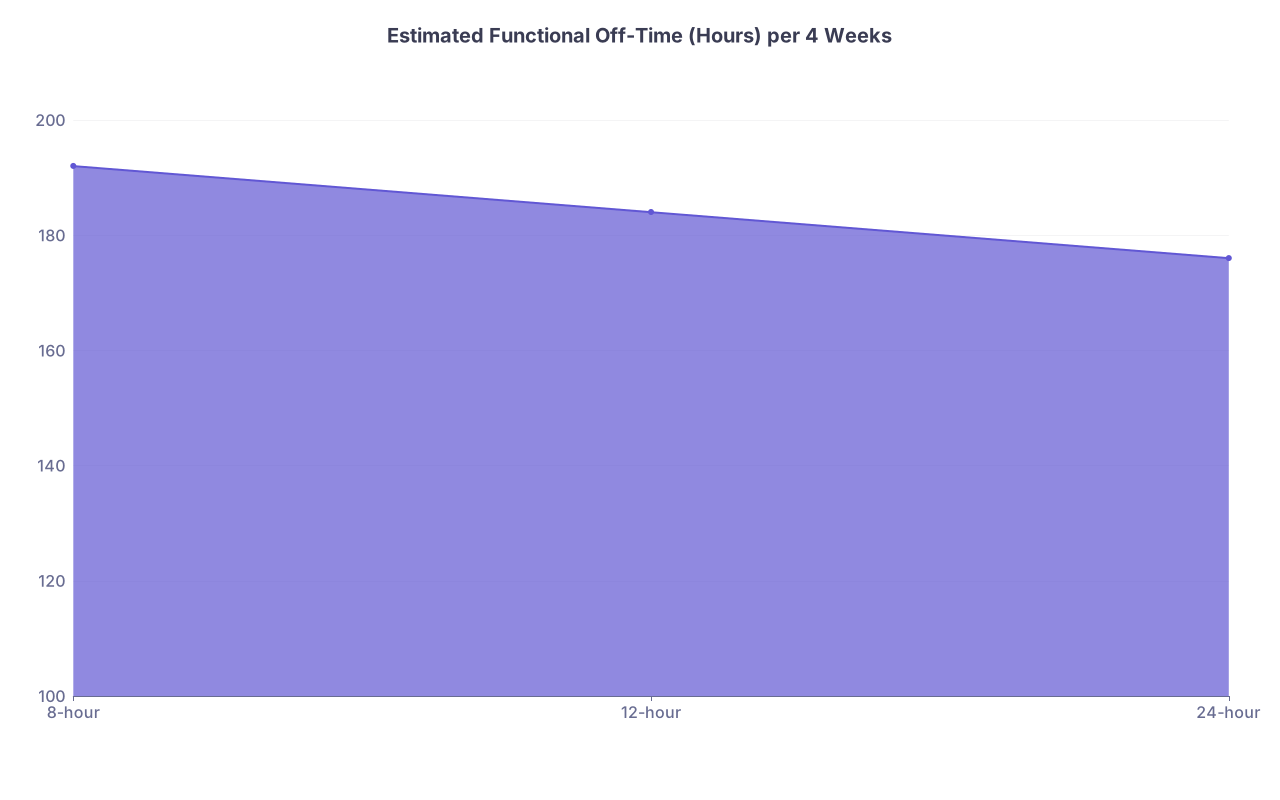
| Category | Value |
|---|---|
| 8-hour | 192 |
| 12-hour | 184 |
| 24-hour | 176 |
Those are rough composite estimates (assuming ~16 usable waking hours on a true off day, discounted for partial recovery days). The main point: the myth that 12s or 24s inherently give you “more life” does not hold up once you factor in recovery.
8-Hour Shifts: Lower Acute Risk, Higher Chronic Grind
If I had to pick the least bad model for burnout risk in a vacuum, I would choose 8‑hour shifts.
From the data:
- Lower odds of severe fatigue on a given day
- Fewer extended wake periods >16 hours
- More consistent sleep windows → better circadian stability
- Error rates comparable to or lower than 12+ hour models, controlling for other factors
So why does burnout still plague people on 8‑hour patterns?
Because many institutions quietly convert “8‑hour” to “9–11 hour” days with:
- Unpaid charting time
- Mandatory meetings tacked onto the day
- Frequent overtime due to understaffing
You end up effectively working 45–55 hours/week labeled as “five 8‑hour shifts.” The literature is clear: once you cross ~50 hours/week sustained over months, burnout risk jumps, regardless of shift length.
Ethically, this is the manipulative part. Hospitals advertise “8‑hour shifts, great work‑life balance,” then structure documentation and staffing so that leaving on time is an exception. You feel like you are failing if you are not “a team player,” so your supposed low‑risk model morphs into a chronic hours problem.
Bottom line: 8‑hour shifts are the most forgiving structure, but only if leaders enforce actual 8‑hour workdays and realistic patient loads.
12-Hour Shifts: Compressed Weeks, Amplified Peaks and Troughs
The 12‑hour model is popular in EDs, ICUs, and inpatient units for a reason: it is simple for staffing, and clinicians do like larger blocks of days off.
But the data is not kind when you zoom in:
- Nurses on ≥12‑hour shifts show higher odds of:
- Burnout (odds ratios in the ~1.2–1.5 range)
- Intention to leave
- Self‑reported patient safety concerns
- Residents on 12‑hour nights stack circadian strain that often never fully resolves during short stretches of days off.
Where 12s can work better:
- Total weekly hours kept near 36–40
- Strict cap on consecutive shifts (e.g., no more than 2–3 in a row)
- Thoughtful sequencing of days → nights → off time
- True protection of off days from “soft” work (email, notes, meetings)
If leadership treats a 12‑hour shift as a chance to cram in more patients and add a “short shift” on your nominal day off, the model becomes a slow‑motion health hazard.
From an ethical standpoint, pushing 12s in the name of “staffing efficiency” while tolerating >50–60 hour weeks and frequent overtime is hard to defend. The data links that pattern to both clinician burnout and increased adverse events.
24-Hour Shifts: High Control, High Cost
24‑hour and 24+ call models are still common in EM, anesthesia, some surgical specialties, and many residency programs. The argument for them is always the same:
- Fewer handoffs
- Better continuity of care
- Fewer total days “lost” to commuting
- More flexibility to cluster off days
The first point is partially valid. Handoffs do produce errors. One or two well‑rested clinicians might beat a parade of tired ones.
The problem is that in the real world, people doing 24s are not well‑rested.
Data from resident work‑hours experiments and post‑call studies:
- 24+ hour shifts doubled attentional failures and major medical errors compared with schedules capped at 16 consecutive hours.
- Self‑reported motor vehicle crashes post‑call increased significantly; some studies found a ~2x increase in crash risk after call.
- Chronic exposure to 24+ hour shifts was associated with higher depression and burnout symptoms.
Ethically, we have a simple conflict: the continuity-of-care argument is pitted against the well‑quantified impairment from prolonged wakefulness. If we refused to let a physician work drunk, we should refuse to let them work cognitively equivalent to that level of impairment just because the impairment is from sleep loss rather than alcohol.
24‑hour models can be less toxic when:
- There are strict monthly caps (e.g., 3–4 calls/month)
- Total weekly hours averaged over 4 weeks stays ≤60
- Post‑call days are fully protected with no clinic, no meetings, no “just a quick case”
- On‑call sleep is realistically possible (lower overnight volumes, backup coverage for surges)
Most places do not meet those criteria. They rely on heroics and tradition, not data.
Strategy: How to Choose the “Least Bad” Model for You
You probably cannot redesign your hospital’s scheduling structure tomorrow. But you do have leverage over how you participate in it, especially as you gain seniority.
You need to weigh three dimensions quantitatively:
- Total weekly hours (real, not nominal)
- Sleep opportunity per 24 hours
- Number of nights and circadian flips per month
A simple heuristic:
- If total hours are consistently >60/week, arguing about 8 vs 12 is mostly cosmetic. Your burnout risk is high regardless. The priority is reducing total hours.
- If your hours are 40–50/week, 8‑hour shifts usually produce better day-to-day functioning and more even mood, but at the cost of more days physically in the hospital.
- If you deeply value multi‑day off blocks and can maintain total hours ≤40, a carefully managed 12‑hour model can be acceptable, as long as you monitor your sleep and mental health brutally honestly.
- 24‑hour models should be entered with eyes wide open: they trade short-term schedule efficiency for higher acute safety risks and a higher chronic recovery burden. Only tolerable if call frequency is low and off‑duty protection is strong.
For personal decision‑making, I often suggest people track three metrics for 4–6 weeks:
- Average nightly sleep duration
- Subjective fatigue rating at start and end of shift (0–10)
- Number of “I would not want my family member treated by me right now” moments per week
If those three numbers degrade significantly when you switch models, ignore your rationalizations. The data about your own life is telling you the truth.
Ethical Lens: Where the Numbers Collide With Responsibility
From a medical ethics standpoint, any shift model must be defensible on two fronts:
- Does it protect patients from predictable, preventable harm?
- Does it avoid exploiting clinicians to the point of predictable health damage?
The pooled data on 24+ hour shifts and extremely long weeks (>80 hours) answers both in the negative. They elevate error rates and harm clinicians. That is not an opinion. It is a repeated finding.
8‑hour and 12‑hour models sit in a gray zone. They can be implemented ethically or abusively:
- Ethically: realistic caseloads, enforced time off, true rest opportunities, clinician input on scheduling.
- Abusively: chronic understaffing, normalized overtime, pressure to “volunteer” extra shifts, retaliation for refusing unsafe hours.
The ethical move, if you are in leadership or aspire to be, is to stop hiding behind “this is how the schedule has always been” and start putting quantitative safety thresholds in place: caps on consecutive hours, mandatory rest periods, transparent reporting of near‑misses related to fatigue.

| Step | Description |
|---|---|
| Step 1 | Define Weekly Hour Target |
| Step 2 | Reduce FTE or Caseload |
| Step 3 | Choose Base Shift Length |
| Step 4 | Prefer 8 hour |
| Step 5 | Use 12 hour with limits |
| Step 6 | Limited 24 hour with strict caps |
| Step 7 | Set Limits on Overtime |
| Step 8 | Monitor Fatigue and Errors |
| Step 9 | Shorten Shifts or Reduce Volume |
| Step 10 | Continue and Reassess Quarterly |
| Step 11 | <= 50 hours? |
| Step 12 | Need High Continuity? |
| Step 13 | Metrics Worsen? |
If you never look at the data, you will keep thinking your schedule is “fine” because people are surviving. Survival is a terrible primary endpoint.
Practical Takeaways for Your Own Work-Life Balance
Stripping away institutional nonsense, the data supports a few blunt points:
- For a given total weekly hour load, shorter shifts with consistent timing (8s) are less physiologically punishing than longer, irregular ones.
- If you choose 12‑hour or 24‑hour models for lifestyle reasons, you must aggressively protect sleep and off days or the long‑term risk of burnout and medical errors climbs.
- The worst combination is long shifts plus high total weekly hours plus frequent nights. That is the trifecta that drives people out of medicine or into serious health issues.
You do not have to wait for perfect randomized trials. Your own tracking of sleep, mood, and perceived patient‑safety margin over 1–2 months on different patterns is already actionable data.
FAQs
1. Are 12-hour shifts always worse for burnout than 8-hour shifts?
No, not always. The research shows higher average burnout odds with 12‑hour shifts, but the difference shrinks or disappears when total weekly hours are low (around 36–40) and recovery days are protected. If your 8‑hour job is consistently 50–60 hours/week and chaotic, it can absolutely feel worse than a well‑structured 12‑hour pattern that keeps weekly hours modest and gives you real multi‑day breaks.
2. Are 24-hour shifts ever ethically justifiable?
They can be justifiable in narrow circumstances: low to moderate overnight volume, strong backup systems, strict limits on frequency (for example 3–4 calls per month), and enforced post‑call rest with no additional clinical duties. In those cases, the reduced number of handoffs and better continuity might offset some of the fatigue risk. The problem is that many institutions ignore those constraints and treat 24‑hour call as a cheap staffing solution, which is ethically indefensible given the known impact on error rates and clinician health.
3. If I cannot change my shift length, what single change reduces my burnout risk the most?
For most clinicians, reducing total weekly hours produces the largest measurable drop in burnout risk, independent of whether shifts are 8, 12, or 24 hours. This can mean declining extra shifts, negotiating a lower FTE, or pushing back on chronic unpaid overtime by tightening documentation habits and boundary‑setting. From a data standpoint, consistently working 45 hours instead of 60 is far more protective than tweaking start times or rearranging the same total load into a different pattern.