

It’s July 10th. You’re on your third block of nights in four months. You open the new schedule, scroll to the week you requested off six months ago for your sister’s wedding… and it’s not there. Again. Denied. Again. No explanation, just your name slotted into “Wards – Nights.”
You’ve already “followed the process.” Put requests in early. Traded with co-residents. Sent polite emails. Maybe you’ve even brought it up casually with the chief or scheduler: “Hey, just wanting to confirm my time off in October is approved?” And every time, you either get ignored, pushed off, or given some non-answer like, “We’ll see what staffing looks like.”
This is the point where most people either:
- give up and eat the loss (again), or
- snap and fire off an angry email that torpedoes their reputation.
You’re not doing either.
You’re going to escalate. Systematically. Professionally. And in a way that actually works.
Let’s go step by step.
Step 1: Get Clear On What’s Actually Happening (Not What It Feels Like)
Before you escalate, you need to know whether you’re dealing with:
- a systems problem (bad scheduling process, chronic understaffing),
- a fairness problem (you’re being treated differently), or
- a communication problem (approvals/denials are random and undocumented).
You cannot argue “this is unfair” if you cannot articulate the pattern.
Take 20 minutes and do this on paper or in a note:
List every vacation / time-off request you’ve made in the last 12–18 months:
- Dates requested
- When you submitted the request
- Whether it was approved, denied, or never answered
- Any reason given (verbatim if you remember)
Compare yourself to peers:
- Ask 2–3 co-residents: “How often are your vacation requests denied?”
- Specifically for the same periods: holidays, popular rotations, interview season.
Pull your program/department policy:
- GME handbook
- Program-specific policies
- Any email from chiefs/PD about how vacation is assigned
Now look at your data like a human quality improvement project.
| Checkpoint | What To Look For |
|---|---|
| Timing of requests | Were you on time or early compared to the policy? |
| Denial rate vs peers | Are you denied significantly more often? |
| Rotations affected | Are denials clustered on specific services? |
| Documentation | Are reasons ever written or always verbal/vague? |
If you realize, “I’m actually getting the same number of weeks off, just not the exact dates I want,” that’s a different conversation than, “I’ve had 4 major life events denied while others get wedding weeks, honeymoons, and vacations approved.”
You escalate differently depending on which one it is.
Step 2: Fix the Basics So You’re Not Easy to Dismiss
If you’re going to escalate, you cannot give them easy ammunition like:
- “You always put in requests late.”
- “You never read the policy.”
- “You’re constantly swapping and disrupting the schedule.”
Harsh truth: leadership will absolutely reach for any defensible reason to say, “This isn’t a systemic problem; it’s a you problem.” Do not give them that.
Audit yourself against the written rules:
- Are you consistently meeting the program deadlines for requests?
- Are you avoiding “blackout” dates the policy clearly restricts?
- Are you making more last-minute changes than most people?
If you’ve slipped before, fine. From this point forward, you become annoyingly compliant:
- Submit future requests on the earliest possible date.
- Use the exact channel they require (online form, email, whatever).
- Reference the policy in your requests: “Per the vacation policy (submitted by X deadline; not during inpatient wards)…”.
This does two things:
- It builds a written record that you’re following the rules.
- It sets you up so that when you escalate, the story isn’t “noncompliant complainer” but “compliant resident being treated inconsistently.”
Step 3: Direct, Non-Whiny Conversation With the Scheduler/Chief
Do not go over someone’s head until you’ve given them a clean shot to fix it.
That means a focused, non-emotional meeting. Not a vague hallway conversation. Not a 2-line text.
Script it roughly like this:
“I wanted to talk specifically about my time-off requests. I’ve had several important requests denied or not approved, including [X, Y, Z]. I went back and checked our policy and my emails. I’m putting requests in on time and within the rules, but I’m noticing I get denied more often than others on the same rotations.
Can you help me understand what criteria are being used to approve or deny requests? And what I need to do differently to get reasonable time off for major life events?”
Key moves here:
- You’re not accusing. You’re asking for their framework.
- You show you’ve done your homework.
- You focus on “reasonable time off for major life events,” not “I want this exact beach week.”
Listen to what they say. And write it down after.
You’re looking for one of three responses:
- Clear, fair criteria that you just didn’t know about. Fine. Adjust.
- Vague hand-waving, e.g., “It’s just hard,” “We try our best,” “The schedule is tight.” Red flag.
- Defensive or dismissive, e.g., “Everyone feels that way,” “We can’t make everyone happy,” “Well, it’s residency.” Huge red flag.
If you get #2 or #3, you’re not going to fix this at their level. Time to escalate.
Step 4: Put the Pattern in Writing (Professionally, Not Like a Rant)
Before you go above their head, you need a clean written summary.
This is not an essay. One page max. Bullet points are fine. Something like:
- “Over the past 12 months, I have requested X weeks of vacation/time off, all submitted by the required deadlines and within policy.”
- “These are specific examples where my requests were denied despite meeting the stated criteria: [list dates + rotations + brief context].”
- “In the same period, multiple peers received time off for similar or later requests on comparable rotations.”
- “I met with [Scheduler/Chief] on [date] to clarify criteria. I was told: [quote or paraphrase]. Despite this, the pattern has continued.”
- “Impact: I have missed [wedding/funeral/religious holiday/etc.]. I am concerned this is not consistent with program policy or with reasonable support for resident wellness and basic work-life balance.”
This document is what you’ll lean on in every subsequent conversation. It keeps you from getting flustered and rambling. It also signals that you’re serious and organized.
Step 5: Strategic Escalation Path (Who To Go To, In What Order)
Do not start with GME or union or a lawyer. That’s like calling a code on a patient with normal vitals.
The usual ladder in residency or employed physician roles looks like this:
- Scheduler / Chief Resident / Admin – already tried
- Program Director (PD) or Section Chief
- Department Chair (if needed)
- GME Office / HR / Union (if residency or hospital-employed)
- Outside licensing/oversight or legal (only in extreme, rights-violating situations)
Here’s how to approach each step.
A. Meeting With the Program Director or Section Chief
Send a short, professional email:
“Dear Dr. X,
I’d like to request a brief meeting to discuss an ongoing concern about my ability to take approved vacation and time off per our program policy. I’ve already spoken with [Scheduler/Chief] and am still encountering repeated denials of reasonable requests.
I’ve summarized the pattern and specific examples in a short document and would really value your guidance on how to resolve this.
Best,
[Name]”
In the meeting, stay calm and specific. Use your document. Emphasize impact on ethics and safety, not just “I want a trip.”
For example:
- “I’m working 70–80 hours most weeks and have had multiple major family events denied. I’m worried this level of fatigue without real rest isn’t safe for patients, and it’s not sustainable.”
- “Other residents on the same service have been given that time off, so I’m concerned about fairness and transparency in schedule decisions.”
Ask explicitly:
“What can you do to help fix this going forward? And what is the appropriate next step if this pattern continues?”
You’ve now put the PD on notice. Which matters later if this escalates further.
B. When to Go to GME / HR / Union
You go higher when:
- You’re consistently denied vacation despite following written policy, or
- You’re punished or retaliated against for asking, or
- Your program’s culture is basically, “Residents don’t really get time off. Suck it up.”
At this level, your framing matters a lot. You’re not just “I’m mad about my vacation.” You’re bringing a systemic wellness and ethics concern.
For GME or HR, something like:
“Over the last year, I’ve repeatedly been unable to take vacation and time off as outlined in our GME policies, despite submitting timely requests and attempting to resolve the issue within the program. I’m concerned this reflects a broader problem with how schedules and leave are managed, with implications for resident wellness and patient safety.
I’d appreciate guidance on how to ensure policies are being followed and what protections exist when residents are denied reasonable time off.”
If you have a union, get them involved early. They know exactly where the levers are. They’ve seen this play before.
Step 6: Use Ethics and Safety As Your Backbone, Not an Afterthought
You’re in medicine. “I just want a beach vacation” isn’t going to move most administrators. “Chronic, unrelieved fatigue is compromising safety and violating duty hour and leave policies” will.
Tie your situation explicitly to:
- ACGME or institutional duty hour / leave standards
- Burnout, depression, and medical error data (you do not need citations; they all know)
- The ethical obligation to be rested enough to treat patients competently
This is not dramatizing. I’ve watched residents nodding off in sign-out because they haven’t had a real break in half a year. That’s not “resilience.” That’s dangerous.
Example language in a meeting or email:
“My inability to take meaningful time off has left me increasingly exhausted. I’m worried that this is affecting my cognitive performance, which isn’t fair to patients. It also seems out of step with our stated commitment to resident wellness and ACGME expectations around leave and vacation.”
You’re not threatening. You’re making clear this is not a “luxury request” but a basic safety and ethics issue.
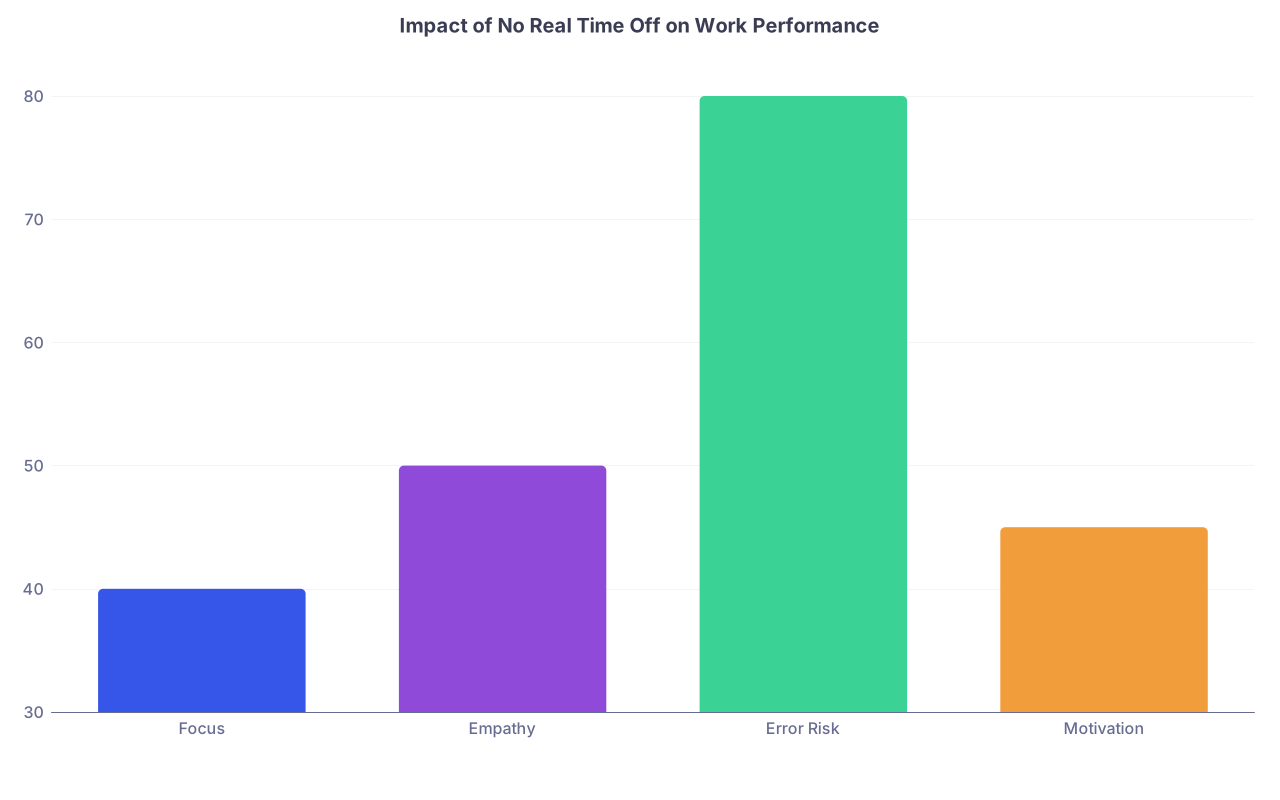
| Category | Value |
|---|---|
| Focus | 40 |
| Empathy | 50 |
| Error Risk | 80 |
| Motivation | 45 |
Step 7: Drawing Lines: When a Denial Is Actually Unethical
Not every denial is an ethical crisis. Some are just annoying. But there are situations where saying “no” really does cross a line.
Red flag situations:
- Repeatedly denying time off for major life events: funerals of first-degree relatives, your own wedding, critical medical care for yourself.
- Denying all vacation during the entire academic year or repeatedly “pushing” it to some theoretical future that never comes.
- Using time off as retaliation (“If you hadn’t complained, maybe we could’ve been more flexible.”).
- Conditioning approval on inappropriate things (favors, silence, extra unpaid work).
When you’re in that territory, your responsibility is not just to yourself. It’s to the culture you’re leaving behind.
Document everything. Save emails. After especially concerning verbal comments, send a recap email:
“To confirm our conversation earlier today: my request for time off to attend my father’s funeral from [dates] was denied due to ‘staffing,’ with no alternative dates offered. I expressed that this was a first-degree family loss and that I’ve not taken any vacation in the last [X] months.”
If you’re seeing or experiencing this level of disregard, you’re justified in pulling every available lever: GME, HR, union, ombudsperson, even outside reporting if you’re in a residency that is totally ignoring ACGME standards.
Step 8: Protect Yourself From Retaliation While You Push
Retaliation is real. Anyone who says otherwise hasn’t worked in a toxic program.
To lower your risk:
- Keep every communication neutral and professional. No sarcasm in writing.
- Use “we” and “policy” language more than “you’re doing this to me.”
- CC people strategically, not vindictively. PD on key emails, not every trivial thing.
- Keep a private log (dates, who said what, how they responded) in case you ever need to demonstrate a pattern.
Focus on solutions in your language:
“I want to find a sustainable way to ensure residents can use their vacation time in a way that respects both staffing needs and major life events.”
Administrators respond better to “how do we fix this?” than “you’re awful.”
Step 9: If Nothing Changes – Exit Strategy and Long Game
You might do everything “right” and still get nowhere. Some places are that entrenched.
If that’s where you land, you have three parallel jobs:
Minimize harm to yourself short-term.
- Take whatever partial days, post-call protections, or smaller breaks you can.
- Use sick days appropriately if you’re genuinely unwell or mentally at the wall. That’s not “gaming the system.” That’s why they exist.
Plan your exit.
- If you’re a resident: think hard about whether you can endure until graduation without serious mental health or safety consequences. If not, start talking quietly with mentors and possibly GME about transfer options.
- If you’re an attending: update your CV, start exploring other jobs where time off is actually real, not theoretical.
Leave a record.
- End-of-year anonymous surveys? Use them. Be specific.
- If accrediting bodies survey you, do not sugarcoat. They cannot fix what they do not know about.
This is not being dramatic. This is self-preservation. Your career is long. No job or program deserves your health, your relationships, and every major moment in your personal life.

| Step | Description |
|---|---|
| Step 1 | Identify Pattern |
| Step 2 | Fix Basics and Follow Policy |
| Step 3 | Meet Scheduler or Chief |
| Step 4 | Monitor Future Requests |
| Step 5 | Prepare Written Summary |
| Step 6 | Meet Program Director |
| Step 7 | Contact GME HR Union |
| Step 8 | Formal Complaint and Documentation |
| Step 9 | Adjust Expectations and Strategy |
| Step 10 | Consider Exit or Transfer |
| Step 11 | Resolved? |
| Step 12 | Improves? |
| Step 13 | Systemic or Ethical Issue |
Step 10: How To Ask Next Time So It’s Harder To Dismiss
Last practical piece. The way you request matters.
Bad version:
“Hey, any chance I can get off Oct 10–17 for a trip?”
Better version:
“I’d like to request vacation from Oct 10–17. This is for my sister’s wedding, and I’m submitting this today, which is 5 months in advance and within our policy. I’ve confirmed coverage needs and this is not during an inpatient block per the guidelines.”
Then, if it’s denied, follow up:
“Can you clarify which specific policy or staffing limitation led to the denial of this request? I’d like to understand what criteria I should use when planning vacation so that I can attend major family events when possible.”
You’re calmly forcing them to justify the decision. On the record.
FAQs
1. What if my co-residents are fine with the way things are and think I’m overreacting?
Then they’re either not in your situation, more privileged in how their requests are handled, or they’ve normalized dysfunction. You don’t need a resident union inside your class to advocate for your own basic needs. That said, quietly compare notes. Sometimes people are suffering in parallel but think they’re the only one. If you discover a pattern that affects multiple residents, that’s stronger ammunition when you go to PD or GME.
2. Can I just start using sick days as “mental health days” since vacation keeps getting denied?
If you’re truly at the point where your mental health is compromised, you are not “faking” being sick. Mental exhaustion and burnout are legitimate health issues. But you need to be honest with yourself: is this a needed health break or passive-aggressive payback for vacation denials? Use sick time judiciously and, if this becomes a pattern, consider formally talking with a physician, therapist, or occupational health. That creates both support and documentation.
3. Won’t escalating like this destroy my relationship with my PD or hurt fellowship/job prospects?
Handled poorly, yes. Handled the way I’ve laid out—fact-based, non-emotional, aligned with policy and safety—it usually does not. The biggest risk to your future is uncontrolled burnout or a reputation for being unreliable, not “this person asked for reasonable time off in a professional way.” When people whisper about “problem residents,” they’re usually talking about people who explode, disappear, or fight about everything. You’re not doing that. You’re picking one important issue and addressing it like an adult.
4. How do I know when it’s time to involve a lawyer or outside body?
That’s the nuclear tier. Consider it if:
- You’re being systematically denied leave in violation of written contracts or laws (e.g., FMLA, disability accommodations, parental leave),
- You face retaliation (threats, discipline, bad evaluations) documented clearly tied to your time-off requests or complaints, or
- Internal bodies (PD, GME, HR, union) have either ignored you or clearly protected a blatantly abusive system.
If you’re even asking this, start by anonymously consulting your union (if you have one) or a physician advocacy group. They can tell you if your situation meets the threshold where legal advice makes sense.
Do something concrete now:
Open your email and draft a one-page summary of your past 12–18 months of denied vacation requests: dates, context, and how they fit (or don’t) with your program’s written policy. Save it as a document. That’s your foundation. From there, schedule a 15-minute meeting with your scheduler or chief and use that document as your script.


