
The belief that “once you leave clinical medicine, you can’t go back” is exaggerated, lazy, and only half-true.
You can return to clinical practice after an industry detour. People do it every year. But the longer you’re out, the more the odds shift from “challenging but doable” to “structurally stacked against you.” The barrier isn’t some moral judgment; it’s regulation, recency, and risk management.
Let’s kill the mythology and talk about what actually happens when a doctor leaves clinical work for industry and later wants back in.
The Core Myth: “Industry = One-Way Exit”
(See also: No, You Don’t Need an MBA to Work in Consulting as a Physician for more details.)
The narrative goes like this: you leave residency or practice, go to pharma/biotech/consulting/health tech, cash bigger checks, wear nicer clothes, and then realize… you miss clinical work. Or you want to diversify income. Or your startup implodes. You try to go back and every door slams shut because “you haven’t practiced clinically in years.”
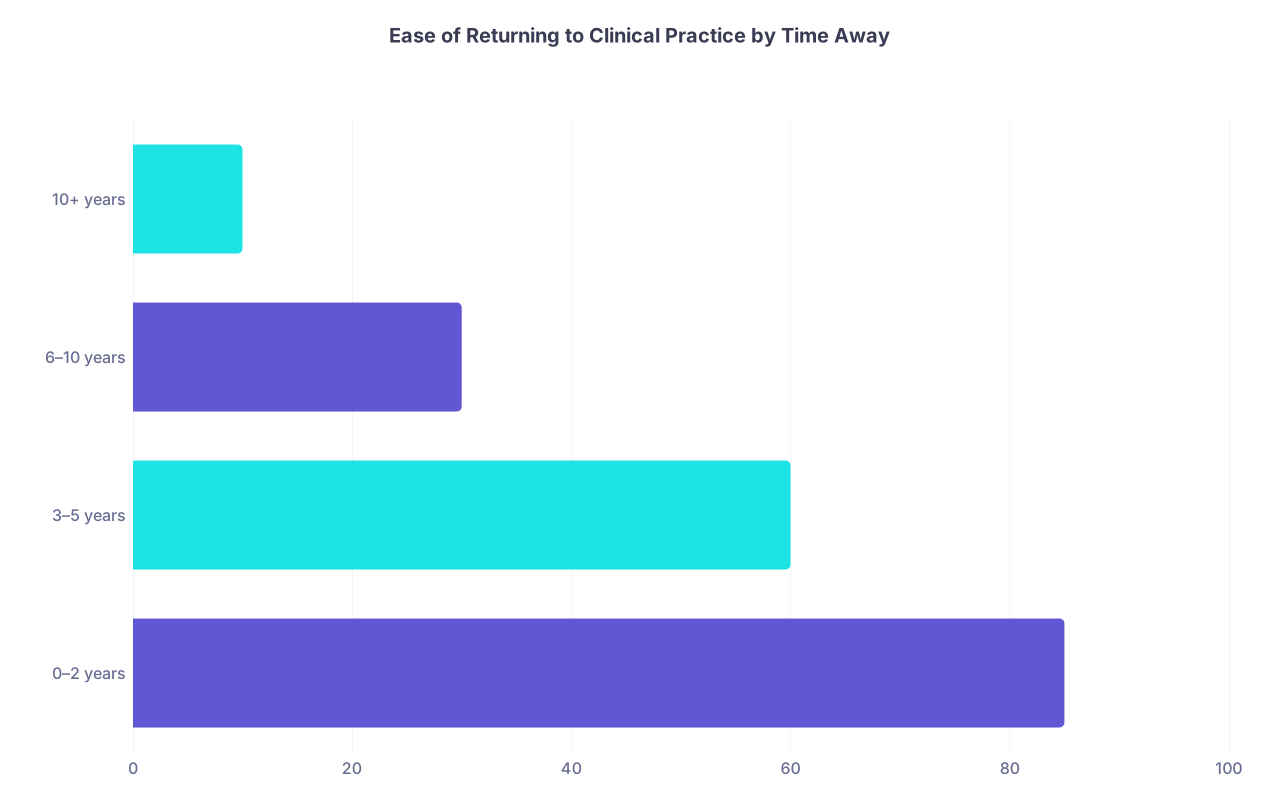
Here’s what the data and real-world patterns show instead:
- Short detours (0–2 years) are usually recoverable, often with minimal friction.
- Medium detours (3–5 years) are recoverable, but require planning, retraining, and humility.
- Long detours (5–10+ years) are sometimes recoverable, but only with structured reentry pathways—and only in some specialties and regions.
- Extremely long or post-licensure-but-never-practiced gaps? Those are brutal.
| Category | Value |
|---|---|
| 0–2 years | 85 |
| 3–5 years | 60 |
| 6–10 years | 30 |
| 10+ years | 10 |
The percentages above are not from a single randomized trial (because no one funds that), but they reflect what you see across state licensing boards, hospital privileging rules, and reentry program acceptance patterns: time away is the single biggest variable.
The other uncomfortable truth: the system doesn’t care that you were “VP of Medical Affairs” or “Clinical Strategy Lead.” Non-clinical prestige doesn’t substitute for recency of hands-on practice. Your title at Pfizer doesn’t reassure a credentialing committee that you can handle a crashing patient at 3 a.m.
What Actually Blocks You From Returning
People like to reduce it to “programs are biased against industry people.” That’s lazy thinking. The barriers are mostly structural:
1. State Licensing: Recency of Practice Rules
Most US states (and many countries) don’t just ask if you ever practiced; they care when you last practiced.
Common patterns:
- Some boards start getting jumpy once you’re out >2 years.
- Many trigger additional scrutiny or requirements at 3–5 years out.
- A minority have explicit reentry requirements at defined gaps (e.g., >5 years without clinical work = formal reentry plan).
They worry about:
- Skill decay (procedures, acute management, EMR changes).
- Medical-legal risk (plaintiff attorneys love long gaps).
- The optics of reinstating someone without proof of competence.
2. Hospital Privileging and Credentialing
Even if the state gives you a license, hospitals are another gate.
Their risk calculation:
- If you haven’t touched a patient in 6 years, and something goes wrong, they will be roasted in court.
- They have plenty of applicants without gaps. Why pick the risky one unless you bring something special or they’re desperate?
So you see requirements like:
- Recent case logs (last 12–24 months).
- Recent references from clinical supervisors.
- Proof of CME, simulation, or supervised refresh.
This is why people hit a Catch-22:
- You need recent supervised clinical work to get privileges.
- You need privileges somewhere to get supervised clinical work.
3. Insurers and Payers
Payers credential you too. Their checklists echo the same theme:
- Unexplained or long gaps = more paperwork, more questions, sometimes more denials.
None of this is personal. It’s actuarial.
The Role of Specialty: Not All Fields Are Equal
Let’s be blunt: some specialties are far more forgiving than others.
| Specialty Type | Relative Difficulty Returning | Why |
|---|---|---|
| Outpatient primary care | Easier | High demand, lower acuity |
| Psychiatry | Easier | Huge shortages |
| Hospitalist IM | Moderate | EMR-based, protocols |
| Emergency Med | Harder | High acuity, skill decay |
| Surgical specialties | Harder | Procedure volume & skills |
| Anesthesia/ICU | Harder | High-risk, fast-changing |
If you’re a psych doc who did 4 years in digital mental health product at a tech company, you can often slot back into outpatient clinical roles with a ramp-up phase.
If you’re a cardiothoracic surgeon who has not operated in 7 years, that’s almost an entirely different universe. You are asking systems to bet on your ability to jump back into high-risk work after a long layoff. They’re going to demand serious retraining, and some places will just say no.
I’ve seen:
- Ex-IM residents who left for pharma return as hospitalists after a formal reentry plan and 3–6 months of supervised work.
- Ex-EM physicians who left clinically for 8–10 years struggle to find anything but urgent care or occupational medicine, even after re-training.
- Surgeons who essentially had to accept they were never going back to the OR at prior complexity, and instead moved into non-operative roles (wound care, clinic-only, telemedicine consults).
How Long Is “Too Long” Away From Clinical Practice?
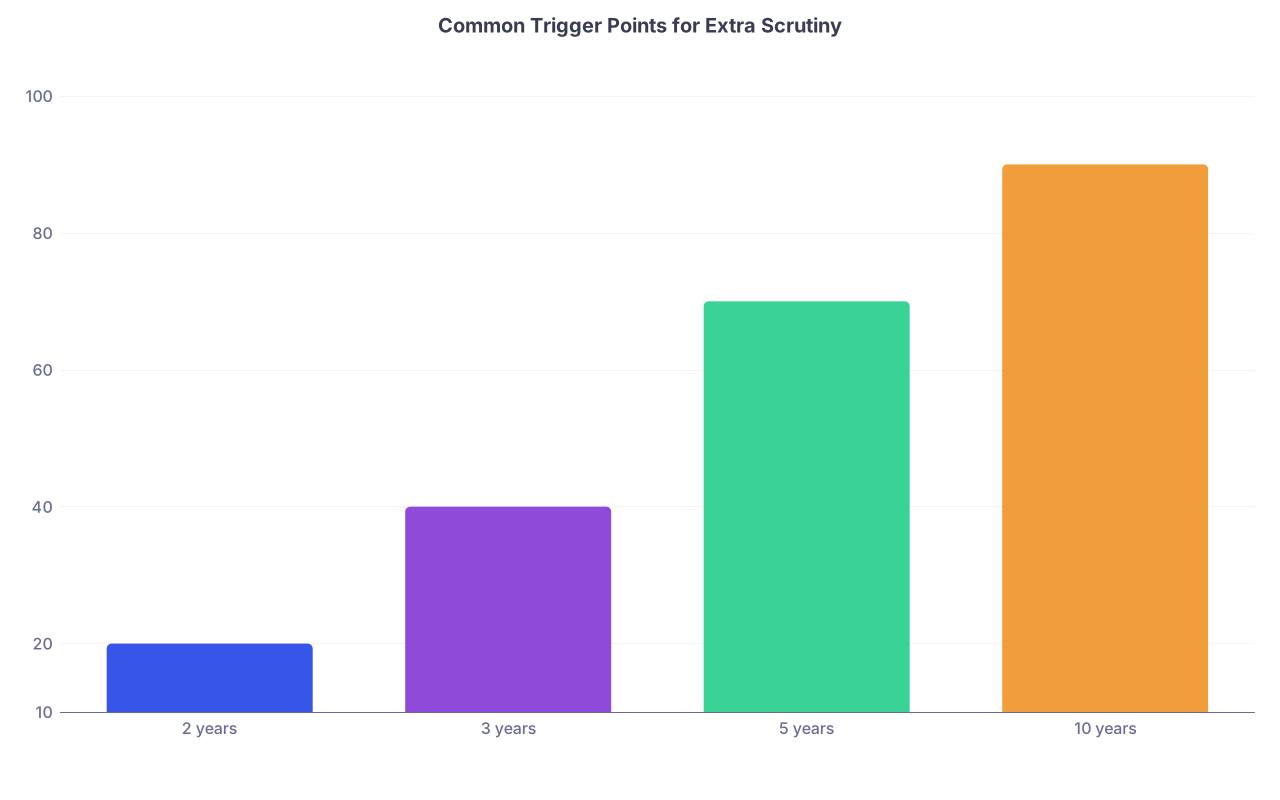
There’s no universal cut-off, but patterns repeat.
| Category | Value |
|---|---|
| 2 years | 20 |
| 3 years | 40 |
| 5 years | 70 |
| 10 years | 90 |
Those percentages roughly reflect how often you start hitting formal additional requirements:
Around 2 years:
You’re still very viable. You may need to explain the gap and show consistent CME and/or part-time locums or moonlighting, but doors are open.Around 3–5 years:
You’re in the “prove it” territory. Boards and hospitals may:- Ask for a reentry plan.
- Require simulation-based assessment.
- Request supervised clinical time in a structured environment.
Around 6–10 years:
That’s where things get harsh. Systems start treating you almost like someone switching specialties or coming from a completely different training environment. You haven’t just missed EMR updates—you’ve missed protocol shifts, new standards of care, whole lines of therapy.10+ years:
At this point, “returning” really means “redoing a substantial portion of training” or accepting a narrowed, lower-risk clinical scope. Expect:- Formal reentry fellowships or mini-residency–like tracks (where available).
- Strong bias against high-acuity procedures.
- Negotiations over malpractice premiums and supervision.
Reentry Programs: Real, But Limited and Uneven
There are structured physician reentry programs. They’re not mythical; they’re just patchy, specialty-limited, and sometimes expensive.
Some examples of what these programs look like:
- Didactic refresh (CME, guideline updates).
- Simulation labs (codes, procedures, operations, airway management).
- Supervised clinics or inpatient rotations with documented evaluations.
- Formal assessments and competency reports you can hand to boards and hospitals.
The problem:
- Not every state or specialty has a robust option.
- Many programs prioritize primary care, internal medicine, or psych.
- Highly procedural specialties are under-served.
If you’re serious about an industry stint and you want to keep the option of returning clinically:
- You should know where your nearest reentry programs are, what they require, and how long your gap can be before they turn you away or make it significantly harder.
What Actually Improves Your Chances of Returning
Here’s where people get this wrong. They think “I’ll just keep my license and do some CME” and everything will be fine. Not quite.
You significantly improve your odds of a smooth return if you:
Maintain some clinical activity
Even 4–6 hours a week of telemedicine, urgent care, or low-acuity clinic makes a massive difference. It keeps:- Case logs active.
- References fresh.
- The “not touched a patient in 7 years” label off your file.
Stay on top of CME and board status
Letting your ABIM/ABEM/ABFM/etc certification lapse while not practicing clinically is a double hit. Doable to recover from, but you’re multiplying your own hurdles:- Keep certification active if at all possible.
- If you can’t, at least keep documentation of substantial CME in your specialty.
Keep your narrative coherent
Credentialing committees hate confusion. If your CV looks like:- 2017–2020: Clinical practice
- 2020-2026: Non-clinical with no CME, no moonlighting, no explanation
that’s a harder sell than:
- 2017–2020: Clinical practice
- 2020–2026: Industry (with explicit clinical relevance, e.g., clinical trials, safety)
- Ongoing: 4 hours/week tele-psych + annual X hours CME
Your story should sound like you stayed in the field, even if not on the front line.
Accept that your “return” may not be at your previous level
This is where ego gets in the way. Returning may mean:- Hospitalist instead of intensivist.
- Clinic-only instead of OR-heavy.
- Community setting instead of academic tertiary center.
- Urgent care/telehealth instead of trauma bay.
Some people decide that adjusted scope is worth it. Others don’t. But pretending the previous level is guaranteed after a 7-year gap is fantasy.
The Harshest Cases: Those Who Never Truly Started
There’s a specific group that gets misled by the “you can always go back” myth: people who leave before they’ve actually established independent practice.
Think:
- Residents who finish but never practice independently and jump directly to industry.
- People who complete one residency year, quit, and go to non-clinical roles assuming they’ll “maybe finish residency later.”
These cases are among the hardest:
- No case logs as attending.
- No long-term practice history.
- Skill set is “recent trainee once” rather than “experienced clinician who took a break.”
They’re not doomed, but:
- You’re more likely to need to re-enter training (another residency, extra years).
- Programs may view you as an “older trainee” with question marks.
- The system has far less evidence that you were ever fully competent on your own.
(Related: Common Errors Doctors Make When Transitioning to Medical Writing)
International and Telemedicine Loopholes (and Their Limits)
People sometimes imagine workarounds:
- “I’ll just practice abroad for a while then come back.”
- “I’ll just do telemedicine only; that must be easier.”
Reality:
- Practicing abroad can help if it’s formal, supervised, and well-documented. But some US boards treat foreign practice as less equivalent, especially if not in comparable systems.
- Telemedicine can count as clinical practice, but it’s weaker if:
- You’re not managing full-spectrum care.
- You’re essentially doing low-risk triage or refills.
- You’re in a different field than your original specialty.
Still, if you compare:
- 5 years of no clinical work vs
- 5 years of part-time telehealth + CME + some relevant industry clinical interface
The latter wins every time on paper.
The Real Answer: Yes, You Can Go Back—If You Plan Like It’s Hard
The phrase “you can always go back” is comforting, but sloppy. It hides the parts that matter: timeline, specialty, and documentation.
If you’re currently in clinical practice and considering industry:
- The smartest move is to assume that returning will be possible only if you deliberately preserve that option.
If you’re already in industry and years out:
- Your path back is not theoretical. You’d need concrete steps:
- Call your state board and ask about reentry expectations at your specific gap length.
- Identify reentry programs for your specialty.
- Accept that you may have to start in a narrower, lower-risk role and rebuild over time.
Bottom Line
You can return to clinical practice after an industry detour, but the feasibility drops sharply after about 3–5 years fully out, and even more after 7–10 years—especially in high-acuity or procedural fields.
The system doesn’t care that you were “important” in industry; it cares about recency, documented competence, and risk. Keeping a toe in clinical work, maintaining certification, and having a clean narrative radically improves your odds.
“You can always go back” is only true if you act like you might want to go back: plan deliberately, protect your clinical currency, and be realistic about the scope and setting you’ll be able to return to.