
The biggest mistake fellows make when jumping to industry is waiting until “after boards” to get serious. By then, you’re behind.
I am going to walk you quarter by quarter, from 12 months before graduation through 3 months after, and tell you exactly what should be done when. No fluff. No “follow your passion.” This is about sequencing the work so you actually land a viable role in pharma, biotech, medtech, consulting, or digital health.
Assume a June 30 fellowship completion date. Adjust a month or so either way as needed. I will talk in quarters, then break them into monthly and weekly targets.
Q4: 12–9 Months Before Graduation – Exploration With Teeth
This is where most people either win or lose the entire transition. At this point you should stop vaguely “thinking about industry” and start running a structured exploration process.
Month 12: Decide You’re Seriously Considering Industry
At 12 months out (July if you finish next June), you should:
Commit to exploring industry as a real option.
Not “maybe one day.” Make it a project with deadlines.Block time on your calendar.
Two 60–90 minute blocks per week. Treat them like clinic. Non-negotiable.Create a simple tracking system.
Spreadsheet or Notion board with columns:- People to contact
- Conversations completed
- Companies of interest
- Roles of interest
- Skills to build
Clarify your broad target lanes.
By the end of the month, you should have 2–3 lanes you’re exploring, not 12 fantasies:- Pharma/biotech: medical affairs, clinical development, safety/pharmacovigilance
- Medtech/device: medical affairs, clinical research
- Health tech: clinical strategy, product, clinical operations
- Consulting: life science or healthcare strategy
- Payer / health systems innovation
If at month 12 you cannot list at least two of those that sound more exciting than private practice, that is your homework.
Weekly breakdown (Month 12)
Week 1
- Write a 1-page “career direction draft”: what you like, what you hate, constraints (geography, salary floor, visas).
- Skim 3–4 job descriptions each in pharma, medtech, and health tech. Just to see language and patterns.
Week 2
- Update your CV (academic style) so you have a clean baseline.
- Start a “jargon doc” where you paste unfamiliar industry terms with definitions.
Week 3
- Identify 10–15 people (alumni, previous grads, attendings with industry ties) to reach out to.
- Draft a short, direct email template for informational chats.
Week 4
- Send 3–5 outreach emails. Not “networking for later.” Networking now.
- Schedule at least 2 calls for next month.
Month 11: Serious Informational Interviewing
By 11 months out you should be talking to actual humans in industry every week.
Your goals this month:
- Identify at least 2 specific roles that sound like “you could see yourself there in 12–18 months.”
- Start to understand title ladders and entry points for physicians.
Common entry titles you should be hearing repeatedly:
| Sector | Typical Entry Title |
|---|---|
| Pharma | Associate Medical Director |
| Biotech | Clinical Scientist |
| Medtech | Medical Affairs Manager |
| Health Tech | Clinical Lead / Medical Director |
| Consulting | Associate / Consultant |
Weekly targets (Month 11)
Every week
- 2–3 informational calls (30 minutes each).
- Add notes immediately after the call: what the role actually does day-to-day, what surprised you, what skills are “must have.”
By end of month
- Narrow from 2–3 lanes to 1–2 primary lanes (for example: pharma medical affairs + health tech clinical strategy).
- Identify 3–5 target companies per lane.
At this point you should be able to answer quickly if someone asks:
“Are you thinking more pharma, medtech, or tech? And in which function?”
If you cannot, you have not talked to enough people. Increase volume.
Month 10: Skill Gap Reality Check
Now you stop hand-waving and start identifying gaps.
At 10 months out:
Study 10–15 actual job descriptions in your top 1–2 lanes.
Copy recurring requirements into your tracking doc.Highlight skills you lack or cannot prove.
Common ones:- Clinical trial design / GCP familiarity
- Experience with RWE, HEOR, or outcomes research
- Basic familiarity with regulatory/labeling
- Stakeholder communication beyond medicine (marketing, commercial, regulatory)
- Slide creation, data storytelling, basic Excel or analytics tools
Choose 2–3 gaps to actively close over the next 4–6 months.
Not 10. Two or three. Examples:- Enroll in a short GCP course.
- Join (or start) a outcomes / QI project that intersects with real-world data.
- Take a short online course on clinical trial design or biostats for clinical research.
At this point you should not be telling yourself “I will just learn on the job.” That works occasionally. Mostly, it is an excuse.
Q3: 9–6 Months Before Graduation – Positioning and Early Visibility
This is where you shift from exploration to positioning. You want to be visible and legible to hiring managers in your lanes.
Month 9: Convert Your CV to an Industry-Ready Resume
Your 12-page academic CV will not work. At 9 months out, you build a lean, targeted resume.
Key steps:
Trim to 2 pages.
You are not that special. Neither am I. Two pages is enough.Translate activities into outcomes.
- “Led multicenter trial of XYZ with 120 patients; improved enrollment by 25% vs prior year.”
- “Designed and delivered 15+ CME-style talks to multidisciplinary clinicians across 3 states.”
- “Collaborated with analytics team to develop dashboard for heart failure readmissions.”
Highlight industry-relevant bullets:
- Clinical research
- Cross-functional collaboration
- Guideline writing, consensus statements
- Speaking / educational experience
- Data interpretation, publications, posters
By end of Month 9 you should have:
- One core resume tailored to your primary lane.
- A draft LinkedIn profile (even if not perfect yet).
Weekly targets (Month 9)
Week 1–2
- Draft resume v1.
- Have 1–2 industry people review it, not just your academic mentor.
Week 3–4
- Build or clean up LinkedIn:
- Professional headshot (good smartphone photo is fine, just not in scrubs on night float).
- Headline that actually signals your direction:
- “Cardiology fellow pivoting to pharma medical affairs and clinical development”
- About section with 3–4 lines: what you do, what you are targeting, what value you bring.
- Build or clean up LinkedIn:
Month 8: Begin Light Market Testing
At 8 months out, you start testing without fully committing to applications.
Goals this month:
- Apply to 2–3 stretch roles you are probably a bit early for.
- Identify how recruiters and automated systems respond to your profile.
What you learn:
Are you getting auto-rejections within 24–48 hours?
Then your resume is not aligned enough with the posting language.Are you getting a “we’d like to learn more” email?
Good. It means your profile looks plausible.
At this point you should still treat any interviews as practice, not “do or die.” You are early. Use that.
Month 7: Build Real Relationships, Not Just Connections
At 7 months out, the networking has to become deeper.
Actions:
Choose 10–15 people across your target lanes who seemed helpful or insightful from earlier chats.
Schedule follow-up conversations:
- Show them your updated resume.
- Ask, “If you were me, and wanted a role like yours in 6–9 months, what would you focus on this quarter?”
Ask specifically:
- “Which 3 companies would you strongly recommend for a first role?”
- “Which roles are bad first roles for physicians?” (Yes, ask this. People will tell you.)
By end of Month 7, you should have at least:
- 2–3 people who genuinely remember you.
- 1–2 who say, “Send me your resume when you start applying seriously.”
That is your early pipeline.
Q2: 6–3 Months Before Graduation – Active Applications and Interview Prep
Now the pace picks up. At this point you should begin serious applications. Not dabbling.
Month 6: Structured Application Sprint #1
This is the first real push. Timing wise, this often lands around January–February for June graduates.
Your target:
- 5–10 well-chosen applications this month. Not 50 random Indeed clicks.
How to choose:
Focus on:
- Roles that explicitly list “MD, DO, or equivalent” as required or preferred.
- Locations or remote positions you could realistically accept.
- Companies where you already know at least one person.
Use your relationships:
- Ask contacts, “Would you be comfortable referring me for this posting?”
- Internal referral massively improves your odds of an actual human review.
Weekly plan (Month 6)
Week 1
- Finalize resume v2 based on early feedback.
- Create 3 templates for cover letters / short application notes tailored to:
- Pharma/biotech
- Medtech
- Health tech / consulting
Week 2–3
- Submit 2–3 targeted applications per week.
- Track dates, responses, and contact people in your spreadsheet.
Week 4
- Begin basic interview preparation:
- Your story: 60–90 second “walk me through your background” answer.
- Top 10 behavioral questions (“tell me about a time…”) with bullet answers.
- Begin basic interview preparation:
At this point you should be able to explain why industry without insulting clinical medicine and without sounding like you just want more money and fewer weekends.
Month 5: Interview Reps and Technical Basics
If your applications are decent and you have referrals, Month 5 often produces your first screening calls.
Your job now:
Refine your narrative.
- Why you are moving out of full-time clinical.
- Why this function (medical affairs, clinical development, etc).
- Why this company or sector.
Study your chosen function in detail.
- Medical affairs: MSL vs medical director, typical metrics, how they interact with commercial.
- Clinical development: phases of trials, protocol development, endpoints, safety review.
- Product / clinical strategy: roadmap, user research, regulatory constraints.
Do at least 2 mock interviews.
- One with someone in industry.
- One with a peer who will be brutally honest.
At this point you should stop answering questions like a fellow presenting on rounds. Shorter, sharper, oriented to outcomes.
Month 4: Second Application Sprint and Narrowing
At 4 months out, you launch Application Sprint #2. This is usually March–April for June grads.
Targets:
Apply to another 10–15 roles, but now:
- More targeted (companies and functions you actually like).
- Better tailored (resume and language aligned to each posting).
Evaluate traction:
- If you have zero interviews by now, something is wrong:
- Either your resume is off.
- Or your role targeting is unrealistic (for example, trying to jump straight into senior strategy roles with zero prior industry time).
- If you have zero interviews by now, something is wrong:
You tighten your story again. You cut lanes aggressively. By end of Month 4, you should really be focused on one primary lane.
Q1: 3 Months Before to 1 Month After Graduation – Offers, Negotiation, and Contingencies
Now you are in the critical window. At this point you should prioritize this over yet another optional research project.
Month 3: Closing Interviews and Shortlists
Three months before graduation, you want:
- Active conversations with 2–4 companies if possible.
- At least 1–2 processes that seem serious (multiple rounds, talking to potential peers and cross-functional partners).
Your tasks this month:
Prepare for second- and third-round interviews.
- Case-style questions (especially in consulting and some product roles).
- Scenario questions:
- “How would you handle a KOL disagreeing with your data interpretation?”
- “We have a safety signal in post-marketing surveillance; how do you think about escalation?”
Clarify your constraints.
- Earliest start date (often 1–3 months post-graduation).
- Visa issues if relevant.
- Geographic flexibility.
Line up references.
- At least 2–3 attendings who can speak to your:
- Judgment
- Communication
- Ability to work across disciplines
- At least 2–3 attendings who can speak to your:
At this point you should have a polished, confident “this is who I am and where I am headed” that takes under 5 minutes to deliver and can be adapted to any executive level.
Month 2: Negotiation and Backup Plans
At 2 months out, offers may start coming in. Not always. But you need to be ready for both scenarios: offer or silence.
If you have an offer (or several)
Compare roles on more than salary:
- Scope of responsibility
- Quality of manager
- Growth path for physicians
- Onsite vs remote vs hybrid
- Company stability (especially in small biotech / startups)
Ask direct questions during final conversations:
- “Where have prior physicians in this role moved after 2–3 years?”
- “How is success measured for this position?”
- “How many hours per week does your team realistically work?”
Negotiate:
- Base salary (research typical ranges for your function and region).
- Signing bonus.
- Relocation support.
- Title if you are borderline between “associate” and “director.”
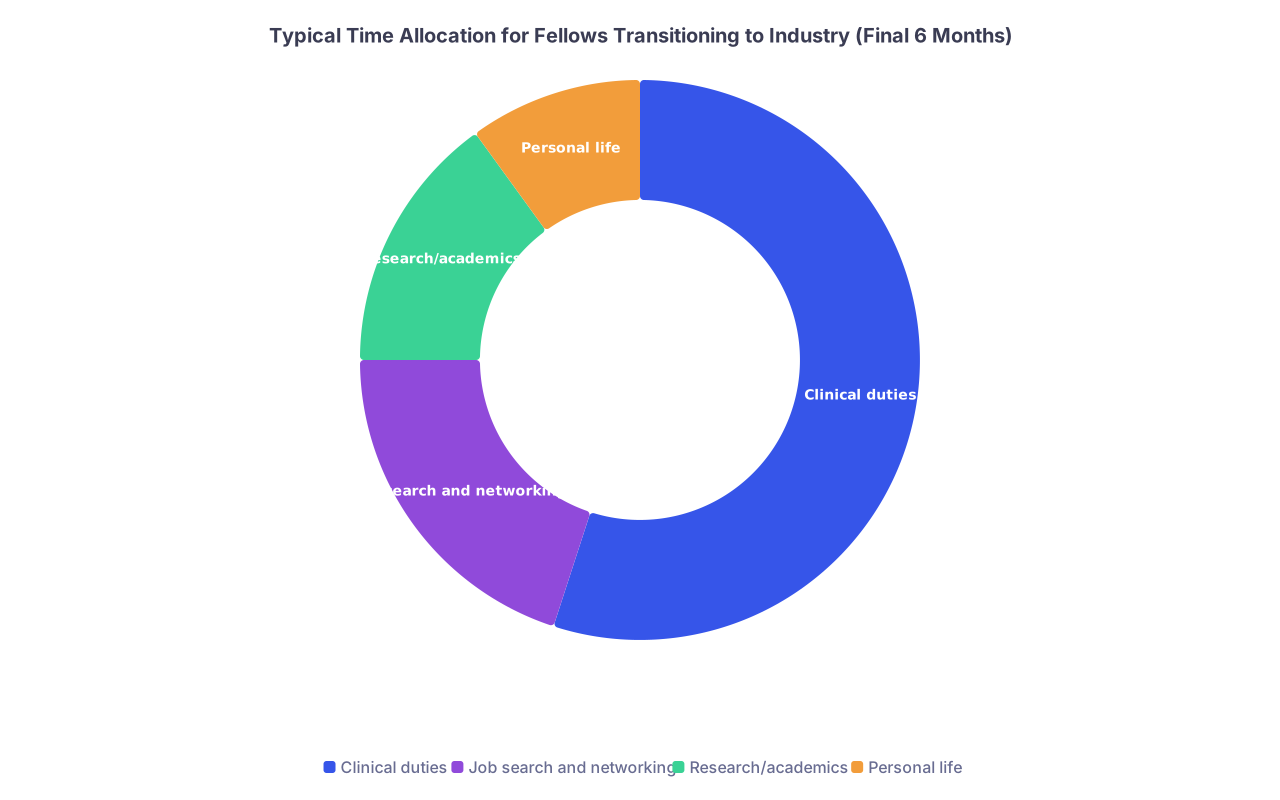
| Category | Value |
|---|---|
| Clinical duties | 55 |
| Job search and networking | 20 |
| Research/academics | 15 |
| Personal life | 10 |
If you have no offers and weak traction
Brutal, but it happens. At 2 months left, you must:
Have a short-term clinical safety net:
- Locums or per-diem shifts.
- A 0.5–0.7 FTE clinical role that does not box you in, while you keep applying.
Diagnose the problem honestly:
- Are you too geographically rigid?
- Are you aiming too high for entry roles?
- Is your narrative confusing or defensive?
Ask 2–3 trusted industry contacts to review your full package (resume + LinkedIn + story) and give unfiltered feedback.
Month 1: Transition Logistics and Clean Exit from Fellowship
In the last month before graduation, you are essentially doing two jobs: finishing fellowship well and preparing to start an industry role (or continue searching).
Your to-do list:
For fellowship
- Close out IRB / research responsibilities.
- Hand off ongoing patients or projects cleanly.
- Avoid burning bridges. Attendings move into industry all the time; they may later be hiring managers.
For industry transition
- Finalize start date and onboarding details.
- Understand your first 90 days expectations from your future manager.
- Ask for any pre-reading, background decks, trial protocols to skim.
For yourself
- Schedule 3–5 days off between fellowship end and job start if possible.
- Decide what clinical maintenance (if any) you will keep: PRN shifts, minimal panel, license and board maintenance.
At this point you should also mentally shift. You are not “a fellow trying to get a job.” You are a physician professional entering a new sector.
Q+1: 0–3 Months After Graduation – Onboarding and Long-Term Positioning
You are either in your first industry role or you are in a holding pattern with some clinical work. Either way, the clock for your next move has started.
First 30 Days: Learn the Game, Not Just the Content
If you are in your new role:
Understand structure and politics.
- Who actually makes decisions?
- What does “medical” own vs “commercial” vs “regulatory”?
Meet widely.
- 15–20 short 1:1s across your team and adjacent teams.
- Questions to ask:
- “What does great look like in this role?”
- “Who should I really get to know to be effective here?”
If you are still searching:
- Treat this as Application Sprint #3 with full intensity.
- Use your now-finished-fellow status to apply broadly; some roles will prefer board-certified / completed-training candidates.
Months 2–3: Build Credibility and Optionality
By the end of 3 months post-graduation, you should:
In-role:
- Have at least 1–2 owned projects where your name is clearly attached.
- Be known as reliable, fast, and not clinically arrogant.
Still searching:
- Have expanded your application set outside your initial comfort zone: smaller biotech, payer organizations, health analytics firms, smaller digital health companies.
Use this period not to relax into “finally done with training,” but to set up your second and third career steps. The transition from fellowship to industry is not a one-time leap. It is the first move in a new game.
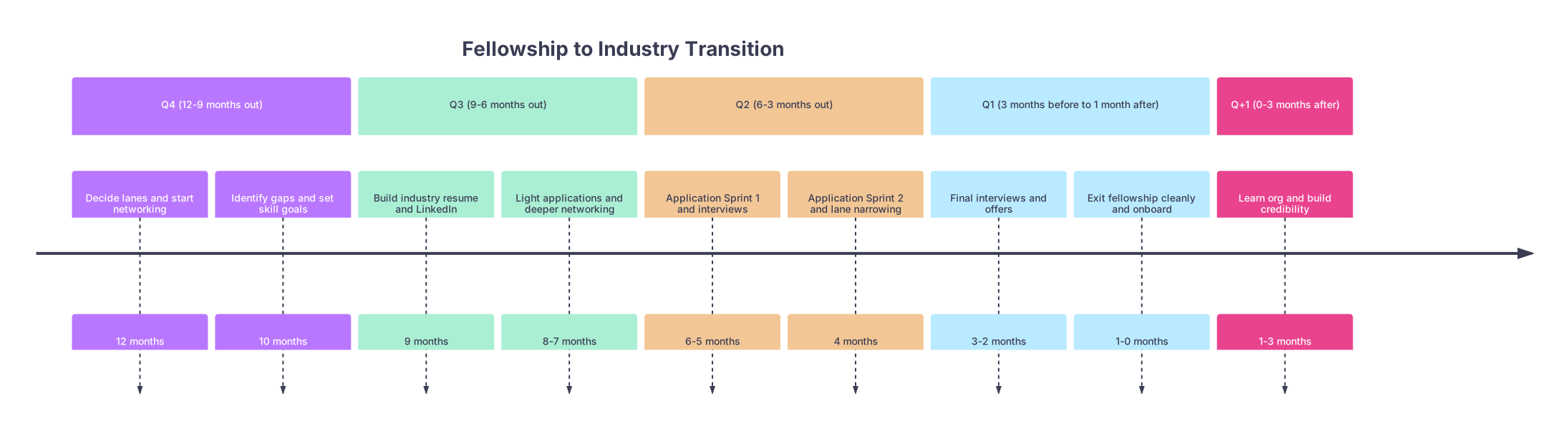
| Period | Event |
|---|---|
| Q4 (12-9 months out) - Decide lanes and start networking | 12 months |
| Q4 (12-9 months out) - Identify gaps and set skill goals | 10 months |
| Q3 (9-6 months out) - Build industry resume and LinkedIn | 9 months |
| Q3 (9-6 months out) - Light applications and deeper networking | 8-7 months |
| Q2 (6-3 months out) - Application Sprint 1 and interviews | 6-5 months |
| Q2 (6-3 months out) - Application Sprint 2 and lane narrowing | 4 months |
| Q1 (3 months before to 1 month after) - Final interviews and offers | 3-2 months |
| Q1 (3 months before to 1 month after) - Exit fellowship cleanly and onboard | 1-0 months |
| Q+1 (0-3 months after) - Learn org and build credibility | 1-3 months |
Key Takeaways
- Twelve months out, you should be exploring lanes and talking to real people. Not reading blogs alone at midnight.
- Six months out, you should be in active, structured application mode with a clear target function and sector.
- By graduation and the 3 months after, you should either be onboarding into a role or running an intense, focused search backed by a clinical safety net, not hoping something “just works out.”