
It’s 10:30 pm. You’ve got UpToDate open in one tab, a half-finished draft in Google Docs in another, and your old stethoscope in a drawer you haven’t opened in months or years. You took a break from clinical work—burnout, caregiving, your own health, immigration, whatever the reason—and now you feel clinically rusty. The thought of jumping straight back onto wards makes your stomach drop.
But you still care about medicine. You want your brain back in that world. You want to feel competent again. Someone mentioned “medical writing” and you’re wondering if that’s just fluff—or if it could actually help you rebuild.
Here’s the blunt answer: used correctly, medical writing can be an extremely effective way to rehab your clinical brain, rebuild confidence, and even create options—whether you go back to direct patient care, pivot fully out, or land somewhere in between.
You just have to treat it like structured rehab, not like random gig work.
Let me walk you through how.
Step 1: Be Honest About How Rusty You Really Are
Before you use medical writing as rehab, you need a realistic snapshot of where you stand. Otherwise, you’ll either overestimate yourself and get exposed—or underestimate yourself and spin your wheels.
Do this self-check. On paper, not in your head:
Write your last fully active clinical year
Example: “Last full-time IM hospitalist year: 2020–2021.”List your last exposure to each:
- Inpatient medicine / ICU
- Outpatient / primary care
- Emergency / urgent care
- Procedural work
- On-call, cross-cover, rapid-response type situations
Rate your comfort (0–10) with:
- Managing a standard CHF/COPD/DM case
- Writing admission + discharge plans
- Interpreting labs, ECGs, imaging reports
- Explaining common conditions to patients in plain language
If you’re below ~5/10 on most of that, you’re more than “a bit rusty.” That’s fine. It just means medical writing should be structured and clinically tied, not random.
Now decide what you’re actually aiming for. Be specific:
- “I want to return to full-time outpatient family med in 12–18 months.”
- “I may never go back clinically; I want a stable, credible nonclinical career.”
- “I want a hybrid life: maybe 1–2 clinic days + writing/industry.”
Your goal matters. It dictates which kind of medical writing is worth your time and which is a poor fit.
Step 2: Pick the Type of Medical Writing That Actually Rebuilds Your Clinical Brain
Not all medical writing will help you feel clinically sharp again. Some of it is barely medicine. You want formats that force you to:
- Read current guidelines
- Think through clinical reasoning
- Translate complex info clearly
Here’s the lay of the land.
| Type | Good for Rusty Clinicians? | Key Benefit |
|---|---|---|
| Patient education articles | Yes | Refresh basics, explain well |
| CME / clinician education | Excellent | Deep guideline-level review |
| Regulatory / safety writing | Moderate | Systems thinking, not acute |
| Health marketing content | Variable | Depends on scientific depth |
| Pharma/med device writing | Good | Evidence appraisal, trials |
Best rehab options
Patient education content (reputable sites, hospital blogs, patient portals)
- You have to get the pathophys right.
- You must know first-line management and red-flag symptoms.
- You practice explaining it in plain language—exactly what you’ll do in clinic.
Continuing medical education (CME) and clinician-facing content
- Case-based modules, review articles, learning questions.
- Forces you into guidelines, algorithms, and nuance.
- This is hands-down the best if you are planning to go back clinically.
Clinical trial / medical affairs writing (pharma, biotech, med device)
- Protocol summaries, slide decks, fair balance, evidence reviews.
- Great for rebuilding your “read the data and decide what matters” muscle.
What’s less useful (if your core goal is clinical rehab)
- Thin SEO “health tips” pieces that barely touch real medicine.
- Purely marketing material where evidence takes a back seat to slogans.
- Generic lifestyle content that any copywriter could do.
You can do those for money if needed, but don’t confuse that with real clinical rehab.
Step 3: Structure Medical Writing Like a Clinical Refresher Program
If you just “take whatever gigs come,” you’ll scatter your brain and stay rusty. You need a curriculum—much like you’d build for board review.
Use medical writing to force a systematic refresh.
1. Choose 3–5 core clinical domains
Pick areas you’re most likely to work in again or where you feel embarrassingly rusty.
For example (internal med / FM flavor):
- Cardiometabolic: HTN, DM2, lipids, obesity
- Pulm: asthma, COPD, OSA
- ID: common outpatient infections + sepsis basics
- Psych: depression, anxiety, insomnia
- Geriatrics or women’s health, depending on your plans
Now, align your writing work to those.
2. Pair every writing project with a mini–guideline review
For each article/module you take:
Look up the latest guideline or high-yield review
- ACC/AHA, ADA, GOLD, IDSA, NCCN, etc.
- Or a strong UpToDate topic + 1–2 key primary sources.
Do a quick “one-pager” in your notes:
- Summary of diagnosis criteria
- First-line, second-line treatment
- Monitoring, follow-up, red flags
- Any big changes since you last practiced
Then outline your article/module and write from that refreshed foundation.
This way you’re not just producing content; you’re actively rebuilding a mental library.
3. Use spaced repetition between projects
After you’ve written about, say, heart failure:
- 1 week later: skim your summary
- 1 month later: answer 5–10 practice questions (BoardVitals, UWorld, AMBOSS, whatever you have)
- Then, if possible, take another writing assignment on a related topic (e.g., AFib, CAD) to reinforce.
Medical writing becomes your anchor; questions and quick rereads become your deliberate practice.
Step 4: Build a Weekly “Rust Recovery” Schedule
You’re not in residency anymore. You can’t brute-force this with 80-hour weeks. So you design a sustainable but serious structure.
Let’s say you’re part-time at another job or caregiving. Aim for:
- 10–20 hours/week on medical writing and clinical refresh combined.
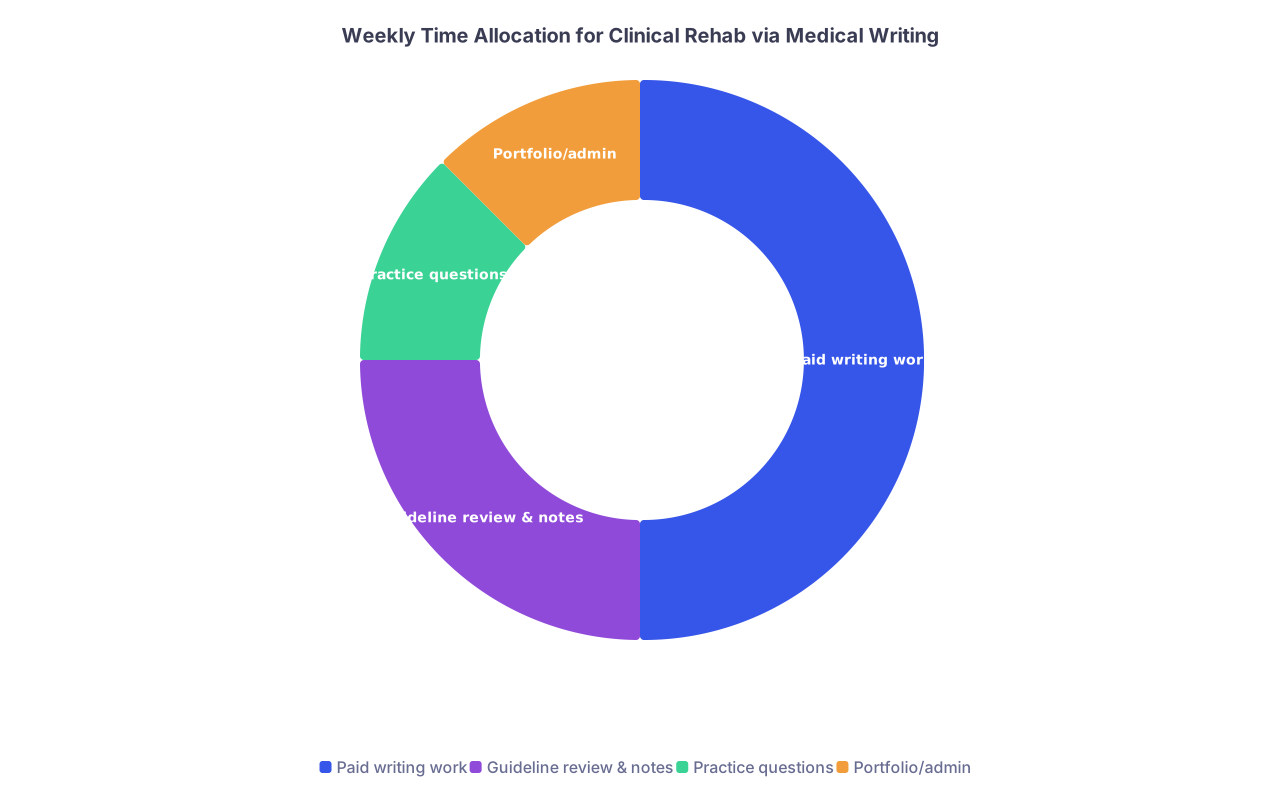
Here’s a concrete template:
| Category | Value |
|---|---|
| Paid writing work | 8 |
| Guideline review & notes | 4 |
| Practice questions | 2 |
| Portfolio/admin | 2 |
Example week (16 hours total):
- 8 hours – Paid writing on 1–2 topics (e.g., HTN, COPD exacerbation)
- 4 hours – Deep-dive review of 2 guidelines related to those topics
- 2 hours – 20–40 practice questions in that domain
- 2 hours – Portfolio, outreach to clients, updating CV/LinkedIn
Is this “perfect”? No. Is it dramatically better than just doing random content mills or binge-watching FOAMed videos? Absolutely.
Step 5: Use Writing to Rebuild Confidence and a Paper Trail
If you’ve been out of clinical work, you’re fighting two battles:
- Actual skills rust
- Perception of rust (by yourself and by others)
Medical writing can help both—if you use it strategically.
Build a visible portfolio
Forget ghostwriting only. You need some bylined work you can point to.
Start with:
- Article for a hospital/clinic blog (even if it’s your former institution)
- A piece on a reputable patient education site
- A CME module where your name is on the credits
Then you can literally say to a future employer or credentialing committee:
“I’ve been actively engaged in evidence-based medical education and content development, including recent work on updated guidelines for [X, Y, Z].”
That sounds a lot better than: “I haven’t seen a patient in four years.”
Use writing to prep for interviews or re-entry programs
If you’re planning to re-enter clinical practice:
- Pick your likely practice area (e.g., outpatient IM).
- Write a series: “Current management of hypertension,” “Approach to DM2 intensification,” “Common outpatient antibiotic pitfalls.”
- Turn the notes behind those pieces into a cheat-sheet binder or digital notebook.
You walk into re-entry interviews already having re-immersed yourself in the bread-and-butter.
Step 6: Get Real About Money and Trajectory
Let’s kill a fantasy fast: you won’t instantly replace a full attending salary just by “doing medical writing from home.” Not in the first year. Maybe not ever, depending on how you structure it.
But you can use it as:
- Bridge income while you rehab clinically
- A stepping stone to more stable nonclinical work
- A test bed for whether you actually like this world
Rough, very general ballpark ranges for physicians:
| Experience Level | Typical Hourly Range (USD) |
|---|---|
| New, building portfolio | $40–$80 |
| 1–2 years, solid samples | $80–$150 |
| Specialized CME/industry work | $125–$250+ |
Those numbers vary wildly, but here’s the point: initially, you’re being paid partly in upskilling and portfolio-building. That’s fine if your primary goal is clinical rehab plus options.
What’s dumb is treating $50 SEO gigs as a long-term career plan. Do that briefly if you must, then move hard toward:
- CME shops
- Medical communications agencies
- Health systems and academic centers
- Medical device/pharma content roles
- Long-term retainers, not one-off blog posts
Step 7: If You Might Return to Clinical Work, Plan Backwards
If there’s even a 30% chance you want to get back into clinical medicine, your writing strategy should support that from day one.
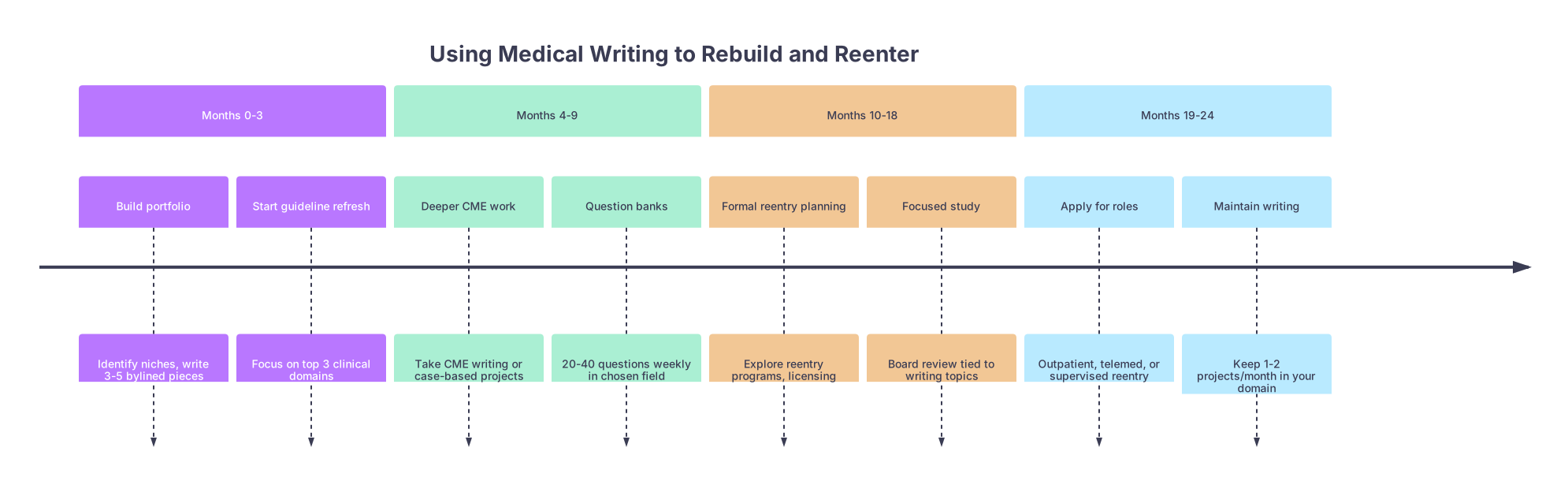
Map a 12–24 month arc
Something like:
| Period | Event |
|---|---|
| Months 0-3 - Build portfolio | Identify niches, write 3-5 bylined pieces |
| Months 0-3 - Start guideline refresh | Focus on top 3 clinical domains |
| Months 4-9 - Deeper CME work | Take CME writing or case-based projects |
| Months 4-9 - Question banks | 20-40 questions weekly in chosen field |
| Months 10-18 - Formal reentry planning | Explore reentry programs, licensing |
| Months 10-18 - Focused study | Board review tied to writing topics |
| Months 19-24 - Apply for roles | Outpatient, telemed, or supervised reentry |
| Months 19-24 - Maintain writing | Keep 1-2 projects/month in your domain |
You’re not just “doing some writing.” You’re using writing as the spine of a structured reentry plan.
Telemedicine as a bridge
Reality: some folks use medical writing + telemed to re-enter gently. Writing rebuilds knowledge; telemed forces you to apply it in real time with low-acuity cases.
But do not jump into telemed just because it’s remote and “easier.” If you feel raw panic thinking about managing a simple UTI or URI, keep building your writing + study foundation first.
Step 8: If You’re Done With Clinical Work, Use Writing to Pivot Further
Maybe you’re finished. Your body, your family, your values—something made it clear you’re not going back to full clinical practice. Fine. Then treat medical writing as:
- A landing pad
- A launch pad
Landing pad: stable enough income + identity re-anchoring. You’re still “in medicine,” just not face-to-face.
Launch pad: you build experience that translates to:
- Medical communications leadership
- Pharma / biotech medical affairs, MSL, or clinical development roles
- Health tech roles (clinical content lead, clinical strategy)
- Education roles (course creation, online programs)
Look at your projects through that lens. A few examples:
- Wrote 10 CME modules → You’re learning adult learning design, accrediting standards, and clinical evidence.
- Created clinical algorithms for a health app → That’s product + clinical safety experience.
- Built a hospital patient education library → That’s health literacy + quality / safety aligned.
Document the hell out of this. Keep a log of:
- Topics
- Target audience
- Outcomes (traffic, adoption, course completion, clinician feedback)
It becomes your “experience” section when you pitch beyond pure writing.
Step 9: How to Start Today (Concrete First Steps)
You’re probably wondering what to do this week, not in some abstract perfect-world version.
Here’s a simple first-steps sequence over 2–4 weeks:
Week 1: Stabilize your story and your CV
- Update your CV/LinkedIn with:
- Your last clinical role (be honest about end date)
- A new section: “Medical Education and Content Development” (even if it’s only starting now)
- Draft a 2–3 sentence explanation of your break that doesn’t sound apologetic:
- “After X years in [specialty], I took a planned break for [brief reason]. During this time, I’ve been returning to clinical content through evidence-based medical writing and education projects, with a focus on [area].”
Week 2: Build a sample set
- Pick 3 common conditions in your likely future practice area.
- For each:
- Read one guideline or high-yield review.
- Write:
- One 800–1200 word patient piece, and
- One 1–2 page clinician summary (bullet-style, guideline-based).
- Clean them up. These are your samples.
Weeks 3–4: Start knocking on the right doors
Target:
- Smaller medical communications agencies
- CME providers (look up “CME writer positions”)
- Hospital systems/clinics that publish patient education blogs
- Health startups with clinical content (telehealth, chronic disease platforms)
Your message is not “I’m a random physician who wants to write.” It’s:
“I’m a [specialty-trained] physician with [X] years clinical experience and recent focused work reviewing [topic domains]. I specialize in clear, evidence-based content for [patients/clinicians]. Here are 3 sample pieces I’ve produced recently on [conditions]. Do you ever work with contract medical writers for [patient/CME/clinical] content?”
You’ll get ignored a lot. That’s fine. You only need 1–2 “yes” responses to start.
Step 10: Protect Your Clinical Integrity While Writing
There’s a trap here. You can slide into bad habits: oversimplifying risk, endorsing garbage supplements, blurring lines between education and marketing.
Resist that. If you’re clinically rusty and trying to rebuild, you need your internal ethics fully switched on.
Basic guardrails:
- Do not put your name on content you know is misleading or non–evidence-based.
- For supplement-heavy or wellness brands, insist on references and evidence thresholds.
- Avoid scope creep where companies pressure you to implicitly “diagnose or treat” in content or tele-sales roles.
You’re using writing to rebuild a professional identity you can live with, not just to pay random bills.
FAQs
1. I’m extremely rusty—should I even call myself a physician in my writing work?
If you’re still licensed (active or inactive depending on jurisdiction rules) and you were trained and board-eligible/board-certified, you can honestly state your background: “Internal medicine physician with X years of clinical experience.” What you do not do is imply current active practice if you’re not actually seeing patients. Be precise in bios: “formerly practicing,” “trained in,” “board-certified through [year].” When in doubt, understate current clinical involvement rather than inflate it.
2. Can medical writing alone get me ready for hospitalist work again?
No. If you’ve been out more than a couple of years, writing plus reading is not enough to walk into nights on a busy service. You’ll likely need a formal reentry pathway, supervised practice, or a controlled ramp-up (e.g., outpatient first, low-acuity telemed, then gradually more complex cases). But writing can dramatically soften the return: your guideline knowledge, vocabulary, and comfort with cases will be far better than if you just “crammed” for a few weeks.
3. How long before I realistically feel less rusty using this approach?
If you commit 10–20 hours/week to targeted writing + guideline review + questions, you’ll usually feel noticeably sharper in 8–12 weeks in your chosen domains. Truly solid again? Think 6–12 months. The timeline depends on how long you’ve been away and how broad your target scope is. A narrow outpatient niche (e.g., diabetes + obesity) comes back faster than “all of internal medicine.”
4. What if I start medical writing and realize I hate it?
Then you learned something valuable without wrecking your life. You can still use the content prep you did as clinical rehab and pivot to other nonclinical roles: utilization review, case management, informatics, education, telemed (once you’re ready), or industry roles that are more about strategy than writing. The same guideline refresh and case thinking you did for writing translates directly into those worlds. It’s not wasted effort.
Key takeaways:
Use medical writing as structured rehab, not random side gigs. Tie every piece you write to guideline-level learning and, if needed, practice questions. And design your writing trajectory to support where you want to end up—back in clinic, fully nonclinical, or somewhere in between.