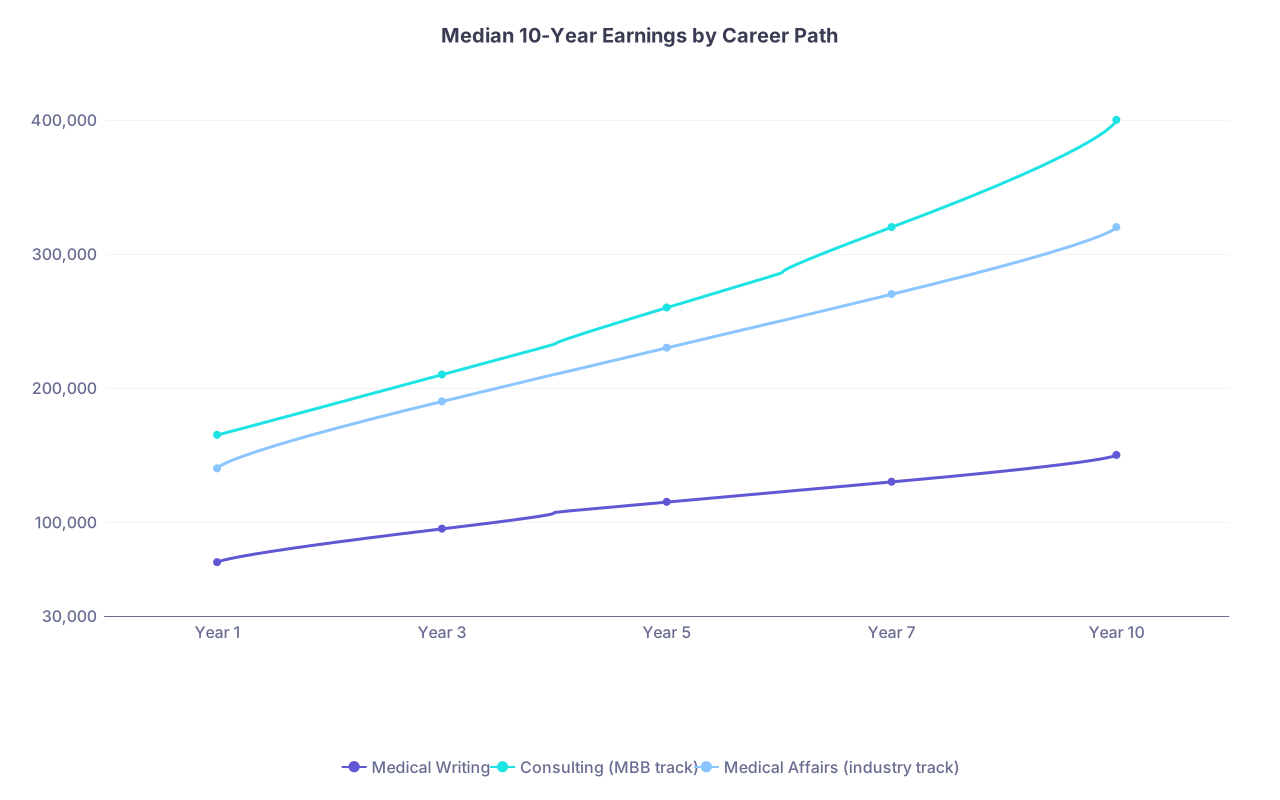
| Category | Medical Writing | Consulting (MBB track) | Medical Affairs (industry track) |
|---|---|---|---|
| Year 1 | 70000 | 165000 | 140000 |
| Year 3 | 95000 | 210000 | 190000 |
| Year 5 | 115000 | 260000 | 230000 |
| Year 7 | 130000 | 320000 | 270000 |
| Year 10 | 150000 | 400000 | 320000 |
The biggest mistake physicians make when comparing non‑clinical careers is obsessing over starting salary instead of income trajectory. The data is very clear: how fast your earnings compound matters far more than where you start.
In alternative medical careers, three paths keep showing up in the numbers: medical writing, management consulting, and medical affairs. They are not even close in trajectory, risk, or ceiling. Lumping them together as “industry” or “non‑clinical” is lazy thinking.
Let’s quantify the differences.
1. Baseline Assumptions: What the Numbers Actually Look Like
I will anchor this on realistic 2024–2025 US figures, combining sources like Glassdoor, Levels.fyi, salary surveys, and what I have seen in actual offers.
Think “typical but not extreme” candidate:
- MD or DO, no active clinical practice (or part‑time)
- 0–2 years of experience in the new field at entry
- Large metro, not rural; mix of remote and onsite
- Full‑time W‑2 unless stated otherwise
Here is the rough baseline for year‑1 total compensation (salary + bonus where common):
| Path | Low End (USD) | Median (USD) | High End (USD) |
|---|---|---|---|
| Medical Writing (FT) | 55,000 | 75,000 | 95,000 |
| Medical Writing (Freel.) | 40,000 | 90,000 | 150,000 |
| Consulting – MBB* | 150,000 | 185,000 | 210,000 |
| Consulting – Tier 2/Bout. | 130,000 | 160,000 | 190,000 |
| Medical Affairs – entry | 125,000 | 150,000 | 180,000 |
*MBB = McKinsey, BCG, Bain
Already you can see the distortion: medical writing looks underwhelming next to consulting and medical affairs. But focusing only on year‑1 ignores three critical dynamics:
- Growth rate (annual % increases and promotion jumps)
- Volatility (risk of income drop, gaps, or feast‑famine cycles)
- Optionality (paths to higher‑paying roles over 5–10 years)
This is where the trajectories start to diverge sharply.
2. Medical Writing: Slow and Steady, With a Hidden Power Law
The stereotype is: “Medical writers barely clear six figures.” That is true for a large chunk of full‑timers. It is absolutely not true for the top 10–20% of freelancers and agency owners.
Here is what the data and rate sheets typically show.
2.1 Income structure and hourly reality
Typical full‑time in‑house medical writer:
- Salary: 70–95k early, 90–120k mid‑career
- 3–4% annual raises, mild bonuses if in pharma/agency
- 40 hours/week, fairly stable
Typical freelance medical writer after 1–3 years:
- Hourly effective rates: 60–150 USD/hour
- 60–80: generalist content, agencies, CME modules
- 80–120: regulatory, HEOR, value dossiers
- 120–150+: niche expertise, rush jobs, direct‑to‑client pharma
- Realistic annual billable hours (solo): 1,000–1,400 hours
- Typical gross income: 80k–180k
- High end (established, good marketing, no underpricing): 200k–300k+
So why do most people never see the 200k+ writers? Because they are not visible. They are too busy billing.
2.2 A realistic 10‑year earnings path in medical writing
Let us take a conservative “motivated but not superhuman” freelancer:
- Year 1: part‑time ramp, effective rate 50 USD/h, 800 billable hours
→ 40,000 gross (often combined with another job) - Year 3: 85 USD/h, 1,100 billable hours
→ 93,500 - Year 5: 110 USD/h, 1,250 billable hours
→ 137,500 - Year 7: 125 USD/h, 1,300 billable hours
→ 162,500 - Year 10: 140 USD/h, 1,350 billable hours
→ 189,000
Now compare that to a salaried writer who never freelances:
- Year 1: 75,000
- Year 3: ~83,000
- Year 5: ~90,000
- Year 7: promotion to senior, 110,000
- Year 10: 125,000
The delta by year 10 between serious freelancer and solid in‑house: ~60k/year. Over a decade, that is 300–400k in cumulative difference, even before you consider agency‑building or subcontracting.
2.3 Upside ceiling and risk profile
The data shows:
- Majority of writers cluster between 70k–130k long term
- Top slice (agency owners, specialists) hit 250k–400k+ after 7–10 years
- Volatility mainly in freelance client pipeline, not salary cuts
So the trajectory is:
- Low starting point
- Moderate slope (5–10% per year if you actively raise rates and niche down)
- Long, stable runway with good work–life balance
You are not getting rich fast in medical writing. But you can build a durable 150–200k income with high autonomy and low burnout if you treat it as a business, not a side hobby.
3. Consulting: High Slope, High Burn, High Optionality
Consulting, especially at MBB, is an income acceleration machine for people who can survive 60–80 hour weeks, constant travel (less now, but still), and a culture where “average” is a euphemism for “out in 18 months.”
Let us look at actual comp ladders.
3.1 MBB‑type trajectory (pharma / healthcare focus)
Typical US MBB total comp (salary + bonus) in 2024:
- Business Analyst / Associate (post‑MD can start at Associate):
175k–220k - Engagement Manager:
240k–320k - Associate Partner:
350k–500k - Partner:
600k–1M+ (including profit share)
Only a minority hit partner. But you do not need to. The exit options are where the data gets interesting.
3.2 Five‑ and ten‑year income snapshots
Scenario: MD enters at Associate level, exits to pharma/tech health in year 3–4.
Let us map a plausible 10‑year path:
Years 1–3 (Associate / EM track):
- Y1: 190k
- Y2: 210k
- Y3: 240k
Exit to industry role (strategy, product, medical affairs leadership):
Years 4–10:
- Y4: Senior Manager – 230k
- Y5: Director – 260k
- Y7: Senior Director – 310k
- Y10: VP‑level – 380k–450k (wide range)
Cumulative 10‑year earnings for this path, rough total:
- Years 1–3: ~640k
- Years 4–10: let us average 290k over 7 years → ~2.03M
- 10‑year total: ~2.67M
Contrast with a solid medical writer who hits 150k by year 10 and averages ~110k over 10 years: ~1.1M total.
Consulting + typical exit literally doubles or more your 10‑year income vs “steady” writing.
But that is the median successful consulting trajectory among those who survive and perform. People who stall at Associate or leave underperformed after 2 years look different:
- Y1: 190k
- Y2: 200k
- Exit to mid‑level corporate role at 140k–160k
- Slow climb to 180k–220k by year 10
- 10‑year total more like 1.6M–1.8M
Better than writing, yes, but with far higher stress, travel, and burnout risk.
3.3 Risk, burnout, and probability of “making it”
The data pattern in consulting is consistent:
- 20–30% churn in first 2–3 years is common at big firms
- Of those who stay, maybe 20–40% progress into true leadership or lucrative exits
- Others move laterally into “good but not spectacular” corporate roles
So consulting has:
- Very high initial pay
- Very steep early growth slope
- Very high variance in where you land by year 10
If you want maximum optionality and can handle brutal hours for 3–5 years, the math favors consulting heavily. If your risk tolerance and energy are low, the expected value drops.
4. Medical Affairs: The Middle Path with Strong Floor and Decent Ceiling
Medical affairs sits between writing and consulting on almost every metric:
- Pay: higher than writing, lower than consulting at the top end
- Stability: more than consulting, similar or better than in‑house writing
- Growth: slower than consulting, faster than most writing roles
You see this most clearly in pharma and biotech org charts: MSL → Sr MSL → Manager → Director → VP Medical Affairs.
4.1 Entry‑level and early years
Typical entry‑level medical affairs roles for an MD/DO:
Medical Science Liaison (MSL, field‑based):
- Base 130k–165k
- Bonus 10–20%
- Total 145k–190k
Associate / Manager in Medical Affairs (office‑based):
- Base 120k–150k
- Bonus 10–15%
- Total 135k–175k
Annual raises: 3–5%, promotion bumps 15–30%.
4.2 A data‑driven 10‑year career ladder
Let us model a straightforward climb for someone who “does well but not superstar level” in medical affairs.
Year 1–3 (MSL):
- Y1: 155k
- Y2: 165k
- Y3: 180k
Year 4–6 (Sr MSL or Manager):
- Promotion bump: 25% → base 190k, total ~210k
- Y4: 210k
- Y5: 220k
- Y6: 230k
Year 7–10 (Director‑track):
- Promotion bump: another 25–30% → total 270k
- Y7: 270k
- Y8: 285k
- Y9: 300k
- Y10: 320k
Rough 10‑year total:
- Y1–3: ~500k
- Y4–6: ~660k
- Y7–10: ~1.18M
- 10‑year total ≈ 2.34M
That slots almost exactly between:
- Medical writing solo path (~1.1–1.7M across wide range)
- Consulting + strong exit (~2.6–3.0M)
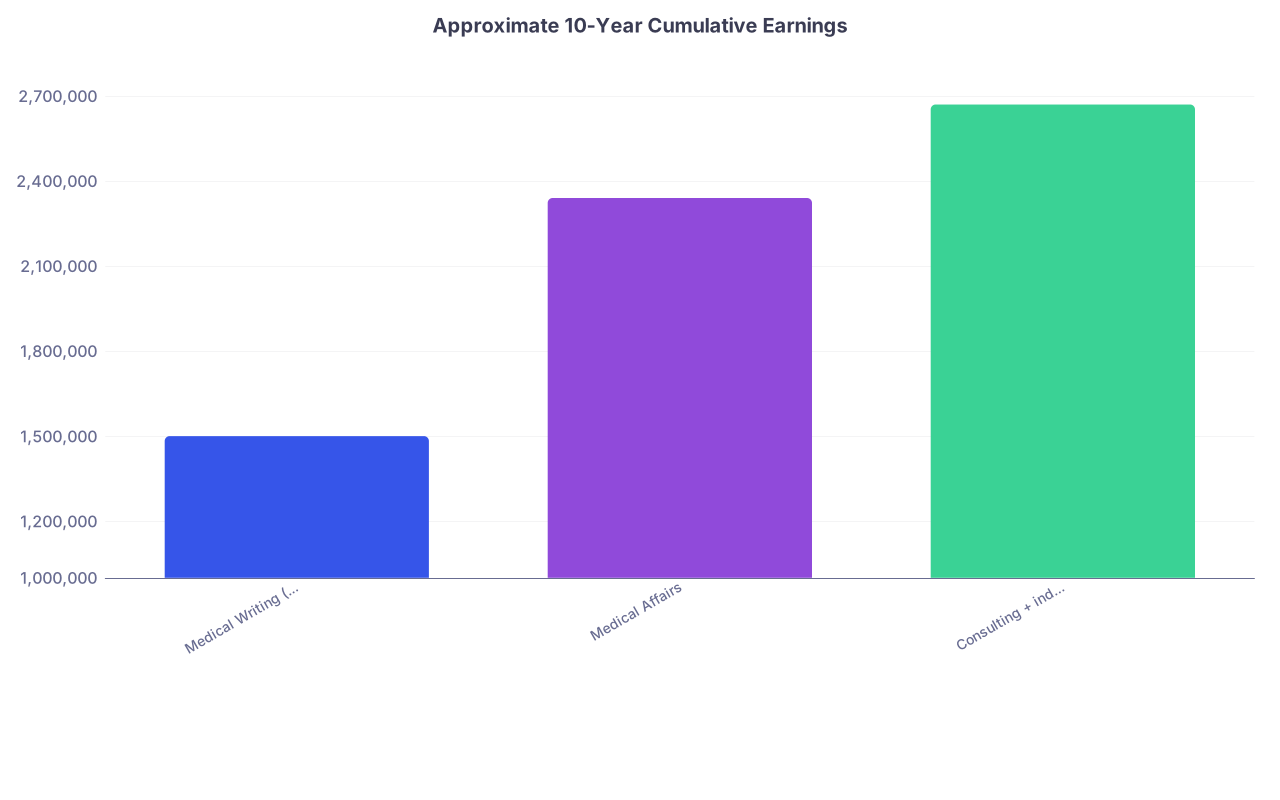
Or visualizing median paths:
| Category | Value |
|---|---|
| Medical Writing (freelance) | 1500000 |
| Medical Affairs | 2340000 |
| Consulting + industry exit | 2670000 |
The pattern is clear: on raw money alone, consulting > medical affairs > writing for the median serious professional. But the variance and costs differ dramatically.
5. Beyond Income: Volatility, Burnout, and Control
Money is not the only quantitative variable that matters. You also care about how predictable it is and how many hours you are trading for it.
5.1 Time‑for‑money ratios
Rough weekly hours by path (averages, not horror stories):
- Medical writing (in‑house): 35–40
- Medical writing (freelance serious): 30–45 (depending on how you manage pipeline)
- Consulting (top firms): 55–75
- Medical affairs (field MSL): 45–55 with travel
- Medical affairs (office): 40–50
Translate to effective hourly rates at year 5 for a typical performer:
Assume:
- Writer freelance Y5: 140k on 1,300 hours → ~108 USD/h
- Consultant post‑exit Y5: 260k on 55 hours/week → ~91 USD/h
- Medical affairs Y5: 220k on 47 hours/week → ~90 USD/h
So by mid‑career, a well‑run writing practice starts to match or exceed corporate hourly economics, without the meetings, travel, and corporate politics. That is the piece many people miss when they fixate on salary size alone.
5.2 Volatility and job security
From a risk analyst’s perspective, consider:
Consulting
- High performance pressure, “up or out” model
- Big firms rarely go bankrupt, but they do push people out on performance
- Market downturns → hiring freezes and delayed promotions
Medical affairs
- Tied to product pipelines and portfolios
- Layoffs occur when pipeline drugs fail or companies merge
- But MDs with medical affairs experience are very re‑employable
Medical writing
- Freelance: client churn, marketing burden, but diversified income streams
- In‑house: agency consolidation can kill roles, but writing demand is steady
The risk profile looks like this:
- Highest volatility: consulting careers dependent on firm promotion
- Moderate: pharma/biotech roles tied to product success
- Lowest individual‑level dependency: diversified freelance writing with 6–12 active clients
6. Where Each Path Wins: Data‑Driven Matching to Your Priorities
Strip away the marketing gloss. Look at the data.
6.1 If your primary goal is maximum 10–15 year earnings
The income models are unambiguous:
- Best raw earnings potential (non‑clinical): consulting + high‑level industry exit, then senior leadership in pharma/biotech/tech health.
- Reaching 400k–600k+ by year 10–15 is common in strong exit paths.
Medical affairs can get you into the low‑to‑mid 300k range without ever doing consulting, but typically slower and with less upside past VP level unless you jump to broader leadership roles.
Medical writing only competes financially at the far right tail: agency founders, niche experts, or writers who build scaled content businesses. Most do not, either due to lack of interest or business skills.
6.2 If you care most about control and flexibility
Look at autonomy metrics:
- Decide when you work
- Decide what you work on
- Ability to scale up/down around life events
Here the order flips:
- Medical writing (freelance) → maximum control, especially once pipeline is stable
- Medical affairs → medium control (some travel, corporate timelines, launches)
- Consulting → minimal control for the first 3–5 years
I have watched physicians with young children choose freelance writing specifically because the effective hourly rates at 120 USD/h and 20–25 hours/week give them 120–150k with half the workweek of their consulting peers.
6.3 If you want strategic influence and status inside industry
This is where many clinicians underweight the numbers. Earning 250k as a director of medical affairs or 350k as VP in pharma is not just about money. It is about:
- Budget control
- Seat at the table during launch decisions
- Influence over trial design, evidence generation, and indication strategy
You rarely get that from writing. And only temporarily from consulting, since as a consultant you advise, then leave. Medical affairs and broader medical leadership let you own decisions over time.
7. Putting It Together: Choosing the Right Trajectory for You
Let me summarize the comparative picture as cleanly as possible.
| Dimension | Medical Writing (Freelance) | Consulting (MBB Track) | Medical Affairs (Pharma) |
|---|---|---|---|
| Year-1 Median Pay | 70–90k | 180–200k | 145–170k |
| Year-10 Typical Pay | 140–190k (solo) | 300–450k (with strong exit) | 260–330k |
| 10-Year Total (med) | 1.1–1.7M | 2.3–3.0M | ~2.0–2.4M |
| Hours/Week | 30–45 | 55–75 | 40–55 |
| Volatility | Low–Moderate | High (up or out) | Moderate |
| Autonomy | High | Low | Medium |
| Ceiling (non-founder) | ~250–300k | 500k–1M+ (partner) | 350–450k (VP and up) |
And if you want to visualize how these paths “feel” over a career journey:

| Stage | Activity | Score |
|---|---|---|
| Medical Writing | Ramp up clients | 3 |
| Medical Writing | Stable pipeline | 4 |
| Medical Writing | Scale or plateau | 3 |
| Consulting | Early grind | 2 |
| Consulting | Promotion push | 3 |
| Consulting | Lucrative exits | 5 |
| Medical Affairs | Learn industry | 3 |
| Medical Affairs | Climb ladder | 4 |
| Medical Affairs | Leadership roles | 4 |
So what do you do with this?
- If you are purely money‑maximizing, willing to trade 3–5 brutal years for a very high long‑term trajectory, consulting wins.
- If you want strong, stable income with industry influence and can tolerate corporate life, medical affairs is the rational median choice.
- If you prioritize autonomy, location independence, and controlled hours, and you are willing to think like a business owner, medical writing can quietly deliver a very comfortable life with an excellent effective hourly rate.
The worst decision is to drift into any of these without running your own numbers: desired income, hours, ramp time, and how long you can tolerate low control.
The income trajectories are not mysterious. They are surprisingly predictable once you know the ladders and promotion patterns. What varies is whether you are honest about what you actually value.
Run the math. Match it to your tolerance for risk and grind. Then commit.
Once you have chosen a lane, the next problem is different: how to actually break into that field as a clinician with zero “official” experience. That requires a different kind of analysis—portfolio strategy, networking funnels, and signal‑building—which we can dissect another day.