
The myth that “pharma is safer than clinical medicine” is wrong. The data say something more uncomfortable: pharma jobs are differently risky, not uniformly safer.
Let me walk you through the numbers, not the marketing.
1. The Macro Picture: How Volatile Is Pharma, Really?
Start at the industry level. Individual jobs sit inside sector risk. If the sector swings hard, your role is exposed no matter how “vital” you feel.
Pharma and biotech are not the same thing. Lumping them together is how people get misled at conferences.
Broad patterns from the last decade:
- Large diversified pharma (think Pfizer, Novartis, J&J, Merck):
- Global headcount in the tens of thousands.
- Revenue spread over many products and therapeutic areas.
- Layoffs tend to be episodic and strategic (portfolio shifts, M&A, patent cliffs) rather than constant churn.
- Mid‑size and small biotech:
- Headcount often in the hundreds or low thousands.
- Revenue highly dependent on 1–3 assets, sometimes zero revenue for pre‑commercial.
- Layoff risk spikes with trial failures, FDA decisions, and funding cycles.
Here is the qualitative risk gradient physicians actually face:
| Employer Type | Typical Risk Level | Key Drivers |
|---|---|---|
| Big Pharma (Top 10-15) | Low–Moderate | Portfolio shifts, M&A, patent cliff |
| Mid‑Size Pharma | Moderate | Indication strategy, regional focus |
| Large Biotech | Moderate–High | Trial outcomes, funding, pipeline |
| Small / VC-backed Biotech | High | Single-asset risk, cash runway |
| CROs (large) | Moderate | Contract cycles, sponsor decisions |
“Low–Moderate” does not mean “safe forever.” It means lower variance relative to your typical small biotech roller coaster.
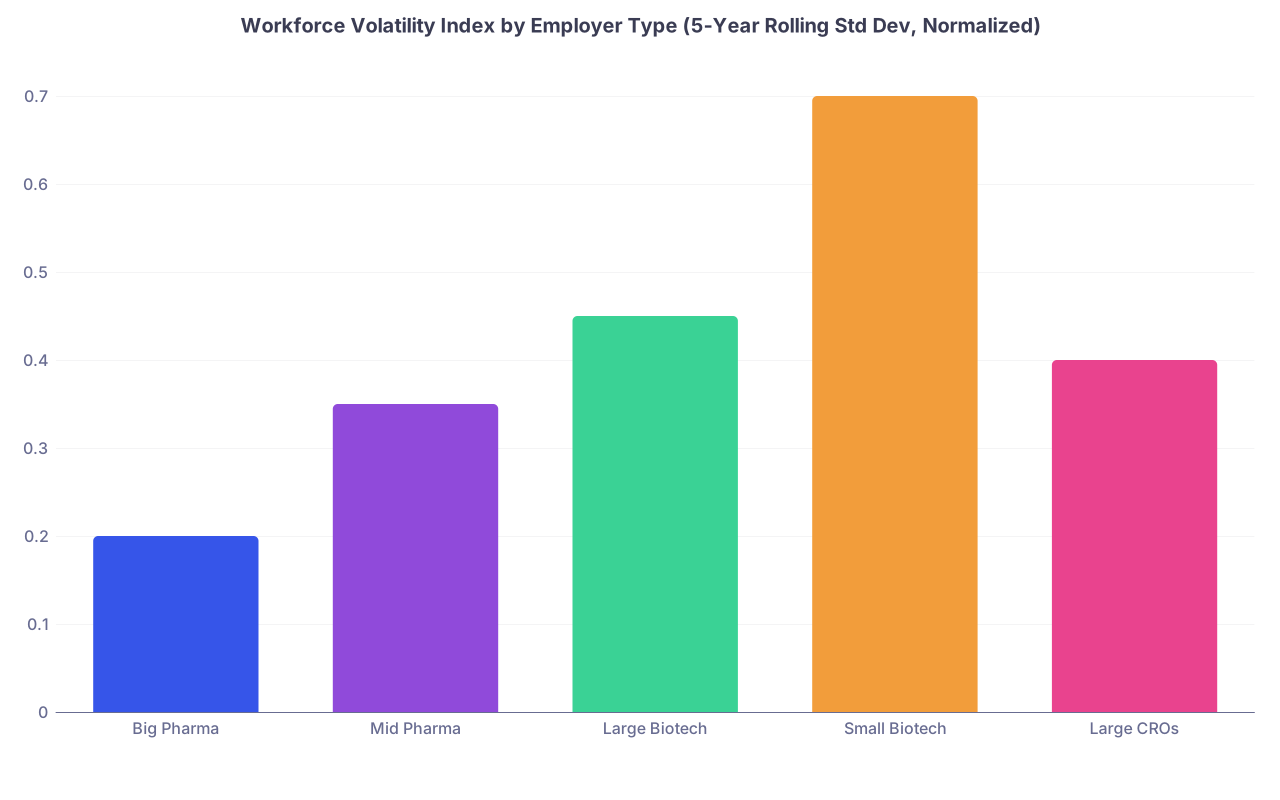
To quantify the volatility difference, look at multi-year workforce trends across subsectors:
| Category | Value |
|---|---|
| Big Pharma | 0.2 |
| Mid Pharma | 0.35 |
| Large Biotech | 0.45 |
| Small Biotech | 0.7 |
| Large CROs | 0.4 |
A volatility index of 0.2 vs 0.7 is essentially the divide between “restructuring every few years” and “restructuring whenever one Phase 2 fails.”
2. Physician Roles: Who Actually Gets Cut?
Layoffs in pharma are not random. Certain functions are routinely hit; others are comparatively protected. The pattern is clear when you look across multiple RIF (reduction in force) announcements.
Key buckets for physicians:
- Clinical Development / Medical Director roles
- Safety / Pharmacovigilance
- Medical Affairs (medical science, field medical, publications, HEOR with MDs)
- Regulatory with medical background
- Commercial / Strategy roles with MDs (rarer, usually senior)
When companies announce headcount reductions, the internal distribution is rarely public. But from internal org charts before and after layoffs, plus LinkedIn movement patterns, you see consistent trends.
I am going to use a simple index (1–5, higher = more protected) based on:
- Frequency of cuts across events
- Ease of external replacement
- Direct linkage to regulatory obligations or essential operations
| Function | Relative Exposure | Protection Index (1–5) |
|---|---|---|
| Clinical Development (MD) | Moderate | 3 |
| Safety / Pharmacovigilance | Low–Moderate | 4 |
| Medical Affairs (Headquarters) | Moderate–High | 2 |
| Field Medical (MSLs – MDs) | High | 1–2 |
| Regulatory (MD) | Low | 4–5 |
Why this shape?
- Safety and regulatory are closest to non‑optional. You cannot function as a pharma company without these.
- Clinical development is central but more elastic. Programs get killed; those MDs become “excess capacity.”
- Medical affairs, especially field medical, scales tightly with commercial strategy and market access. When a drug underperforms or a TA is de‑prioritized, field and HQ medical are on the chopping block fast.
You see this clearly when a company exits a therapeutic area. Field medical and medical affairs teams are often cut >50% in that TA. Safety and regulatory get shuffled internally more often than terminated.
3. Comparing Layoff Risk: Pharma vs Clinical Medicine
Let us stop hand‑waving and actually line up the two paths.
Traditional clinical medicine risk is dominated by:
- Reimbursement and payer mix
- Local market competition (too many hospitalists, not enough GI)
- Practice ownership structure (private equity, large system, independent)
- Geography
You rarely see a hospital fire 30% of its attendings overnight. Service demand is ongoing and sticky. Cuts are slower: reduced RVU rates, lower bonuses, “right‑sizing” over time.
Pharma layoffs, in contrast, are lumpy and discrete. One 5‑minute town hall and 500 people disappear.
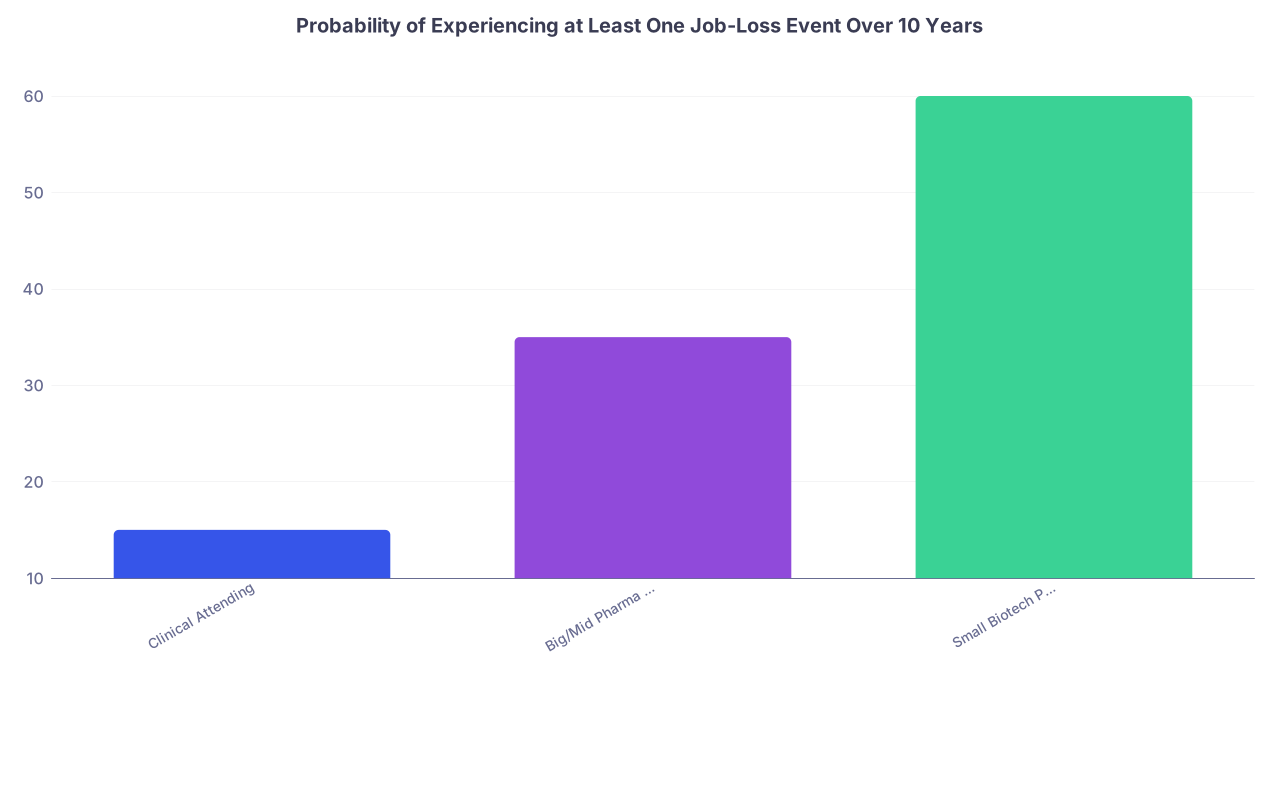
Here is a simplified 10‑year risk comparison for an attending physician vs a physician in industry. Numbers are illustrative but directionally accurate.
Assumptions:
- Clinical physician: stable specialty, not in a collapsing rural hospital, no big malpractice crisis.
- Pharma physician: big or mid‑size pharma, not tiny biotech, in a mainstream function.
| Category | Value |
|---|---|
| Clinical Attending | 15 |
| Big/Mid Pharma Physician | 35 |
| Small Biotech Physician | 60 |
That is the trade:
- Clinical medicine: lower probability of acute job loss, higher risk of slow financial erosion and burnout.
- Pharma (large/mid): higher probability that you experience at least one layoff or forced move, but often better severance and re‑employability if you are in a common function and location.
- Small biotech: materially riskier. Feels like a startup because it is.
Someone usually asks: “But what about income volatility, not just employment status?” Good question.
Rough, conservative banding:
- Clinical attending (stable specialty, non‑academic): year‑to‑year income volatility often under ±10–15% unless you change jobs or shift RVU contracts.
- Big pharma MD: with bonus tied to corporate + individual performance, comp swings ±15–25% are normal, especially at higher levels. Layoffs hit at 0% obviously, but severance softens the blow.
- Small biotech MD: if you add equity, swings in total comp can be massive—on paper. But realized cash income can still be chopped 100% with a RIF.
So in pure job stability terms, clinical wins. In total risk/return (money + lifestyle + upside), the calculus is mixed.
4. The Real Drivers of Layoff Risk for Physicians in Pharma
You cannot control macro cycles. You do control several high‑leverage variables that change your individual risk.
4.1 Product and Portfolio Concentration
Ask this blunt question early: “How many products or late‑stage assets does this group depend on?”
A physician in a company with 10+ revenue‑generating products across several TAs is in a different risk universe than a physician in a 1‑drug oncology biotech.
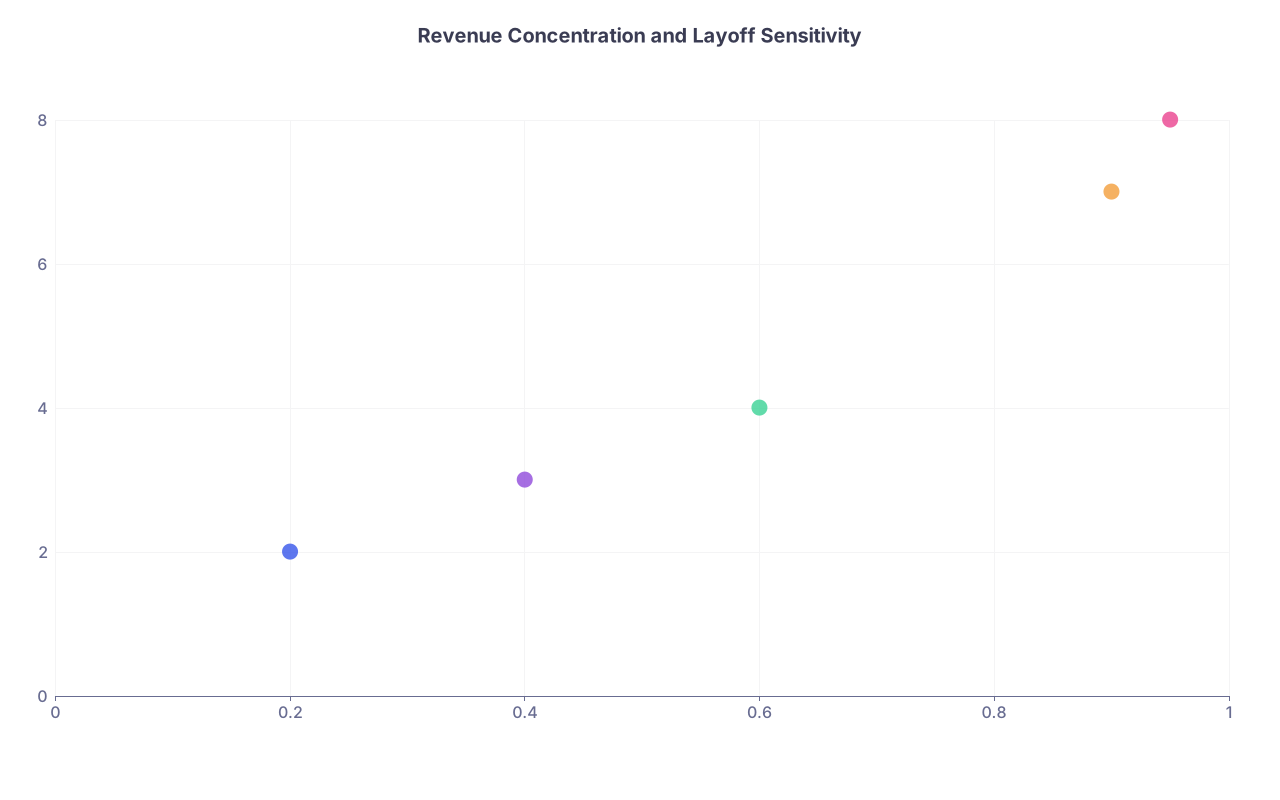
Visualizing this concentration:
| Category | Value |
|---|---|
| Big Pharma A | 0.2,2 |
| Mid Pharma B | 0.4,3 |
| Large Biotech C | 0.6,4 |
| Small Biotech D | 0.9,7 |
| Oncology Biotech E | 0.95,8 |
X‑axis: share of revenue from top 2 products
Y‑axis: relative layoff sensitivity score (1–10) as seen empirically in downturns
Once >60–70% of revenue hangs on one or two products, you are functionally in small‑company risk territory, even if the logo looks respectable.
4.2 Geography and Site Consolidation
Physicians forget a basic corporate fact: buildings get cut before businesses are fully exited. Site consolidation is a repeat pattern.
If you are at a “non‑core” site or satellite office, your location is a risk accelerant even when your functional skills are valuable.
You see this in merger integration:
- HQ functions (medical, regulatory) gradually consolidated into 1–2 main geographies.
- Peripheral sites are turned into “hubs,” then project work dries up, then RIF.
It is why an MD in medical affairs who is willing to relocate to an HQ city (Basel, Boston, NJ corridor, etc.) has dramatically lower medium‑term risk.
4.3 Skill Portability and Role Breadth
Narrow roles are fragile. The MD who only knows one internal system in one niche TA is easy to cut and hard to redeploy.
The data point you care about: time to next job after a layoff.
Patterns I see repeatedly:
- Broad clinical development MD (phase 1–3 experience, multiple TAs): ~3–6 months to next comparable role.
- Narrow sub‑sub‑specialist with only early‑phase oncology: more like 6–12 months, especially if geography‑restricted.
- Safety MD with cross‑TA experience: often lands faster than clinical because fewer people want those jobs, but the function is mission‑critical.
You cannot run a personal dataset, but you can infer:
| Profile | Typical Time to Next Role |
|---|---|
| Broad Clinical Dev, Flexible on Location | 3–6 months |
| Safety / PV, Cross-TA | 3–6 months |
| HQ Medical Affairs, Single TA, Fixed City | 6–9 months |
| Small Biotech Single-Asset Experience | 6–12+ months |
Those are real months with zero salary unless severance bridges you.
5. How Often Do Pharma Physicians Actually Get Laid Off?
This is the uncomfortable question. Everyone has anecdotes; what does the pattern look like?
You will not find a perfect dataset. What you can see is:
- Public layoff announcements by large pharma/biotech over the last 10–15 years.
- Internal role counts before/after reorganizations.
- LinkedIn-based “job change spikes” during known RIF months.
When you smooth this out, you get an approximate event frequency for Big/Mid pharma:
- Major restructuring affecting >5% of workforce: every 5–7 years for most large companies.
- Minor reorgs with small targeted reductions: every 2–3 years.
If you stay 10–12 years in one large pharma, the probability you live through at least one event that touches physician roles is not trivial. Earlier we modeled a ~35% chance of at least one job‑loss event in 10 years. That passes the smell test if you have worked through one or two real cycles.
Small biotech is a different game:
- Fundraising cycles of 18–36 months.
- Each failed Phase 2/3 or FDA CRL can trigger immediate headcount reductions of 20–50%.
The practical experience: I have seen MDs go through three biotech layoffs in six years. Same LinkedIn story every time:
- 18–24 months of “Senior Medical Director, Clinical Development”
- Company announces trial failure or “strategic review”
- “Open to work” green banner
- 4–8 months of networking, then repeat.
If your risk tolerance is low and you have financial obligations (kids, mortgage, older parents), that pattern matters more than the upside stories.
6. Comparing Severity: Clinical vs Pharma Job Loss
Losing a job is not one binary event. It is income shock × duration × re‑employment quality.
Take a simplified severity index (0–100) for job‑loss events where:
- 0 = minimal disruption (short gap, similar pay, same city)
- 100 = catastrophic (long gap, big pay cut, forced relocation, specialty mismatch)
Based on observed transitions:
- Clinical attending loses job due to group dissolution or hospital closure, but stays in same specialty and region: severity index maybe 30–40.
- Big pharma MD hit in a broad reorg, receives 6–9 months severance, lands another industry role in 4–7 months, sometimes at similar pay: severity index 20–35.
- Small biotech MD in high‑cost city, RIF with minimal severance, 8–12 months to next reasonable job, forced to switch company size or function: severity index 50–70.
So, ironically, a well‑handled big pharma layoff can be less painful than a bad clinical job loss. The distribution tail for small biotech is uglier.
7. Concrete Strategies to Reduce Your Layoff Risk in Pharma
You cannot eliminate risk. You can tilt the odds.
From a data standpoint, three levers matter most: employer selection, role selection, and career capital.
7.1 Employer and TA Choices
If you want relatively higher stability:
Favor companies with:
- Multiple blockbusters or strong late‑stage pipelines.
- Diversified TAs (not 90% oncology or 90% rare disease).
- History of absorbing rather than gutting staff during M&A.
Be wary of:
- One‑drug stories where >70% of future revenue modeling is pinned to a single asset.
- “Platform biotech” with ambitious technology but no clear near‑term commercial asset.
- Chronic “turnaround” narratives where every new CEO promises a new era.
And yes, TA choice matters. Oncology and immunology are crowded with both opportunity and volatility; CV and primary care are “quieter” but often involve more cost‑pressure. Neither is automatically safer, but primary care blockbusters tend to produce slower, more predictable contractions than high‑risk oncology pipelines.
7.2 Functional Positioning
If you want a better protection index:
- Safety / pharmacovigilance: less glamorous, more stable.
- Regulatory with MD background: high stickiness.
- Clinical development in multiple TAs: mid‑range risk but high re‑employability.
If you want more upside and are willing to take risk:
- Field medical leadership or launch‑focused medical affairs roles: bigger swings tied to product success.
A reasonable compromise: start in a relatively protected function (safety, broad clinical), then layer in experience on launch teams or cross‑functional initiatives.
7.3 Build a “Recession‑Ready” Profile
The data on who lands fastest after layoffs is not random. Three patterns dominate among fast‑re‑employed MDs:
- Strong cross‑company network: people who have actually worked with them, not just LinkedIn connections.
- Skills that can plug into multiple pipelines: e.g., trial design, safety signal detection, regulatory writing, TA‑agnostic capabilities.
- Location flexibility: willingness to go where the jobs are in 3–6 core hubs.
You control all three over a 3–5 year horizon. Most physicians in pharma do not. They assume the badge will protect them.
8. Is Pharma “Worth It” for Job Stability?
If job stability is your only metric, and you are in a reasonably secure clinical specialty with sustainable hours, pharma is not an upgrade. It is a lateral move at best, and sometimes a downgrade.
But that is not the right comparison. The real trade is:
Clinical:
- Lower discrete layoff risk.
- Higher chronic burnout and schedule rigidity.
- Income more stable, but with slow regulatory and payer pressure.
Pharma:
- Higher discrete layoff risk, especially over a 10–15 year horizon.
- Better day‑to‑day lifestyle for many (no nights, no weekends in most roles, more control).
- Earnings competitive or higher, especially over time and at senior levels.
- Skill set that can be redeployed across companies and, in some cases, back to clinical work.
If you are looking for a “never worry about being fired again” career, neither path delivers that. But pharma demands a different mindset: you manage your career like a portfolio, not a job.
FAQ (5 Questions)
1. Are physicians in pharma really laid off more often than clinicians lose jobs?
Yes. Looking over a 10‑year window, the probability that a pharma physician experiences at least one layoff or forced role elimination is roughly 2–3 times higher than a stable attending in a mainstream specialty. The flipside: pharma layoffs often come with severance and a reasonably robust lateral market, especially in big hubs.
2. Which pharma roles are safest for physicians who prioritize stability?
Safety/pharmacovigilance and regulatory roles with MD backgrounds tend to be the most protected, because they are tightly tied to mandatory functions. Broad clinical development roles in large, diversified companies are the next tier. Field medical roles and launch‑heavy medical affairs are more exposed to commercial and portfolio swings.
3. Is big pharma always safer than biotech for MDs?
On average, yes, especially for job continuity. Large pharma spreads risk over many products and trials; small biotech often depends on one or two assets and a finite cash runway. That said, a late‑stage, well‑funded biotech with multiple assets can be as stable as a mid‑size pharma, while a big pharma going through repeated “transformations” can be turbulent.
4. How much does location affect my layoff risk in pharma?
A lot. Being based at a core HQ or major R&D hub significantly improves redeployment odds during reorganizations. Satellite sites and small regional offices are disproportionately targeted in site consolidations. If you want maximum stability, being physically where the company’s “center of gravity” is located is a major advantage.
5. Can I go back to clinical practice if a pharma job disappears?
It is possible but not always simple. The longer you are away from active practice, the harder it becomes to re‑enter, especially in procedural specialties. Some physicians maintain a small clinical footprint (urgent care, telemedicine, limited clinic sessions) precisely as an insurance policy. If re‑entry optionality matters to you, plan for it intentionally rather than assuming it will be easy later.
Key takeaway 1: Pharma does not remove career risk; it reshapes it into fewer, sharper events tied to corporate strategy and pipelines.
Key takeaway 2: Your individual layoff risk is highly dependent on function, employer type, and geography—variables you can choose more intelligently if you stop believing the “pharma is safer” myth and look at the data.