
You are here
It is July 1. Your final year of residency just started. Everyone around you is talking about chief schedules, fellowship interviews, and board review courses.
You, on the other hand, are quietly thinking: “I am not sure I want to do this version of medicine for the next 30 years.”
You are not alone. I have watched at least one senior each year shift into pharma, consulting, informatics, telehealth leadership, utilization management, or full‑time education by the time boards rolled around. The ones who succeed do one thing differently:
They treat their final year like a structured transition project, not a vague “I will figure it out later.”
Here is your month‑by‑month playbook.
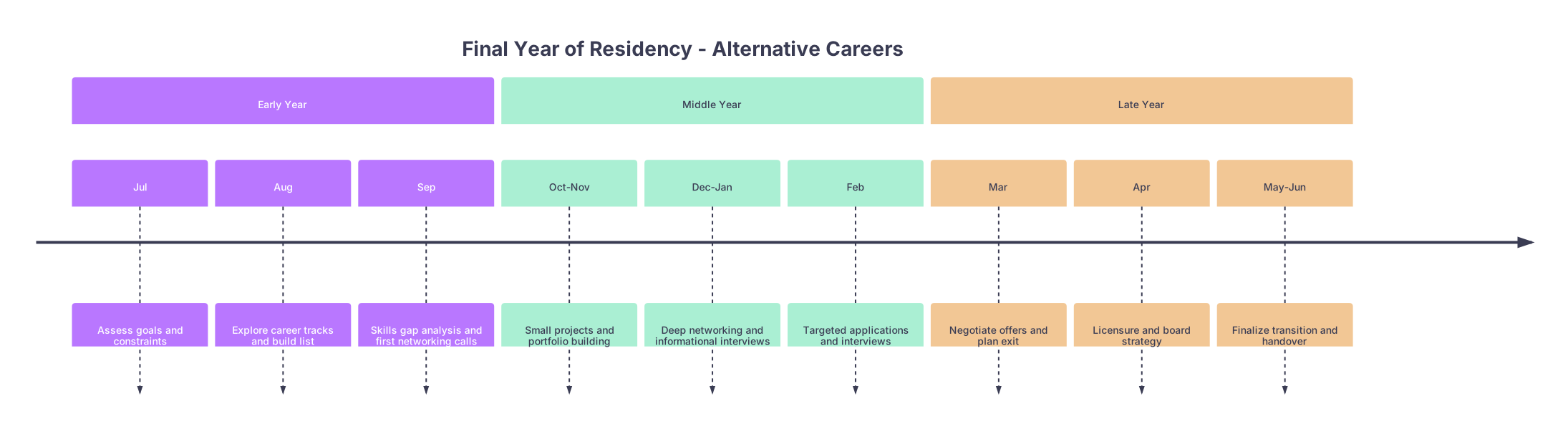
| Period | Event |
|---|---|
| Early Year - Jul | Assess goals and constraints |
| Early Year - Aug | Explore career tracks and build list |
| Early Year - Sep | Skills gap analysis and first networking calls |
| Middle Year - Oct-Nov | Small projects and portfolio building |
| Middle Year - Dec-Jan | Deep networking and informational interviews |
| Middle Year - Feb | Targeted applications and interviews |
| Late Year - Mar | Negotiate offers and plan exit |
| Late Year - Apr | Licensure and board strategy |
| Late Year - May-Jun | Finalize transition and handover |
July: Reality check and constraints
At this point you should stop fantasizing and write down constraints in black and white.
Core tasks for July
Define your non‑negotiables Sit down one evening for 60 minutes, no phone.
Write three lists:
- Geographic constraints (must stay near spouse job? visa issues? family care?)
- Financial minimums (loan payments, childcare, baseline lifestyle)
- Time constraints (board exam timing, contract end date, visa deadlines, fellowship match dates if you are still half‑considering)
This will later kill a lot of noise: random startup jobs in another state, “maybe I should just do another residency,” etc.
Clarify why you are leaving traditional practice (or considering it) Bullet form. Be ruthless and specific:
- “Hate nights and weekends”
- “Love systems and process, hate 15‑min patient churn”
- “Want location flexibility”
- “Interested in data / analytics, not clinic”
This becomes your filter for alternative careers.
Inventory your strengths You are not “just” a resident. Translate your work:
- Ran code team → crisis decision‑maker
- Built intern handbook → operations + content
- Led QI project → project management + data literacy
- Epic super‑user → informatics capacity
Capture 5–7 concrete achievements with outcomes (even rough): “Reduced ED LOS for chest pain pathway by ~20% over 6 months.”
Start a simple tracking system Do not “remember it in your head.” Make:
- One spreadsheet: columns for company, role, contact, date contacted, follow‑up, status.
- One folder in your cloud drive: “Alt Career Transition” with subfolders:
- Resume & CV versions
- Portfolio / projects
- Notes from calls
By end of July you should have:
- A 1‑page document of constraints + motivations.
- A working list of 5–10 potential non‑clinical / hybrid paths that might fit.
- A tracking spreadsheet and folder structure set up.
August: Map the alternative career landscape
Now you move from vague ideas to defined tracks.
At this point you should:
Choose 3–4 target lanes (not 12)
Typical lanes for residents:- Pharma / biotech
- Medical science liaison (MSL)
- Clinical research / medical affairs associate
- Health tech / digital health
- Clinical product specialist
- Medical director (junior) for telehealth or digital product
- Consulting / strategy
- Healthcare associate at MBB or boutique (if timing works)
- Internal strategy/innovation roles at hospitals or payers
- Payer / utilization management
- Associate medical director (some accept residents plus board‑eligible)
- Informatics / data
- Clinical informatics analyst
- Physician informatics liaison
- Education / writing
- Medical education companies, board review, content creation
- Government / public health
- CDC, local health departments, VA quality roles
Pick the top 3–4 lanes that match your July constraints and motivations.
- Pharma / biotech
Research role requirements
Use LinkedIn, Indeed, pharma career pages, and health tech job boards. For each lane, find 3–5 real job postings and capture:
- Typical titles
- Common keywords / required skills
- Location expectations
- Remote vs on‑site
- Board certification required or not?
Put this into a small summary table.
| Lane | Common Entry Role | Board Cert Required | Remote Friendly |
|---|---|---|---|
| Pharma / MSL | Medical Science Liaison | Often yes, sometimes BE | Sometimes |
| Health Tech | Clinical Product Specialist | Usually BE enough | Often |
| Utilization Mgmt | Associate Medical Director | Frequently yes | Often remote |
| Consulting | Associate / Consultant | No (MD sufficient) | Travel heavy / hybrid |
| Clinical Informatics | Physician Informaticist | Usually yes + fellowship preferred | Mixed |
- Clean up your LinkedIn
One evening, 90 minutes:
- Headline: “Internal Medicine PGY‑3 | Interested in Medical Affairs & Health Tech” (adapt to your lane)
- About section: 3–4 sentences, outcome‑oriented.
- Experience: List residency with bullet points focused on leadership, projects, systems, not “delivered patient care.”
By end of August you should have:
- 3–4 clearly defined target career lanes.
- A short summary document of what each lane wants.
- A professional LinkedIn profile that does not scream “I only want fellowship.”
September: Skills gap and first networking moves
Now you stop researching and start talking to humans.
At this point you should:
Do a quick skills gap analysis For each chosen lane, ask:
- What 3 skills show up repeatedly that I do not obviously have?
- Examples: “KOL engagement,” “SQL / R,” “market access,” “GCP,” “product lifecycle,” “health economics,” “payer strategy.”
- Which of these can I reasonably start building during residency?
Do not sign up for a second degree. Look for:
- Short courses (Coursera, edX, Udemy) with applied projects.
- Internal hospital committees (informatics, quality, sepsis, stroke).
- Existing resident QI or research that you can shape toward your lane.
- What 3 skills show up repeatedly that I do not obviously have?
Initiate 5–10 networking contacts Tactics that work:
- Search LinkedIn: “medical science liaison internal medicine,” “physician advisor utilization,” “clinical informatics physician.”
- Filter to alumni from your med school or residency.
Reach out with a short, honest message:
- 3 sentences: who you are, what you are exploring, concrete ask for a 15–20 minute call.
Expect maybe 30–40% response rate. That is fine.
Prepare an alternative‑career resume skeleton Not your academic CV. A 1–2 page resume with:
- 3–4 bullet summary at top (“Senior internal medicine resident with X, Y, Z”).
- Experience organized around impact: “Led project that cut readmissions by 10% using structured phone follow‑up.”
By end of September you should have:
- A simple skills gap list with 1–2 actionable items per lane.
- At least 2–3 networking calls scheduled or completed.
- A working draft of a non‑clinical resume.
October–November: Small projects and early portfolio building
This is where most residents fail. They keep “reading about it” instead of doing anything concrete.
You need artifacts. Evidence. Something to point to besides “I am smart and I worked hard in residency.”
At this point you should:
Attach yourself to 1–2 strategic projects Examples:
- For pharma / medical affairs
- Join or help design an investigator‑initiated trial.
- Work on a protocol amendment, adverse event review, or data presentation.
- For health tech / informatics
- Become an Epic/Cerner super‑user for a clinic rollout.
- Lead a small pilot of a new digital tool, collect outcome metrics.
- For utilization management / payer
- Work on order set optimization, prior auth simplification, or DRG documentation improvement.
- For consulting / strategy
- Help your department chair with a business case, volume projections, staffing model, or budget analysis.
Timebound is key: Define something you can complete in 8–12 weeks at 2–3 hours/week.
- For pharma / medical affairs
Document outcomes as you go Keep a short “project log”:
- Problem
- Your role
- Data used
- Result (even if preliminary numbers)
Later, this becomes gold for interviews.
Increase networking volume Goal for these two months:
- 2–3 calls per month with people currently working in:
- Your targeted pharma/tech company
- A payer you might want to join
- A tech startup in your city During each call:
- Ask: “If you were me, with 9 months left in residency, what 2 things would you do to be competitive for a role like yours?”
- 2–3 calls per month with people currently working in:
By end of November you should have:
- At least one concrete, ongoing project aligned with a target lane.
- 5+ conversations with professionals in alternative careers.
- Clearer view on which 1–2 lanes are rising to the top.

December–January: Decide your primary direction and go deeper
Holiday season is when hiring slows but networking actually gets easier. People take your calls.
At this point you should:
Commit to a primary and a backup lane This matters for focus. Examples:
- Primary: health tech product. Backup: clinical informatics at a hospital.
- Primary: pharma medical affairs. Backup: clinical research organization.
- Primary: utilization management. Backup: telehealth medical director.
You are not burning bridges with clinical practice. You are choosing an entry door.
Refine your story You need a tight 60‑second narrative:
- Who you are (specialty, stage).
- What you discovered about yourself in residency (what you enjoyed, what you did not).
- How that maps directly to the lane you are pursuing.
- Specific projects that prove it.
Practice it aloud. Yes, actually say it.
Do targeted skill upgrades This is where a single short course or certificate might make sense. But only if:
- It shows up directly in job descriptions.
- You can complete it by March.
- It produces something you can show (capstone, project, portfolio).
Examples that are usually worth it:
- Basic SQL / Python for data‑leaning roles.
- GCP (Good Clinical Practice) training for research/medical affairs.
- Short health economics or payer systems course for utilization roles.
Start building a micro‑portfolio This can be:
- Slide decks from your QI or digital health project (scrub PHI).
- One‑page summaries of your project outcomes.
- A short write‑up of a case study: problem, intervention, results.
By end of January you should have:
- A clearly chosen primary lane and a realistic backup.
- A practiced, coherent career story.
- At least one tangible artifact (slides, case study) that demonstrates non‑clinical value.
February: Start active searching and early applications
By now, graduation is about 4–5 months away. This is where time starts to matter.
At this point you should:
Identify realistic hiring windows Many non‑clinical roles do ongoing hiring, but:
- Consulting: structured recruiting cycles; you may be off‑cycle and need to target smaller firms or internal strategy.
- Pharma: roles open unpredictably but often want someone to start within 1–3 months.
- Payers and telehealth: more flexible, often okay with future start dates.
On your spreadsheet, note target start windows and whether they can wait until July/August.
Start soft applications For February:
- Apply to 2–4 roles/week that:
- Match your lane
- Do not demand 5–10 years of experience (ignore those for now)
- Use networking contacts to:
- Get internal referrals where possible.
- Ask “Is this truly a senior role, or would they consider a new grad MD?”
- Apply to 2–4 roles/week that:
Customize your resume and cover for each lane You need:
- One base resume per lane.
- Minor tweaks for each application:
- Align language with the exact posting.
- Put the most relevant project at the top of the experience section.
Prepare for non‑clinical interviews Different from fellowship interviews. Expect:
- Behavioral questions (“Tell me about a time you influenced without authority.”)
- Problem‑solving scenarios (“How would you approach a clinic using our product incorrectly?”)
- “Why this role, why now, why us?”
Write and rehearse 6–8 bullet‑point stories from residency that you can reuse across questions.
By end of February you should have:
- A steady cadence of applications (even if no bites yet).
- Basic comfort with behavioral interviewing.
- Clear notes on which companies you would actually join if they offered.
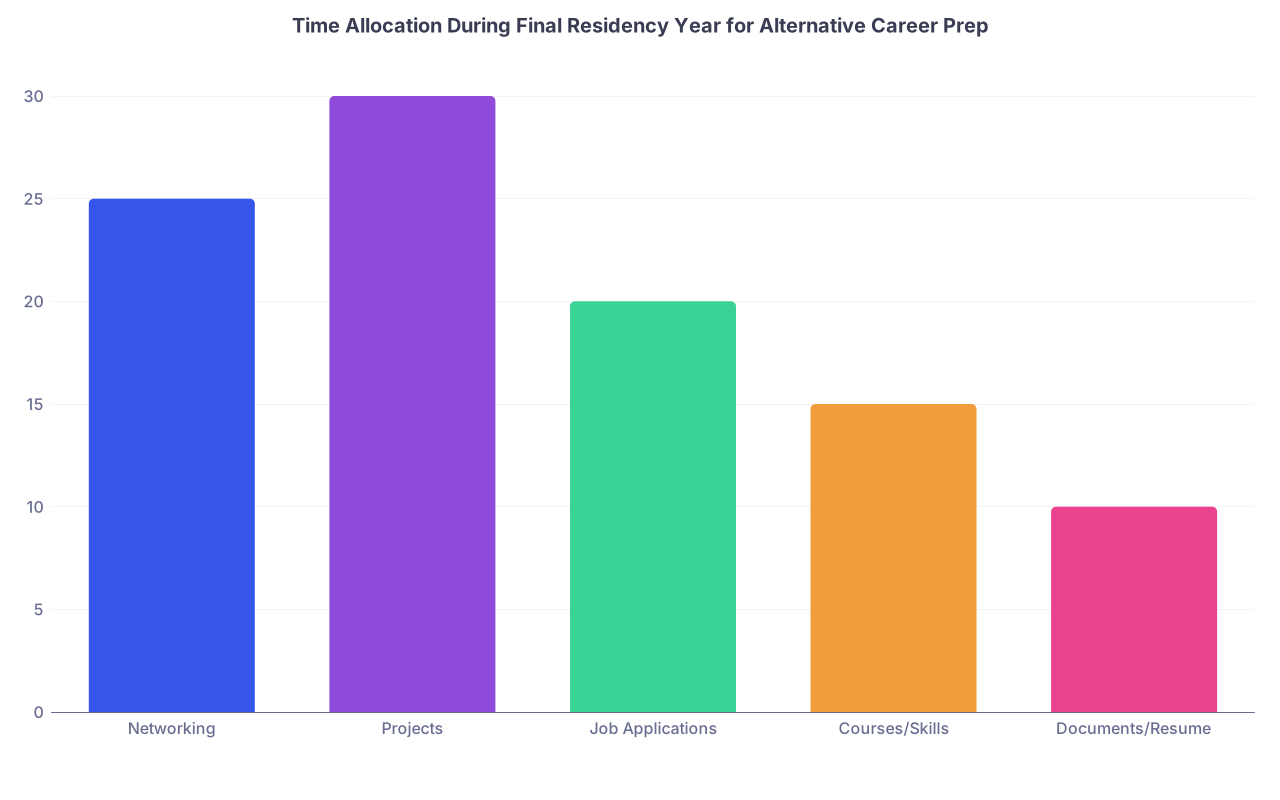
| Category | Value |
|---|---|
| Networking | 25 |
| Projects | 30 |
| Job Applications | 20 |
| Courses/Skills | 15 |
| Documents/Resume | 10 |
March: Push on interviews and offers, plan your exit strategy
If you have done the previous months well, March is where conversations start turning into processes.
At this point you should:
Aggressively follow up on warm leads
- Any recruiter you spoke with in winter – reconnect: “Graduation is in June; I am now actively exploring opportunities starting August.”
- Any mentor or attending with industry contacts – ask explicitly: “Is there someone at X company you would feel comfortable introducing me to?”
Clarify your risk tolerance You need a decision: are you okay finishing residency without a guaranteed job in hand, or do you need a bridge job (locums, part‑time clinical) while you transition?
Write down:
- How many months of expenses you can cover without a full‑time salary.
- Minimum acceptable first‑year compensation for an alternative role.
Prepare to negotiate like an attending, not like a trainee For alternative roles:
- Salary bands are often opaque. Use Glassdoor, Levels.fyi (for tech), and alumni data.
- Do not undersell: your MD + residency is valuable, even if it is your first non‑clinical job.
Be ready to negotiate:
- Base pay
- Start date (you may need time for boards or relocation)
- Remote vs hybrid arrangements
- Professional development budget (courses, conferences)
By end of March you should have:
- 1–2 active interview processes or at least serious recruiter conversations.
- A clear financial plan if offers are delayed.
- A mental “floor” for what you will and will not accept.
April: Licensure, boards, and safety nets
This month is unglamorous but critical. Alternative careers do not magically remove the need for credentials.
At this point you should:
Finish your full license application Even if you think you are done with clinical work. You want:
- A full, unrestricted license in at least one state.
- Possibly a compact state if you plan any telehealth or per‑diem clinical.
Some non‑clinical roles still require active licensure for:
- Writing utilization reviews
- Approving coverage decisions
- Signing off on clinical content
Lock your board exam plan Decide:
- Exact exam date.
- Study window (4–8 weeks) and how it intersects with a new job’s start if you have one.
Many residents I have seen in alternative roles still sit for boards once. It protects your long‑term options and often bumps your value.
Set up clinical backup options This is your safety net:
- Reach out to an outpatient group for PRN/part‑time status.
- Explore locums agencies and have your profile started.
- Clarify with your program director about moonlighting rules for final months.
By end of April you should have:
- License applications submitted and in process.
- Concrete board exam date or at least a narrow date range.
- At least one clinical backup avenue partially arranged.
May–June: Finalize your landing and handover professionally
The last two months can be chaotic. You are finishing residency responsibilities, maybe acting as chief, studying for boards, and juggling job conversations.
At this point you should:
Close the loop on applications and offers
- Push any slow processes: “I am graduating June 30 and would need to decide by [date] to align start and relocation.”
- If you have multiple options, compare using a simple grid (compensation, flexibility, career growth, alignment with your motivations from July).
Plan a clean transition out of residency Do not ghost your program on your real plans. You can be honest without burning bridges:
- “I will be going into medical affairs at [company] after graduation; I am very grateful for the training here.”
- Offer to present a noon conference on “Non‑clinical careers for physicians” or to mentor residents behind you.
Your current attendings can become your future references. Treat them that way.
Prepare for the identity whiplash When July 1 comes and you are not “the senior on nights” anymore, it can be weird. Expect:
- Loss of built‑in status and structure.
- A learning curve where you are the novice again.
Before end of June, outline:
- Your first 90‑day plan for the new role (or for your search if it is still ongoing).
- Simple routines: study blocks for boards, networking cadence if you are still searching, clinical shifts if you are doing PRN.
By end of June you should have:
- Either a signed offer with a defined start date, or a clearly structured plan for continued search plus financial and clinical backup.
- A professional, respectful exit from residency with references intact.
- A realistic picture of your first 3 months post‑residency.
Month‑by‑month snapshot
Here is the condensed version so you can see the arc.
| Month | Primary Focus |
|---|---|
| July | Constraints, motivations, skill inventory |
| August | Define 3–4 career lanes, clean LinkedIn |
| September | Skills gap, first networking calls, resume |
| Oct–Nov | Projects aligned with lanes, portfolio start |
| Dec–Jan | Choose primary/backup lane, deepen skills |
| February | Active applications, interview prep |
| March | Push interviews, consider offers and finances |
| April | Licensure, boards, clinical backup |
| May–June | Finalize landing, exit residency cleanly |
Two closing points
Your final year is not “wasted” if you leave clinical practice. Every call night, every QI meeting, every mess you fixed is raw material for your alternative‑career pitch. The trick is writing it down and translating it.
Do not try to optimize 10 paths at once. Pick a lane, build evidence in that lane, and let the year move in a deliberate sequence: awareness → projects → network → applications → transition. That is how residents actually land good non‑clinical roles, not by sending one random resume in April.