
The biggest lie people tell you about backup specialties is that “you can decide later.” You can’t. Not if your international rotations already boxed you in.
You’re in that awkward spot: you chased international experiences, maybe did electives abroad, or your home school is outside the US/Canada, and now you’re applying to residency. Suddenly you’re hearing: “We don’t take IMGs without US clinical experience.” Or: “We prefer at least two US LORs in this specialty.”
And your brain goes: “Great. My ‘backup’ is… what, exactly?”
Let’s fix that.
This is about how to choose realistic backups if your international rotations limit your options. Not fantasy backups. Not “if everything goes perfectly and the PD loves my story” backups. Actual, statistically and structurally plausible lanes you can pivot into this cycle.
1. Get Brutally Clear on How Your International Rotations Hurt (and Help)
First, stop hand-waving “I’m an IMG” or “I did rotations abroad.” That’s too vague. Programs reject people for specific structural reasons, not vibes.
Here’s what you’re up against (and sometimes what you’ve got going for you):
| Factor | Why It Limits You |
|---|---|
| No recent US clinical experience | Many programs automatically filter you out |
| Only non-US letters | PDs trust US letters more for performance comparison |
| Graduation year > 3–5 years | Hard cutoff at some community and academic programs |
| Visa required (J1/H1B) | Fewer programs sponsor; some specialties sponsor almost none |
| Pass-only Step scores or low Step 2 | You lose an easy screening metric in competitive fields |
Now, ask yourself five questions. Answer them honestly, not aspirationally:
- Are any of my rotations in the US or Canada, in the specialty I want?
- Do I have at least 2 strong US letters from attendings who know me well?
- Do I need visa sponsorship?
- Are my Steps (or equivalent) strong enough for my target specialty, or are they basically average?
- Have I been out of med school >3 years?
If you’re saying:
- “No US rotations in my main specialty,”
- “Mostly international letters,”
- “Need a visa,”
…then your backup planning is not optional. It’s mandatory.
Now the good news: international work can help you in specific lanes: global health, primary care in underserved areas, hospitalist-track internal medicine, certain FM programs that love “broad exposure.”
You just need to aim those bullets at the right targets.
2. Understand Which Specialties Actually Work as Backups for You
Some specialties are terrible backups for someone with limited US rotations. I see people every year do this and then wonder why they tank the Match.
Here’s the short version:
Bad “backups” for limited-US-experience applicants:
- Dermatology
- Plastics
- Ortho
- ENT
- Neurosurgery
- Ophthalmology
- Radiation Oncology
These are not backups. These are primary moonshots.
Questionable backups:
- EM (especially now; market is tightening, many programs IMG-averse)
- Anesthesia (variable; some IMG-friendly, some not, and lots want US letters in-field)
- Categorical general surgery (few IMG slots, usually high Step expectations)
Realistic backups (for many IMGs / international rotators, assuming decent scores):
- Internal Medicine (especially community / mid-tier university)
- Family Medicine
- Pediatrics (varies but often more open)
- Psychiatry (still fairly IMG-friendly, though tightening in top markets)
- Transitional / Preliminary medicine years (as stepping stones)
Here’s a rough hierarchy of IMG-friendliness if you have mostly international rotations and need visa sponsorship:
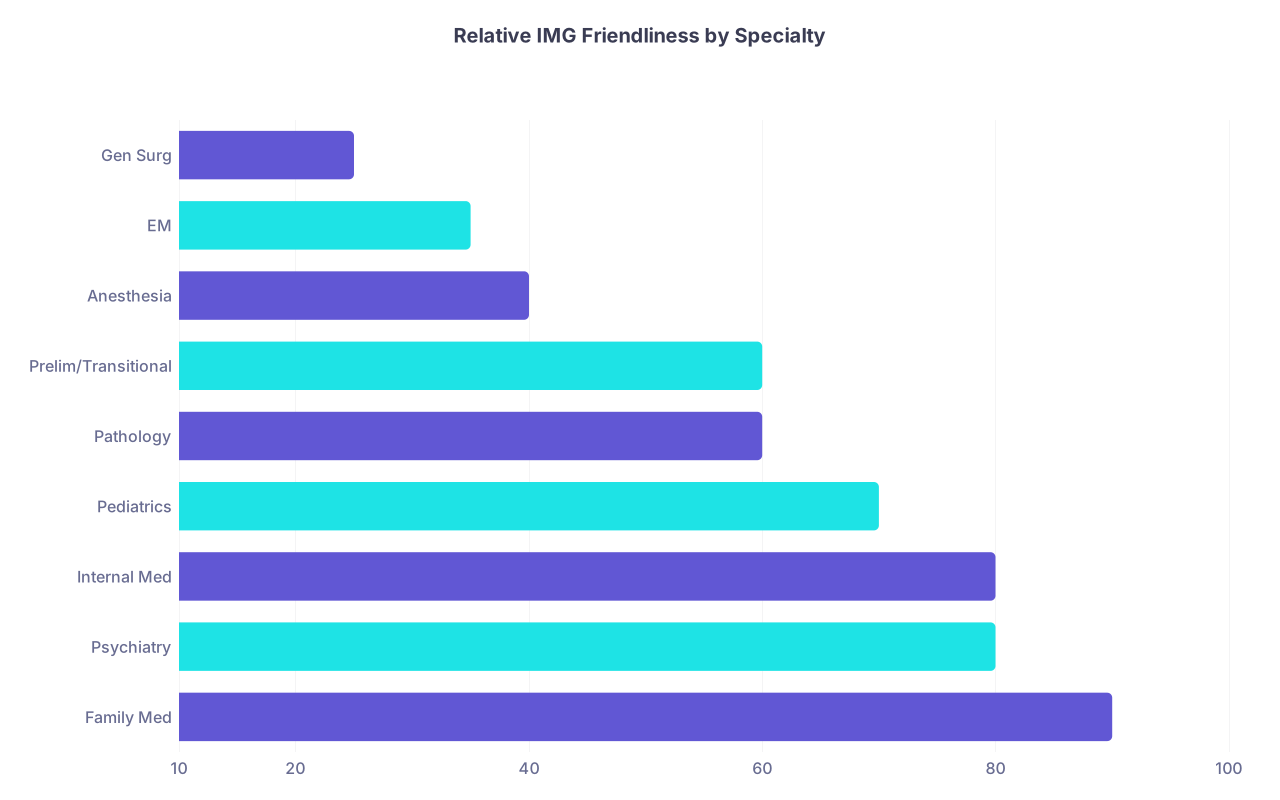
| Category | Value |
|---|---|
| Family Med | 90 |
| Psychiatry | 80 |
| Internal Med | 80 |
| Pediatrics | 70 |
| Pathology | 60 |
| Prelim/Transitional | 60 |
| Anesthesia | 40 |
| EM | 35 |
| Gen Surg | 25 |
(The percentages are a feel for relative friendliness, not literal match rates.)
If your dream is, say, neurosurgery, your realistic backup is not anesthesia at a top academic center without US letters. Your realistic backups are probably:
- Internal Medicine at community programs
- Family Medicine, including rural or community-based
- Possibly preliminary medicine year, with a plan to reapply more strategically
You may not like that, but ignoring it is how people end up unmatched twice.
3. Turn Your International Rotations into Assets (Not Red Flags)
Right now, program directors might interpret “international rotations” as:
- You’re untested in the US system
- Your evaluations aren’t comparable
- They can’t tell if you know US documentation / EMR / communication norms
You’re going to flip that script. Not by hand-wavy passion talk, but by tactical framing.
Here’s how you convert those rotations into professional currency, especially for backup specialties:
Focus on what US programs actually care about
For IM/FM/Psych/Peds, they want to know:
- Can you function safely with high patient loads?
- Can you handle breadth of disease?
- Are you mature, adaptable, not going to melt down on nights?
- Do you have a track record with underserved / complex populations?
International rotations can hit all of those. But only if you say it clearly.
Example translation:
“Worked in a rural clinic in Ghana”
becomes
“Managed 20–25 patients per day with limited diagnostics, requiring strong clinical reasoning and prioritization of sick vs stable.”“Rotated in a public hospital in India”
becomes
“Exposed to high-volume internal medicine and pediatric cases, including advanced presentations due to delayed access to care.”
Use that language in:
- Your ERAS experiences
- Your personal statements (especially for primary care backups)
- Interview answers: “Tell me about your international experience.”
4. Choosing Backup Specialties That Actually Fit Your File
Now the core problem: what specifically should you pick as backups?
Let’s break it down by your primary target and your constraints.
If your primary is a competitive field (derm, ortho, ENT, neurosurg, plastics, rad onc, ophtho)
With mostly international experience and limited/no US specialty rotations, your real options:
Primary backup: Internal Medicine
- Community programs
- University-affiliated but not top 20
- Programs with a history of taking IMGs and sponsoring visas
Secondary backup: Family Medicine or Psychiatry
If you can demonstrate:- Longitudinal outpatient / community work
- Any psych exposure, especially if you can get one psych letter
Don’t bother with:
- “Backup to ortho is general surgery.” Not with your profile. That’s just a second competitive match.
If your primary is Internal Medicine at strong academic centers
Your backups:
Same specialty, different tier:
- Community IM programs
- Smaller university-affiliated places in less popular locations (Midwest, South, rural)
True alternate specialties:
- Family Medicine (especially if you have outpatient/community rotations)
- Psychiatry (if you can make a coherent narrative from your experiences)
If your primary is EM or Anesthesia
This is where people crash hard because they underestimate the risk.
Realistic backups:
- Internal Medicine categorical (community-heavy list)
- Family Medicine at IMG-friendly programs
- Preliminary medicine + strong strategy to re-apply EM/Anesthesia next year (only if you accept a longer road)
5. Build a Narrow, Focused Backup Plan — Not Chaos
Most people screw up backups by going too broad and too shallow. They shotgun apps at five specialties, write one generic personal statement, and then complain the Match was unfair.
You’re going to do the opposite: fewer lanes, deeper tailoring.
Step 1: Limit yourself to 1–2 true backup specialties
Typical good combos:
Ortho / neurosurg / ENT applicant
→ Backup: IM + FMDerm / rad onc / ophtho
→ Backup: IM + Psych or IM + FMEM / Anesthesia
→ Backup: IM only or IM + FM
Avoid going beyond 2 backup specialties. The tailoring cost becomes huge and your letters start looking mismatched.
Step 2: Decide where your letters are strongest
If almost all your letters are:
- General internal medicine → IM and FM are natural backups.
- Psychiatry or strong mental health work → Psych is stronger than FM for you.
- Pediatrics-heavy → Peds + FM or Peds + IM.
Don’t pick a backup where all you have is: “Open to writing a letter if needed” from someone who barely remembers you.
6. Rewrite Your Application for Each Backup — For Real
If you’re going to do backups halfway, don’t bother. Programs can smell “I don’t really want your specialty” from a mile away.
Here’s what has to change per backup specialty:
Personal statement
- One main for primary specialty
- One fully separate, honest PS for each backup
- Different first paragraph, different core story, different “why this field”
Experience descriptions
- For IM: emphasize inpatient, complex medicine, longitudinal follow-up, teamwork
- For FM: continuity, community health, breadth across age groups, prevention
- For Psych: communication, longitudinal therapeutic relationships, complex psychosocial cases
- For Peds: child/family-centered care, development, communication with parents
Program signaling (if applicable)
- Don’t waste signals on backup programs you’re not willing to attend.
- Prioritize your realistic primary lane, then_backup_ for safety.
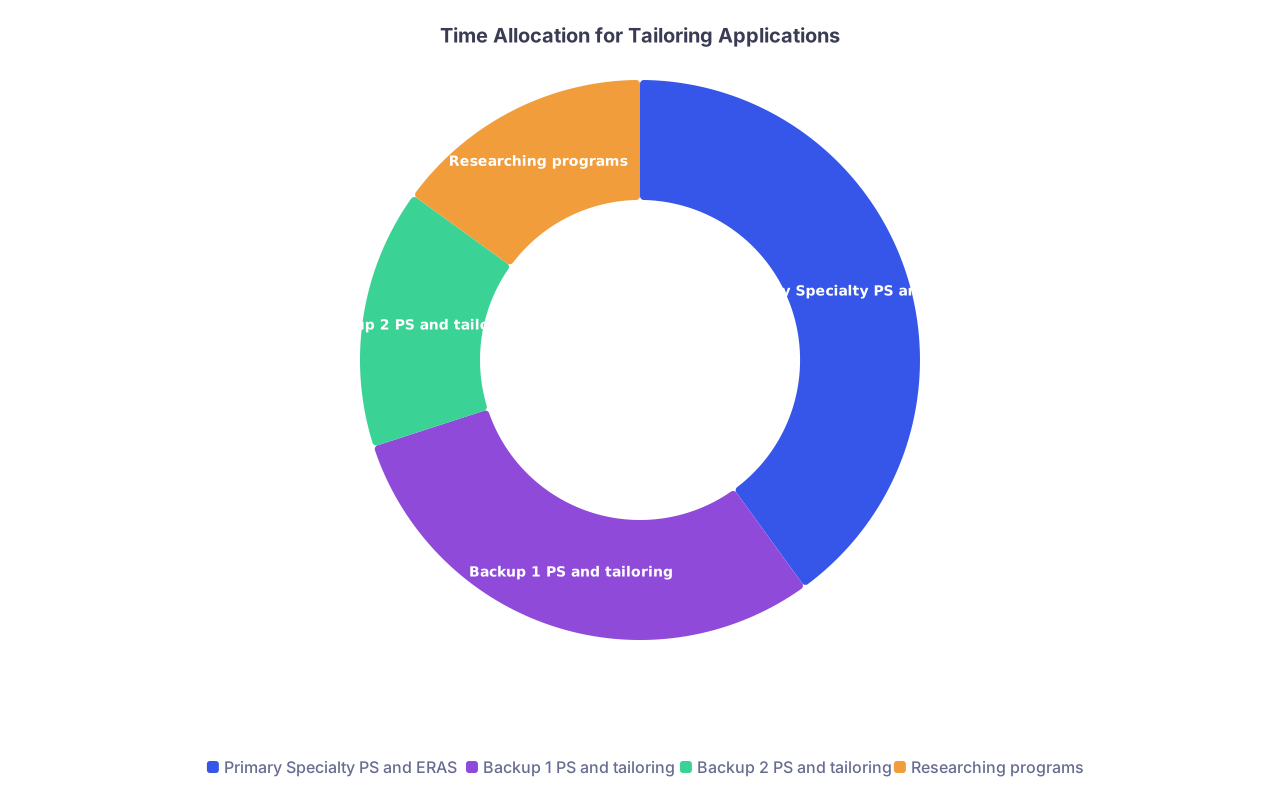
| Category | Value |
|---|---|
| Primary Specialty PS and ERAS | 40 |
| Backup 1 PS and tailoring | 30 |
| Backup 2 PS and tailoring | 15 |
| Researching programs | 15 |
Roughly this is how your application prep time should split if you’re serious.
7. Build a Target List That Matches Reality (Not Ego)
You can’t afford a fantasy rank list. Not with your constraints.
For each specialty (primary + backups), build a spreadsheet with:
- Program name
- Location
- IMGs accepted recently (from their website or online forums)
- Visa sponsorship: yes/no/unknown
- US clinical experience required/preferred
- Your realistic interest level (1–3)
Then categorize like this:
| Category | % of Apps | Program Type |
|---|---|---|
| Safety | 40–50% | IMG-friendly, community, less popular locations |
| Core | 30–40% | University-affiliated, moderate competitiveness |
| Reach | 10–20% | Larger academic centers, more competitive cities |
For your backup specialties, skew harder toward safety:
- 60–70% safety
- 20–30% core
- <10% reach
If you have mostly international rotations and need a visa, your “reach” definitions need to be conservative.
8. Timing: When to Pivot and How Hard
You’re probably either:
- Pre-ERAS submission
- Post-submission, pre-interview season
- In interview season with poor invite numbers
- Post-Match (SOAP situation)
If you’re pre-ERAS
This is the best time to do the hard choices.
- Finalize primary + 1–2 backups.
- Get at least one letter that can flex across fields (e.g., IM inpatient attending).
- Write full separate personal statements now. Not later.
If you already submitted ERAS and panic is setting in
Options:
Add a backup specialty late:
- Write a quick but specific new PS for that specialty.
- Reuse existing letters that are generic enough (e.g., medicine, not subspecialty).
- Target known IMG-friendly, visa-sponsoring programs.
Email a small number of backup programs:
- Especially in FM/Psych/IM
- Short, respectful message: who you are, why them, attached PS/CV
Is it ideal? No. But I’ve seen it work.
If you’re in SOAP
SOAP is a salvage operation. You don’t get picky.
Focus on:
- Any IM/FM/Peds/Psych/prelim IM spots that:
- Sponsor visas (if needed)
- Are not known malignant
- Have any precedent of taking international grads
Then you survive a year and plan a proper second-cycle strategy.

| Step | Description |
|---|---|
| Step 1 | Primary Specialty Chosen |
| Step 2 | Standard backup planning |
| Step 3 | Focus on IMG friendly IM/FM/Psych/Peds |
| Step 4 | Broader range but still IM/FM heavy |
| Step 5 | Limit to 1-2 backup specialties |
| Step 6 | Write separate PS for each specialty |
| Step 7 | Build target lists with safety core reach mix |
| Step 8 | Mostly US or International Rotations |
| Step 9 | Need Visa |
9. How to Talk About Your “Backup” Without Sounding Fake
Programs will sometimes ask, “Why this specialty?” when you clearly applied to another one too (they can see your NRMP specialty choices in some contexts, and sometimes it comes out in conversation or signals).
You need one clean, honest internal script. Something like:
- “I’m genuinely drawn to X for [reasons]. I also applied to Y because [true overlap / interest], and I would be very comfortable building my career in either lane.”
What you don’t say:
- “This is my backup.”
- “I really wanted [other specialty] but I didn’t think I’d match.”
- “I’m here in case the other plan doesn’t work.”
Instead, connect your international experience and your traits to each field:
For IM:
- “In my international rotations I saw the value of a strong internist who can manage complex, undifferentiated patients. That’s where I see myself.”
For FM:
- “Working in community clinics abroad, I realized how powerful it is to be the first and sometimes only contact for patients and families. That aligns directly with family medicine.”
For Psych:
- “Many of my international patients had profound psychosocial and psychiatric components to their illness. The mental health side of care became the most compelling part of my work.”
You’re not lying. You’re choosing which piece of the truth to emphasize.

10. If You Don’t Match: Use a Gap Year to Fix the Core Problem
If this cycle goes badly, it’s not because you didn’t want it enough. It’s because structurally, your file didn’t match your targets.
In a gap year, the highest-yield moves for someone limited by international rotations:
Get US clinical experience in your realistic lanes
- Observerships, externships, or research with clinical exposure
- Preferably in IM/FM/Psych/Peds settings that actually take IMGs
Secure US letters
- From attendings embedded in residency programs
- Ask explicitly: “Would you be comfortable writing a strong letter for my residency applications?”
Tighten your backup strategy early
- Don’t wait until September to decide if you’re also doing FM.
- Build everything (PS, list, mentors) by midsummer.
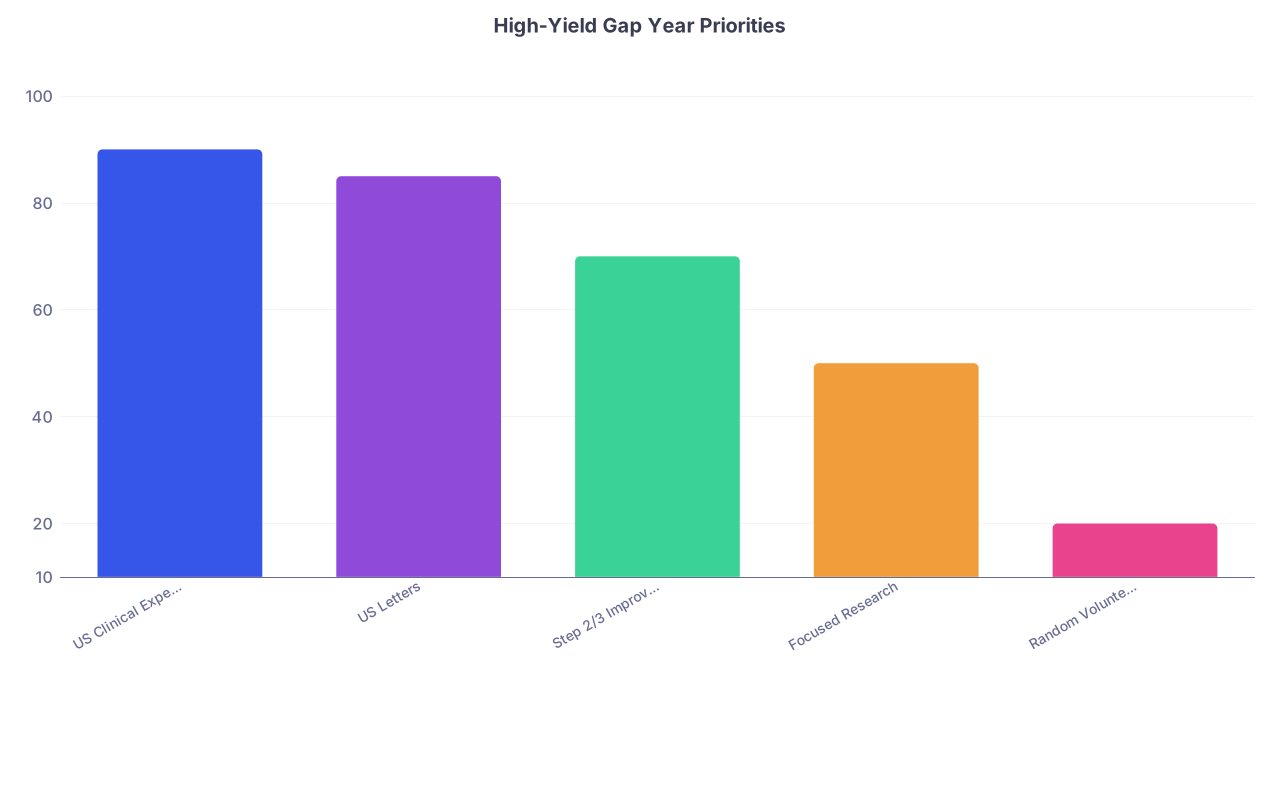
| Category | Value |
|---|---|
| US Clinical Experience | 90 |
| US Letters | 85 |
| Step 2/3 Improvement | 70 |
| Focused Research | 50 |
| Random Volunteering | 20 |
Random volunteering is nice. But it won’t fix the structural US-experience gap. US clinical and letters will.
FAQ (Exactly 5 Questions)
1. Should I bother applying to my dream competitive specialty at all, or just go straight to my backups?
Apply to your dream field if you can do it without sabotaging your entire cycle. That means: you still submit enough applications to realistic backup specialties, with fully tailored materials. If money or time forces a choice between 40 derm programs and 40 IM programs as an IMG with international rotations only, you prioritize IM. One or two moonshot specialties are fine; an entire application built on them is not.
2. Can I use the same letters of recommendation for multiple specialties?
Yes, if the letters are generic enough. A strong inpatient IM attending letter can support IM, FM, and even Psych or Peds, depending on how it’s written. But a letter that says, “They will make an excellent neurologist,” should not be used for family medicine. When you ask for letters, say: “I’m applying primarily in X, with possible applications to Y; could you keep the letter somewhat flexible?”
3. How many programs should I apply to in my backup specialty as an IMG with mostly international rotations?
For IM/FM/Psych/Peds, many IMGs in your situation end up applying to 60–120+ programs per backup specialty, depending on budget and competitiveness. That sounds insane, but the filters are real: no USCE, visa needs, and international letters all shrink your accessible pool. If you can’t afford large numbers, your targeting and networking need to be extremely sharp.
4. Is it bad to tell programs I’m also applying in another specialty?
You don’t volunteer it casually, but you also don’t lie if you’re asked directly. If it comes up, frame it as: “I’m genuinely drawn to both for [reasons], and I’d be very happy training in either. In this field, I see myself doing X long term.” The moment you sound apologetic or like they’re Plan B, you’re done. Talk like someone who’s fully prepared to commit if they take you.
5. What if my school offers one short US rotation — which specialty should I choose it in?
Pick the most realistic long-term lane, not the sexiest. If you’re an IMG dreaming of ortho but your scores and visa needs make IM your most plausible match, put that US rotation in internal medicine at an IMG-friendly program. Use it to get at least one gold-standard US letter that can anchor your IM/FM applications. That single rotation, done well, can turn a “maybe” backup into a very real match outcome.
Key points to walk away with:
- Pick 1–2 realistic backup specialties that match your actual profile—international rotations, visa needs, scores, and letters—not the fantasy version of you.
- Do the unglamorous work: separate personal statements, tailored experience descriptions, and heavily IMG-friendly program lists for each backup.
- Use your international rotations strategically: frame them in the language of US program needs—breadth, volume, underserved care, adaptability—especially in IM, FM, Psych, and Peds.