

The most interesting medical labor markets in the next 20 years will sit on borders, not in capitals.
If you are only thinking in terms of “which single country should I move to,” you are already behind. The sharper question is: where can you live in one jurisdiction, work in another, and arbitrage the difference in salary, tax, lifestyle, and regulation?
Let me walk you through the real cross‑border practice hubs that matter, how they actually function on the ground, and where the opportunities are expanding.
1. What “Cross‑Border Practice” Really Means (And What It Doesn’t)
People romanticize this idea as: “I’ll live in a cheaper, nicer place and just hop over the border to a higher‑pay country.” Sometimes that is true. Often it is not.
There are three distinct models:
Physical commute across a land border
You literally drive or take a train from Country A (home) to Country B (work) daily or weekly. Classic example: living in France, working in Geneva.Licenced practice in two adjacent countries with partial telehealth
You keep home base in one country, but work physically some days in the neighboring country and do telemedicine for that same country from home. This requires dual licensure or specific cross‑border compacts.Remote cross‑border telemedicine
You live in Country A, work entirely online for Country B’s patients, fully inside Country B’s regulatory and billing frameworks. Much more restricted than tech people think.
What it is not:
You cannot “just Zoom into another country” and practice medicine there without being licensed and compliant with that country’s law. Boards and insurers have started cracking down on that fantasy.
So, for this article, I am focusing on real, structurally supported cross‑border hubs where physicians commonly live on one side and work on the other, or where the system is explicitly built for cross‑border practice.
2. The Flagship Example: Geneva (Switzerland) – French Border Region
If you want the poster child of cross‑border doctor life, it is Geneva.
You see the pattern on call-room whiteboards: half the names have Swiss mobile numbers, half have French numbers. The French‑resident doctors leave a little earlier on Friday to beat the tunnel traffic.
How it works
- Live: French side – e.g., Annemasse, Saint-Julien-en-Genevois, Ferney-Voltaire
- Work: Geneva University Hospitals (HUG), private clinics in Geneva/Lausanne, Swiss group practices
You are dealing with:
- Swiss salaries (higher than France, often significantly)
- French housing prices and cost of living (lower than Geneva and Vaud)
- A well‑established status: “frontaliers” – cross‑border workers with specific tax and social security arrangements.
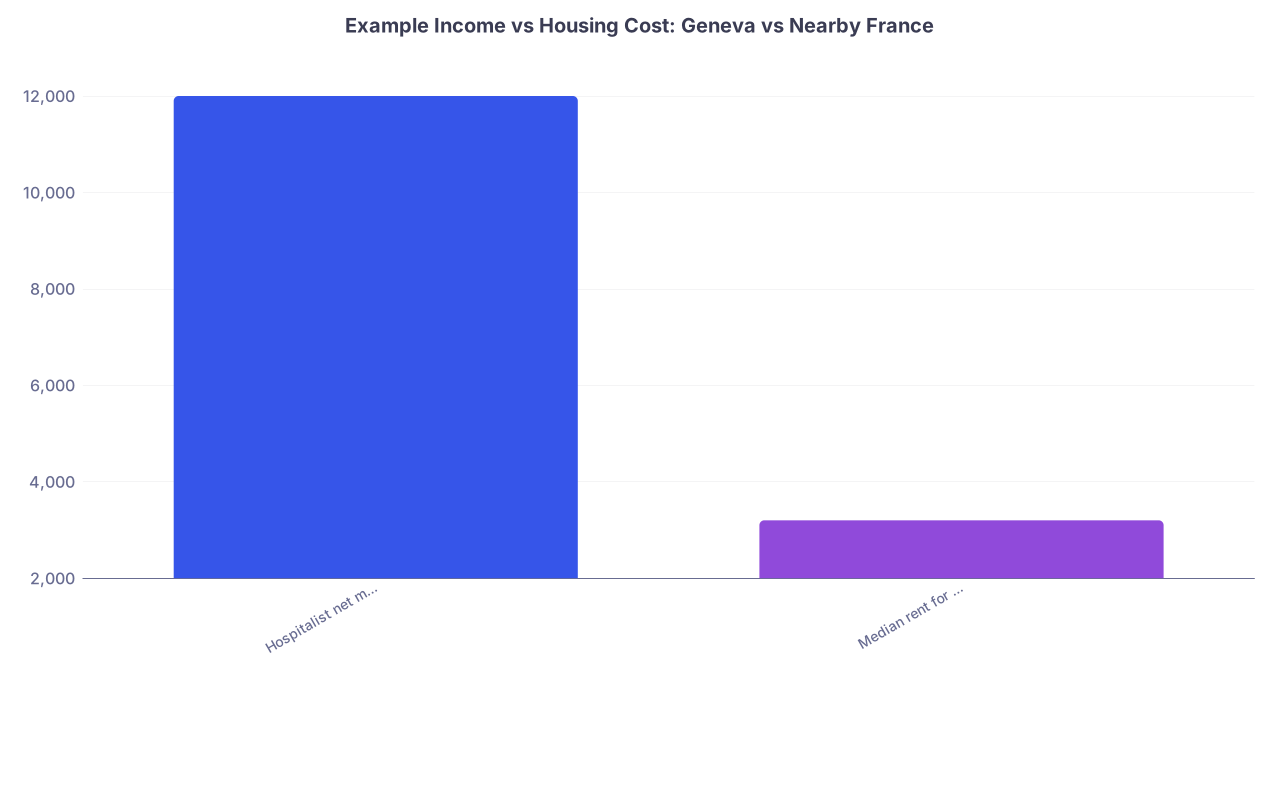
| Category | Value |
|---|---|
| Hospitalist net monthly pay | 12000 |
| Median rent for 3BR apt | 3200 |
Interpretation for that rough snapshot: similar Swiss contract whether you live in Geneva or just across the border, but rent might drop from ~CHF 3,200+ in Geneva to something closer to €1,700–2,000 equivalent in nearby France, depending on where and what you rent. That arbitrage is the entire game.
Regulatory and tax structure
- You must be licensed in Switzerland, not France, to work in Swiss hospitals.
- Residency training and language:
- Typically French‑speaking, sometimes need German depending on region.
- EU/EEA grads have an easier path; non‑EU IMGs will find it competitive and bureaucratic.
- Taxes: historically, many frontaliers paid income tax to Switzerland at source with specific agreements on how money goes back to French communes. The exact arrangement depends on canton and evolving bilateral deals.
Pros
- High salary.
- High clinical standards and infrastructure.
- Short commute – 20–40 minutes from many French towns.
- You can access French schools, healthcare, and housing costs, which are generally more affordable.
Cons
- Licensing into Switzerland is not trivial, especially for non‑EU physicians.
- Traffic at border crossings is real. Winter and snow add friction.
- The cost of living gap between Geneva and the French side is narrowing; the arbitrage is no longer as outrageous as it was 15 years ago.
This is the most mature cross‑border medical ecosystem in Europe. If your training and language fit, it is probably the cleanest version of the live-one-side, work-the-other model.
3. Luxembourg and the Greater Region (France–Belgium–Germany)
Luxembourg is tiny, rich, and chronically short of health professionals. It leans heavily on cross‑border workers.
The setup
- Live: Metz/Thionville (France), Arlon (Belgium), Trier/Saarbrücken region (Germany)
- Work: Centre Hospitalier de Luxembourg (CHL), Hôpitaux Robert Schuman, Hôpitaux Kirchberg, private clinics
Tens of thousands of cross‑border workers overall, and a non‑trivial number are in healthcare.

Why doctors do this
- Luxembourg salaries are solidly higher than public hospital wages in neighboring France or Belgium.
- Tax and social security are often more favorable when the work is in Luxembourg.
- Housing is shockingly expensive inside Luxembourg, so many people choose to live across the border.
Licensing reality
- You must be licensed by Luxembourg authorities, but recognition of EU medical degrees and specialties is usually straightforward.
- Language cocktail: French and German used frequently; Luxembourgish in some interactions; English in certain hospital environments, but it is not enough by itself for most patient‑facing work.
Pros
- Strong income–cost differential if you live in France or Belgium.
- Highly international environment.
- Compact geography; commutes can be 30–45 minutes across a border.
Cons
- Pricing pressure on housing in border towns – they are not as “cheap” as they used to be.
- Generous tax and social regimes are politically sensitive; expect gradual tightening.
Still, as of today, Luxembourg and its ring of cross‑border towns is one of the highest‑yield hubs for EU‑trained physicians who want this life.
4. Northern Europe: Scandinavia – Baltic – Polish Axis
The Scandinavian system has quietly built a cross‑border health workforce, particularly with Polish and Baltic doctors and nurses.
But the “live in cheap Poland, work in expensive Sweden” fantasy is less direct than the Geneva story.
Nordic cross‑border flows
The more realistic pattern is:
- Live in Poland or Latvia,
- Work in Sweden, Norway, or Denmark on block contracts or locum stints,
- Then return home for weeks.
That is cross‑border practice, but not daily commuting. It is rotational migration.
For actual daily or weekly commuting, you see:
- Øresund region:
- Live: Malmö/Lund (Sweden)
- Work: Copenhagen area (Denmark)
- Many nurses and some doctors do this via the Øresund Bridge.
Øresund reality check
- Danish salaries in healthcare are usually higher than Swedish ones.
- But Danish tax and cost of living are also higher.
- Commuting over the bridge costs money (tolls, time); some people take the train.
So the arbitrage is narrower, but the professional flexibility is the value:
- You can work in Denmark’s system while retaining Swedish residence.
- Both countries are within EU/EEA free movement and have strong degree recognition frameworks.
Language: Danish and Swedish are mutually intelligible to some extent, but clinical work still demands high language proficiency. Everyone speaks “Scandinavian globish” informally; patients do not care. They want fluent, empathetic communication.
5. North America: The US–Canada Border Fantasy vs Reality
This is where many physicians get misled by simplistic advice.
“I’ll live in Canada with universal healthcare, then commute to the US for high pay,” or vice versa. Sounds elegant. Usually is not.
Structural blocks
Licensure does not cross the border.
A Canadian license does not allow US practice and vice versa. You need full licensing in each country, each with its own exams, training recognition, and credentialing.Immigration and work status
You need work authorization in the country where you practice. That alone kills a lot of naive plans.Standards and malpractice
Malpractice standards, EMR systems, billing codes: all completely different.
There are niche realities though
Detroit–Windsor, Buffalo–Fort Erie, and similar corridors
A small number of physicians live in Canada and work in the US, or the reverse, especially if they:- Are dual citizens or permanent residents in both countries.
- Completed residency in one system and later got licensed in the other.
- Work in specific high‑need areas (e.g., US border hospitals).
Academic cross‑appointments
Example: A Canadian academic physician with a visiting or adjunct appointment at a US institution across the border (Buffalo–McMaster, Seattle–UBC region). They may physically cross for clinics or procedures on specific days.Telemedicine from border regions
This is heavily regulated. Some physicians licensed in multiple US states (and/or Canadian provinces) may live near the border and do telehealth into the other system, but they still need:- Full licensing in the patient’s jurisdiction.
- Compliance with billing and malpractice on that side.
In practice, for most people, the US–Canada border is not a stable, easy daily cross‑border practice hub. It is possible, but highly conditional.
6. US Interstate “Cross‑Border” Hubs: Not Different Countries, But Same Logic
You asked about doctors living in one country and working in another, but I would be doing you a disservice if I skipped the US interstate version. Because practically, it plays the same arbitrage game.
Classic examples:
- Live in Washington State (no income tax), work in Portland, Oregon (higher pay environment for some roles).
- Live in New Hampshire (no state income tax), work in Boston, Massachusetts.
- Live in Nevada, fly in for California locums.

| Step | Description |
|---|---|
| Step 1 | Live in Vancouver WA |
| Step 2 | Work in Portland OR |
| Step 3 | Live in NH |
| Step 4 | Work in Boston MA |
| Step 5 | Live in Reno NV |
| Step 6 | Locums in CA |
Not different countries, but the tax and cost-of-living differentials can rival cross‑border European moves. And the regulatory barrier (state licensure) is much lower than crossing a national border.
The US Interstate Medical Licensure Compact (IMLC) will matter more for cross‑border telehealth than international borders in the short term.
7. Gulf Region: Living in One State, Working in Another City‑State
In the Middle East, you frequently see physicians living in one Gulf state and being flown into another for block shifts. But daily commuting is rarer because distances and borders do not function like Schengen.
Patterns that exist:
- Live in Bahrain, work some days in Saudi Arabia’s Eastern Province (e.g., Aramco, Johns Hopkins Aramco Healthcare).
- Live in UAE, cross periodically to Oman or Saudi for part‑time work, especially in under‑served regions.
This is much less “I drive 20 minutes across a casual border” and more “I have multiple Gulf licenses, and my employer organizes my travel and visas.” It is cross‑border practice, but handled at an institutional level, not a casual decision by an individual.
For most foreign physicians, the Gulf region is best treated as: you reside and practice in one country at a time, occasionally doing additional blocks elsewhere.
8. Emerging Telemedicine Cross‑Border Hubs
Now we get to the future. This is where things are moving, and where younger physicians should pay attention.
The principle
Telehealth breaks geography but not regulation. You still must:
- Be licensed in the jurisdiction where the patient sits.
- Follow local data protection, prescribing, and malpractice rules.
So the viable model is not “I will sit in Thailand and treat British patients for cash without GMC oversight.” That is how you lose your license. The viable model is institutional cross‑border telehealth.
Real and emerging configurations
Nordic cross‑border telehealth companies
Example: A Swedish telehealth company licensed in Sweden, Denmark, Norway. Doctors may live in one Nordic country and see patients across others, fully licensed in each.EU telemedicine platforms
Some platforms recruit doctors licensed in multiple EU states, then route patients by jurisdiction. The doctor might live in Spain but see patients in Germany and France via video, because they hold those licenses.US telehealth with physicians living abroad
This is quietly growing. For example:- US‑licensed psychiatrists or radiologists living in Portugal, Mexico, or Costa Rica.
- They work US hours, see US patients, bill US insurance.
- They must maintain US license, DEA as appropriate (for controlled meds), malpractice coverage.
Here, cross‑border is: country of residence ≠ country of licensure and patient location. There is no daily “border crossing,” but the salary and tax arbitrage can be enormous.
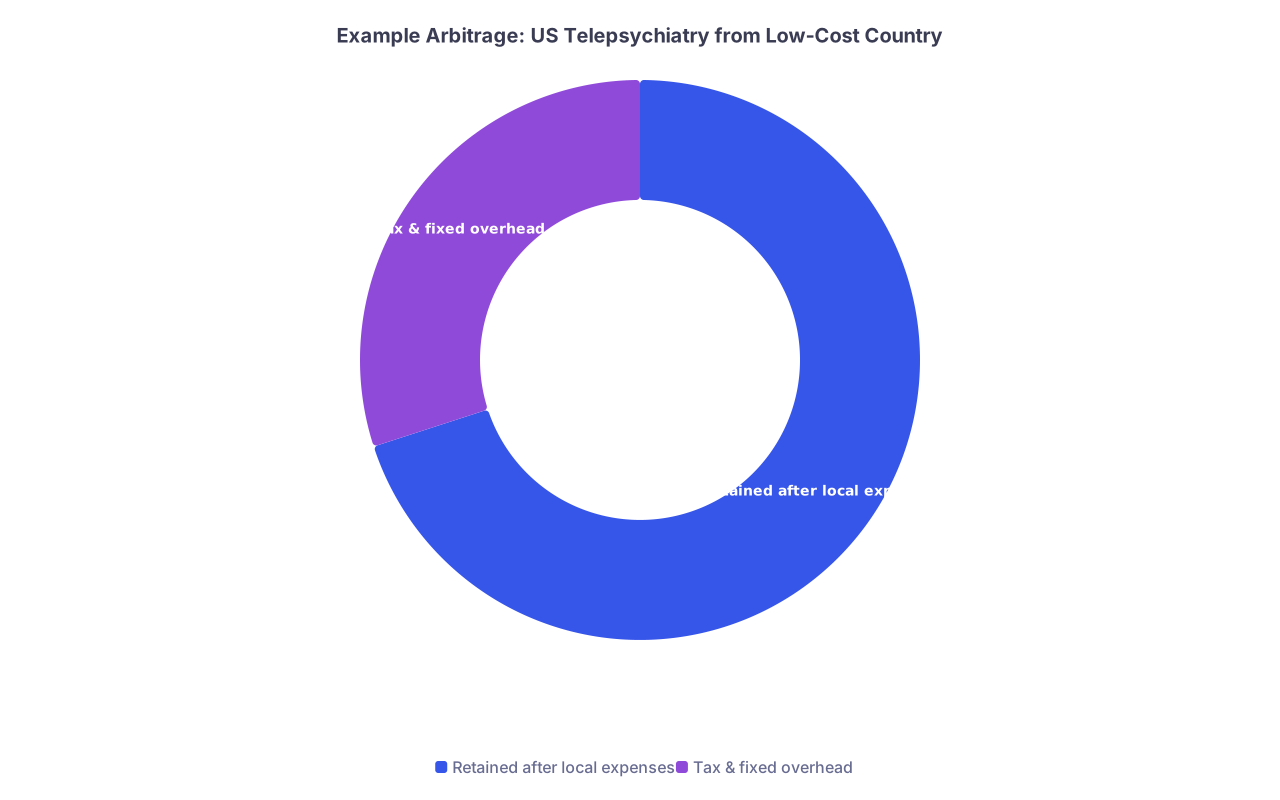
| Category | Value |
|---|---|
| Retained after local expenses | 70 |
| Tax & fixed overhead | 30 |
A US psychiatrist living in Mexico City with US‑level reimbursement and local cost of living is running a completely different financial game than colleagues paying San Francisco rent. I have seen people drop their effective monthly burn rate by 60–70% while maintaining the same income.
But again: they are not treating Mexican patients without Mexican licensure. They remain fully in the US regulatory universe.
9. Concrete Hubs: Where This Already Works Well
Let me give you a structured snapshot of some of the better‑defined physical cross‑border hubs.
| Hub Region | Live Side | Work Side | Typical Specialties |
|---|---|---|---|
| Geneva–French Border | France | Switzerland | IM, anesthesia, surgery |
| Luxembourg Ring | France/Belgium/DE | Luxembourg | IM, psychiatry, GP, ED |
| Øresund (Malmö–Copenhagen) | Sweden | Denmark | IM, pediatrics, psychiatry |
| Detroit–Windsor | Canada/US | US/Canada | Limited; niche hospitalists |
| US Telehealth Abroad | Mexico/Portugal/etc | USA | Psych, radiology, derm |
This is not exhaustive. It is where I see structural, repeatable patterns, not one‑off anecdotes.

10. Who Actually Benefits From Cross‑Border Practice?
Not everyone. Let me be blunt about where this is a good idea and where it is a headache.
Strong candidates for cross‑border setups
EU‑trained physicians with multilingual ability
If you speak French/German/Scandinavian languages, the Geneva/Luxembourg/Øresund setups become realistic. You can walk into real consultant‑level roles and actually understand the patients.US‑trained psychiatrists, radiologists, dermatologists, and some IM subspecialists
With telehealth, you can keep full US income while decoupling your personal cost base. That is cross‑border practice in financial reality, even if your patients are all “back home.”Binational or dual‑licensed physicians
US–Canada dual citizens, EU doctors with Swiss recognition, Nordic doctors with multiple country licenses. The friction is lower across the board.
Poor candidates (or high‑friction situations)
- Non‑EU IMGs hoping to skip proper training/language integration by “just commuting to Switzerland.” It does not work like that.
- People who hate bureaucracy and slow credentialing. Cross‑border anything means double paperwork.
- Those with strong local family roots who cannot relocate within a border region. Because you often need to adjust your life physically closer to where the economic arbitrage is.
11. Future Directions: Where This Is Headed Over the Next 10–20 Years
Let me outline where I expect real movement. Not dreams. Actual shifts.
A. More formalized EU cross‑border zones for healthcare
- The EU is already experimenting with cross‑border healthcare access (e.g., patients going from one country to another for certain treatments).
- I expect:
- More cross‑border staffing agreements in under‑served border regions.
- A bit like the Geneva model, but expanded to other frontiers: Germany–Poland, Austria–Czech Republic, etc.
- “Euro‑hospital” projects drawing staff from multiple states.
B. Telehealth from low‑cost countries to high‑income patients
- US and UK systems are desperate for mental health, radiology, and chronic disease management capacity.
- Cross‑border telehealth with physicians living in:
- Portugal, Spain, Greece, Mexico, Costa Rica, Colombia
will quietly expand.
- Portugal, Spain, Greece, Mexico, Costa Rica, Colombia
- The choke point will be licensure and data protection. GDPR has already forced companies to rethink cross‑border data flows; you will see more localized hosting solutions to keep patient records in origin countries while clinicians are abroad.

| Step | Description |
|---|---|
| Step 1 | Patient in USA |
| Step 2 | US Telehealth Platform |
| Step 3 | US Server with EHR |
| Step 4 | Doctor living abroad |
C. Regional compacts
- Think “IMLC but international.”
- Early candidate zones:
- Nordic bloc expanding recognition across entire region.
- Possibly Gulf states harmonizing aspects of licensing.
- Maybe, long shot, a structured US–Canada medical compact for specific border regions.
D. AI and productivity tools
Ironically, as AI takes over some rote tasks, cross‑border practice becomes easier, not harder:
- Real‑time translation will make it more feasible for a Polish physician to work in a German border clinic.
- Decision support will reduce the friction of jumping between slightly different national guidelines.
That said, AI will also increase the expectations on each remaining human clinician. If you are cross‑border, users will not forgive sloppy understanding of local nuances; you will have to integrate both systems’ logic.

12. How To Decide If a Cross‑Border Practice Hub Is Worth It For You
You should not move countries, or even just borders, because a blog said Geneva is nice. You need a clean checklist.
Ask yourself:
What exactly is my arbitrage?
Salary vs cost of living? Tax vs services? Workload vs family time? Be specific. “Better lifestyle” is meaningless without numbers.What is the licensing timeline and probability of success?
Are you EU‑trained or non‑EU? Which exams? Which language benchmarks (e.g., B2/C1 in French or German)? Are you willing to burn 12–24 months getting through that pipeline?What is the border friction?
- Commute time.
- Border controls (Schengen vs non‑Schengen).
- Reliability of transport (bridge, train, ferries, etc.).
What are the failure modes?
- What if the tax treaty changes?
- What if commuting becomes impossible (pandemic, political crisis)?
- Can you still function if the border suddenly “hardens”?
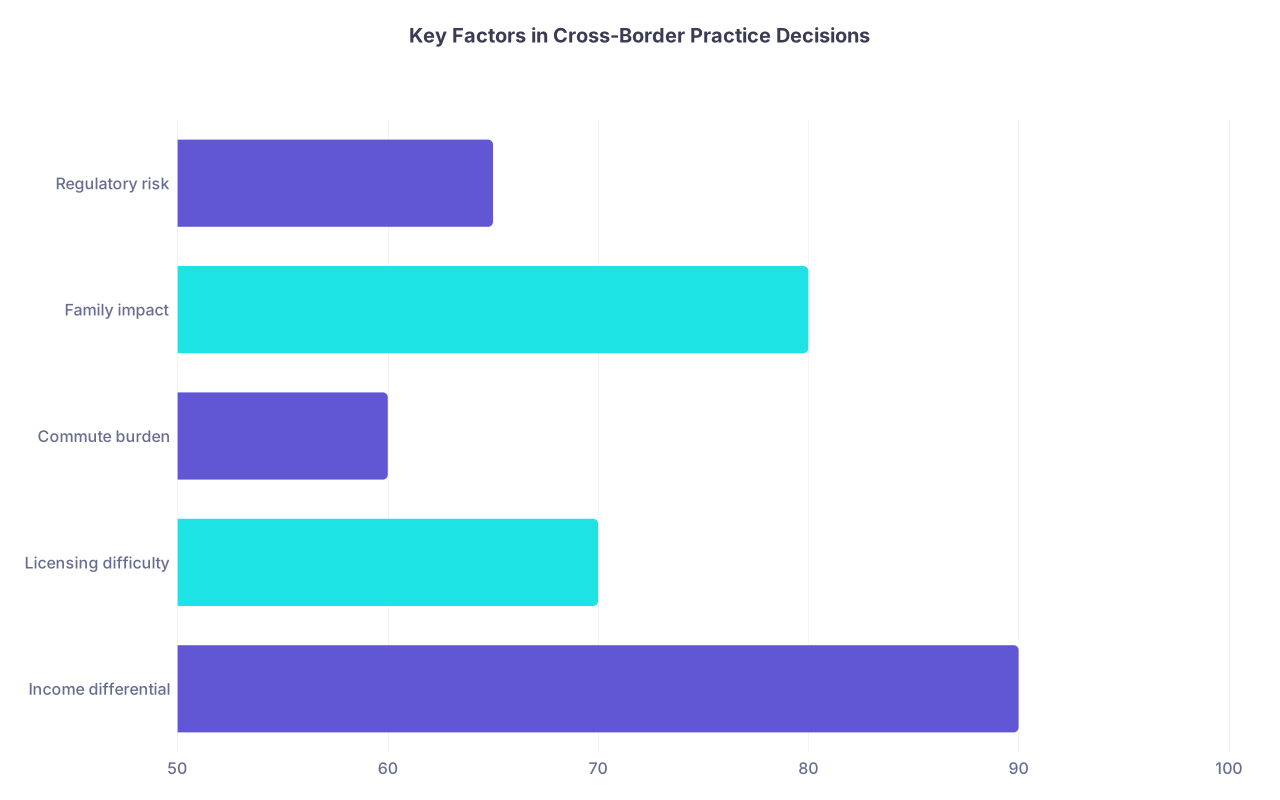
| Category | Value |
|---|---|
| Income differential | 90 |
| Licensing difficulty | 70 |
| Commute burden | 60 |
| Family impact | 80 |
| Regulatory risk | 65 |
Income differential is usually the driver, but if licensing difficulty or regulatory risk scores high for you, the project may be a net loss.
FAQ (Exactly 5 Questions)
1. Can I live in a low‑income country and treat high‑income country patients purely online without their license?
No. You must be licensed in the patient’s jurisdiction. Doing otherwise is practicing medicine without a license. Telehealth has not diluted that requirement; if anything, regulators are more aggressive now.
2. Which cross‑border hub is most accessible for non‑EU international medical graduates?
Honestly, none of them are easy. Switzerland, Luxembourg, and Nordic countries all prioritize EU/EEA qualifications. The most realistic route is often: complete your specialty training in an EU country (Germany, France, etc.), integrate linguistically, then pivot into a cross‑border hub from that base.
3. Are there tax dangers in cross‑border practice (e.g., being taxed twice)?
Yes, and you need a professional tax advisor, not Reddit. Double taxation treaties usually exist, but frontaliers and cross‑border workers can trigger complex residency and social security rules. Mismanaging this can erase your arbitrage advantage.
4. Is cross‑border practice stable, or could treaties and rules change overnight?
It is relatively stable in mature zones like Geneva and Luxembourg, but nothing is immune to political shifts. France and Switzerland, for instance, periodically renegotiate frontalier tax rules. You should plan for some degree of policy drift over a 10‑year horizon.
5. If I want to prepare now for a future cross‑border telehealth career, what should I focus on?
Pick a core license with high global leverage (US, UK, or EU Big Four), cultivate a portable specialty (psychiatry, radiology, derm, some IM subspecialties), keep your board certification spotless, and understand data protection/telehealth regulations in your main market. If you can layer in a second language and a second license (e.g., another EU state), even better.
With that mindset, you are not just chasing the next “hot country.” You are designing a career that can sit on the fault lines between systems—and profit from the tension. The next step is to figure out which licensing corridor fits your background best. That mapping is its own project entirely.


