

You are sitting in a cramped call room, scrolling through job boards between admissions. Every posting sounds the same: “competitive compensation,” “supportive team,” “great work–life balance.” You know most of that is marketing fluff. But you also know there are pockets of the country where one additional physician is not just “nice to have.” It is the difference between transfers vs. local care, 3‑month waits vs. 3‑week waits, strokes caught vs. missed.
This is about those places. The borderline underserved micro‑regions where a single extra doctor actually bends the curve of community health.
Let me break this down specifically. Not vague “rural medicine.” Not abstract “underserved communities.” We are going to talk about concrete micro‑regions, population bands, hospital types, and the levers by which one physician can fundamentally change access, outcomes, and even the local economy.
1. What “Borderline Underserved” Actually Means
Forget the PR language for a minute. “Underserved” in policy documents is usually binary: HPSA or not, MUA or not. Reality is more granular.
Borderline underserved micro‑regions sit in this frustrating middle zone:
- Too resourced to qualify for the most aggressive federal assistance.
- Too thinly staffed for care to be anything but fragile.
- One resignation, maternity leave, or early retirement away from collapse.
Think of:
- A town of 18,000 with two full‑time family physicians and a 10‑bed critical access hospital.
- A cluster of three frontier counties with one general internist covering outpatient and hospitalist duties.
- A ring suburb whose population exploded, but primary care recruitment has lagged 10 years behind housing growth.
These are not physician deserts. They are edge-of-desert oases, running on fumes.
How to recognize a borderline underserved micro‑region
If you see all of the following, you are looking at the right ecosystem:
- Population 10,000–60,000 in catchment, with real travel distances to true tertiary centers (60–120 minutes).
- 1–4 core full‑time physicians in your specialty for that entire catchment.
- Consistently over 4–6 weeks to “soonest available” non‑urgent appointment in primary care or key specialties.
- Heavy reliance on locums or per‑diem coverage to keep call schedules compliant.
That is the sweet spot where one more doctor is not just another cog. You are a force multiplier.
2. The Math: Why One Extra Doctor Changes Everything
Let’s make this concrete. Primary care first, because that is where the math is most dramatic.
A reasonably efficient full‑time primary care physician in a semi‑rural setting can responsibly carry 1,500–2,000 patients in a continuity panel. Many carry more, but quality and access start decaying fast above that. Call it 1,800 as a working number.
Now look at a real, common scenario.
- Catchment population: 24,000
- Reasonable target: 1 primary care physician per 1,800 patients
- Ideal PCP count: ~13 FTE
- Actual PCP count: 10 FTE
You are short 3 FTEs. That is 5,400 people either unpaneled, only using urgent care/ED, or attached to physicians who are already overloaded.
What happens if you add one full‑time PCP?
You do not close the entire gap. But watch the effect:
- Panel coverage improves from 10 × 1,800 = 18,000 to 11 × 1,800 = 19,800.
- Unpaneled or poorly paneled population shrinks from ~6,000 to ~4,200.
- Average panel size drops from 2,400 to ~2,180 if everyone was over‑paneled before.
That translates into:
- More same‑day or 48‑hour slots.
- Less churn of burned‑out physicians leaving.
- Better chronic disease follow‑up because you are not booked with pure acute visits.
You see the same pattern in specialties.
Take general surgery in a 40,000–60,000 catchment with:
- 2 general surgeons on staff.
- 1.2–1.5 OR days per week per surgeon.
- 24‑hour call coverage, 1:2.
Add a third surgeon:
- Call becomes 1:3. Night and weekend fatigue drop.
- Each surgeon has more schedulable time for elective cases.
- Fewer transfers for basic emergencies: appendectomies, cholecystitis, small bowel obstruction.
Outcomes improve not because the third surgeon is superhuman, but because the previous set‑up was structurally unsafe.
Here is the pattern across a few common micro‑region scenarios.
| Setting Type | Before New MD | After New MD |
|---|---|---|
| Rural primary care (10k–30k pop) | Panels >2300, waits 4–6 weeks | Panels ~1800–2000, waits 1–3 weeks |
| Semi-rural general surgery | Call 1:2, frequent transfers | Call 1:3, more local emergency care |
| Micropolitan psychiatry | 3–4 month wait for intake | 4–6 week wait for intake |
| Outer-ring OB/GYN | L&D coverage fragile | More predictable call, fewer diversions |
| Rural hospitalist service | 1 MD nights, high burnout | 2 MD rotation, better lengths of stay |
You are not “just another provider” in these settings. You are reshaping the queueing theory of an entire system.
3. The Geography: Where These Micro‑Regions Actually Are
This is where people get lazy and just say “rural America.” That is sloppy. Borderline underserved micro‑regions come in several distinct flavors, each with its own pattern of need and lifestyle tradeoffs.
Type 1: Frontier + Town Hub
Think Great Plains, Mountain West, parts of Appalachia.
Pattern:
- One small town of 8,000–25,000 acts as the hub.
- Surrounding counties are 3,000–8,000 each, largely agricultural or extractive industries.
- A critical access hospital (CAH) with 10–35 beds, a small ED, and maybe basic imaging.
Common states: Montana, Wyoming, the Dakotas, Nebraska, Kansas, eastern Oregon/Washington, parts of West Texas, Oklahoma panhandle.
What one extra doctor does:
- Family med: absorbs thousands of patients who currently default to ED or have zero continuity care.
- General surgery: keeps ruptured appys and complicated gallbladders from being driven 2–3 hours.
- OB/GYN: makes the difference between a closed or open L&D unit.
Lifestyle: Less anonymity. People know your kids’ names. You are “Doctor So‑and‑So” at the grocery store.
Type 2: Micropolitan Medical Hubs
Think regional centers that are too small to be “urban” but too large to be true frontier.
Definition: 10,000–50,000 residents, usually with a 60–100 bed hospital that does:
- General surgery
- Basic orthopedics
- Some ICU capacity
- Limited specialty coverage (usually cardiology, maybe GI)
Common states: Midwest (Iowa, Wisconsin, Minnesota), Southeast (Alabama, Georgia), upstate New York, inland California.
Here, you are not the only game in town—but you might be the difference between fragile vs. stable coverage.
What an extra doctor does:
- Hospitalist: moves the service from barely covered nights and dangerous census spikes to sustainable staffing.
- Cardiology: allows outpatient consult scheduling within weeks, not months; more local stress testing and cath triage.
- GI: colonoscopy access for screening jumps; fewer patients aging out of recommended screening windows.
Type 3: Outer‑Ring Suburbs with Lagging Physician Growth
These are sneaky. On a map, they look saturated because you are 40–60 minutes from a large metro. The truth: the local clinic grid is totally overwhelmed by explosive population growth.
You see this in:
- North of Austin, TX (Williamson County, for example).
- Outskirts of Phoenix.
- Suburban crescents around Atlanta, Charlotte, Nashville, Denver.
Pattern:
- 20–100k population in the municipality itself.
- Realistically, people do not want to drive into the core city for routine care.
- PC panels are enormous: 2,500–3,000+.
- Specialty visits book out months, “soonest available” often 8–12 weeks.
Here, an extra PCP, OB/GYN, or outpatient psychiatrist can legitimately chop waiting times in half and keep care local—and you still have access to urban amenities.
Type 4: “Shadow Regions” Next to Dominant Academic Centers
Everyone wants to work at the big-name academic hospital. The result is a ring of under‑resourced communities sitting just outside the gravitational pull.
Examples:
- Towns 45–90 minutes from Mayo, Cleveland Clinic, Mass General, Duke, Stanford, etc.
- Counties that send most complex cases to those centers, but have brittle local primary or specialty coverage.
What you see:
- Specialists assume “the big place” will absorb the demand, so they do not come.
- Local hospital/clinic constantly recruit, rarely fully staffed.
- Patients bounce between partial local eval and long trips to tertiary care.
Here, one more solid, broad‑scope internist, cardiologist, or general surgeon makes a disproportionate impact on what stays local instead of getting shipped out.
4. Which Specialties Move the Needle the Most
Not every specialty has the same marginal impact when you add exactly one clinician. Some are force multipliers in these micro‑regions.
Family Medicine / General Internal Medicine
Still the backbone. Few specialties change the trajectory of a micro‑region more than strong primary care.
What you directly change:
- Uninsured or underinsured patients finally have a consistent entry point.
- ED visits drop because people have somewhere to go at 3 p.m. for chest pain that probably is not MI.
- Chronic disease metrics shift—A1c control, blood pressure control, statin use.
If you are comfortable with:
- Office procedures (joint injections, skin, contraceptive procedures).
- Behavioral health triage.
- Basic inpatient rounding.
…you effectively function as a mesh network node holding the whole thing together.
General Surgery
One general surgeon in a CAH is a liability. Two is survival. Three is transformation.
What one more surgeon does:
- Call becomes humane. 1:2 → 1:3 is a huge leap.
- More elective capacity: hernias, laparoscopic cholecystectomies, colon resections that used to be delayed.
- Fewer late transfers for bowel obstruction or trauma that should have been handled locally.
I have watched communities hold onto birthing units, dialysis centers, and even local oncology largely because surgeons were present and stable.
Obstetrics & Gynecology
There is a hard line: a county either has OB coverage or it does not. Losing OB coverage radically changes a region’s risk profile overnight.
One extra OB/GYN in these micro‑regions:
- Prevents L&D closure due to inability to staff call 24/7.
- Reduces diversion of laboring patients to distant hospitals.
- Stabilizes prenatal care access and postpartum follow‑up.
If you want to see real-world impact, watch what happens to a town after the OB call panel drops below sustainable levels. It is brutal. One good OB can prevent that.
Psychiatry (Adult, Child, Addiction)
Psychiatry is the hidden giant. Most borderline underserved regions are in outright crisis here.
Adding one psychiatrist in these areas:
- Cuts new patient wait times from 3–6 months down to 4–8 weeks.
- Offloads primary care from “Band‑Aid prescribing” SSRIs and benzos they are not comfortable managing long term.
- Anchors collaborative care models that extend psychiatric capacity through PCPs and NPs.
Child and adolescent psychiatry is even more glaring. One child psychiatrist in a 200k regional population may be the only one within 60–90 miles.
Hospitalists and Intensivists
Not glamorous, but absolutely system-critical.
One more hospitalist FTE in a borderline region:
- Allows census caps to be respected.
- Shortens length of stay by letting you round more thoroughly and discharge earlier.
- Adds bandwidth for quality initiatives: sepsis protocols, readmission reduction.
In a 50–80 bed hospital with 2–3 hospitalists per day, adding a fourth truly alters safety margins.
5. How One Extra Doctor Cascades Through Outcomes
Do not just think in RVUs. Think system dynamics.
Access and Wait Times
Straightforward but underrated.
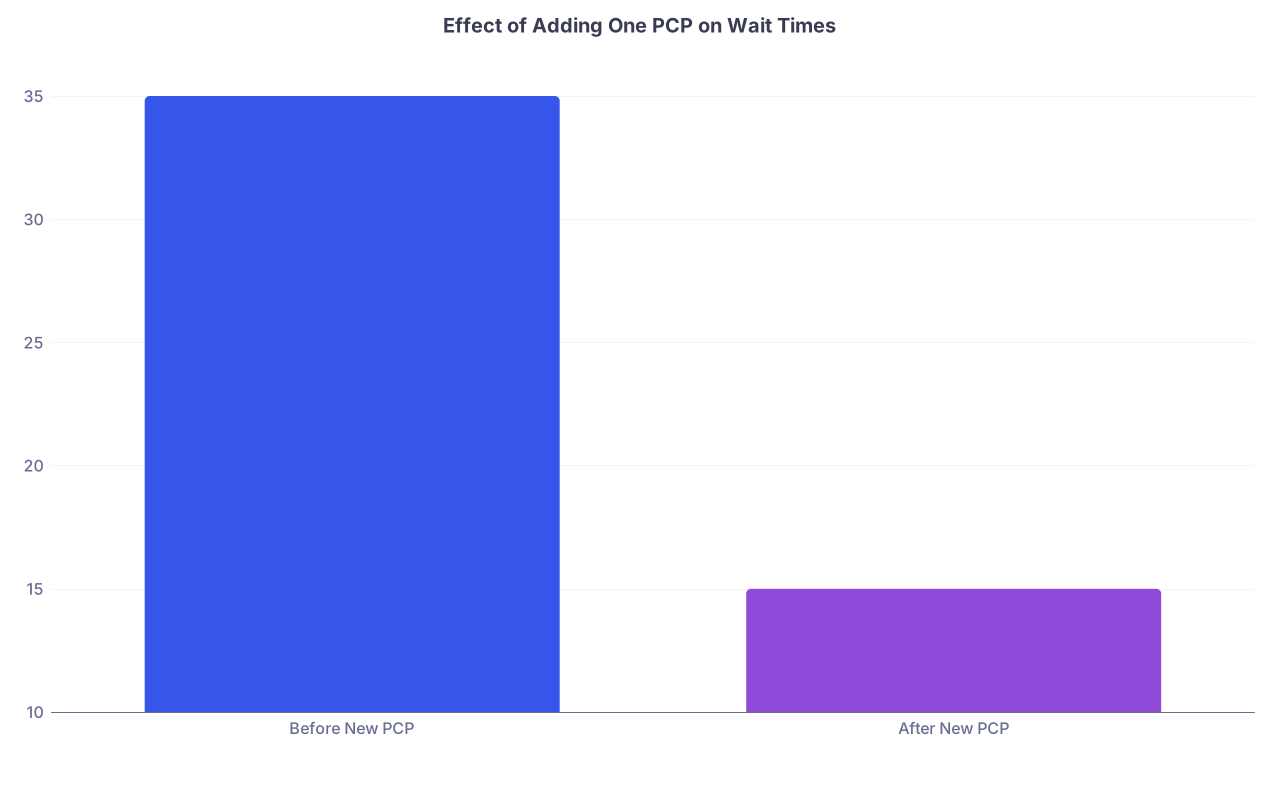
| Category | Value |
|---|---|
| Before New PCP | 35 |
| After New PCP | 15 |
Here, “35” and “15” are average days to next available non‑urgent appointment. This is exactly the kind of drop you see in a micro‑region when one more clinician with a full panel opens up.
Patients see:
- Fewer ED visits for chronic issues.
- Less no‑show behavior because appointments are not 8 weeks away.
- Better adherence to preventive care schedules.
Emergency Care and Transfers
Adding one surgeon, one hospitalist, or one more ED doc creates a ripple:
- More cases handled in-house.
- Shorter door‑to‑decision times for transfers that do need higher care.
- Less burnout on the cores who have been holding the line.
Clinically, that translates into fewer complications from delayed interventions. Fewer night‑time decisions made by someone on their 10th consecutive shift.
Chronic Disease and Preventive Care
You see shifts in:
- A1c distributions in diabetic populations.
- Vaccination coverage.
- Blood pressure control rates.
It is subtle but real. I have seen regional quality dashboards move by several percentage points after a single high-capacity PCP or NP/PA team joined a clinic and absorbed an unassigned population.
Community-Level Effects
This gets ignored in recruitment packets but matters.
One extra stable physician:
- Attracts allied health: PT, OT, pharmacists, behavioral health.
- Justifies expansion of diagnostic services: ultrasound, CT, basic oncology infusion.
- Makes it likelier the local hospital stays open. Which in turn keeps the town economically viable.
Lose that physician, and the reverse starts. I have seen communities “tip” both ways.
6. Lifestyle and Work Realities: The Good, The Bad, The Non‑Negotiable
This is not glossy brochure territory. If you are going to place yourself where you make that kind of difference, you should be brutally clear-eyed about what it feels like.
Workload and Scope
You will likely:
- Work at the top of your license.
- See a broader mix of pathology than in a saturated urban location.
- Carry more informal responsibility: local committees, quality leads, “the person everyone calls.”
The upside: you become extremely competent, very quickly. The downside: boundaries are something you must actively defend.
Relationships and Visibility
In a micro‑region, anonymity does not exist. That can be:
- Rewarding: genuine gratitude, clear sense of purpose, generational relationships with families.
- Claustrophobic: every social interaction potentially involves your patients, your decisions, your reputation.
If you cannot tolerate being recognized in the grocery store, day after day, this will grate on you.
Professional Growth
You are not on a major academic campus. That means:
- Limited in-house subspecialty collaboration.
- Fewer teaching opportunities unless tied to a regional training program.
- Conferences and CME require travel and more planning.
The flip side: you often get leadership titles years earlier than your peers in big cities—medical director, chief of staff, quality chair. If you want to run things, this is fertile ground.
Compensation and Benefits
Here is where the marketing slides are not entirely lying. Strictly on dollars, borderline underserved micro‑regions usually pay:
- More than urban academic.
- Often more than mid‑density suburban private practice.
- With bonuses, loan repayment, and housing support layered on.
But the real “compensation” is control over your schedule and where your energy goes. In well‑run micro‑regions, administrative burden is often lower and your clinical time is actually clinical.
7. How to Actually Identify These Micro‑Regions (Instead of Guessing)
You will not find a job posting labeled “borderline underserved micro‑region where one additional physician will transform care.” You have to reverse engineer it.
Here is a clean way to do that.

| Step | Description |
|---|---|
| Step 1 | See Job Posting |
| Step 2 | Check Population and Catchment |
| Step 3 | Ask About Current Physician Count |
| Step 4 | Request Panel Size and Wait Times |
| Step 5 | Assess Call and Coverage Fragility |
| Step 6 | High Impact Micro Region |
| Step 7 | Standard Market Job |
| Step 8 | Gaps Significant? |
Questions you ask explicitly in interviews:
- “How many full‑time physicians in my specialty are covering this catchment? What is the catchment size?”
- “What are average established and new patient wait times right now?”
- “What is your backup plan when someone is out unexpectedly? How often do you use locums?”
- “How many patients are currently on a waitlist or unassigned to a PCP?”
- “What has turnover looked like in the past 5 years in my department?”
If they cannot answer these cleanly, that is usually a sign of either chaos or denial.
You also cross‑check publicly:
- HRSA HPSA and MUA maps. “Not formally a shortage area” often means borderline.
- State demographic and health department data for hospital closures and physician supply.
8. Future of Medicine: Why Micro‑Regions Will Matter More, Not Less
Telemedicine evangelists love to say geography is dead. It is not. Telehealth is good at extending reach, not replacing the need for boots on the ground.
Here is what is coming, and why these borderline micro‑regions are strategic career bets.
Telehealth: Force Multiplier, Not Replacement
In the next decade, what changes is how that one extra doctor practices, not whether they are needed.
You will see:
- Hybrid models: half clinic, half telehealth, especially in primary care and psychiatry.
- E‑consult systems that let your small hospital tap into tertiary specialists, keeping more care local while you remain the on‑site decision maker.
But someone still has to listen to lungs, run a code, do the section at 3 a.m., put in a chest tube. That does not go away.
AI and Decision Support
Will AI triage some of the low‑complexity stuff? Sure. That helps you in a micro‑region more than it hurts.
Imagine:
- Better risk stratification of chest pain before it hits your ED.
- Automated chronic disease reminders with real follow‑through.
- Decision support that helps a solo internist feel comfortable managing things they previously shipped to the city.
The end result is not fewer doctors in these settings. It is more capable doctors shifting their mix of work toward the tasks that truly require human judgment and procedural skills.
Demographics and Physician Distribution
The physician workforce is still clustering in dense areas. That trend is not slowing. At the same time:
- Rural and semi‑rural populations are aging.
- Regionalization of high‑acuity care continues.
- Smaller hospitals either close or reinvent themselves as focused access hubs.
That creates a bigger band of exactly the kind of micro‑regions we are talking about: not totally abandoned, not fully saturated, heavily dependent on a handful of clinicians.
If you choose to work in one, you are not “behind” the future of medicine. You are exactly where the system has the least redundancy and the highest need.
FAQs
1. How do I know if a job will actually let me practice broad‑scope medicine, or if I will be boxed in like a metropolitan clinic?
Ask directly about scope: procedures supported, inpatient vs. outpatient mix, what current clinicians do day to day. Then talk to a front‑line physician there without administrators in the room. If the job is narrow and RVU‑driven, they will tell you. Borderline underserved settings usually want you to work broadly; if they start hemming and hawing about “system policies,” that is a red flag.
2. Is it a bad move for my career to start in a small micro‑region instead of an academic center?
No, as long as you keep your skills current and maintain some connection to your specialty community. Many physicians do 3–7 years in these regions, become clinically very strong, then move into academic, leadership, or subspecialty roles. The risk is isolation, not lack of prestige. You mitigate that with conferences, CME, and tele‑collaboration.
3. What are the biggest burnout risks in these borderline underserved communities?
The main risks are call intensity, informal workload (“everyone comes to you”), and difficulty saying no. Also the emotional weight of being the doctor for a lot of people. Burnout is high when staffing is marginal. That is why you must insist on clear call schedules, locums support, and realistic panel sizes before signing anything.
4. Can nurse practitioners and PAs fill the gap instead of one more physician?
They can help a lot, but they do not replace the role of a well‑trained physician in these fragile systems. They work best when paired with stable physician leadership—someone to handle high‑complexity cases, supervise, and set standards. A micro‑region with 3 overwhelmed physicians and 5 unsupervised NPs is not healthy. A micro‑region with 4 solid physicians and 6 well‑supported NPs/PAs can be excellent.
5. How long do I need to stay in one of these roles to make a real impact?
Anything less than 2–3 years is basically a stopgap. You help a little but you do not change the structure. If you stay 4–7 years, stabilize a department, mentor a few hires, and embed new processes, you absolutely leave a lasting mark. That is the time frame where one extra doctor truly transforms care rather than just plugging a hole.
Key points, stripped down:
- Borderline underserved micro‑regions are not deserts. They are thinly staffed systems where one added physician measurably changes access, safety, and outcomes.
- The biggest impact comes from primary care, general surgery, OB/GYN, psychiatry, and hospital medicine in small hubs and fast‑growing outer suburbs.
- If you want your daily work to matter at the structural level—not just in individual encounters—these are some of the best, most consequential places to work as a doctor.


