

The myth that “all doctors are overworked everywhere” is wrong. The data show huge variation between countries—on the order of 20–30 hours per week for the same job description.
If you care about burnout risk, lifestyle, and long-term health, where you practice medicine matters almost as much as what specialty you choose.
1. The Core Question: What Does “Protected” Actually Mean?
You cannot compare countries on vibes or anecdotes. You need a working definition.
When I say a country “protects physicians,” I am looking at five measurable dimensions:
- Legal limits on weekly work hours
- Restrictions on continuous shift length and minimum rest periods
- Enforcement strength (real compliance vs paper rules)
- Overtime culture (how much “voluntary” extra work is expected)
- Burnout and satisfaction indicators tied to work time
You will see wildly different patterns:
- Some countries have excellent laws but weak enforcement (e.g., EU states where 48 hours is “official” but 65 is normal in busy specialties).
- Others have minimal formal limits but strong unwritten norms that physicians should not stay absurdly late.
- A few combine tight legal caps, cultural respect for time off, and decent staffing. Those are rare. And they are where the data suggest you should seriously consider working if you value your life outside the hospital.
Let us look at the numbers.
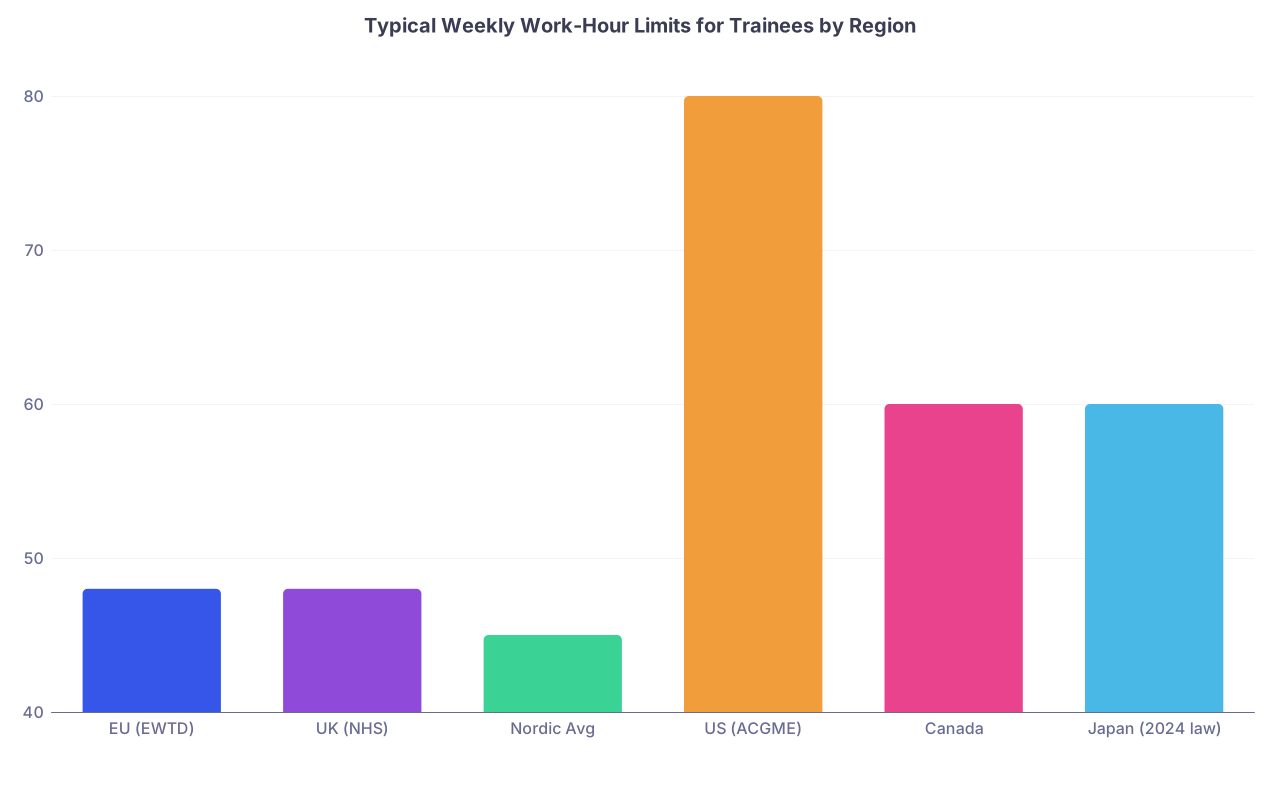
2. Hard Caps: Weekly Hour Limits Across Major Systems
Most governments that regulate physician work hours key off a weekly limit. The “anchor” standard globally is the European Working Time Directive (EWTD): 48 hours per week averaged over a reference period.
Compare that to what you see in places like the United States or Japan, and the differences are not subtle.
| Category | Value |
|---|---|
| EU (EWTD) | 48 |
| UK (NHS) | 48 |
| Nordic Avg | 45 |
| US (ACGME) | 80 |
| Canada | 60 |
| Japan (2024 law) | 60 |
This chart shows policy or common upper limits for residents/trainees, which is where most of the abuse historically happens.
Quick breakdown:
European Union (EWTD):
48 hours/week max, averaged over 4 months; at least 11 hours rest in 24; 24 hours uninterrupted rest per 7 days.United Kingdom (NHS):
Implements EWTD: 48 hours/week average; junior doctor contracts often target 40–48 hours actual. Local rota gaps can push it higher, but the legal framework is clear.Nordic countries (Norway, Sweden, Denmark, Finland, Iceland):
Often 38–40 hours contracted; typical practical weekly load including some on-call lands around 42–48 hours, with relatively strict labor protections. Residents are employees under powerful unions.United States (ACGME):
80-hour limit averaged over 4 weeks. Up to 24 hours continuous clinical work, plus 4 hours for handover. Many programs “live at the ceiling.”Canada:
No single national cap like ACGME; provincial rules and collective agreements typically aim for ~60 hours max and limit in-house call frequency (e.g., 1 in 4). Real-world averages hover ~55–65 for many residents.Japan (2024 reform):
Previously essentially unregulated for doctors. From April 2024, most physicians are limited to 960 hours overtime per year (~60 hours/week total), but “highly skilled” categories can legally hit 1,860 hours overtime/year—a staggering potential 100+ hour work weeks for some.
If you are looking strictly at what is written in law, the Nordic bloc and EWTD countries clearly win. But on paper is not enough.
3. Shift Lengths, Rest Periods, and Safety Nets
Weekly hours are only half the story. A 48-hour week made of 4 × 12-hour shifts is very different from a 48-hour week with one 24-hour in-house call.
Here is how several systems structure maximum continuous duty:
| Region / System | Max Continuous Duty | Mandated Rest Period |
|---|---|---|
| EU (EWTD) | ~24 hours (including call) | 11 hours per 24, 24 hours per 7 days |
| UK (NHS Junior Docs) | 13-hour normal shift; long calls ≤24h | 11 hours between shifts |
| Nordics | Often 8–10-hour shifts; some 24h call still exists | Strong daily/weekly rest requirements |
| US (ACGME) | 24 hours + 4 hours handover (PGY-2+) | “Reasonable” rest; no absolute daily rest like EWTD |
| Canada | Varies; many still use 24–26h call | Post-call day off often guaranteed |
| Japan (post-2024) | No tight universal cap on shift length | Rest rules weaker; focus is annual overtime hours |
The systems that actually protect physicians on the floor share three traits:
- Relatively short routine shifts (8–12 hours).
- Strict post-call rest—no working a full clinic after being up all night.
- Mechanisms to backfill service when someone is off (locums, float pools, mandatory staffing levels).
Nordic countries tend to do this best. Not perfectly, but better than almost anyone else.
4. Where Practice Looks Actually Sustainable: The Real “Best Places”
If you filtered countries by (1) strict hours law, (2) real enforcement, (3) physician-reported burnout, the shortlist looks like this:
- Norway
- Sweden
- Denmark
- Finland
- Netherlands
- Switzerland (good hours, though driven hard in some hospitals)
- To a lesser extent: Germany, France, and some other EU states that genuinely apply EWTD
Let me quantify some of it.
Nordic Numbers
Surveys and time-use studies consistently show:
- Contracted hours: 37–40 per week for specialists, ~40–45 for residents.
- Actual worked hours: commonly 40–46 per week, including some on-call.
- On-call: often paid at a high rate; frequency controlled by union agreements (e.g., not more than 1 in 4 or 1 in 5 weekends in many contracts).
- Burnout prevalence among physicians: varies by study, but typically lower than in the US and Southern/Eastern Europe.
Doctors in Norway and Sweden will tell you their workweeks look similar to other white-collar professionals. Busy. But not annihilating.
Continental Western Europe
Netherlands, Germany, France, Belgium, Austria, etc., are EWTD-signatories, but actual compliance is variable.
Rough pattern:
- Official cap: 48 hours/week averaged.
- Real resident hours:
- Netherlands: often close to 48 actual.
- Germany: many residents report 55–60+ on busy services.
- France: persistent reports of 55–70 in some specialties despite EWTD.
But the presence of EWTD still matters. When hospitals are caught systematically violating it, there are legal and financial consequences. That deterrent alone improves conditions compared with systems that have no such framework.
5. The Problem Children: High-Hour Systems with Weak Protection
On the other side of the distribution, you have countries where the data say: be cautious if you value your own sleep.
The top three usual suspects:
- United States
- Japan
- South Korea
United States: 80 Is a Ceiling That Programs Treat as a Target
ACGME duty-hour reform in 2003 and 2011 looked big on paper. The cap dropped to 80 hours/week averaged over 4 weeks, and 24+4 continuous duty for most residents.
In reality:
- Many surgical and ICU rotations still aim for 75–80 hours as normal.
- Self-reporting systems and cultural pressure lead to under-reporting of violations.
- Attendings and independent physicians (once out of training) have no formal cap. Surveys routinely show 50–60 hours/week for full-time attendings, and significantly higher in some subspecialties and private practice setups.
Tie that to burnout data:
- US physician burnout has hovered around 40–60% depending on specialty and survey year.
- Long work hours, lack of control over scheduling, and administrative burden (EHR, billing) cluster as top predictors.
The US does not protect physicians well on hours compared with the best systems. It just runs them closer to their physiological limits and hopes resilience fills the gap.
Japan: Legal Reform Catching Up to a Brutal Tradition
For decades, Japanese physicians—especially hospital-based—worked some of the longest hours in the OECD. Stories of 100+ hour weeks were not rare.
The 2024 reform, which caps overtime at:
- 960 hours/year for most physicians (~60 hour weeks)
- Up to 1,860 hours/year overtime for “special” categories (~100+ hour weeks total)
is progress. But it still puts the legal ceiling at levels that EU systems would consider unsafe.
Add a strong cultural expectation of loyalty and presenteeism, and you see why Japanese physician burnout and mental health concerns have become more visible.
South Korea: Intense Workload and Weak Hour Caps
South Korea has high healthcare utilization rates and relatively low numbers of doctors per 1,000 population. The math is predictable: the doctors work a lot.
Common resident reports:
- 80–100 hours/week in busy university hospitals.
- Sparse enforcement of any real limits.
- Night float systems often just stack on top of already long days.
No surprise that surveys show high levels of stress and burnout among Korean doctors.
6. Burnout, Satisfaction, and Hours: What the Data Correlate
Let me connect hours to outcomes instead of just listing numbers.
You can broadly say:
- Below ~50 hours/week average with predictable schedules → burnout risk lower, job satisfaction higher.
- Above ~60 hours/week sustained, especially with overnight call → burnout risk climbs fast.
Several international studies show:
- Physicians working >60 hours/week are 1.5–2 times more likely to report high burnout than those at 40–50 hours.
- Irregular, unpredictable hours (frequent unplanned overtime, short-notice rota changes) are worse for mental health than simply “long but stable” hours.
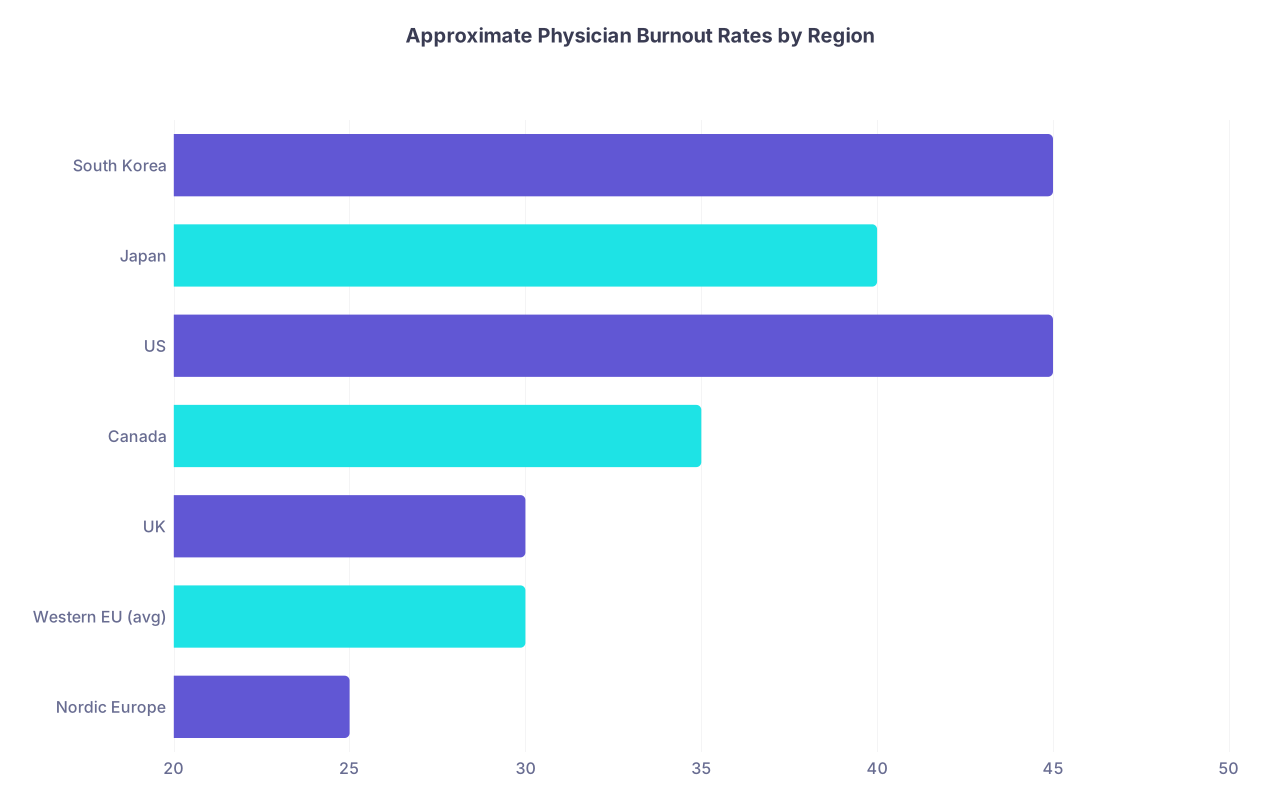
Now look at physician burnout prevalence estimates by region:
| Category | Value |
|---|---|
| Nordic Europe | 25 |
| Western EU (avg) | 30 |
| UK | 30 |
| Canada | 35 |
| US | 45 |
| Japan | 40 |
| South Korea | 45 |
These are approximate ranges from multiple studies; exact numbers vary by source and year. The pattern is consistent:
- Regions with tighter hours and stronger labor traditions (Nordics, some Western EU) cluster at the lower end.
- High-hour, high-intensity systems (US, East Asia) cluster at the high end.
Correlation is not causation, but in this case, it is extremely plausible there is a causal link. Humans are not designed to work 70–90 hours indefinitely, making life-or-death decisions at 3 a.m.
7. Enforcement and Culture: Why “Paper Protection” is Not Enough
Here is where a lot of naive comparisons go wrong. They say, “Country X has a 48-hour law, so it must be safe.” That is how you get fooled.
There are three layers:
- Law / regulation (what is written).
- Enforcement (inspections, fines, legal risks).
- Culture (doctors actually leave at the end of shift, or do they stay until work is ‘done’).
The countries that truly protect physicians score high on all three.
Strong-Protection Archetype: Nordic Model
Concrete features I have seen in contracts and discussions with Nordic physicians:
- Unionized doctors with collective bargaining power.
- Clear overtime premiums; hospitals pay real money if they ask you to stay late.
- Taking all your vacation is normal, not a sign of weakness.
- Staff councils and labor inspectors take violations seriously.
You can technically stay late. But it costs the hospital financially and reputationally. That keeps abuse in check.
Paper-Protection Archetype: Some EWTD Countries
In parts of Southern and Eastern Europe:
- EWTD is law, but hospitals are chronically understaffed.
- Residents sign waivers or “opt-outs” under social pressure.
- Time sheets do not match reality.
On paper: 48 hours.
In reality: 60–70 in some departments.
Better than no law. But not enough to call those systems truly protective.
No-Protection Archetype: Historically the US and East Asia
In the US, until ACGME duty hours, residents could—and did—work 100+ hour weeks as a norm. Even now, enforcement is largely:
- Self-report surveys.
- Occasional ACGME site visits.
Residents know programs can retaliate subtly if they make trouble, and many under-report violations. Cultural norms in surgery and some specialties still glorify extreme hours.
In Japan and South Korea, the employer-employee power imbalance and cultural respect for hierarchy make it difficult for young doctors to refuse dangerous schedules, even with new legal frameworks.
8. Concrete Ranking: Who Protects Physicians the Most?
Based on the combination of:
- Legal weekly hour limits
- Shift and rest rules
- Enforcement track record
- Reported actual hours
- Burnout and satisfaction patterns
Here is a simplified ranking of work-hour protection quality:
| Tier | Countries / Regions | Characteristics |
|---|---|---|
| Tier 1 – Strong Protection | Norway, Sweden, Denmark, Finland, Iceland, Netherlands | 37–48 hour norms, strong unions, real enforcement |
| Tier 2 – Moderate-Strong | Switzerland, Germany, France, Belgium, Austria, UK, Canada | EWTD or similar; actual 45–60 hours, enforcement mixed but present |
| Tier 3 – Moderate-Weak | Southern/Eastern EU, Australia, New Zealand | Laws exist but under-resourcing leads to 55–70 hours in some areas |
| Tier 4 – Weak Protection | United States, Japan (post-2024), South Korea | High formal caps or weak enforcement; 60–80+ common in training |
If your primary goal is lifestyle and protection from chronic overwork, the data are blunt:
- Best bets: Nordic countries, Netherlands, and a subset of Western European systems with real EWTD compliance.
- Reasonable compromises: UK, Canada, Switzerland, selected EU states with decent enforcement.
- High-risk for long hours: United States, Japan, South Korea, and any system where legal overtime ceilings are 60+ hours or under-enforced.
9. Future Trends: Are Things Getting Better or Worse?
Here is where the picture is mixed.
- Pressure for reform is growing almost everywhere. Burnout statistics are impossible to ignore now, and patient-safety data show clear harm from overworked doctors.
- Automation and AI may eventually reduce some cognitive load (documentation, basic triage), but in the short term they often add complexity instead of subtracting it.
- Demographic trends almost guarantee physician shortages in many high-income countries as populations age and older doctors retire. Shortages typically push work hours up, not down, unless staffing is aggressively managed.
The regions most likely to maintain or improve protection:
- Nordic countries and Western Europe with strong unions and social-democratic labor norms. Their default response to staffing shortages leans toward hiring more staff or reducing services, not silently increasing each physician’s hours to unsustainable levels.
Regions at risk of deterioration:
- Systems that rely on moral obligation and “calling” rhetoric to keep physicians working—common in the US and parts of East Asia. When demand rises, they lean on guilt and professionalism rather than enforceable limits.
10. How to Use This Data for Your Own Career Decisions
If you are choosing where to build a medical career, look at work hours with the same seriousness you look at salary.
A simple heuristic:
- Target systems where a full-time doctor averages 40–50 hours/week, not 60–80.
- Confirm there are legal caps plus strong collective bargaining (professional associations or unions) to enforce them.
- Check physician burnout and satisfaction surveys by country, not just salary rankings.
- Talk to multiple physicians currently working there and ask one very specific question:
“When you are post-call, do you actually go home, or do you stay and finish jobs?”
If the honest answer looks like “I stay and finish jobs more often than not,” that country or institution is not truly protecting you—no matter what the regulations say.


