

The biggest mistake IMGs make is chasing “visa-friendly countries” too late in the game. By the time you are googling “which country is easiest for doctors,” the best doors are already closing.
You need a visa strategy timeline just as much as you need a study plan for exams.
Below is a structured, time-based guide: what to do year by year, then month by month, to position yourself for visa-friendly first jobs in the US, UK, Canada, Australia, and a couple of high-yield EU options.
1. Years Before Graduation: Set the Direction (–3 to –1 Years)
At this point you should pick 1–2 primary destination countries, not five. Spraying applications across the planet is how people end up with half-finished exams and no credible path anywhere.
2–3 Years Before Graduation (Early Clinical Years)
Your goal in this phase: decide your primary target and align your CV.
At this point you should:
Roughly choose your top country bucket
Not the specific city. The system.
Typical paths:
- US-focused: USMLE + electives; aim for J‑1 or H‑1B later
- UK-focused: PLAB or UKMLA (future) + NHS foundation/SHO jobs; Tier 2/Skilled Worker visa
- Australia-focused: AMC pathway; employer-sponsored temporary skill shortage visa
- Canada-focused: MCC exams; but treat Canada as “long-shot unless you are already there or have PR”
- EU (e.g. Germany, Ireland) focused: language + licensing route
Pick one primary and optionally one backup. If you say “US + UK + Canada + Australia,” that is not a plan. That is denial.
Benchmark where your profile actually fits
Be honest:
- Multiple attempts on key exams?
- Long gaps after graduation?
- Limited research?
Then:
- US academic programs may be unrealistic; you may need community hospitals, less competitive specialties, or UK/Australia/NHS routes first.
- Canada may be essentially closed unless you secure immigration status by other means.
Align early activities toward visa-friendly systems
For example:
Interested in the US?
- Prioritize research with US-linked groups, online collaborations, poster submissions to US conferences.
- Start saving money early for USMLE, travel, and observerships.
Interested in the UK?
- Follow NHS jobs and GMC guidelines. Get used to UK-style documentation, audit, QI projects, guidelines (NICE, SIGN).
Interested in Germany?
- Start language learning now. B2 or C1 does not happen in 6 months while you are also preparing exams.
Understand which systems are actually visa-friendly for first jobs
Quick snapshot:
| Country | Visa-Friendly for First Job? | Main Route |
|---|---|---|
| UK | High | Skilled Worker sponsored |
| Australia | High (certain areas) | Employer-sponsored TSS |
| USA | Moderate | J-1 for residency, H-1B |
| Canada | Low | Very limited IMG spots |
| Germany | Moderate-High | Work visa + Approbation |
Your “wishlist” country is irrelevant if the visa and training pipeline do not match your profile and timeline.
2. Final Year of Medical School: Lock In Exams and Exposure (–12 to 0 Months)
At this point you should convert intention into exam dates and concrete experiences. Not vague dreams.
–12 to –9 Months Before Graduation
Your focus now: secured exam dates and documented clinical exposure in (or aligned with) your target system.
For US-bound IMGs:
- Book USMLE Step 1 and Step 2 CK windows if possible.
- Start aggressively planning at least one US clinical elective (if you are still a student and your school allows it).
- At this point you should also:
- Build a list of US-affiliated faculty who could later write letters.
- Understand J‑1 vs H‑1B basics. If your Step scores are marginal, H‑1B will be much harder.
For UK-bound IMGs:
- Schedule PLAB 1 for late final year or within 6 months post‑graduation.
- Study UK guidelines, prescribing practices, and NHS structure.
- Join UK-focused groups, webinars, GMC guidance pages.
For Australia-bound IMGs:
- Learn the difference between standard pathway (via AMC exams) and competent authority pathway (e.g., if you already have UK/US/Canadian training later).
- Map out AMC Part 1 date options and approximate preparation length.
For EU routes (e.g., Germany):
- Get a real language plan:
- If you are at A2 now, target B2 in 12–18 months, C1 within 24 months.
- Start collecting documentation needed for Approbation (diploma equivalence, transcripts, detailed curriculum).
–9 to –6 Months Before Graduation
At this point you should lock your primary exam attempt.
- Do not push it indefinitely. Visa and job timelines are built around exam results dates.
- If your exam will be delayed by 6–12 months, you must adjust your entire visa/job timeline accordingly.
You should also:
- Begin drafting a one-page career plan:
“Graduate → 6–12 months of exam taking → apply for X jobs in Y country under Z visa type.” - Start networking deliberately:
- Email departments where you did electives.
- Connect with alumni from your school who matched or are working abroad.
- Ask pointed questions: “How early did your hospital start visa paperwork for you?”
–6 to 0 Months (Final Semester)
At this point you should:
Finish core exams or at least have “first attempt scheduled”
- US: Step 1 finished or close to; Step 2 CK scheduled.
- UK: PLAB 1 booked; start looking at PLAB 2 wait times.
- Australia: AMC part 1 booking done.
Acquire at least one letter of recommendation aligned with your target system
Local professor letters that say you are “hardworking” carry limited weight. Try to get:
- US: Letters from US physicians or those familiar with ACGME and US expectations.
- UK: Consultants who understand NHS-style practice or at least UK curricula.
- Germany: Supervisors who can comment on your clinical skills and professionalism in a way that can be translated and notarized.
Prepare your documentation trail
These countries are bureaucratic. If you wait until after graduation to start, you will hate your life.
Prepare:
- Transcripts
- Graduation certificates
- Internship/house job descriptions
- Logbooks
- Criminal record / police clearance
- Vaccination records
3. First Postgraduate Year (PGY‑0/Intern Year): Build Eligibility While Watching Visa Windows (0 to +12 Months)
This is usually where people lose 1–3 years just drifting. Do not.
Months 0–3 After Graduation
At this point you should:
- Start full-time clinical work locally (internship/house job) if your system requires it for full registration or for foreign recognition.
- Keep detailed proof:
- Rotations, dates, supervisor names, weekly hours.
For every month you work, think: “How does this help my case for a visa-sponsored job in my target country?”
For example:
- UK: Internship recognized as equivalent to UK Foundation Year 1 (FY1) or at least helps for full GMC registration after PLAB.
- Australia: Internship/house job often used to demonstrate comparable experience.
- Germany: Clinical years help, but language fluency is the real gate.
Months 3–6 After Graduation
Now you start to line up your first serious application cycle.
At this point you should:
US-bound:
- Sit for Step 2 CK if not already done.
- Begin prepping for ERAS application season if aiming for residency start in ~18–24 months.
- Decide if you will accept J‑1 (easier to get) or are insisting on H‑1B (harder, needs Step 3 and a sponsoring program).
UK-bound:
- Have PLAB 1 result or be close.
- Book PLAB 2 as early as slots allow (remember, PLAB 2 wait lists can be 3–9 months).
- Start reading about Skilled Worker visa and which NHS trusts regularly sponsor.
Australia-bound:
- Sit or prepare for AMC Part 1.
- Identify whether you will target regional/rural posts, which are much more visa-friendly.
- Note that Australian hospitals often want candidates who can start around their February intake.
Germany-bound:
- Push language to B2/C1 and book exams (Telc, Goethe, etc.).
- Start early discussions with authorities about partial recognition and job search.
Months 6–12 After Graduation
This is your first real decision point: double down on your primary country or pivot.
At this point you should:
Have at least one key exam passed
- US: At minimum Step 1 + Step 2 CK passed, or 1 passed and the second scheduled.
- UK: PLAB 1 passed, PLAB 2 booked or completed.
- Australia: AMC Part 1 passed or very close.
- Germany: Language B2 achieved, documentation submission underway.
Start aligning with recruitment seasons
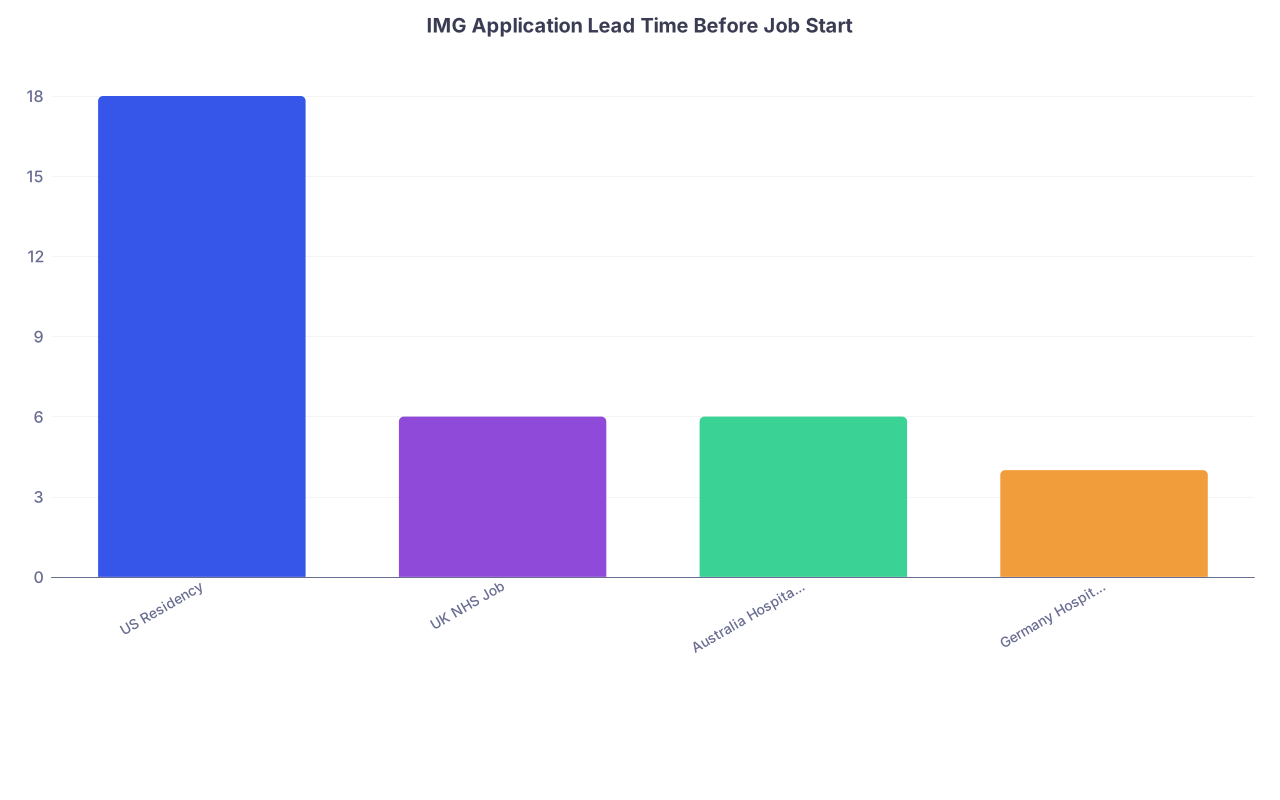
Timing matters more than people think. Here is a simplified view:
| Category | Value |
|---|---|
| US Residency | 18 |
| UK NHS Job | 6 |
| Australia Hospital Job | 6 |
| Germany Hospital Job | 4 |
Roughly:
- US residency: You must be ready to submit ERAS about 12–15 months before your start date. Visa work begins after the Match but relies on that long lead time.
- UK NHS non-training jobs: Applications 3–6 months before start; visa processed within weeks to a few months.
- Australia: Similar 4–8 month lead time, longer for more desirable metro areas.
- Germany: Lead time shorter on paper, but the documentation and language process can blow this up.
- Decide whether to apply this cycle or the next
If your exams, scores, and CV are weak, it might be better to spend 6–12 more months strengthening your profile instead of filing hundreds of doomed applications.
Here is where people ruin their trajectory: applying half-prepared, getting no offers, burning money and morale.
4. Main Application Year: Month-by-Month Targeting of Visa-Friendly Jobs (+12 to +24 Months)
Assume you have your key exams done (or nearly done) and at least 1 year of postgrad clinical experience.
This is when visa-friendly strategy actually kicks in.
For US-Bound IMGs (Residency Route)
Your job is residency. Your visa is secondary but crucial.
–15 to –12 Months Before Desired July Start (e.g., June–September before ERAS)
At this point you should:
- Finalize:
- Step 1 and Step 2 CK scores
- Letters of recommendation
- Personal statement and CV
- Start building your program list with visa filters:
- Check which programs sponsor J‑1 (most university and larger community programs).
- Check which sponsor H‑1B (fewer, more selective, often require Step 3 passed).
You target:
- Visa-friendly specialties: Internal medicine, family medicine, psychiatry, pediatrics.
- Community and mid-tier academic programs outside the hyper-competitive cities.
–12 to –9 Months Before Start (ERAS Submission → Interview Season)
At this point you should:
- Submit ERAS as early as it opens.
- Aggressively track:
- Which programs:
- Explicitly say “no visa sponsorship” → drop.
- “Sponsorship considered for strong candidates” → keep if your scores are strong.
- “Sponsor J‑1 only” → fine for first job if you accept future return-home constraints.
- Which programs:
This is not the time to be sentimental about cities or “dream hospitals.” The bottleneck is visa willingness.
–9 to –3 Months (Interviews, Rank List, Match)
During interviews:
- Ask specifically:
- “Do you routinely sponsor J‑1?”
- “What proportion of your residents are on visas?”
- “Do you support H‑1B transitions after J‑1 or for fellowship?”
By ~3 months before start, programs begin sending documents for ECFMG/DS‑2019 if you are J‑1, or initiate H‑1B paperwork.
If you missed this cycle or did not match, do not immediately jump to another country. First re-evaluate your profile, then decide if an extra year of research or non-training clinical work (US or home country) makes you competitive enough for another US attempt.
For UK-Bound IMGs (NHS Jobs)
The UK is one of the most straightforward visa-friendly markets for first jobs, assuming you move when PLAB is done and GMC registration is ready.
6–9 Months Before Planned Relocation
At this point you should:
- Have PLAB 2 passed (or date imminent).
- Work on GMC registration paperwork.
- Start monitoring NHS Jobs and TRAC for:
- “Trust grade junior doctor”
- “Clinical fellow”
- “SHO level” jobs that explicitly mention visa sponsorship.
You are not aiming at run-through training immediately. Your first job is often a non-training post under a Skilled Worker visa.
3–6 Months Before Move
At this point you should:
- Apply widely to:
- Smaller hospitals.
- Less glamorous locations (Midlands, North, coastal towns).
- Tailor your CV to look like:
- You can slot into a rota immediately.
- You understand UK practice (mention audits, guidelines, SBAR handover, etc.).
Once you get an offer:
- The hospital issues a Certificate of Sponsorship (CoS).
- You apply for the Skilled Worker visa, usually processed in weeks if your documents are clean.
Your “visa-friendly” target here is not a specific hospital. It is any trust that regularly hires IMGs and has existing sponsorship infrastructure.
For Australia-Bound IMGs
Australia is more welcoming if you are flexible on geography.
9–12 Months Before Intended Start
At this point you should:
- Have AMC Part 1 done or almost done.
- Research state-based pathways (NSW, Queensland, Victoria, etc.).
- Accept that:
- Metro areas are competitive.
- Rural/regional posts are where the visa doors are wide open.
6–9 Months Before Start
At this point you should:
- Apply for:
- “Resident Medical Officer” (RMO) roles.
- “Junior Medical Officer” (JMO) roles.
- Make it explicit in your cover letters that:
- You are open to regional/rural rotations.
- You are prepared to commit for more than just 1 year (many hospitals prefer continuity).
Hospitals will typically sponsor a Temporary Skill Shortage (TSS) visa if they want you. Visa timelines are fairly predictable once an offer is in hand.
For Germany-Bound IMGs
Germany is underrated for IMGs if you can commit to the language.
12–18 Months Before Job Start
At this point you should:
- Target B2–C1 language certification dates.
- Prepare detailed documentation for Approbation.
Visa-friendliness here is less about quotas and more about language + bureaucracy. Once you have Approbation, hospitals in smaller cities are usually ready to sponsor.
5. When to Pivot: Recognizing Dead Ends vs Delayed Paths
At some point you must decide whether to persist in a country or shift your primary target.
Clear Signals You Should Pivot
- You have:
- 2–3 failed US match cycles with no interviews or only token ones.
- Weak scores that will not be fixed with time.
- No realistic path to H‑1B and you are unwilling to return home after J‑1.
Then at this point you should consider:
- Moving your primary target to:
- UK NHS jobs.
- Australian regional jobs.
- Germany/other EU systems if language is feasible.
Similarly:
- If you are in the UK with repeated rejections from training posts, you might:
- Use UK experience + exams to later apply to Australia via a more favorable route.
- Or pivot to another UK region or specialty that is less crowded.
Do Not Pivot Just Because of One Bad Cycle
One failed ERAS cycle with low US research or late applications does not mean “the US is impossible.” It might mean your timeline was off.
Before you abandon a path, ask:
- Did I apply early enough?
- Did I target programs that actually sponsor visas?
- Were my exam attempts and scores within realistic ranges for my chosen specialty?
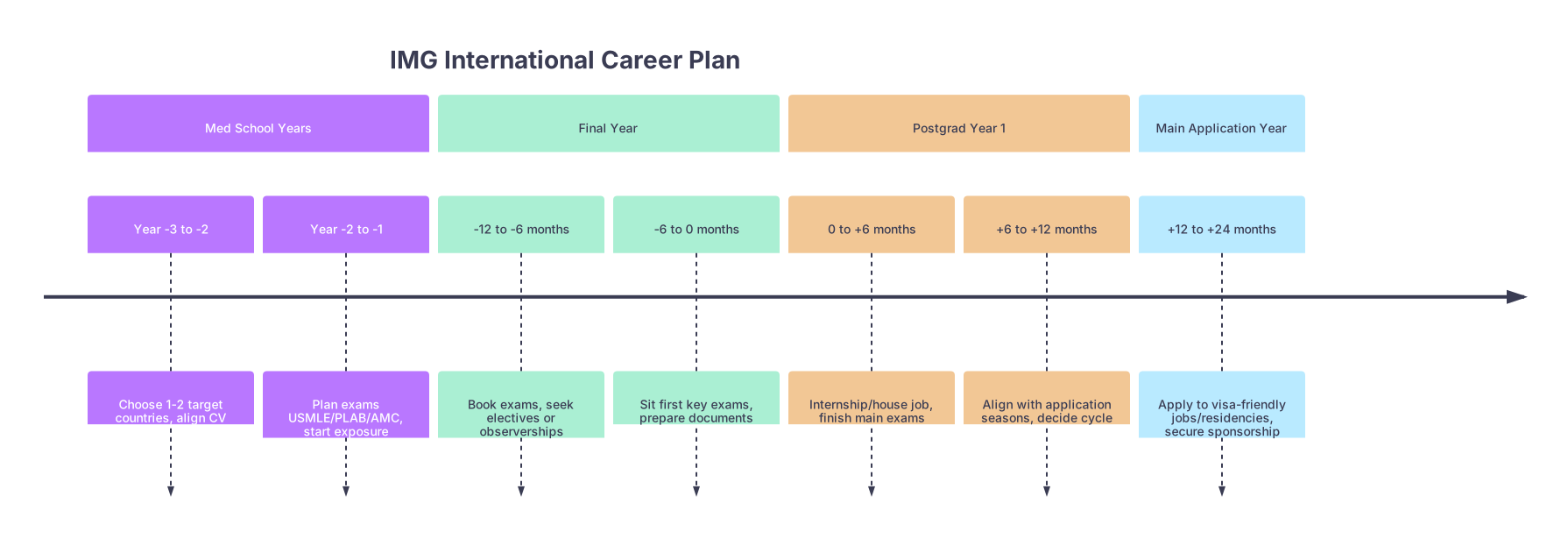
6. Practical Year-by-Year Roadmap (Condensed)
Use this as a sanity check to see if you are early, on time, or late.
| Period | Event |
|---|---|
| Med School Years - Year -3 to -2 | Choose 1-2 target countries, align CV |
| Med School Years - Year -2 to -1 | Plan exams USMLE/PLAB/AMC, start exposure |
| Final Year - -12 to -6 months | Book exams, seek electives or observerships |
| Final Year - -6 to 0 months | Sit first key exams, prepare documents |
| Postgrad Year 1 - 0 to +6 months | Internship/house job, finish main exams |
| Postgrad Year 1 - +6 to +12 months | Align with application seasons, decide cycle |
| Main Application Year - +12 to +24 months | Apply to visa-friendly jobs/residencies, secure sponsorship |
7. Two Things You Must Track Constantly
Visa strategy is not “set and forget.” At every stage you should track:
Policy shifts
Immigration rules change. Example patterns I have seen:
- Countries tightening postgraduate training slots but expanding non-training service posts.
- Shifts in which specialties get shortage lists (family medicine, psychiatry, rural generalist roles often favored).
Your own expiry dates
- Exam score validity (USMLE Step scores usually valid indefinitely for ECFMG but some programs prefer recent completion).
- PLAB and GMC registration timelines.
- How long you can afford to stay in “pre-job” limbo financially and emotionally.
Key Takeaways
- You should decide your primary visa-friendly country 2–3 years before graduation and build your exams, experiences, and documents around it. Not after.
- The critical window to aggressively target visa-sponsoring first jobs is roughly 6–18 months before your desired start date, aligned with each country’s recruitment cycle.
- Do not pivot countries impulsively; pivot only when repeated, well-timed, well-prepared attempts fail and your profile clearly aligns better with another system’s visa and training structure.


