

It’s July 1st of your PGY‑2 year. You just survived intern year. You know how to admit, you know where the crash cart is, and you finally sleep without waking up in a cold sweat about potassium orders.
And in the back of your mind: “I cannot do this forever here. I want out. Maybe UK? Maybe Australia? Maybe the Gulf? I don’t even know where to start.”
This is the moment. A full year before your serious job hunt begins is exactly when you should start researching which country might actually make sense for you as a doctor.
Here’s your roadmap, in time order.
Month 0–1 of PGY‑2: Get Your Baseline and Shortlist Countries
At this point you should stop doomscrolling Reddit threads about “doctors leaving the US/UK” and do something structured.
Week 1: Define your non‑negotiables
Before you chase someone else’s dream, nail down your own.
Sit down one evening and write out:
Clinical priorities
- Specialty (or likely specialty if you haven’t matched yet)
- Do you want heavy acute care, or more outpatient / lifestyle?
- How much trauma/emergency are you willing to tolerate?
Life priorities
- Partners / kids / schooling needs
- Proximity to family (same continent vs same time zone vs “don’t care”)
- Language: are you realistically willing to work in non‑English?
Financial floor
- Absolute minimum post‑tax income you’d accept
- Debt obligations: US med school loans vs none, etc.
Turn that into a one‑page “career spec.” If a country fails 2–3 of these, kill it early.
Week 2: Rough shortlist of 3–5 countries
You do not need to know exact visa categories yet. At this point you should just pick 3–5 countries that look plausible for your specialty and language.
Typical sets I see:
- For US/Canadian grads:
- UK, Ireland, Australia, New Zealand, UAE/Qatar, maybe Singapore
- For EU grads:
- Nordics (Sweden/Norway/Denmark), Germany, UK, Switzerland
- For others:
- Where your degree is recognized or has clear conversion exams
Do a 2‑hour deep dive per country:
- Government or medical council site (not blogs) for:
- Recognition of your degree
- Licensing path for foreign doctors
- Language requirements (not just “English widely spoken”)
Create a simple comparison:
| Country | Language Needed | License Path Complexity | Typical Salary (Relative) |
|---|---|---|---|
| UK | English | Medium | Medium |
| Australia | English | Medium-High | High |
| UAE | English/Arabic | Medium | High |
| Germany | German | High | Medium |
| NZ | English | Medium | Medium-High |
You’re not choosing yet. You’re just deciding what’s worth deeper research.
Months 2–3: Understand Licensing and Training Fit
By now you should have a shortlist of 3–5 countries. This is where people usually get lazy and just listen to anecdotes. Don’t. You need primary sources.
Step 1 (Weeks 5–6): Map the licensing pathway for each country
For each shortlisted country, make a one‑page “licensing brief”:
- Name of medical council
- Steps from “foreign trained” to “fully licensed”
- Exams required (PLAB, AMC, DHA/HAAD, etc.)
- Time from application to being able to work clinically
- Whether PGY‑2 counts as “experience” or not in that system
Example (Australia, US‑trained IM resident):
- Medical Board of Australia → AHPRA registration
- Pathway: Competent Authority or Specialist Pathway (depends where you trained)
- Exams: AMC exams or potentially bypass via recognized training
- Assessment by the relevant College (e.g., RACP, RACS, RACGP)
- Timeframe: 6–12 months realistically, more if documents delayed
You want this level of specificity, not “I heard it’s easier now.”
Step 2 (Weeks 7–8): Check training equivalence and career ceiling
At this point you should ask: “If I move after residency/fellowship, what do I become there?”
Two critical questions per country:
- Will your residency be recognized as specialist training, or will you be treated as a junior again?
- Is there a clear pathway to full specialist recognition, or do you get stuck as a permanent “middle grade” doctor?
Examples I’ve seen:
- US internal medicine attending moving to the UK:
- Often starts as an “ST3/4 equivalent” or “Specialty Doctor”
- May or may not get on the consultant register easily
- EU surgeon moving to Gulf states:
- Gets consultant title quickly, but often tied to a single employer
- Pay is excellent, but long‑term security can be weak
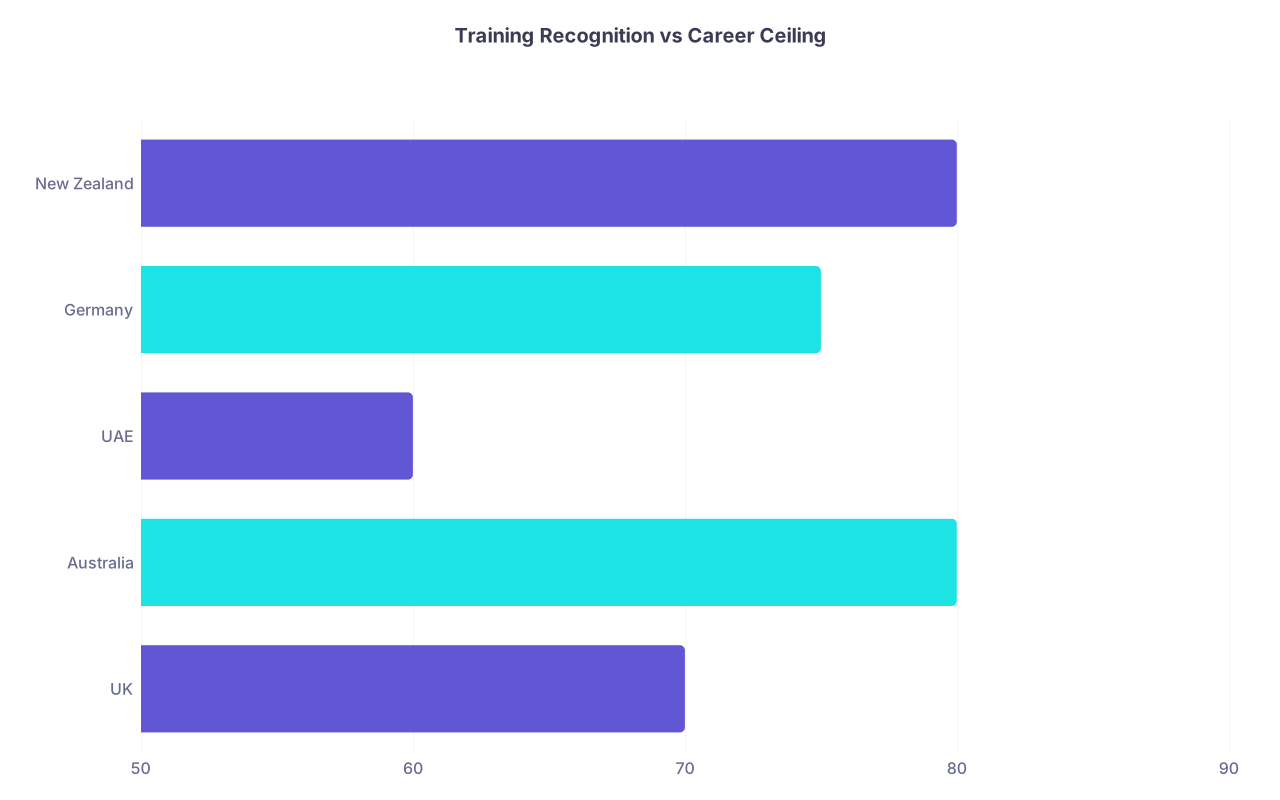
Make a simple ceiling map:
| Category | Value |
|---|---|
| UK | 70 |
| Australia | 80 |
| UAE | 60 |
| Germany | 75 |
| New Zealand | 80 |
(Think of the “value” as your subjective % of how close you can get to full specialist status within 5–7 years.)
If a country looks like it will permanently cap you below your current/expected training level, think hard.
Months 3–4: Cost of Living, Salary, and Lifestyle Reality Check
At this point you should stop romanticizing “moving to Europe” or “working in Dubai” and do the math.
Week 10: Rough financial modeling
You do not need perfect numbers; you need ballparks.
For each country, estimate:
- Gross annual salary for:
- Senior resident / registrar level
- Specialist/consultant level (if possible down the line)
- Effective tax rate
- Cost of:
- 1‑bedroom apartment in a major city vs smaller city
- Childcare (if relevant)
- Typical monthly expenses (food, transport, insurance)
Use local job sites + expat forums + government data, not just hearsay.
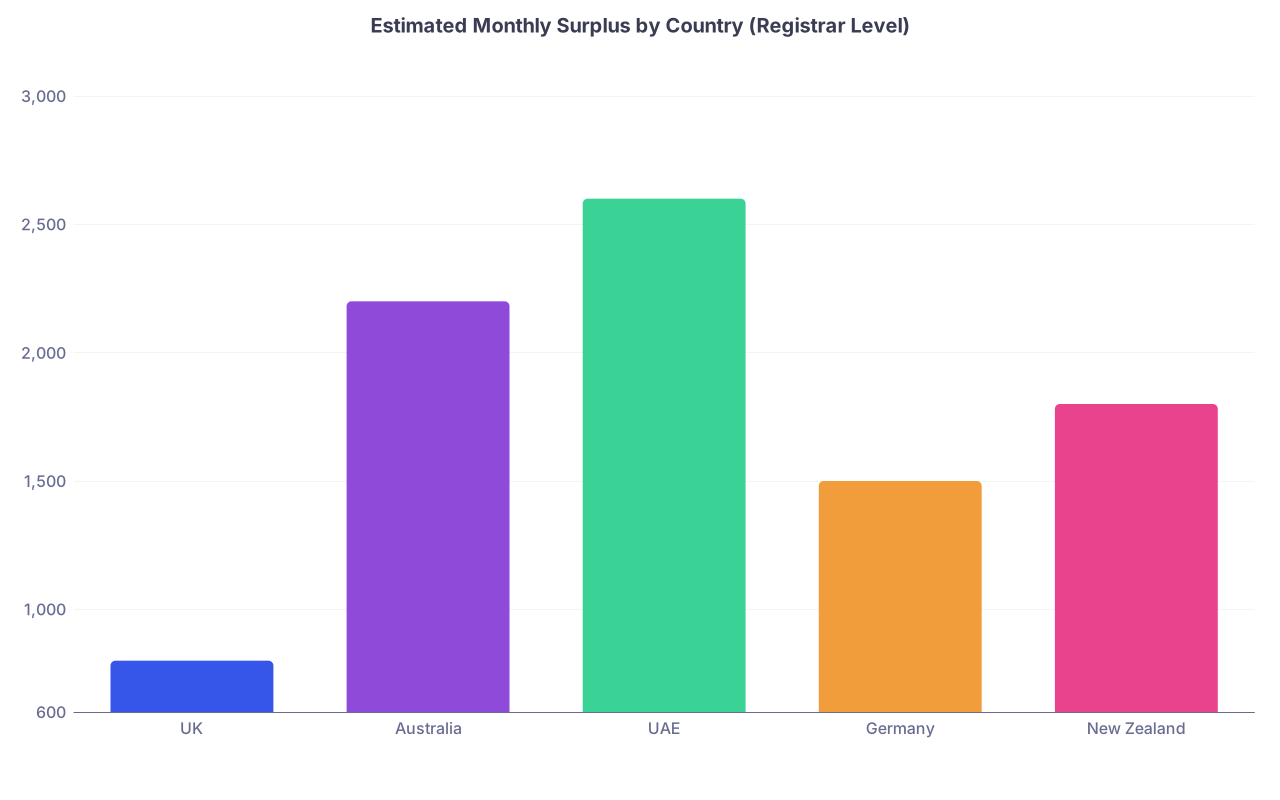
Then build a quick surplus comparison (what’s left after basic costs):
| Category | Value |
|---|---|
| UK | 800 |
| Australia | 2200 |
| UAE | 2600 |
| Germany | 1500 |
| New Zealand | 1800 |
Numbers here are illustrative, but the idea is clear: some “high salary” places evaporate once you factor housing and taxes; others still leave you very comfortable.
Week 11–12: Lifestyle and system culture
Money matters, but so does not hating your work.
Focus research on:
- Average weekly hours and call structure
- Nurse/ancillary staff support levels
- Documentation burden (US‑style? Less? Worse?)
- Litigation climate and malpractice expectations
- Culture around time off and vacation usage
- How foreign doctors are treated in that system
This is where conversation beats Google.
Start collecting data via:
- Alumni from your med school who moved (LinkedIn is your friend)
- Senior residents/fellows who did locums abroad
- Specialty‑specific FB/WhatsApp/Telegram groups (e.g., “UK IMG Anaesthesia,” “US docs in Oz”)
Ask very concrete questions:
- “How many nights per month?”
- “Do you routinely skip breaks?”
- “How many vacation weeks did you actually take last year, not just what’s on contract?”
- “If you had to leave tomorrow, what’s the main reason?”
Save their answers. Patterns appear quickly.
Months 4–6: Deep Dive 1–2 Top Countries and Test the Fit
At this point you should have eliminated at least half your original list. If not, you’re not being honest with yourself.
Pick your top two countries and go deep.
Month 4: Build a “Country Dossier” for Each
One dossier per country, 4–6 pages max. Include:
- Licensing timeline (from your current date)
- Document checklist
- Realistic salary progression 0–5 years after arrival
- Likely first job type and title
- Limits/risks (visa constraints, recognition issues, family issues)
- Best and worst case scenarios
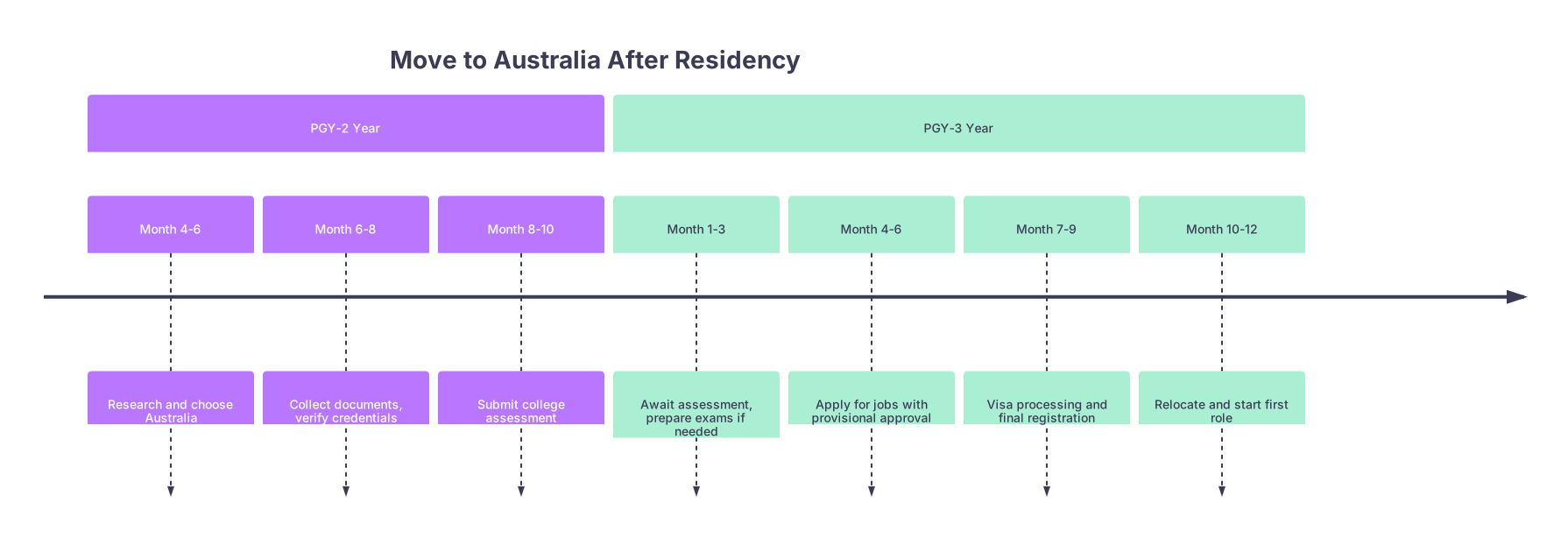
This is where a visual timeline helps.
| Period | Event |
|---|---|
| PGY-2 Year - Month 4-6 | Research and choose Australia |
| PGY-2 Year - Month 6-8 | Collect documents, verify credentials |
| PGY-2 Year - Month 8-10 | Submit college assessment |
| PGY-3 Year - Month 1-3 | Await assessment, prepare exams if needed |
| PGY-3 Year - Month 4-6 | Apply for jobs with provisional approval |
| PGY-3 Year - Month 7-9 | Visa processing and final registration |
| PGY-3 Year - Month 10-12 | Relocate and start first role |
Build something like this for each serious country so you actually see your timeline, not just fantasize.
Month 5: Reality checks via short‑term exposure
You’re still a PGY‑2. You probably cannot vanish abroad for a month. But you can get some exposure.
Options:
- Attend a virtual or in‑person recruitment fair:
- UK NHS recruitment events
- Australian state health job fairs
- Gulf hospital recruitment agencies
- Arrange informational calls with:
- Clinical directors
- Doctors currently in your dream role
- If feasible, a 1‑week observership/visit during vacation:
- Tour hospitals
- Walk neighborhoods
- Watch how teams interact
Goal: turn abstract pros/cons into something your gut can recognize.
Months 6–8: Decide on Primary Target and Map Backwards
At this point you should commit to a “primary target country” and a “backup option.”
Step 1: Choose your primary and backup
Primary = where you will optimize your CV and paperwork.
Backup = realistic alternative if something collapses (visa policy changes, exam failure, family issues).
Be ruthless:
- If language exam is a barrier and you know you won’t study, drop that country.
- If the career ceiling is clearly worse than staying where you are, stop wasting cycles there.
Step 2: Build a backwards timeline from your ideal start date
Pick a realistic “first day in new country” date. Often:
- If you’re PGY‑2 now, and residency ends in 2 years → aim for 3–6 months after graduation.
Then walk backwards:
- Job offer usually needs to be in hand 6–9 months before start.
- Licensing approval may need 3–9 months before job.
- Exam prep may need 6–12 months.
So if you want to start August 2028:
- Job applications: October–December 2027
- License and visa submissions: June–October 2027
- Exam completion: by April 2027
- Serious exam prep: mid‑2026 to early 2027
Put that on a wall calendar. Not as inspiration. As a project plan.
Months 8–10: Align Your Remaining Training and CV
You’ve chosen the country. Now the question is whether your CV looks obvious for that system.
Clinical rotations and skills
At this point you should look at the job ads from your target country and reverse engineer:
- Common buzzwords (e.g., “acute take,” “NHS experience,” “rural/regional practice”)
- Specific procedural skills (e.g., anaesthetics requiring particular competencies)
- Desirable subspecialty clinics or experiences
Then, in your remaining PGY‑2 and early PGY‑3 time:
- Steer electives toward what’s valued there
- Volunteer for roles that match job descriptions (e.g., leading MDT meetings, quality projects)
- Get evaluations or letters from people whose titles will translate well abroad (Program Director, Department Chair, Service Chief)
Research, QI, and teaching
Some systems care less about research, more about service. But all respect proof you can improve systems and teach.
Pick 1–2 projects that you can actually finish before applications:
- QI project: e.g., sepsis bundle compliance, discharge summary quality
- Teaching: design a short teaching series or simulation for juniors
Tie them explicitly to things valued in your target system. For example, the NHS loves QI and guidelines compliance.
Months 10–12: Dry Runs, Language, and Network Consolidation
You’re still a year out from the job hunt. Perfect window for rehearsal.
Mock applications and CVs
At this point you should:
- Draft a CV in the format used in your target country
- UK: NHS‑style CV, with clear training grades and audit/QI sections
- Australia/NZ: detailed clinical experience by hospital and role
- Draft a generic personal statement / supporting info aligned with that system’s values
Get these reviewed by:
- Someone already working there
- Or at least a senior who has recruited for that system
You want feedback like: “You sound very US‑centric; explain your roles in our terms.”
Language and communication
If your target country requires:
- IELTS/OET/German B2/C1/etc → start structured prep now.
- Even if the official language is English, phraseology and expectations differ.
Listen to:
- Local handover styles
- How consultants phrase things to patients
- How clinical documentation looks
It sounds trivial. It’s not. I’ve watched excellent clinicians come across as awkward or blunt simply because they imported US or other local phrasing into a different culture.
Network consolidation
In this phase, your job is to stop being “random foreign applicant” and start being “Oh yeah, I remember them.”
- Keep a simple spreadsheet:
- Name, role, country, institution
- When you last spoke
- Any advice they gave
- Every 3–4 months, send a short update email:
- What you’ve achieved
- How your timeline looks
- One specific question they can answer in 2–3 sentences
You’re not begging for a job. You’re staying on the radar as a serious, organized future colleague.
How This Looks Week‑by‑Week (Condensed View)
To make this more concrete, here’s how a focused year might stack:
| Timeframe | Primary Focus |
|---|---|
| Months 0–1 | Non-negotiables, 3–5 country shortlist |
| Months 2–3 | Licensing pathways, training equivalence |
| Months 3–4 | Salary/cost of living, lifestyle checks |
| Months 4–6 | Deep dive top 2, build country dossiers |
| Months 6–8 | Choose primary and backup, reverse timeline |
| Months 8–10 | Align rotations, QI, research, CV content |
| Months 10–12 | Mock applications, language prep, networking |
And you layer this on top of normal residency life. So you’re doing 1–2 hours per week, not trying to build Rome every Sunday night.
Pitfalls You Should Avoid (Because I’ve Watched People Faceplant)
Three patterns recur:
Anecdote‑driven decisions
- “My cousin’s friend is in Dubai and loves it” is not a plan.
- Your debt, your specialty, your tolerance for bureaucracy aren’t theirs.
Underestimating bureaucracy and time
- Credential verification, good standing letters, translations, notarizations.
- These drag. People who start 6 months before graduation panic. People who start 18 months before are calm.
Ignoring long‑term ceiling
- Being stuck as a forever middle‑grade in a foreign system might feel worse than being a full attending where you are.
- You must know whether you can reach consultant/specialist status or not, and under what conditions.
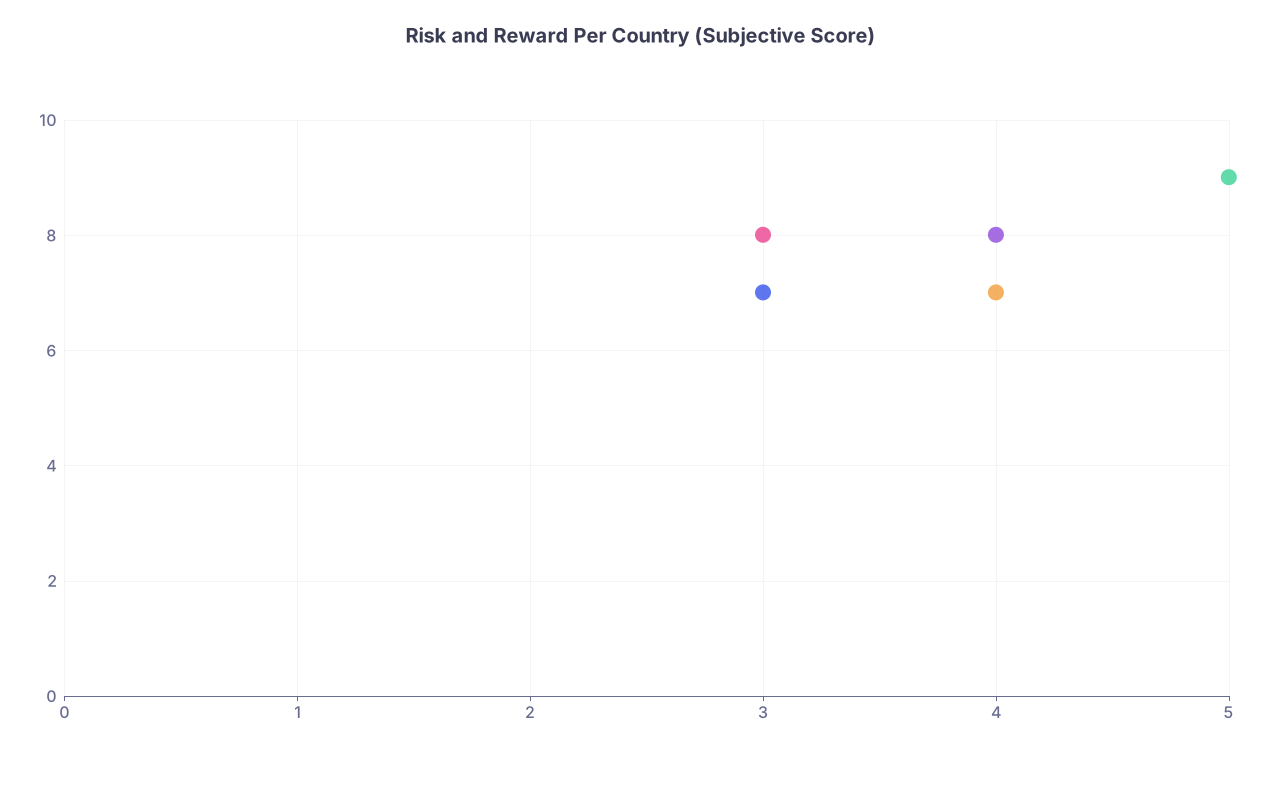
To stay honest with yourself, run a simple “stress test”:
| Category | Value |
|---|---|
| UK | 3,7 |
| Australia | 4,8 |
| UAE | 5,9 |
| Germany | 4,7 |
| New Zealand | 3,8 |
Where x = risk (1 low – 5 high), y = potential reward (1 low – 10 high). You want countries in the upper‑left quadrant: good upside without insane risk.
Final Check: Are You Actually Ready to Move, or Just Fantasizing?
By the end of this PGY‑2 year, if you’ve followed this roadmap, you should have:
- One clearly chosen target country
- One backup country you understand reasonably well
- A written backwards timeline from first‑day‑on‑job back to today
- A list of required exams, documents, and CV gaps to fix during PGY‑3+
If you do not, then be blunt with yourself: either you do not really want to move, or you’re still treating this like a daydream.
Key Takeaways
- Start 12+ months before your job hunt with structured, country‑by‑country research, not anecdotes.
- Build hard timelines backward from your desired start date, including licensing, exams, and job applications.
- Use the PGY‑2 year to quietly align your training, projects, and network with the expectations of the system you actually want to work in.


