

Most doctors pick their first country abroad for the wrong reasons. “My cousin lives there.” “I like the weather.” “The salary looks great.”
That is how careers get stuck and licenses get wasted.
You need a system. Not vibes. Not glossy recruitment brochures.
What follows is a hard-nosed, practical checklist to pick your first country as an internationally minded doctor. Not your dream retirement location. Not your Instagram destination. The first serious step that sets up your long‑term global career.
I am going to walk you through exactly how to evaluate countries, what to ignore, what to verify, and how to avoid the classic traps I keep seeing: people who spend 3 years in exams for a country that would never truly hire them, or who move, lose clinical skills, and are stuck in non‑clinical roles.
Use this as a working document. You should literally score and compare countries with it.
Step 1: Define Your Non‑Negotiables Before You Look at Maps
If you start with countries, you will rationalize almost anything. Start with yourself instead.
Write down, on paper, your non‑negotiables in four domains:
- Clinical trajectory
- Licensing and exam burden
- Lifestyle and family
- Financial and long‑term strategy
1. Clinical trajectory: what kind of doctor do you actually want to be?
Be specific.
Are you:
- Pre‑residency / just graduated
- Mid‑residency
- Fully trained specialist
- GP / family medicine
- Non‑clinical or mixed career
How important are these:
- Procedural volume (surgery, interventional, anesthesia)
- Academic / research track
- Primary care continuity
- Subspecialty fellowship options
- Opportunity to teach / supervise
Example non‑negotiables:
- “I must be able to train as an anesthesiologist within 3–5 years.”
- “I will not accept permanent GP conversion if it blocks future specialty training.”
- “I need a pathway to board‑equivalent status, not just a service job.”
If a country cannot realistically offer your trajectory in a predictable way, it goes down the list or off entirely. No matter how pretty the beaches are.
2. Licensing and exam burden
You have limited bandwidth. Some systems are exam mazes.
Decide:
- How many major exams you are willing to sit (USMLE/PLAB/MCCQE/etc.).
- How many years of exam prep you are willing to commit before working clinically.
- Whether you are okay with repeating residency.
Examples:
- “I am willing to take one full exam series (e.g., PLAB or USMLE) but not repeat a 5‑year residency.”
- “I am okay with repeating residency if it is in a top‑tier system (e.g., US, Germany), but I will not do that in a place with limited global recognition.”
3. Lifestyle and family
Do not pretend this does not matter. It wrecks careers when ignored.
You must decide:
- Language: Will you actually learn a new language to C1 clinical level?
- Climate tolerance: You may underestimate winters. Many do.
- Partner / children:
- Schooling options
- Work options for spouse
- Immigration rights (can they work, study, access health care?)
- Distance to home and ability to travel back (cost, visas, time zones)
Examples:
- “My spouse must be able to work within 12–18 months.”
- “I will not move to a non‑English system with mandatory language C1 before practice.”
- “Max flight time to home: 12 hours; I need regular contact.”
4. Financial and long‑term strategy
This is not only about gross salary.
Clarify:
- Minimum net income you want in first 2–3 years.
- Whether you care more about:
- Savings rate
- Work‑life balance
- Training quality
- Permanent residence (PR) / citizenship
- Your time horizon:
- Is this “first country” a stepping stone or likely long‑term base?
Examples:
- “I am okay with moderate salary for 3–5 years if it leads to a globally strong qualification.”
- “I need to send home at least $1,000/month from year one.”
- “I want PR within 5–7 years.”
Now you have a filter. Only then do we even look at specific systems.
Step 2: Shortlist 3–5 Target Countries Using Hard Criteria
You are not picking from 190+ countries. You are selecting 3–5 realistic contenders.
Here are the core dimensions that matter for doctors:
- Recognition of your degree and training
- Licensing complexity
- Demand for your specialty profile
- Immigration/PR prospects
- Language barrier
- Financial upside and cost of living
| Country | Language for Practice | Typical Entry Exams | PR/Citizenship Path | Suitable For |
|---|---|---|---|---|
| USA | English | USMLE | Long, competitive | High‑ambition specialists |
| UK | English | PLAB / UKMLA | Moderate, structured | GP, IM, hospitalists |
| Canada | English/French | MCCQE/NAC | Long, limited spots | High scorers, select IMGs |
| Germany | German (C1) | Approbation exams | Clear, structured | Willing to learn German |
| Australia | English | AMC/MoJ | Moderate | GP, ED, hospital roles |
This is not exhaustive, but it gives you a pattern. You want to create a similar table for your own realistic options.
Step 3: Use a Scoring Checklist Instead of Gut Feeling
Here is the system I recommend: score each candidate country from 1–5 on each dimension, then compare totals. You will quickly see which one is a better first move, not just a fantasy.
Dimension 1: Licensing and Exam Path (1–5)
Ask:
- Is there a clear official path for IMGs from your country?
- Are exams available in or near your region?
- How many major steps?
- Are pass rates for IMGs transparent and reasonable?
Score:
- 1 – Opaque, highly restrictive, or “case‑by‑case” licensing.
- 3 – Clear but heavy process (multiple exams, possible repeats).
- 5 – Transparent, standardized route with known timelines.
Dimension 2: Training and Career Progression (1–5)
Ask:
Can you:
- Enter residency / specialist training?
- Get credit for previous training?
- Move from service roles to training posts reasonably?
Are there:
- Published eligibility rules?
- Historical examples of IMGs at your stage succeeding?
Score:
- 1 – IMGs largely limited to non‑training / dead‑end roles.
- 3 – Possible but bottlenecked; heavy competition.
- 5 – Common and predictable for IMGs to progress.
Dimension 3: Demand for Your Profile (1–5)
Look at:
- National shortage lists (e.g., shortage specialties).
- Region‑specific recruitment (rural vs urban).
- Whether your:
- Degree country
- Specialty
- Years of experience
are commonly accepted or discriminated against.
Score:
- 1 – No active recruitment for your profile.
- 3 – Some openings but not strongly targeted.
- 5 – Clear shortage, active campaigns, bonuses, relocation offers.
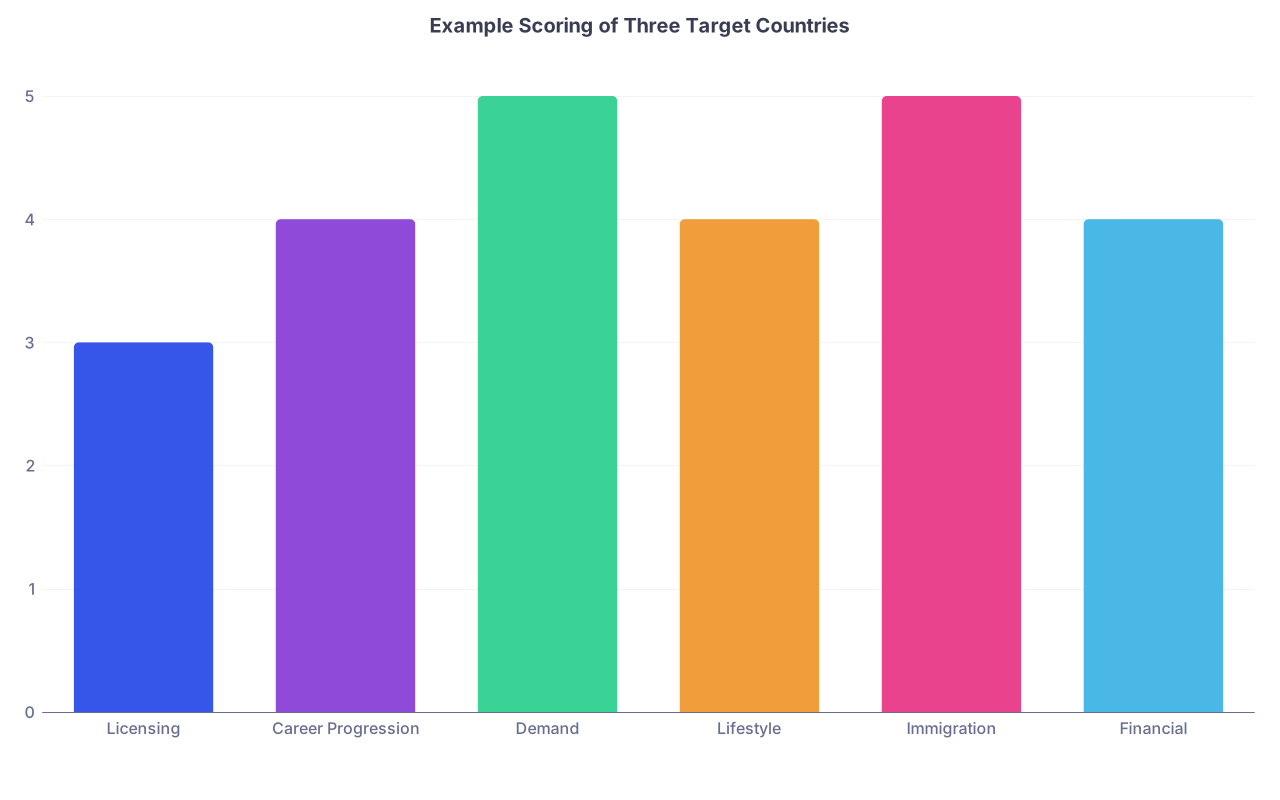
| Category | Value |
|---|---|
| Licensing | 3 |
| Career Progression | 4 |
| Demand | 5 |
| Lifestyle | 4 |
| Immigration | 5 |
| Financial | 4 |
(Imagine repeating this for each country and comparing side by side.)
Dimension 4: Lifestyle Alignment (1–5)
Practical factors:
- Language barrier and your willingness to learn.
- Work hours and culture (documented averages, not rumors).
- Safety, school quality (if relevant), and social integration.
Score:
- 1 – Serious mismatch with your constraints (e.g., mandatory rural posting alone while you have small kids and no support).
- 3 – Some trade‑offs but manageable.
- 5 – Strong fit with your personal and family situation.
Dimension 5: Immigration and Security (1–5)
You do not want to build a career where your visa can vanish abruptly.
Ask:
Is there:
- A defined path from work permit → PR → citizenship?
- Historical evidence of doctors obtaining PR/citizenship regularly?
Are visas:
- Tied tightly to a single employer?
- Transferable between employers?
Score:
- 1 – No realistic path to long‑term security or extremely restrictive.
- 3 – Possible but slow or uncertain.
- 5 – Clear pathway within a known time frame (e.g., 5–7 years).
Dimension 6: Financial Reality (1–5)
You care about:
- Starting salary in typical first roles for IMGs.
- Cost of living in likely locations (not just capital cities).
- Taxes and student loan implications.
- Ability to save or remit money.
Score:
- 1 – You will barely survive or will be worse off than at home.
- 3 – Comfortable but limited savings early on.
- 5 – Strong earning potential even at entry level.
Now, build yourself a simple grid. Example:
| Dimension | Country A | Country B | Country C |
|---|---|---|---|
| Licensing/Exams | 3 | 4 | 2 |
| Career Progression | 4 | 3 | 2 |
| Demand for Profile | 5 | 3 | 4 |
| Lifestyle Fit | 3 | 5 | 2 |
| Immigration Path | 4 | 2 | 3 |
| Financial Outcome | 4 | 3 | 5 |
| **Total (max 30)** | **23** | **20** | **18** |
You are no longer just “feeling” like the UK is better than Germany or vice versa. You have structure.
Step 4: Avoid the 6 Classic Traps That Derail International Careers
I see the same mistakes over and over. If you avoid just these, you are ahead of most.
Trap 1: Choosing by Exam Difficulty Alone
Doctors talk as if the “easiest exam” equals the best country. That is lazy.
- An easy exam leading to non‑training service posts forever is a trap.
- A harder exam that unlocks residency in a world‑class center can be worth it.
Fix:
- Always pair exam difficulty with post‑exam opportunity. Ask: “What jobs have actual IMGs with my profile obtained after passing?”
Trap 2: Underestimating Language Barriers
“I will learn German once I get there.” No, you will not. You will be exhausted, working, dealing with immigration, and supporting family.
If a country demands:
- B2–C1 language level before licensing
- Country‑language medical exams
Then treat language learning as a full part of the plan, not an afterthought.
Fix:
- Commit: “I am willing to spend 9–18 months to reach B2/C1 German/French/etc. before serious application.” Or rule those systems out as first destinations.

Trap 3: Believing Recruiters’ Promises Without Cross‑Checking
A recruiter saying “We have many doctors like you there” means nothing without proof.
You want:
- Names, positions, and exact job titles of IMGs placed.
- Confirmation of:
- Contract type (training vs service)
- Minimum contract length
- On‑call expectations
- Mandatory rural rotations
Fix:
- Cross‑check everything with:
- Official medical council / licensing authority websites.
- Unfiltered IMG forums (Reddit, Facebook groups, specialty societies).
- Direct email to current IMG doctors in that system.
Trap 4: Ignoring Specialty‑Specific Realities
Some specialties travel well. Some do not.
Patterns I have seen repeatedly:
- Family medicine / GP / internal medicine / psychiatry – more pathways, especially in English‑speaking countries.
- Highly procedural, niche subspecialties – often forced to redo training or accept downgraded roles abroad.
- Pathology / radiology / anesthesiology – competitive and often under the radar; rules can be strict.
Fix:
- Do not generalize from “doctors” to your field.
- Search specifically: “IMG cardiology training [Country]”, “foreign trained pediatrician [Country] pathways.”
Trap 5: Overweighting Short‑Term Money
I have seen people chase Gulf region salaries, work 8 years as service registrars, then discover they have:
- No recognized training.
- No PR options.
- No pathway to Europe / North America / Australasia.
- Skills that do not translate easily back home.
For some, that trade‑off is acceptable. For many, it is a trap.
Fix:
- Decide upfront: “Is this a money‑max move, or a training‑max move, or a migration‑max move?” One country rarely optimizes all three.
Trap 6: Not Planning Your “Exit Option”
Your first country may not be your last. But it should keep doors open.
Ask:
- Does this country’s:
- Postgraduate training
- Specialist certification
travel well to other systems?
Examples:
- UK CCT, US board certification, German Facharzt: often recognized or at least well‑regarded in multiple other regions.
- Unaccredited local certifications from small systems: usually not.
Fix:
- On day one, know what your credential there will be worth in at least 2–3 other destinations.
Step 5: Build a 3‑Year Action Plan Around One Primary Target and One Backup
Once you score and compare, choose:
- 1 primary country
- 1 serious backup
Not 5. Focus wins.
Then build a simple 3‑year plan with quarter‑level milestones.
Example: Primary – UK; Backup – Germany
Year 1:
- Q1–Q2:
- Deep dive UK GMC rules for your degree country.
- Start PLAB 1 prep.
- Begin A2 German coursework as hedge.
- Q3:
- Sit PLAB 1.
- Intensify German to B1.
- Q4:
- PLAB 2 prep.
- Research NHS trust jobs; contact medical HRs.
- Decide if German path remains attractive.
Year 2:
- Q1:
- Sit PLAB 2.
- Start applying to UK non‑training posts (FY2/SHO/Trust grade).
- Q2–Q3:
- Move to UK, start job.
- Begin portfolio building: audits, teaching, UK referees.
- Q4:
- Apply for training posts if eligible; if not, strengthen CV.
Year 3:
- UK track:
- Secure training number or structured non‑training post with clear steps.
- If UK blocks:
- Use German B2–C1 progress to start Approbation process as alternative.
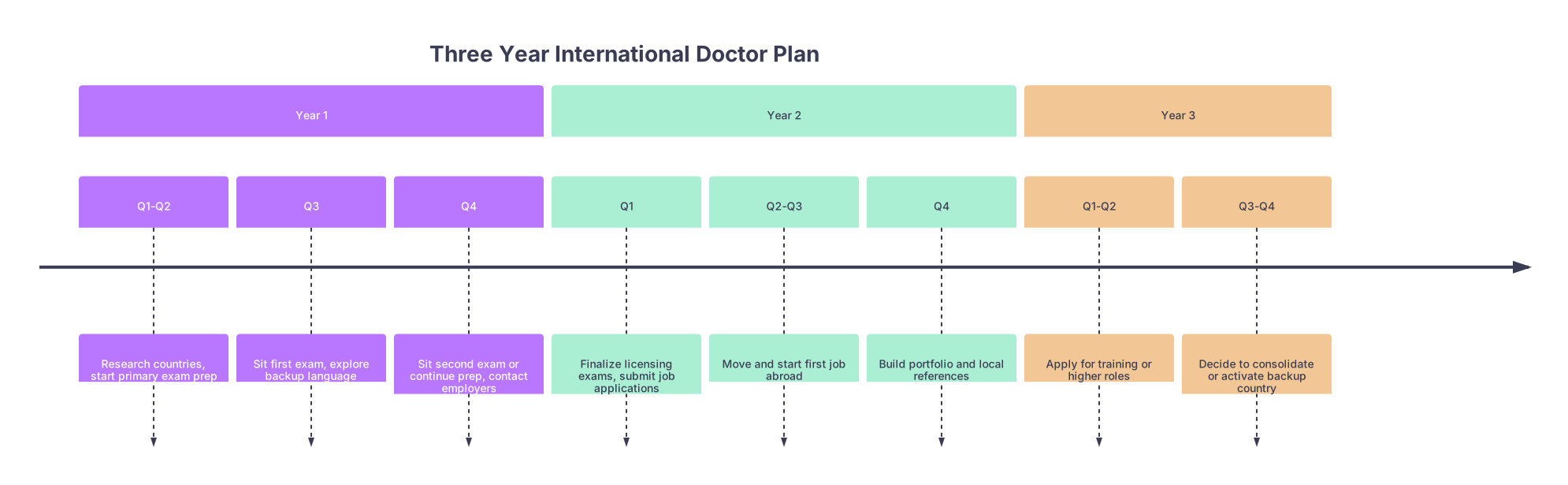
| Period | Event |
|---|---|
| Year 1 - Q1-Q2 | Research countries, start primary exam prep |
| Year 1 - Q3 | Sit first exam, explore backup language |
| Year 1 - Q4 | Sit second exam or continue prep, contact employers |
| Year 2 - Q1 | Finalize licensing exams, submit job applications |
| Year 2 - Q2-Q3 | Move and start first job abroad |
| Year 2 - Q4 | Build portfolio and local references |
| Year 3 - Q1-Q2 | Apply for training or higher roles |
| Year 3 - Q3-Q4 | Decide to consolidate or activate backup country |
The details will differ for you, but the structure should not: clear quarters, specific outcomes.
Step 6: Do a Reality Check With Three Pieces of Evidence
Before you fully commit to a country, you want three forms of proof:
- Official documentation
- Real IMG stories
- Employer behavior
1. Official documentation
Go straight to:
- Medical council / licensing authority website.
- Ministry of health or national health service pages.
- Immigration department pages.
You should be able to identify:
- Whether your degree is in an accepted list.
- Exact exam requirements.
- Required postgraduate years for entry to specific posts.
- Visa categories available for doctors.
If anything is only “explained” by an agent, be suspicious.
2. Real IMG stories
Target people:
- With your:
- Specialty
- Degree country
- Graduation year range
Where to find:
- Specialty‑specific Facebook groups (“IMG anesthesiologists in Germany”, etc.).
- Reddit boards (r/IMGreddit, r/UKmedicine, etc.).
- LinkedIn (search: “Specialty + hospital + country” and look for foreign names and medical schools).
Ask direct questions:
- How many years from graduation to first job there?
- Did you have to repeat residency?
- How competitive was training entry?
- Would you pick this country again as your first move?
3. Employer behavior
Look at:
- Job adverts:
- Do they explicitly welcome international graduates?
- What visa support is offered?
- Hospital staff pages:
- Do you see IMGs in consultant/attending positions or only at junior levels?
If a system only has IMGs at the bottom but almost none at consultant level, that tells you something.

Step 7: Decide Whether You Need a “Bridge Country” First
Sometimes your dream system is too far away from where you are now. The gap is:
- Language
- Training quality perception
- Residency matching competitiveness
- Visa policy
In that case, a bridge country can be smart: a 3–6 year stop that upgrades your CV and opens doors to a third country.
Typical patterns:
- Lower‑middle income → Gulf or Eastern Europe → Western Europe / UK.
- Non‑EU → Germany or Ireland → Scandinavia.
- Latin America → Spain/Portugal → Rest of EU.
The key:
- The bridge country must actually improve your profile:
- Recognized specialist training
- Good letters, procedures, research
- Better exam performance (because of improved training environment)
What you avoid:
- Bridge countries where you:
- Work in low‑recognition roles.
- Get stuck without formal training.
- Cannot easily exit because your experience is not counted elsewhere.
If a bridge country does not strengthen your paper trail, it is just a detour.
Step 8: Build a Personal Country Checklist (Copy This)
Here is a condensed, practical checklist you can apply to any country you are considering. Answer each line with “Yes/No” plus notes.
A. Degree and Registration
- My medical school is recognized by this country’s authority.
- I understand exactly which exams I must pass.
- There are exam centers I can realistically access.
B. Training and Jobs
- IMGs from my region currently work there in my specialty.
- I can name at least 3 hospitals that have IMGs at my level.
- There is a published route from:
- Non‑training → training posts
or - Direct entry to training.
- Non‑training → training posts
C. Immigration and Security
- There is a documented path to PR/citizenship for doctors.
- My spouse/children can join and have clear rights.
- I am not locked to a single employer forever.
D. Language and Integration
- Either the system is fully workable in English
or - I have a realistic plan and timeline to reach required language levels.
E. Money and Lifestyle
- Starting salary (after tax) covers realistic cost of living plus some savings.
- Work hours and rota expectations are acceptable.
- City/region options fit my family and social preferences.
F. Long‑term Strategy
- Training/credentials from this country are recognized in at least 2 other systems I might want later.
- I can see a clear 5–10 year story that makes sense for my CV and life.
If a country fails in multiple sections, do not convince yourself with wishful thinking. Move it further down the list.
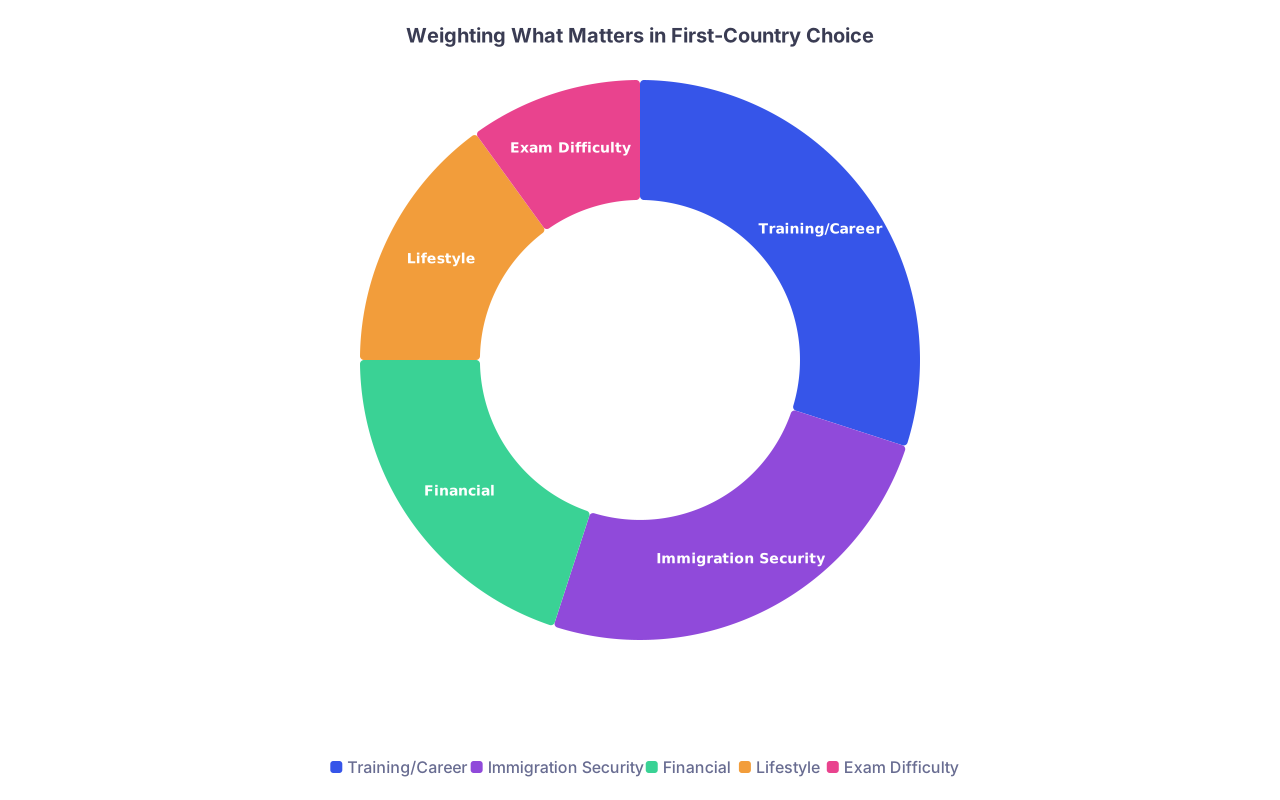
| Category | Value |
|---|---|
| Training/Career | 30 |
| Immigration Security | 25 |
| Financial | 20 |
| Lifestyle | 15 |
| Exam Difficulty | 10 |
This is roughly how I would weight priorities for most internationally minded doctors. Notice exam difficulty is last.
Step 9: When to Stop Researching and Commit
Analysis paralysis is real. At some point you must pick and execute.
You are ready to commit when:
- You have:
- Scored at least 3 realistic countries with the 1–5 system.
- Identified one that aligns with your non‑negotiables best.
- You have:
- Verified core facts using official sources.
- Spoken (or at least messaged) with 2–3 real IMGs on the ground.
- You can:
- Articulate a 3‑year plan with specific exam and job milestones.
If all of that is done and you are still “unsure,” the problem is not information. It is fear of committing. That is normal, but it is not a reason to keep scrolling instead of acting.
Pick your primary. Pick your backup. Start the first concrete step.
FAQs
1. Should I pick the country where I can get in fastest, then move again later?
Sometimes yes, sometimes no. If “fastest” means:
- Weak supervision
- Poor training environment
- No recognized qualifications
- No PR path
then you are just postponing the real work and burning years.
Fast is acceptable when:
- You still get structured training or legitimate titles.
- The system improves your CV in a way other countries will respect.
- You are clear that you will move again and what milestone will trigger that (e.g., after getting board‑equivalent status).
If “fast entry” is your only filter, you usually end up stuck or forced to start from zero a second time.
2. I am already several years into practice in my home country. Is it still worth moving?
Often yes, but you must be honest about trade‑offs. Past a certain seniority, you may face:
- Pressure to redo some or all of residency.
- Downgrading from consultant to registrar or resident.
- Temporary pay cuts during transition.
For many mid‑career doctors, it is still worth it if:
- The target system offers better long‑term stability and working conditions.
- You can realistically regain or exceed your previous level within 5–8 years.
- You are willing to take a short‑term status hit for a long‑term gain.
The mistake is assuming your current seniority will map 1:1 abroad. It usually does not. If you are prepared for that and still want the move, you are making an informed choice, not a fantasy.
Open a blank page right now and write the names of three countries you are considering. For each, score them 1–5 on licensing, training, demand, lifestyle, immigration, and finances. The country with the strongest total becomes your primary target. Then outline what you will do in the next 90 days to move one step closer—whether that is booking an exam, enrolling in a language course, or emailing a doctor already working there.


