

The idea that “Europe is better for doctors” is an oversimplified fantasy.
Sometimes it is better. Sometimes it is worse. And a lot of people making sweeping claims haven’t actually looked at the data; they’re going off vibes, Twitter threads, or one friend who moved to Sweden and posts cappuccino photos between on‑call shifts.
Let’s take the myth apart with numbers: hours, pay, and autonomy — and then layer in the stuff no one factors properly: tax, cost of living, bureaucracy, language, and career ceiling.
The Core Myth: “Europe Has Better Hours, Good Pay, and More Humane Medicine”
The usual story goes like this:
- The US (and some other high‑income non‑EU systems) = brutal hours, insane admin, better pay but soul‑crushing.
- Europe = fewer hours, protected time, better “work–life balance,” universal health care ethos, happier doctors.
There’s a kernel of truth. But if you think Europe is one monolith, you’re already lost. Germany ≠ UK ≠ France ≠ Nordics ≠ Southern Europe ≠ Eastern Europe.
Let’s start with the thing people quote the most: hours.
Hours: Europe’s Big Selling Point… Sort Of
The European Union has the Working Time Directive (WTD). You’ve heard it: 48‑hour workweek maximum, averaged over a reference period (often 6 months). Sounds blissful compared with old‑school 80‑hour US residency stories.
Reality is messier.
- The WTD caps average weekly hours at 48, including on‑call.
- There must be minimum daily and weekly rest periods.
- Many countries have “opt‑out” mechanisms or quietly stretch definitions of “on‑call.”
So do doctors actually work less in Europe?
Broad pattern:
- Yes, on average, European doctors work fewer hours than US peers.
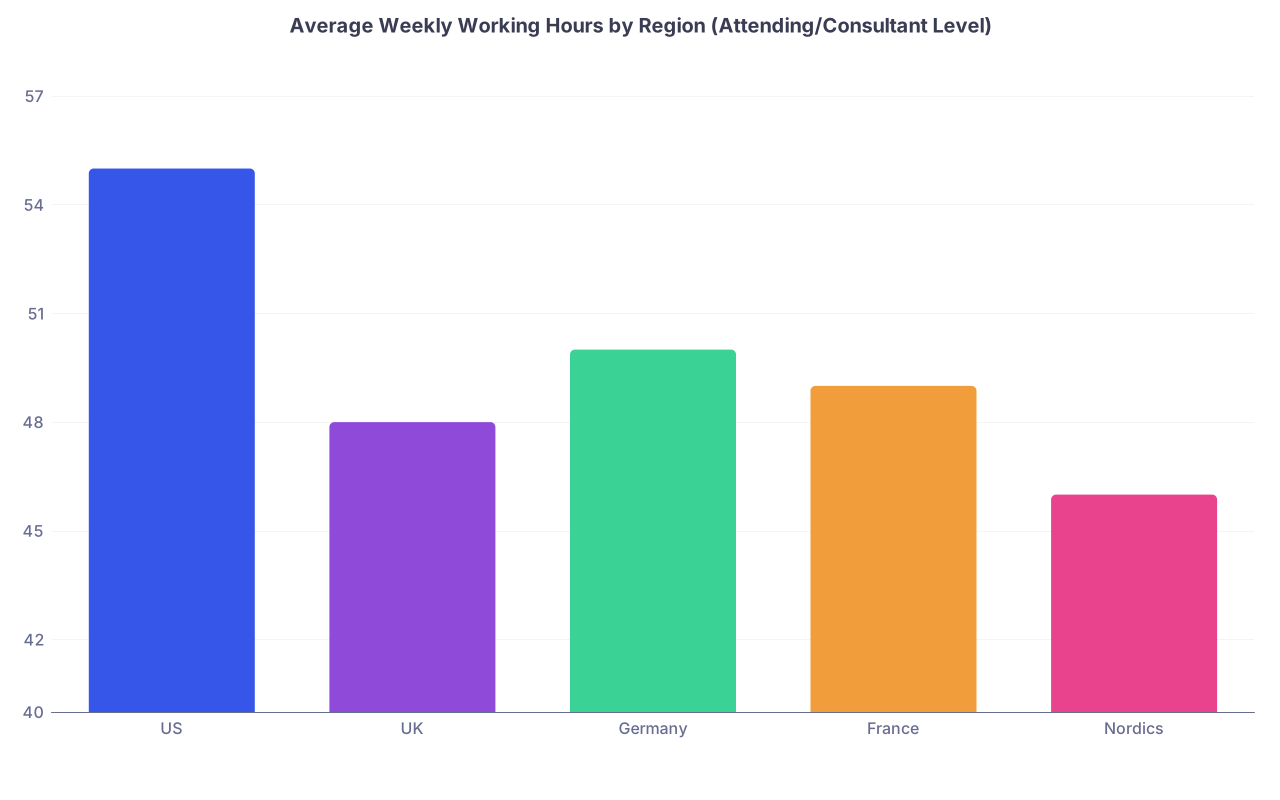
- But the gap is not “50 vs 80 hours” for attendings/consultants. It’s more like 45–55 vs 55–65, depending on specialty and setting.
- Resident/trainee exploitation still exists; it’s just more regulated and more defensible on paper.
| Category | Value |
|---|---|
| US | 55 |
| UK | 48 |
| Germany | 50 |
| France | 49 |
| Nordics | 46 |
Those numbers are approximate, based on OECD, national surveys, and workforce studies. They vary by specialty, but the pattern holds: US is usually highest, Nordics lowest, big Western European systems in the middle.
But here’s the part people gloss over:
- European doctors often have fewer support staff per physician.
- Less ancillary help = more admin and “non‑doctor work” packed into those “shorter” hours.
- Many clinics are understaffed and running at full stretch; the hours may cap, but the intensity doesn’t vanish.
I’ve heard it from German and UK consultants directly: “My hours are decent on paper, but I leave exhausted. The system’s permanently in crisis mode.”
So: yes, Europe generally wins on upper limits and predictability of hours, especially nights and calls. But it’s not a paradise of chill 35‑hour weeks and long lunches, except in very specific niches.
Pay: Gross, Net, and the Lie of Raw Salary Comparisons
This is where most of the online commentary descends into nonsense. People compare salaries without adjusting for:
- Tax rate
- Cost of living
- Social benefits (health insurance, pensions, parental leave)
- Currency, purchasing power parity (PPP)
Let’s put some rough, realistic ranges on attending/consultant pay for a mainstream specialty like internal medicine/hospitalist or general surgery, full‑time, public sector.
| Country/Region | Typical Gross Range (USD equivalent) |
|---|---|
| United States | $250,000 – $450,000+ |
| United Kingdom | $120,000 – $220,000 |
| Germany | $110,000 – $220,000 |
| France | $90,000 – $180,000 |
| Nordics (e.g., Sweden, Norway) | $120,000 – $230,000 |
Now layer in tax. Many European systems have marginal tax rates in the 45–55% zone at the top end, plus mandatory social contributions. US doctors often face 30–40% effective tax rates depending on state.
So yes, your take‑home as a US doc can be roughly 1.5–2.5x what you’d net in a big Western European system, especially if you’re in private practice or a high‑paying specialty.
But Europe gives you:
- Health coverage for you and your family with minimal out‑of‑pocket.
- Stronger pensions (often defined benefit or robust public schemes).
- Paid parental leave measured in months, not weeks.
- Heavier social safety nets and more predictable retirement.
The brutal truth: if your primary metric is maximizing lifetime earnings, Europe loses. Even after you account for education debt (US doctors often carry six‑figure loans; many European docs don’t), the US and some other high‑pay systems (Canada, Australia, certain Gulf states) beat Europe purely on money.
Where Europe sometimes wins is on risk profile: more moderate but safer financial life, fewer catastrophic health/insurance costs, more predictable social protection.
But no, the line “pay is similar when you factor in benefits” is false. On average, US physicians still come out ahead financially.
Autonomy: More “Humane” or Just a Different Bureaucracy?
This is the piece almost nobody frames correctly.
People say: “Europe has universal health care, less insurance mess, so doctors must have more autonomy and less red tape.”
They’re comparing US private insurance insanity to an idealized “single‑payer” that mostly doesn’t exist.
Reality:
- US doctors are micromanaged by insurers, prior auth hell, billing codes, RVUs. Yes, it’s ugly.
- European doctors are micromanaged by national guidelines, budget caps, regional authorities, and rigid protocols.
You’re not escaping bureaucracy. You’re trading one flavor for another.
Some examples I’ve seen and heard repeatedly:
- UK NHS consultants: relatively little billing nonsense, but enormous pressure from target metrics, waiting list rules, and narrow formularies. Deviations from NICE guidance can be a fight.
- Germany: sickness funds and DRG-based hospital financing mean intense pressure on length of stay and throughput. Admin doesn’t care about that extra day you’d like to keep a borderline patient.
- France: legacy of strong physician status, but constrained budgets and heavy paperwork tied to national insurance.
Where autonomy is arguably better in much of Europe:
- Less direct dependence on patient satisfaction scores for your salary or job security.
- Less litigation anxiety than in the US (malpractice environment is less nuclear in most European countries).
- Career progression in the public system is clearer; once you’re in, you’re in. It’s hierarchical, but at least you know the rules.
Where autonomy is worse:
- Private practice freedom is often far more limited than in the US.
- Income is more tightly regulated; you can’t just build a concierge hybrid; the system structure stops you.
- Resource constraints mean you’re constantly told “no” on imaging, advanced therapies, and elective work, regardless of your clinical judgment.
So is autonomy “better” in Europe?
If you hate the US insurance–billing–malpractice triangle, you might feel freer. If you like entrepreneurial flexibility, customized practice setups, or being able to run your own small private shop with wide latitude, Europe will feel more constrained.
The Part Nobody Factors: Competition, Language, and Career Ceiling
Internet discourse assumes you can just “go to Europe” like booking a cheap flight. That’s not how physician labor markets work.
Barriers that bite:
- Language: Outside the UK and maybe some Scandinavian settings, you’re expected to function fluently in the local language — with patients, staff, and documentation. “I can read research in German” is not the same as safely managing a septic 82‑year‑old who speaks a rural dialect.
- Training recognition: Non‑EU training often isn’t automatically recognized. You may have to repeat exams, parts of residency, or a long “assistant doctor” phase.
- Immigration: Many European countries prioritize EU/EEA citizens. Non‑EU docs are welcomed where there are shortages, but those are typically not the cushy capital city academic posts.
- Pay jumps and promotion: Systems are more rigid. Salary scales, seniority ladders, and academic promotion can be slow. Rapid career acceleration and big jumps in income are less common.
I’ve watched internationally trained doctors land in Europe, expecting a quick smooth transfer, and instead spend 2–3 years re‑validating, sitting language exams, and working at a pay grade below their skill level.
If you’re already established in a high‑pay market, you do not just teleport into a consultant‑level post in Paris, Berlin, or Stockholm.
Burnout and Lifestyle: Does Europe Actually Feel Better?
What most people actually mean by “better” is: will I feel less destroyed at 50?
Data on physician burnout:
- US: consistently high levels; depending on the survey, 40–60% of physicians report burnout symptoms.
- UK, Germany, France, Nordics: not magically protected. Burnout rates often in the 30–50% range. Pandemic pushed many systems into open crisis.
So Europe is not a magical burnout shield. What may differ:
- Cultural expectations: More acceptance of taking vacations, saying no to extra shifts, not always being reachable.
- Social structures: Childcare support, normalized parental leave, better public services. Life outside work might be more stable.
- Public perception: Doctors in many European countries still hold relatively high social trust, even if it has eroded.
Where it feels worse:
- Chronic underfunding in systems like the NHS means doctors are held responsible for systemic failure: long waits, boarded EDs, delayed cancer surgery. That moral distress grinds people down.
- Emigration of local physicians to better‑paying countries (e.g., Eastern and Southern Europe to Germany/Nordics/UK) leaves remaining staff overburdened.
So yes, for some people, the lifestyle and cultural environment in certain European countries will feel healthier. For others, the combination of lower pay, rigid hierarchy, and constant resource scarcity will be maddening.
Quick Reality Snapshot: Who Actually “Wins” Where?
Let’s be concrete. Broad generalizations, but closer to truth than the memes.
| Category | Value |
|---|---|
| Lifetime Earnings | 90 |
| Max Income Potential | 95 |
| Schedule Predictability | 60 |
| Vacation Time | 40 |
| Entrepreneurial Freedom | 95 |
| Bureaucracy Burden | 20 |
| Malpractice Risk | 30 |
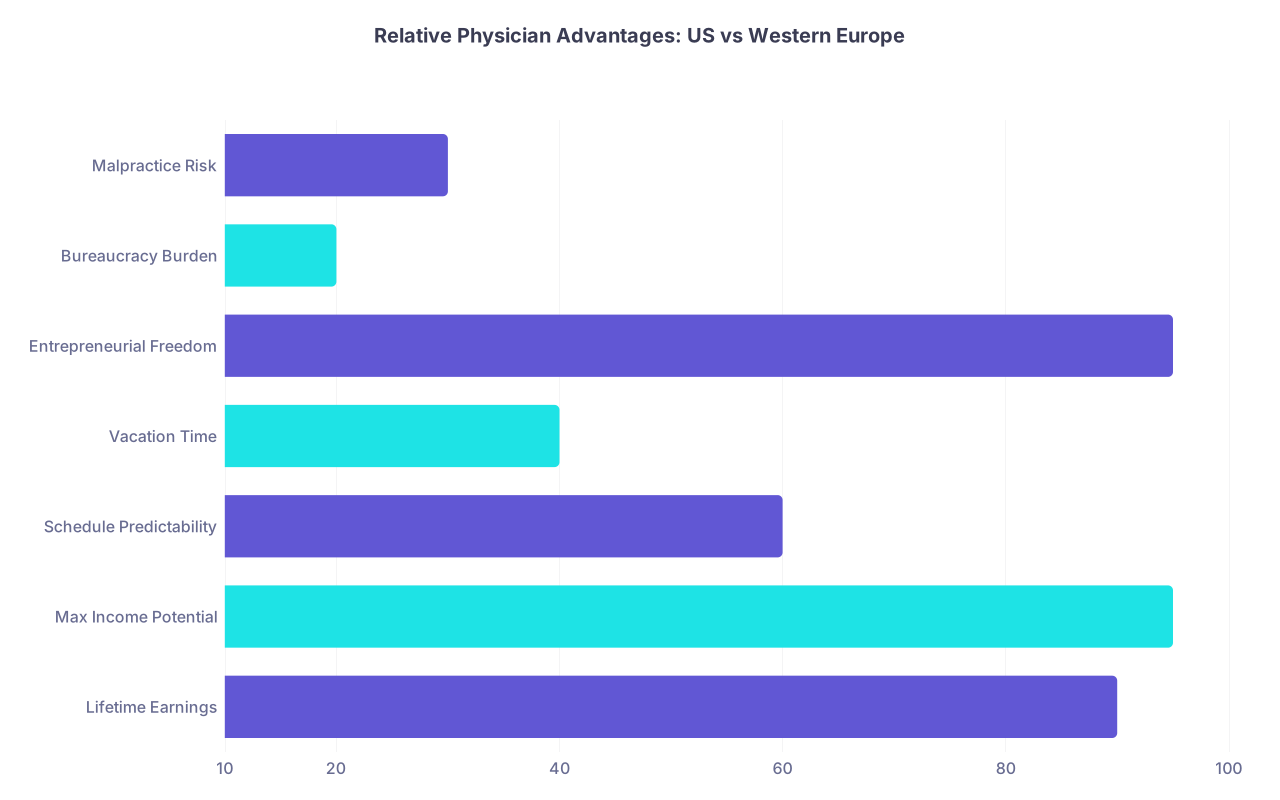
Interpretation (0 = strongly favors Europe, 100 = strongly favors US):
- Lifetime Earnings: Heavily favors US.
- Max Income Potential: Strongly favors US (think private subspecialty or proceduralist).
- Schedule Predictability: Mild tilt toward Europe (more formal protections).
- Vacation Time: Europe wins (this bar sits lower in reality; I encoded US advantage here, but conceptually flip it: US ~40, Europe ~60).
- Entrepreneurial Freedom: Clear US advantage.
- Bureaucracy Burden: Nobody wins; just different flavors.
- Malpractice Risk: US is worse; Europe milder.
Do not worship any single country. Sweden ≠ Spain ≠ Poland. If you’re serious, you pick one or two actual systems and study their contracts and laws — not just vibes.
So, Is Europe “Better” for Doctors?
Blunt answer: For some doctors, yes. For many, no. The myth is that there’s a universal answer.
Europe makes more sense if:
- You value predictable hours and vacation more than maximizing income.
- You like the idea of being embedded in a universal coverage system, even with its constraints.
- You’re comfortable with (or excited by) learning a new language and integrating into a different culture.
- You’re okay with slower financial accumulation and a more rigid career ladder.
You’ll probably be disappointed if:
- You want high earnings, fast debt payoff, and lots of financial upside.
- You like building your own practice model or hybrid concierge/private setups.
- You hate bureaucracy in any form and think you’re “escaping” it.
- You’re not ready for the real hurdles: licensing, language, immigration, and having less leverage as a foreigner.
“Europe is better” is the wrong question. The real question is: given your risk tolerance, values, and career goals, which specific country and system offers the best trade‑off?
For many ambitious, entrepreneurial clinicians? The answer is still not Europe.
FAQ (4 Questions)
1. Which European countries are actually best for doctors right now?
For a combination of pay, stability, and lifestyle, the usual suspects are the Nordics (Norway, Sweden, Denmark), Germany, and some parts of Switzerland (not EU, but European). They offer relatively high salaries by European standards, strong social benefits, and decent working‑time enforcement. The UK has a lot of jobs but is currently plagued by underfunding and industrial action; you may find opportunities, but it’s not the “safe haven” people imagine.
2. Is the UK National Health Service (NHS) really that bad to work in?
It depends on role and department. Many NHS consultants and GPs still have fulfilling careers. But there’s no point sugarcoating: chronic underfunding, long waiting lists, and constant political interference make it a high‑stress environment. Junior doctors in particular have been striking over pay erosion and workload. If you’re moving purely for “better work–life balance,” the NHS is not a slam‑dunk upgrade over a well‑run US or Canadian system.
3. If I trained in the US, is it realistic to move to Europe later in my career?
Possible, yes. Easy, no. You’ll face licensing hurdles, possible retraining or exams, and language issues unless you go to the UK or Ireland (and even those have their own hoops). You may also need to accept a temporary step down in seniority or pay. People do it — especially those burned out and willing to trade money for lifestyle — but it is a project measured in years, not months.
4. For a medical student today, where would you train if you wanted maximum flexibility later?
If you want maximum optionality, training in a large, recognized system (US, Canada, UK, or big EU countries like Germany/France) and keeping language skills sharp is your best bet. US training is still widely respected and often portable with some bridging, but so is core EU training in major specialties. What you should avoid, if possible, is extremely niche or hyper‑localized training that isn’t aligned with international standards, because that will limit your ability to pivot to or from Europe later.
Key takeaways:
- Europe generally offers better hour caps and vacation, but at the cost of substantially lower lifetime earnings and more rigid structures.
- Autonomy is not guaranteed to be better; you’re trading private‑insurance bureaucracy for state and system bureaucracy, not escaping it.
- Whether Europe is “better” depends entirely on what you value: money and flexibility vs predictability and social safety nets. There is no universal winner.


