

It’s 10 p.m. Your shift finally ended, you’re scrolling through Doximity jobs, and you see it: same specialty, same hours, $80,000 more… in a different state. Your first thought is, “Am I an idiot for not taking this?” Your second thought is, “Do I really want to move my entire life for money?”
Here’s the answer you’re looking for:
Moving states only for a higher physician salary is usually a bad decision if you don’t run the numbers and ignore quality of life. It can be a very smart decision if you treat it like a business move, not a fantasy escape.
Let’s break it down like an adult who understands taxes, school districts, and burnout.
Step 1: Understand What “Higher Salary” Really Means
Most physicians get burned here. They see $350k vs $450k and assume they’re “making” $100k more.
You’re not.
You care about take-home pay, not gross.
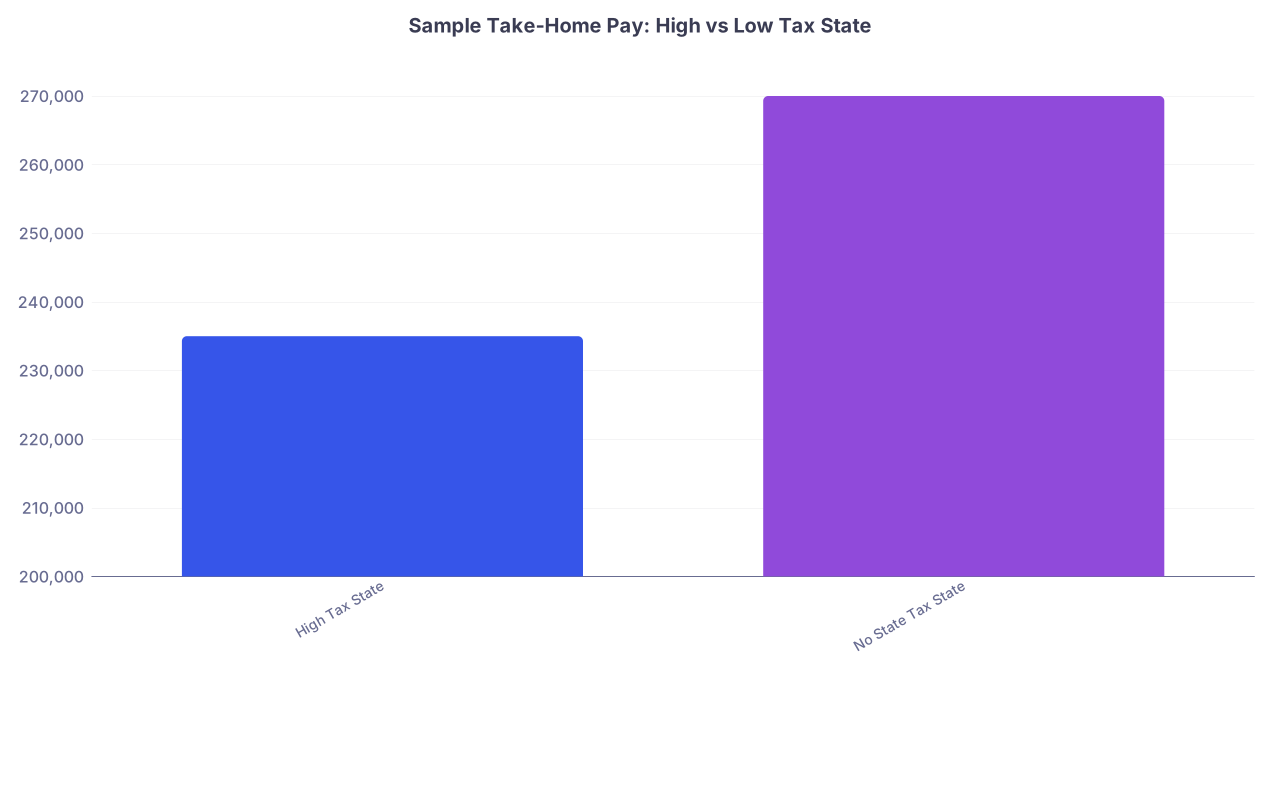
| Category | Value |
|---|---|
| High Tax State | 235000 |
| No State Tax State | 270000 |
Simple example (numbers are approximate, not personalized tax advice):
State A (high tax, big city)
Salary: $350,000
State tax: ~8–10% effective
Federal, FICA, etc.: chunk of the rest
Take-home might be around: $220–240kState B (no state income tax, smaller city)
Salary: $450,000
No state tax
Same federal hit, but you keep more
Take-home might be closer to: $270–290k
So yes, that might be a real $40–60k extra in your pocket each year.
But now subtract:
- Higher health insurance costs (if benefits differ)
- More expensive malpractice (some states are brutal)
- Increased commuting costs, childcare, etc.
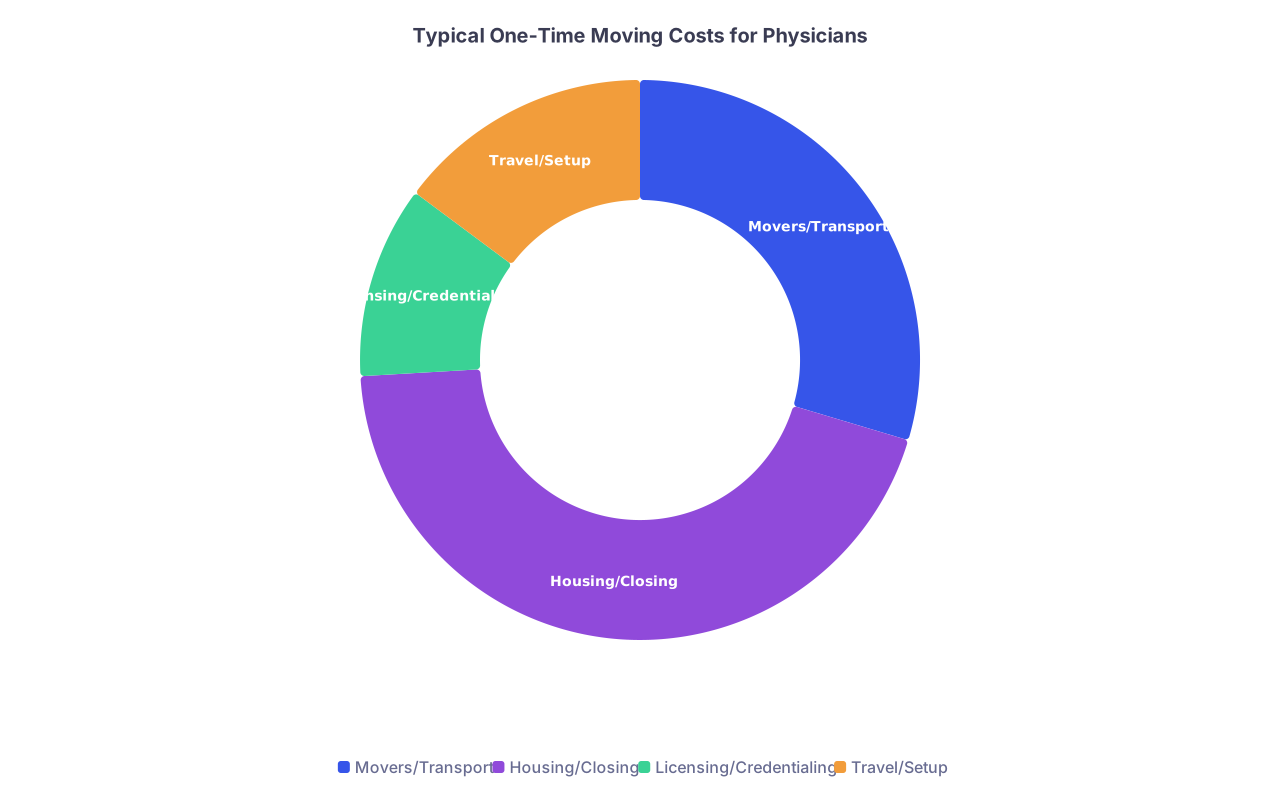
- One-time moving costs (which can quietly hit $15–30k when you add everything)
And then look at cost of living. A $450k salary in a low-cost city can feel like $600k relative to your current life. Or it can just feel like more money you never see if you inflate your lifestyle.
Step 2: Cost of Living vs Quality of Life
If you’re considering a move solely for salary and ignoring cost of living, you’re playing checkers in a chess game.
| State Type | Salary | Rent/Mortgage (3BR) | Childcare (per child) | Overall Feel |
|---|---|---|---|---|
| Big coastal city | 350k | $4,000–5,500 | $2,000–2,500 | Great, but cramped |
| Midwestern metro | 350k | $2,000–3,000 | $1,200–1,600 | Comfortable |
| Rural low-cost | 350k | $1,200–2,000 | $800–1,200 | Spacious, quieter |
Two key rules:
- Always run a cost-of-living calculator using your specific city, not just the state.
- Translate everything into “How many free hours and stress reduction does this buy me?”
If moving gets you:
- Shorter commute
- Bigger house so you’re not tripping over your kids
- Enough margin to drop a clinic session or a moonlighting shift
Then that salary bump isn’t “just money.” It’s buying your sanity back.
If it gets you:
- Slightly nicer car
- Slightly fancier vacations
- Same daily grind, same burnout
That’s just gilded misery.
Step 3: State-Specific Physician Realities You Can’t Ignore
This is the unsexy part no recruiter leads with.
1. Malpractice Climate
Some states are lawsuit magnets; others have strong tort reform.
- High-risk states: Certain parts of NY, NJ, PA, FL, CA. Higher premiums, more nuisance suits.
- Safer climates: Texas, some Midwest and Southern states with caps and stronger protections.
You’re not just trading salary; you’re trading legal risk and chronic low-level anxiety.
2. Payer Mix and Collections
Two “$400k jobs” can feel wildly different if one is:
- 60% commercial, 20% Medicare, 10% Medicaid, 10% self-pay
and the other is:
- 30% commercial, 40% Medicare, 25% Medicaid, 5% self-pay
Even if you’re “guaranteed” base salary, future comp models, RVU incentives, and job stability hinge on collections. I’ve seen doctors move to “better-paying” jobs only to get crushed when the guarantee period ends and they realize the payer mix is trash.
3. Scope of Practice and Autonomy
States vary a lot on:
- NP/PA independent practice
- Telemedicine rules
- Call burden enforced by local norms
- Hospital politics (single dominant system vs multiple competing ones)
Some states are NP-heavy, and specialists find their referrals diluted. In others, primary care is so under-supplied that you’re booked 6 months out on day one. Same salary, very different day-to-day life.
Step 4: The “Hidden Costs” of Moving States
People underestimate this badly. Moving isn’t just the cost of the U-Haul.
Direct costs you’ll feel immediately
- Actual move: movers + packing + travel: $8–20k easy
- Selling and buying a house: realtor fees, closing costs, taxes
- Licensing and credentialing: state license, DEA, controlled substance registration, board fees
- Gap in pay: 1–3 months of limbo where money is going out, not coming in
| Category | Value |
|---|---|
| Movers/Transport | 8000 |
| Housing/Closing | 12000 |
| Licensing/Credentialing | 3000 |
| Travel/Setup | 4000 |
Indirect costs that show up later
- Spouse/partner’s career disruption
- Kids adjusting to new schools (or regressing behaviorally for 6–12 months)
- Loss of childcare network, friends, neighbors
- Starting at zero socially and professionally: new referrals, new reputation, new politics
If you’re single with no kids? That’s noise. Move, experiment, reset.
If you’ve got a partner and a couple kids in school? This is not a trivial “let’s try it for a year” decision.
Step 5: When Moving for Money Actually Makes Sense
Let me be very clear: I’m not anti-move. I’m anti-blind-move.
Moving for higher salary is usually smart when:
You have a clear financial goal with a timeline
Example: “I want to be student-loan-free in 4 years” or “I want financial independence in 10–12 years.”The job meaningfully moves the needle
- $50–150k more per year
- Lower cost of living
- Reasonable call and schedule
You commit to not inflating your lifestyle
If you move to a higher-paying state and instantly upgrade house, car, vacations, and private school, you just traded places, not improved them.You treat it as a medium-term move (3–7 years), not “this is my forever city”
You can do a high-income stint, crush your financial goals, then later trade back to a more desirable location with much better leverage and less pressure.
This is exactly what a lot of docs quietly do: three years in rural Midwest or South, slam loans and build a real investment base, then move back to their preferred coastal city and accept a lower salary with way less stress.
Step 6: Red Flags in “High Salary” Job Offers
I’ve reviewed enough contracts to see the patterns. Some “too good to be true” offers really are.
Watch for:
- RVU targets that are 90th percentile of MGMA “but you can definitely hit it, we’re very busy”
- Call described as “light” that mysteriously doesn’t show exact numbers in writing
- Vague non-compete that basically chains you to the system or forces you to move again if things go sideways
- Guaranteed salary only for 12–24 months, then pure productivity in a saturated market
- Extremely vague language about support staff and APPs (“we’re growing this area” = you’ll be doing everything for 18 months)
If the salary is significantly higher than regional norms, there’s always a reason:
- Geography is hard to recruit to
- Reputation of the group or hospital is bad
- Patient volume is insane
- Turnover is high
Sometimes that tradeoff is still worth it. But you should know exactly what you’re selling for that extra money.
Step 7: What Actually Matters More Than Salary
Here’s the uncomfortable truth: a lot of doctors think they’re moving for salary, but they’re really running from something else.
The main drivers of long-term happiness are:
- Who you work with
- How much control you have over your schedule
- Your call burden and night/weekend load
- Commute time
- Support staff quality
- Being near people you care about
A $60k salary bump doesn’t fix:
- Toxic leadership
- Unsafe staffing ratios
- Chronic understaffing of nurses and MAs
- An EHR that makes you want to walk into the ocean
If your current job is destroying you, then yes, a new job in a new state may be absolutely worth it, even at the same or lower pay.
But that’s a “quality of life and survival” move. The money is a side benefit.
A Simple Decision Framework
Here’s the no-BS way I’d think about it.

| Step | Description |
|---|---|
| Step 1 | Considering move for salary |
| Step 2 | Probably not worth a full state move |
| Step 3 | High risk - dig deeper |
| Step 4 | Strong case to move - get contract review |
| Step 5 | Is take home pay +50k or more? |
| Step 6 | Cost of living same or lower? |
| Step 7 | Job quality equal or better? |
| Step 8 | Family/partner on board? |
If you want a rule of thumb:
Less than $30–40k difference in true take-home + similar or higher cost of living?
Usually not worth uprooting your life.$50–150k more in take-home + lower cost of living + reasonable schedule?
That deserves a very serious look.
Quick Specialty Angle: Who Gains the Most?
Some specialties see bigger swings between states and markets:
- Primary care, hospitalist, EM: Big variation rural vs urban; no-state-tax + rural can be a massive jump.
- Procedural fields (GI, cards, ortho, derm): Private practice-friendly states with good payer mix can be game-changing.
- Psych, peds: Less salary variation, lifestyle and COL usually matter more than headline number.
The more commoditized your work is in your market, the more a strategic move can pay off.
FAQs
1. Is it worth moving states for a $50,000 salary increase?
Maybe, but only if that $50k is real take-home after taxes and cost of living, and the job quality is at least equal. If that $50k comes with worse call, worse leadership, or much higher living costs, I’d pass. For many attendings with families, I’d want closer to a $75–100k net improvement to justify a full relocation.
2. Which states are best for high physician pay and low taxes?
Common high-pay, physician-friendly, or tax-advantaged states: Texas, Florida, Tennessee, Nevada, and some Midwestern states (Indiana, Missouri, etc.). But you can’t just pick a state; you have to look at the specific city, payer mix, and job. A great offer in suburban Indiana can beat a mediocre one in Texas any day.
3. Should new attendings move to a “high paying” state first and then relocate later?
That’s actually a smart strategy if you’re flexible. Do 3–5 years in a high-income, lower-cost market; crush your loans and build a financial base; then move to your preferred city or state and accept less pay with far more freedom. The key is not inflating your lifestyle while you’re in that high-paying role.
4. How do I figure out my real take-home pay in a new state?
Use a physician-specific salary calculator or at least a decent online paycheck/tax calculator. Plug in: base salary, filing status, expected bonus, and state. Then cross-check that with cost-of-living calculators for your current city vs target city. Don’t forget health insurance costs, retirement contributions, malpractice, and any expected productivity bonuses.
5. What’s the biggest mistake doctors make when moving for salary?
They chase the headline number and ignore everything else: cost of living, call burden, family impact, malpractice climate, and job culture. I’ve seen people move for +$60k and end up more burned out, more isolated, and no better off financially because they increased spending. If you’re going to move for money, treat it like a deliberate, strategic business decision—not a fantasy escape.
Key takeaways:
- “Higher salary” only matters after taxes, cost of living, and lifestyle are factored in. Headline numbers lie.
- A move is worth it when it meaningfully accelerates your financial goals and doesn’t wreck your quality of life or family stability.
- If you wouldn’t take the job at the same salary you make now, the extra money probably isn’t enough to justify moving states.


