

Can I Realistically Pay Off Loans Faster by Moving to a Different State?
What actually happens to your loan payoff timeline if you leave your current job and move to a lower cost-of-living state or a higher-paying market? Are we talking “maybe a few months earlier” or “I shaved off 5+ years of debt”?
Let me give you the blunt answer first, then we’ll unpack it.
If you choose well, moving can realistically cut 3–7 years off a typical doctor’s loan payoff timeline. If you choose poorly, you just traded your support system and sanity for a slightly bigger SUV and the same 20-year repayment.
The difference is math and mindset, not magic.
The Core Equation: Why Location Actually Matters
Forget the glossy “Best Places to Live” lists. For loan payoff, only one equation matters:
Speed of loan payoff = (After-tax income – Real cost of living – Lifestyle creep) / Your aggressiveness
State or city impacts every single part of that.
Here’s what moving can realistically change:
Income
- Some states and regions pay 1.5–2x for the same specialty.
- Rural and smaller markets often add big sign-on bonuses, loan repayment, and RVUs.
- Example I’ve seen more than once:
- Big coastal city hospitalist: $240k
- Smaller Midwest city hospitalist: $330–350k
Same job. Very different math.
Taxes
- State income tax goes from 0% (TX, FL) to 10–13% (CA, NY) depending on where you are.
- That’s easily $20k–40k/year difference for an attending.
Cost of Living
- Rent/mortgage can literally be half or less.
- Childcare, insurance premiums, groceries, gas, parking, malpractice costs – all move with geography.
Loan Repayment & Incentives
- Federal/state loan repayment programs are heavily location-dependent.
- Rural/underserved areas can stack:
- NHSC or state programs
- Hospital loan repayment
- Sign-on bonuses
- It’s not rare to see $50k–100k+ forgiven or paid off over a few years.
So yes, state absolutely matters. But not just “red vs blue” or “coast vs no coast.” It’s specific metro vs specific metro, or suburb vs rural, with your specialty layered on top.
A Simple, Real-World Comparison
Let’s make this concrete. Assume you’re an IM hospitalist with $300k in loans at ~6.5%, aiming to kill them in <10 years.
| Scenario | Big Coastal City | Midwestern Regional City |
|---|---|---|
| Gross salary | $250,000 | $340,000 |
| State income tax | 10% | 5% |
| Take-home after fed/state (rough) | ~$155,000 | ~$220,000 |
| Annual living costs (family) | ~$115,000 | ~$80,000 |
| Left for loans/investing | ~$40,000 | ~$140,000 |
Same person. Different zip code. That’s a $100k/year swing in money available to throw at loans and investments.
At $40k/year toward loans, $300k disappears in ~9–10 years.
At $140k/year, you can wipe that out in a little over 2–3 years if you’re aggressive.
That’s not subtle.
The Three Levers You Actually Control
If you’re thinking about moving to pay off loans faster, look at three levers in this order:
- Compensation delta – What’s the realistic bump after RVU and call expectations?
- Cost-of-living delta – How much does housing, childcare, and basic life actually drop?
- Tax delta – State income tax plus any local city tax.
You want a move that improves at least two of those, ideally all three.
1. Compensation: Where Doctors Actually Get Paid More
You’re not looking for “fun” states. You’re looking for supply-demand imbalances.
Consistently higher-paying regions for many specialties:
- Upper Midwest (ND, SD, MN outside the Twin Cities, WI, IA)
- Central states (KS, MO, OK, NE)
- Some Southeast and non-coastal South (AL, MS, AR, TN, KY)
- Parts of Texas (away from the major big-city competition)
Places that tend to pay less but attract people anyway:
- Coastal big-name cities (SF, LA, NYC, Boston, Seattle)
- “Lifestyle” metros with lots of physicians eager to live there (Denver, San Diego, Austin, Portland)
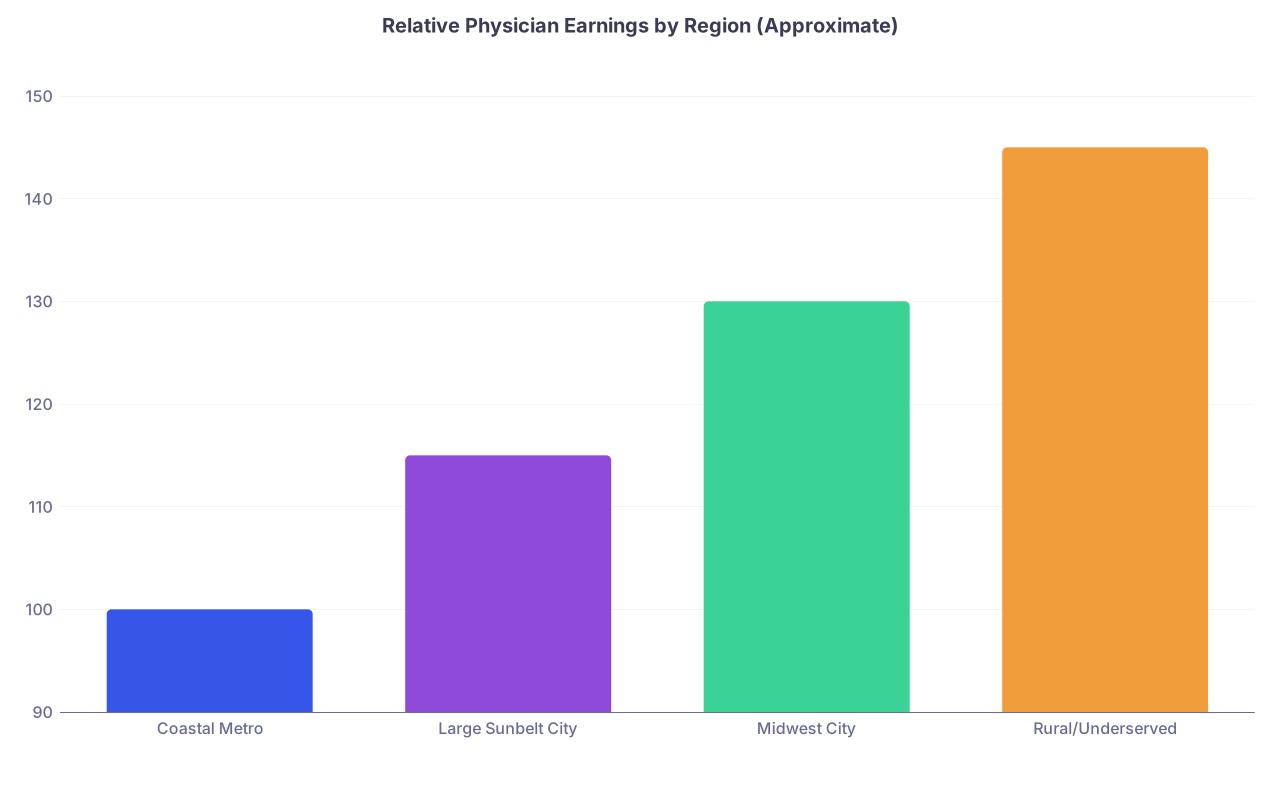
| Category | Value |
|---|---|
| Coastal Metro | 100 |
| Large Sunbelt City | 115 |
| Midwest City | 130 |
| Rural/Underserved | 145 |
Baseline coastal metro = 100. Realistically, rural/underserved can easily feel like 140–150% of that.
2. Cost of Living: The Silent Killer or Secret Weapon
A lot of docs massively underestimate this part.
Quick example of annual rough numbers for a family with young kids:
Major coastal city:
- Rent/mortgage: $4,500/month = $54,000
- Childcare for 2 kids: $3,000/month = $36,000
- Everything else (food, transit, etc.): $4,000/month = $48,000
Total: $138,000
Mid-sized non-coastal city:
- Mortgage: $2,200/month = $26,400
- Childcare: $1,600/month = $19,200
- Everything else: $3,000/month = $36,000
Total: $81,600
That’s a $56k/year difference without you working a single extra shift.
Add housing to comp to tax and you see why some folks wipe loans in 3–5 years while others feel trapped at year 12.
How State Choice Interacts With Loan Forgiveness & Repayment
The other big question: “Won’t I lose PSLF or some forgiveness if I move?”
You might. Or you might supercharge payoff so much that PSLF becomes irrelevant.
PSLF (Public Service Loan Forgiveness)
- PSLF needs:
- Direct federal loans
- Income-Driven Repayment (IDR)
- 120 qualifying payments at a 501(c)(3) or government employer
Where moving helps:
- Many community hospitals, safety-net systems, VA hospitals in lower-cost, higher-paying areas are PSLF-qualifying.
- You can move into a better-paying PSLF-eligible job.
Where moving hurts:
- If your new job is private practice or for-profit hospital, PSLF is off the table.
- If you’re already 7–9 years into PSLF, jumping ship is usually dumb unless your current plan is a disaster.
State & Employer Loan Repayment
All over the country you’ll find:
- State programs: $25k–$100k over 2–5 years for working in shortage areas.
- Employer programs: $20k–$200k spread over a contract period, usually with clawbacks if you leave early.
Typical pattern I see:
- Midwestern or Southern community hospital:
- $30k–$50k sign-on
- $20k–$50k/year in loan repayment for 3–5 years
| Setting | Typical Incentive Range | Commitment |
|---|---|---|
| Urban academic center | $0–$20k total | 3–5 years |
| Suburban private group | $0–$50k total | 3 years |
| Rural community hospital | $50k–$150k total | 3–5 years |
| FQHC / NHSC site | $50k–$100k+ | 2–4 years |
That’s real money. And yes, it stacks on top of your own aggressive payments if you plan it correctly.
The Traps: How Moving Can Fail to Speed Up Loan Payoff
This is where people screw it up.
Moving doesn’t magically fix bad behavior. It amplifies whatever you’re already doing.
Here’s how a move can totally fail you:
You inflate lifestyle instead of payments.
New job, more money, bigger house, nicer car, private school. Loans? Still crawling along at $1,500/month.You underestimate how miserable you’ll be.
If you hate rural life or despise the new city, burnout hits, you cut shifts, or bail early and lose bonuses/repayment.You don’t run the after-tax, after-benefit math.
Some “higher paying” jobs look good on the base salary but:- Higher health premiums
- Worse retirement match
- Expensive malpractice tail
- Brutal call that pushes you to cut back later
You give up PSLF too late in the game.
If you’re 8 years into PSLF, you’re probably better off finishing than chasing a high-salary private job for a few years.
Bottom line: Moving only speeds payoff if you actually keep fixed costs below your new income and throw the difference at debt.
A Clean Framework: Should You Move for Faster Loan Payoff?
Here’s the decision tree I’d use if you were sitting in front of me.

| Step | Description |
|---|---|
| Step 1 | Unhappy with loan pace? |
| Step 2 | Flexible strategy |
| Step 3 | Check PSLF progress |
| Step 4 | Usually finish PSLF |
| Step 5 | Model 3 to 5 year payoff |
| Step 6 | Optimize current city |
| Step 7 | Estimate forgiveness vs move |
| Step 8 | Consider high pay move |
| Step 9 | Move and attack loans |
| Step 10 | Stay and focus on balance |
| Step 11 | Years since entering repayment |
| Step 12 | High paying low COL job available? |
| Step 13 | At PSLF eligible employer? |
| Step 14 | Willing to cap lifestyle? |
If you’re early, not PSLF-committed, and you can line up:
- +$60k–$150k/year income
- -$20k–$60k/year cost of living
- Reasonable call and lifestyle
…then yes, moving is one of the most powerful levers you have.
How Long Could This Actually Save You?
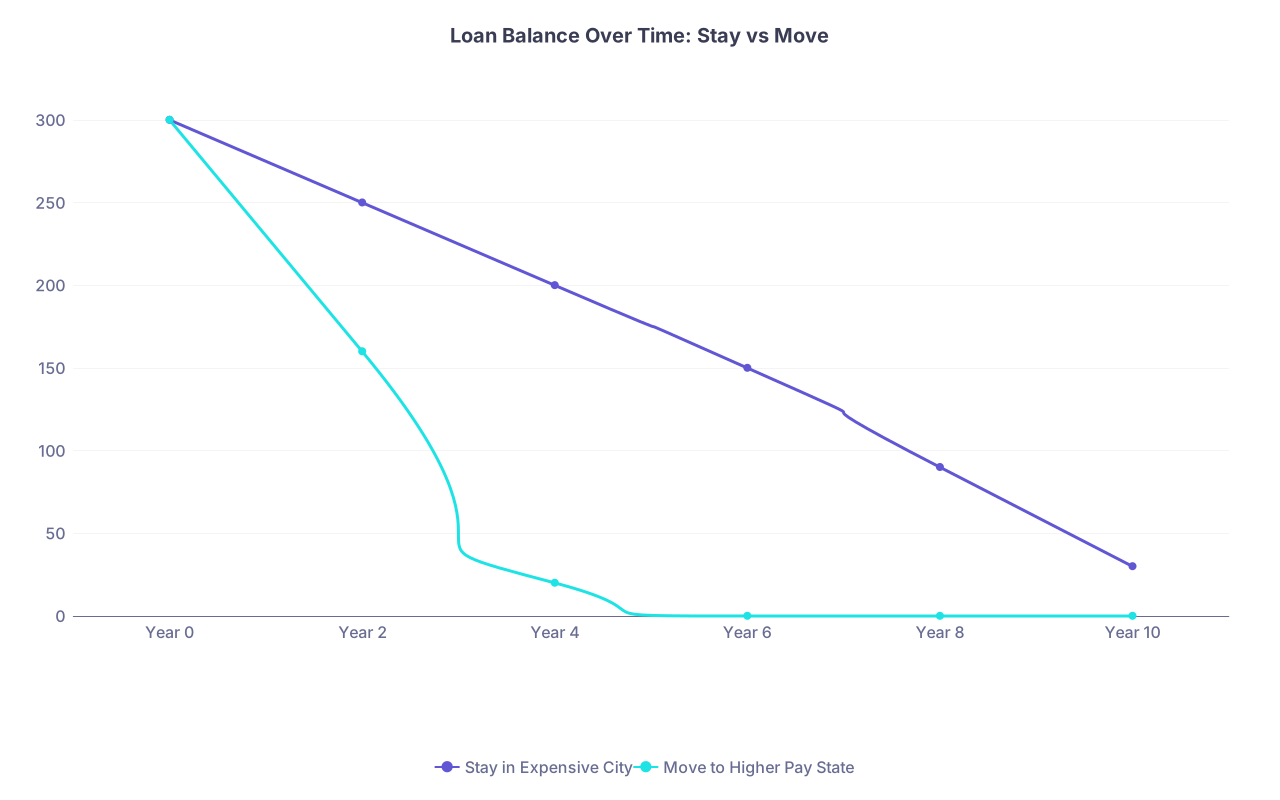
Let’s look at a simple timeline comparison with the same $300k loan:
Scenario A – Stay put in expensive city:
- Payment toward loans: $3,000/month
- Time to payoff: ~11–12 years
Scenario B – Move to high-pay, lower-COL state, stay disciplined:
- Payment toward loans: $9,000/month
- Time to payoff: ~3.5–4 years
| Category | Stay in Expensive City | Move to Higher Pay State |
|---|---|---|
| Year 0 | 300 | 300 |
| Year 2 | 250 | 160 |
| Year 4 | 200 | 20 |
| Year 6 | 150 | 0 |
| Year 8 | 90 | 0 |
| Year 10 | 30 | 0 |
Same person. One chooses “normal” payments in a shiny city, the other chooses a 3–5 year sprint in a less sexy ZIP code.
I’ve seen physicians pull this off and then move back to their dream city later, debt-free and actually in control.
Practical Steps If You’re Seriously Considering a Move
If all this is resonating, here’s how to do it like an adult, not a runaway resident.
Get real about your numbers.
- Exact loan totals and interest rates
- Current take-home pay and spending
- How much you actually send to loans monthly
Define your “sprint” window.
Decide: “I’m willing to live in X place for 3–5 years to erase this debt.” That mental frame helps a lot.Target jobs with all of:
- Significant pay jump (not $15k, I’m talking +$50k+)
- Lower cost of housing and childcare
- Some combo of sign-on/loan repayment/bonus structure that doesn’t require your soul
Do hardcore due diligence.
- Talk to current docs there without admin present.
- Ask exactly how many RVUs people are hitting and what they actually collect.
- Confirm any loan repayment program details in writing.
Pre-decide lifestyle boundaries.
- Housing budget cap
- Car budget cap
- Minimum monthly payment you’ll commit to loans the day you start Write it down. Future you in a new house with new colleagues will be very tempted to “forget.”
Decide your exit condition.
- “I’m done when loans hit zero and I have $X invested”
- Or: “I’ll reassess at year 3 with these metrics”
You’re not signing a life sentence in rural Nebraska. You’re signing up for a 3–5 year financial residency.
Quick Reality Check: Who Should Not Move Just for Loans?
I’d be cautious about moving solely for faster payoff if:
- You’re 7–10 years into PSLF at a good employer.
- You or your partner has strong geographic ties (elderly parents, kid with special needs care team, spouse’s career).
- You’re already in a fairly low-cost region with solid pay, and the alternatives are marginal improvements with big personal downsides.
- Your burnout risk is high, and the jobs offering the most money are clearly meat-grinders.
You can still get aggressive where you are. Side shifts, smarter spending, refinancing if appropriate, optimizing tax-advantaged accounts. Geography is a powerful lever, not the only one.
FAQs
1. Is moving to a no-income-tax state (like Texas or Florida) always better for paying off loans?
No. Taxes are just one piece. If you move from a high-cost, high-tax coastal city to a high-cost, zero-tax city (e.g., some parts of Austin or Miami), your rent and general costs may eat the tax savings. Run the full math: post-tax income minus real living costs. Sometimes a low-tax state still loses to a moderate-tax, dirt-cheap Midwest city.
2. Should I give up PSLF to move to a higher-paying private practice job?
Only if you’re early in the PSLF path or PSLF is effectively dead for you anyway (wrong loans, wrong employer, inconsistent payments). If you’re past 5–6 years of qualifying payments at a stable 501(c)(3) job, you need a very compelling reason—and a detailed side-by-side projection—before abandoning PSLF. Past year 8, it’s usually a mistake.
3. How far should my salary increase be to justify moving for loans?
As a rough rule of thumb, look for at least $50k/year more in net (after tax) income plus a meaningful drop in cost of living. A $20k raise is rarely worth uprooting your life for loan payoff alone. If the move doesn’t create at least an extra $3k–$5k/month you can deploy to loans, it probably won’t change your payoff timeline dramatically.
4. Is rural always better than urban for loan repayment?
Financially, rural or underserved settings often win: higher pay, better incentives, lower housing costs. But “always” is too strong. Some mid-sized cities hit a sweet spot—good pay, decent cost of living, plus a life you and your family can tolerate. If you hate rural life, the burnout cost can outweigh the financial win.
5. Should I refinance my loans if I move to a higher-paying state?
Maybe, but only if:
- You’re giving up PSLF/forgiveness permanently,
- You’re confident in your job stability and health,
- You’re planning a fast payoff (3–7 years), not 20+ years of private refinancing.
If those are true, refinancing can cut interest and speed payoff. If you might go back to nonprofit work or need IDR safety nets, be very careful—refinancing federal loans is irreversible.
6. What’s a realistic aggressive payoff timeline if I move?
For attendings with $200k–$400k in loans who move to a higher-pay, lower-COL state and stay disciplined, 3–7 years is very realistic. The shorter end (3–4 years) requires strong income, low fixed expenses, and few dependents. The longer end (5–7 years) fits people with families, childcare, or slightly lower pay but still making hefty monthly payments.
Bottom line: Yes, you can realistically pay off your loans significantly faster by moving—if the move meaningfully boosts your surplus cash and you don’t let lifestyle creep eat it. Focus on after-tax income, cost of living, and your own discipline. Choose one place to sprint, crush the debt, then decide where you actually want to build your long-term life.


