

The biggest mistake student-loan heavy physicians make is chasing prestige instead of cash flow. You do not need a “cool city.” You need margin.
You are not choosing the best state to be a doctor in general. You are choosing the best state to destroy debt as fast as humanly possible. Different game. Different rules.
Let’s set up the situation clearly.
You owe $300k–$600k+ in federal loans, maybe some ugly private loans mixed in. You’re finishing residency or early attending. You’re tired of watching $2,000–$4,000 a month evaporate and barely touch principal. You want out in 3–7 years, not 20–25.
That goal should drive where you work. Not beaches. Not food scene. Not “my friends live there.”
The Core Formula: How To Judge a State for Aggressive Paydown
Forget fifty different factors. For crushing debt, nearly everything reduces to this simple formula:
After-tax income – required cost to live and work = your weapon against loans.
So the “best” states are the ones that maximize the size of that weapon.
You’re looking at five main levers:
- How much they pay you
- How much of that the government takes
- How expensive it is to exist there
- How brutal the call/shift load is (you can’t moonlight if you’re destroyed)
- Whether you’re going PSLF/forgiveness or straight payoff
Let’s walk each one.
1. States that pay physicians more
In broad strokes, lower-density, less “sexy” states pay more. Because they have to. Nobody dreams of moving there.
Think: Plains, Midwest, parts of the South, interior West. The Dakotas, Wyoming, Montana, Iowa, Kansas, Oklahoma, Arkansas, non-coastal Texas.
You see it all the time:
- Hospitalist in Boston: $260k–$300k
- Same hospitalist in mid-size Midwest city: $320k–$380k
- Same in rural upper Midwest/plains: $350k–$420k+
Same training. Sometimes worse lifestyle, sometimes better. But the gap is real.
2. What the state takes from you
State income tax matters. Not as much as people think, but for an attending it’s not noise either.
No-income-tax states:
- Texas
- Florida
- Tennessee
- Nevada
- Wyoming
- South Dakota
- Washington
- Alaska (yes, there are doctors there, and some do very well)
High income tax, still physician-attractive, but more painful for payoff:
- California
- New York
- New Jersey
- Oregon
- Minnesota
- Massachusetts
Then there’s the middle — 4–6% states that won’t kill you but still take a bite: Colorado, North Carolina, Georgia, etc.
3. How much it costs to live
Your debt payoff speed depends much more on rent/mortgage and childcare than on your latte habit. Everyone argues about coffee while paying $3,000/month for a 1-bedroom in a “good” neighborhood.
Basic rule: expensive coastal city = slow payoff unless your income is truly absurd.
Low cost-of-living states + small/medium cities let you:
- Rent a decent 1–2 BR for $1,200–$1,800, not $3,000+
- Buy a house that doesn’t look like a shoebox for < $400k
- Actually save 30–50% of your take-home if you’re disciplined
That’s how you kill $400k of debt in 5–7 years.
4. Lifestyle and hours (so you can actually push)
You can’t do extra shifts if you’re post-call and barely functional. In reality:
- Some high-pay rural jobs are high-burnout
- Some mid-market community jobs hit the sweet spot: good pay, manageable call, room for moonlighting
- Academic coastal jobs: often worst for payoff (lower salary, high CoL, more non-RVU work)
You’re looking for the combo where you can realistically:
- Work your main job
- Add extra shifts/moonlighting (if you want)
- Still be a human
5. Your loan strategy: PSLF vs pay-it-off
Critical fork in the road:
- If you’re going PSLF (10 years of qualifying payments, then tax-free forgiveness), you might want:
- Non-profit/academic hospital in higher cost-of-living city
- Payment as a % of income (IDR plans) → higher CoL can actually help because you’ll have more deductions and may not chase maximum salary
- If you’re not doing PSLF and want loans gone in 3–7 years, you want:
- Max income
- Min expenses
- Likely private/refinanced loans at lower rates
- Zero lifestyle creep
This article is mostly for that second group: you are not hanging around for PSLF; you want the loans dead.
The Shortlist: States That Often Win for Aggressive Paydown
Let me give you a blunt short list first, then I’ll break them down.
If your goal is maximum dollars to loans, these states repeatedly surface as strong options (specific city/region still matters, obviously):
- Texas
- Florida
- Tennessee
- Indiana
- Ohio
- Wisconsin
- Iowa
- South Dakota
- North Dakota
- Wyoming
And a second tier that’s still very solid if you pick the right city:
- Missouri
- Oklahoma
- Kansas
- Arkansas
- Nebraska
- North Carolina (non-coastal, non-Raleigh/Charlotte-core)
- Georgia (outside Atlanta core)
Let’s compare a few so you see the pattern.
| State | State Income Tax | Typical Attending Pay (Primary Care/IM) | Cost of Living vs US Avg | PSLF-Friendly Jobs Availability |
|---|---|---|---|---|
| Texas | 0% | High | Slightly below to avg | High in big systems |
| Florida | 0% | High | Around average | Moderate |
| Tennessee | 0% | High | Below average | Moderate |
| Indiana | ~3% flat | High | Below average | Good in urban centers |
| California | ~9–13% high earners | Medium | Very high | Very high |
This is directional, not gospel, but you get it.
State Profiles: What It Actually Feels Like
Texas: The Classic “Payoff State”
Why Texas works so well for loan-heavy physicians:
- No state income tax
- Big health systems, lots of hospital jobs
- Pay: usually strong to very strong, especially outside Austin inner core and fancy Dallas suburbs
- Cost-of-living: Houston, San Antonio, many Dallas/Ft. Worth suburbs = much cheaper than coastal cities
Typical scenario I’ve seen:
- IM hospitalist in Houston or San Antonio: $320k–$380k
- State tax: 0
- Reasonable rent: $1,800–$2,300 for a good 1–2BR
- Aggressive doc lives like a resident, drives a paid-off car, doesn’t try to “flex” early
That physician can throw $8k–$12k/month at loans without living like a monk.
Caveats:
- Property taxes are high (if you buy early, run the numbers)
- Some markets are getting saturated; be picky about contracts and RVUs
- Lifestyle and politics might not be your thing. That matters for longevity.
Florida: Sunshine, No State Tax, Variable Pay
Florida is a mixed bag but can be powerful if you choose your spot carefully.
Pros:
- No state income tax
- Strong pay in many community/rural hospitals
- Some lower cost-of-living pockets inland and north (away from Miami/Tampa/Orlando cores)
Cons:
- Certain coastal cities have California-level housing insanity
- Some hospital systems are grindy: high volumes, metrics pressure
- Flood/insurance costs if you buy near coast
For an aggressive payoff doc, think more Jacksonville, Gainesville-adjacent, Panhandle, inland cities — not Miami Beach penthouse.
Tennessee: Underrated Workhorse State
If you care more about payoff than clout, Tennessee deserves a serious look.
Pros:
- No state income tax on wages
- Cost-of-living in many areas still clearly below national average
- Medium-sized cities (Knoxville, Chattanooga) with solid hospital systems and reasonable housing
Nashville has gotten expensive, but even there, you can often do better than coastal megacities. The magic is picking a job 30–60 minutes outside the hottest zip codes.
Upper Midwest / Plains: South Dakota, North Dakota, Iowa, Wisconsin, Wyoming
This is where Main Character Energy physicians refuse to look — and where quiet killers wipe out their loans.
Things you get here:
- Big pay differentials for primary care, hospitalist, EM, anesthesia, some surgical subspecialties
- Often lower rent and house prices
- Signing bonuses, relocation bonuses, sometimes loan repayment incentives on top
Things you give up:
- Big-city nightlife
- Short winter
But if you can do 3–5 years there? You walk away with:
- Loans annihilated
- Fat emergency fund
- Maybe 6-figure retirement accounts started
- The ability to later take a “passion” job in a coastal city without the anvil of debt
Midwest Value States: Indiana, Ohio, Missouri, Kansas, Arkansas, Oklahoma, Nebraska
These are the “marathon states” — not as extreme as the Dakotas, but very efficient.
Why they work:
- Many cities where rent/mortgage is sane
- Taxes moderate but not insane
- Solid mid-sized academic + community systems
- Easy to get a high-salary community gig within 60–90 minutes of a major city airport
This is where you can live a fairly normal life while still throwing big money at loans.
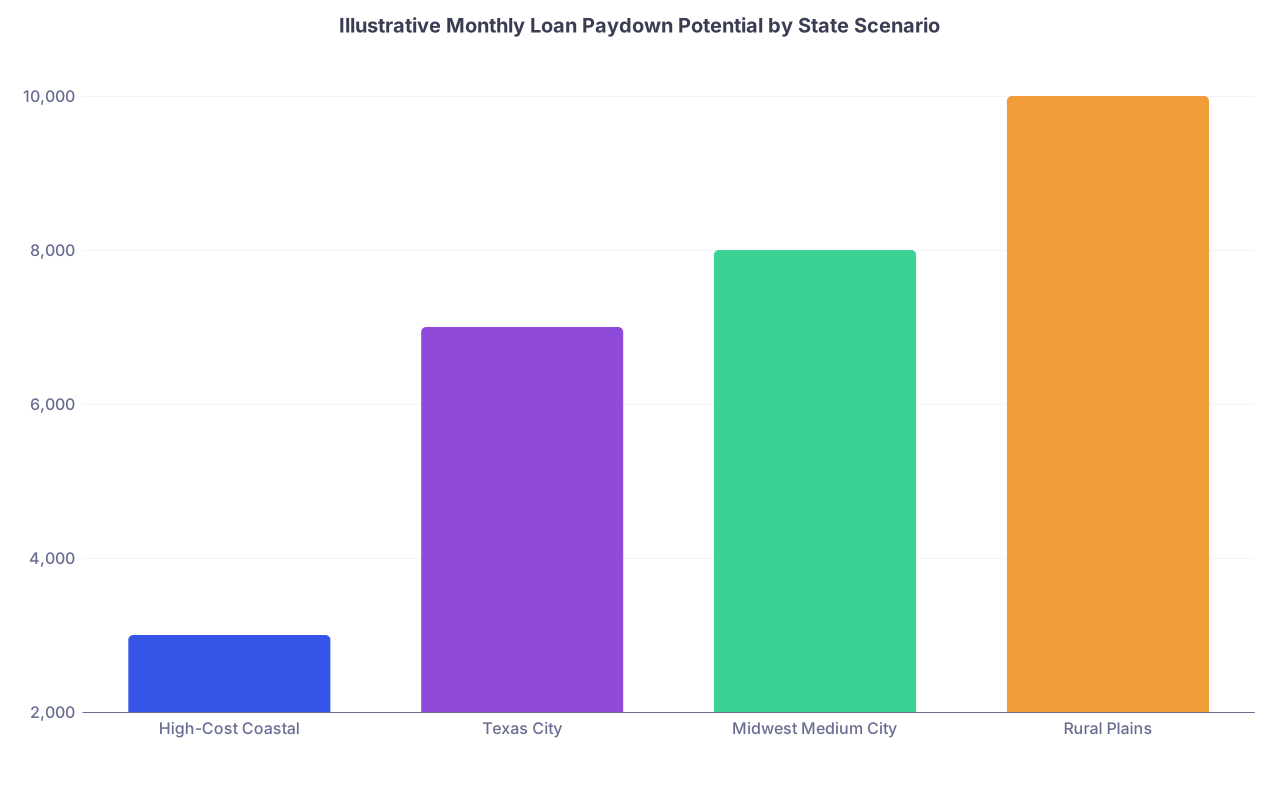
| Category | Value |
|---|---|
| High-Cost Coastal | 3000 |
| Texas City | 7000 |
| Midwest Medium City | 8000 |
| Rural Plains | 10000 |
Interpretation of that chart: same specialty, different geography. The gap is what you can potentially send to loans if you keep lifestyle under control.
Where PSLF Changes the Answer Completely
If you are 100% committed to PSLF — meaning you will:
- Work at a 501(c)(3) or qualifying government entity
- Stay full-time for 10 years
- Use IDR (SAVE/IBR/etc.) correctly the whole time
— then the “best state” ranking shifts.
In that case you want:
- A stable non-profit hospital or academic center job
- A place you’re willing to stay for a decade
- High rent hurts less because your required payment is based on income, not rent, and the forgiveness at the end is tax-free
So yes, someone at UCSF, NYU, or Mass General with $500k+ loans, low attending pay relative to CoL, and PSLF dialed in might come out ahead versus a high-paying Texas private group doc who refinances and pays everything off.
But that requires:
- Trusting PSLF rules will not radically worsen for you
- Tolerating academic politics and lower pay for 10 years
- Not burning out and leaving for private practice in year 6 (I’ve watched people nuke their PSLF path that way)
If you’re PSLF-committed, you evaluate states and cities by:
- Density of non-profit health systems
- Academic center opportunities in your specialty
- Where you can stay for a decade without hating your life
For many, that still means higher-cost blue states with dense hospital networks. That’s fine — but that’s a different game than aggressive pay-down.

| Step | Description |
|---|---|
| Step 1 | Graduating Resident |
| Step 2 | Refinance and pay off fast |
| Step 3 | PSLF path in non profit job |
| Step 4 | Choose city for long term fit |
| Step 5 | Choose state for max cash flow |
| Step 6 | Debt over 300k? |
| Step 7 | Plan to stay 10 years in one system? |
Realistic Lifestyle Examples: What This Looks Like Month-To-Month
Let’s build two fictional but very believable examples.
Example 1: “Coastal Academic” vs “Midwest Community”
Same specialty: Internal Medicine hospitalist
Same starting debt: $450,000 at blended 6.5%
Scenario A – Coastal Academic (PSLF path):
- Job: Academic hospitalist in San Francisco
- Gross: $250k
- State tax: ~9–10% effective on high bracket
- Rent: $3,200 for modest 1BR
- Federal + State + FICA: roughly $70k–$80k total (ballpark)
- Take-home: maybe $11k–$12k/month after tax and benefits
- IDR payment: maybe $1,500–$1,800/month
Realistically can send:
- $1,500–$1,800 required loan payment under PSLF
- Maybe another $1k–$2k if ultra-disciplined
- But you’re planning on PSLF, so you probably just pay minimum
Scenario B – Midwest Community (payoff path):
- Job: Community hospitalist in Indiana midsize city
- Gross: $340k
- State tax: ~3% flat
- Rent: $1,600 for good 1BR or modest house share
- Federal + State + FICA: ~ $90k–$100k
- Take-home: ~ $15k–$16k/month
If this person lives like a resident:
- Basic expenses: $4k–$5k/month (rent, food, car, insurance, etc.)
- Leftover: $10k–$12k/month to loans and savings
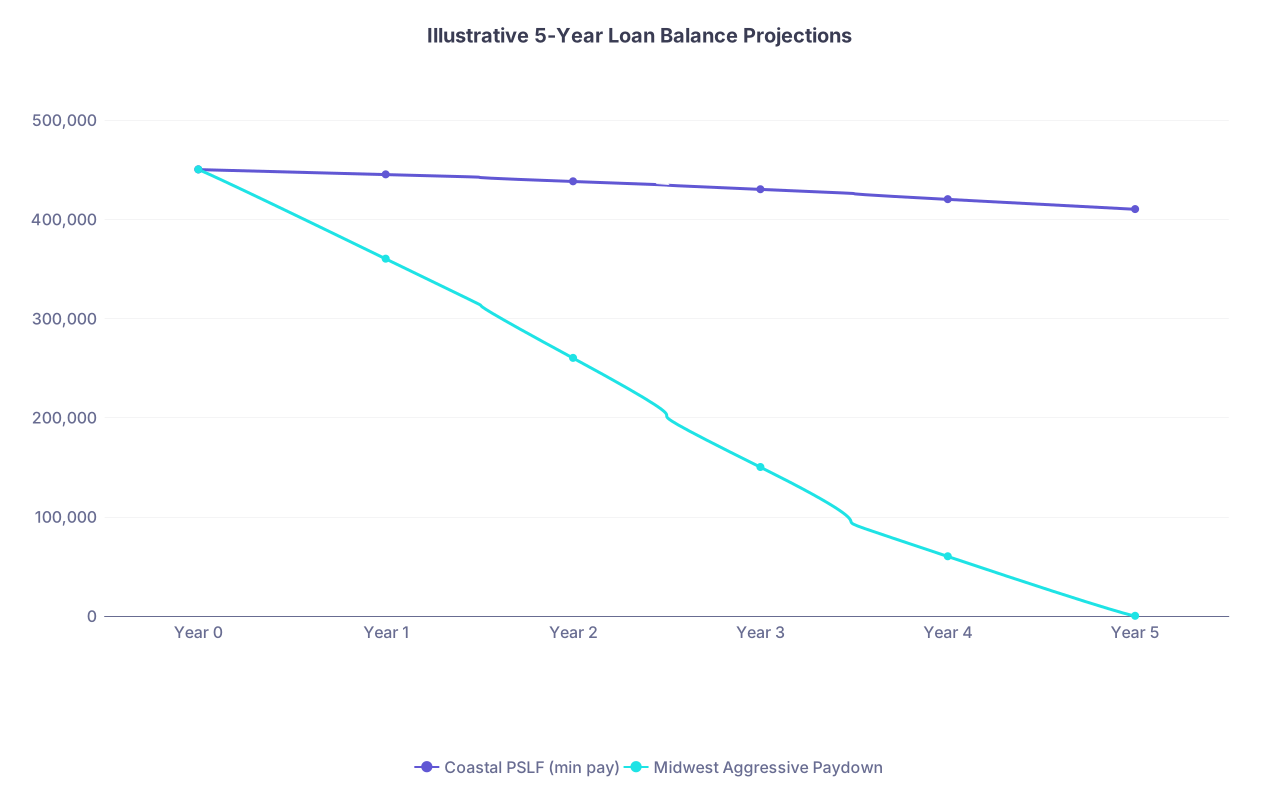
That’s a $8k–$10k monthly difference in attack money. Over 5 years, that’s $480k–$600k.
One is playing the PSLF long game. The other is just deleting the debt aggressively. Both are rational. But only one state setup lets you pay off quickly without living like a monk.
| Category | Coastal PSLF (min pay) | Midwest Aggressive Paydown |
|---|---|---|
| Year 0 | 450000 | 450000 |
| Year 1 | 445000 | 360000 |
| Year 2 | 438000 | 260000 |
| Year 3 | 430000 | 150000 |
| Year 4 | 420000 | 60000 |
| Year 5 | 410000 | 0 |
Those numbers are simplified, but that’s the shape of it.
How To Actually Use This: A Stepwise Approach
You don’t need a perfect state. You need a state that gives you:
- A realistic shot to save and pay 30–50% of your take-home
- A job that won’t break you
- Enough life satisfaction to not bounce after 12 months
Here’s how to approach this like a grown-up instead of just chasing “vibes.”
Step 1: Decide your primary goal
You have to pick a lane.
- Lane 1: “I want loans gone in 3–7 years. I will move.”
- Lane 2: “I want PSLF/forgiveness. I will commit to a 10-year employer type.”
- Lane 3: “I care more about location than money. I accept slower payoff.”
If you’re reading this, you’re probably Lane 1 or 2. Say it out loud. Write it down.
Step 2: Run rough numbers for 3–5 states
Pick a handful of states that meet your non-negotiables (climate, distance to family, whatever).
For each state, estimate:
- Likely salary in your specialty (talk to recent grads, recruiters, specialty societies)
- State income tax rate
- Average rent/mortgage where you’d realistically live
- Typical childcare costs if relevant
Then do this on scratch paper:
- Annual gross – federal + state taxes ≈ take-home
- Subtract actual lifestyle number you’re willing to live with (be honest)
- What’s left = potential monthly attack money
If that number is under $4k–$5k, you’re not doing “aggressive” payoff. That’s slow burn. You want those math results up around $7k–$10k/month or more.

Step 3: Filter jobs within those states by three criteria
Once you’ve narrowed states, job matters more than the state average.
Red flags for someone trying to pay debt fast:
- “Partnership track” with unclear numbers and low guaranteed base
- Heavy unpaid admin/teaching work in a non-PSLF-eligible private system
- RVU comp in a saturated market with no volume
- No moonlighting allowed, or extremely restrictive covenants
Green flags:
- Clear base salary + transparent RVU/bonus structure
- Reasonable call schedule
- PSLF-eligible if that’s your chosen lane
- Benefits that don’t destroy your usable take-home (insane mandatory pension contributions can be a hidden tax)
Step 4: Decide what you’re willing to sacrifice short-term
There is no aggressive payoff without tradeoffs. You pick:
- Geography: maybe you live somewhere “boring” for 3–5 years
- Housing: you rent smaller or older
- Car: you drive something reliable but not impressive
- Trips: fewer, cheaper, later
If you want everything — cool city, luxury housing, expensive car, big trips — you are implicitly choosing 15–25 years of loans. That’s fine, but name it.

What I’d Do If I Were You (Different Debt Levels)
Let me be more concrete and opinionated.
If you owe under $250k
You have options. You don’t have to contort your life.
- You can live in a medium-cost state, take a solid community job, and still kill your loans in 5 years while living decently.
- I’d still avoid the highest-cost cities if you can, but you don’t need to run to the Dakotas unless you want to.
If you owe $250k–$500k
Now location and job start to matter a lot.
I’d lean heavily toward:
- No-tax or low-tax states with strong physician pay: Texas, Tennessee, Florida, Indiana, Ohio, upper Midwest, Plains
- Community or hybrid academic positions with high base pay and manageable call
- 5–7 year plan: 3–5 years of aggressive attack, then reassess
If you have a strong PSLF-eligible offer in a desirable city, you can run that scenario too, but you’d better be confident you’ll stay.
If you owe $500k–$700k+
This is where trying to brute-force payoff in San Francisco or Manhattan is almost comical unless you’re in derm, ortho, plastics, etc. and making obscene money.
You basically have two sane options:
- PSLF in a high-paying non-profit or academic center, in a place you can stomach for a decade
- Massive-income job in a low-cost, low/no-tax state + spartan lifestyle for 5–7 years
The second option almost always means:
- Community or rural job
- Willingness to live off a minority of your income
- Treating those years as a focused “financial residency” before you move where you truly want
You’re not stuck there forever. But you need to get brutally honest about the math.

The One Mindset Shift You Need
Stop asking: “What’s the best state to work as a doctor?”
Start asking: “Where can I live for 3–7 years that lets me pay myself first and destroy this debt, while staying sane?”
That question leads to very different answers.
Your co-residents will go to shiny places with famous names on the hospital badge and giant apartments they can barely afford. Some of them will still be complaining about loans at 45.
You can do this differently.
Pick one action today: open a blank page and write down three states you’d never considered seriously — but that match the high-pay, lower-cost pattern. Then, for one of them, pull two real job listings and rough out the monthly take-home vs expenses. Look at the number that’s left over. Does it change how you feel about where you were planning to go?


