The idea that “slow readers can’t finish board exams” is garbage.
Not because timing isn’t real. It’s very real. But because most people confuse “I read slowly” with “I have zero strategies and my anxiety is driving the bus.” Those are not the same problem.
And yeah, I’m talking to you—the person who’s done UWorld blocks where you look up and somehow 33 questions took you 80 minutes and you don’t even know how. The person who reads every answer explanation like it’s sacred scripture because “what if I miss something.” Then you extrapolate and think, “If I can’t finish 40 UWorld questions, how the hell am I supposed to finish a 280‑question board exam?”
Let me walk straight at the fear you probably have sitting in the back of your mind:
What if the clock runs out and I still have 20 unanswered questions sitting there?
The ugly math: can you actually finish in time?
Let’s do the thing that keeps you up at night and put numbers to it.
For big board exams (think USMLE/COMLEX level style), you’re usually looking at something like:
| Exam Type | Questions per Block | Minutes per Block | Time per Question |
|---|---|---|---|
| USMLE-style | 40 | 60 | 1.5 min |
| COMLEX-style | 44 | 70 | ~1.6 min |
| In-service exam | 25–50 | 30–75 | 1.3–1.8 min |
So reality: you’re supposed to read, process, decide, click, and move on in like a minute and a half. That’s it. For a stem that sometimes takes an entire screen and a half to scroll.
If you’re a “slow reader,” this feels instantly impossible. Your brain goes:
- I read the stem slowly
- I reread because I’m scared to miss things
- I second-guess between two answers
- The clock evaporates
So can you finish? Yes. But not if you keep using your “I’m reading a textbook” brain on an exam that’s really “pattern recognition speed chess.”
The bigger truth: this is less about your reading speed and more about what you insist on doing with each question.
Why “slow reader” is usually code for something else
Every time I hear someone say “I’m just a slow reader,” what I see in practice is usually one of these:
- You’re trying to understand every word like you’re about to give a grand rounds on the vignette.
- You don’t trust your first impression, so you reread the stem. Twice.
- You read all four (or five) answer choices in full, twice, just to be sure.
- You feel weird guessing, so you burn time trying to be 100% sure on stuff nobody is 100% sure about.
That’s not “I’m slow.”
That’s “I treat each question like it’s my last chance to prove I’m not an impostor.”
I’ve watched residents do “timed” UWorld blocks, and they’ll spend 4+ minutes on some vague vasculitis question, then panic toward the end and blitz through the last six questions in 30 seconds. Then they leave thinking, “See? I’m too slow.”
No. The issue is you gave some questions way more time than they deserve.
The boards are not graded on “who read the most carefully.” They’re graded on “how many you got right,” and timing is a silent, ruthless constraint.
The weird truth: you can be a slow reader and still finish
Here’s the part nobody says clearly: you don’t need to read fast enough for every question. You just need your average time per question to stay under ~1.5 minutes.
That means:
You can absolutely take 2+ minutes on a monster ethics or stats question
if
you also take 45 seconds on straightforward slam-dunks.
So the real game becomes:
How do you intentionally read some questions “shallow and fast” and others “deeper and slower” without losing points?
This is where strategy starts to matter much more than raw reading speed.
Let me show you the pattern difference.
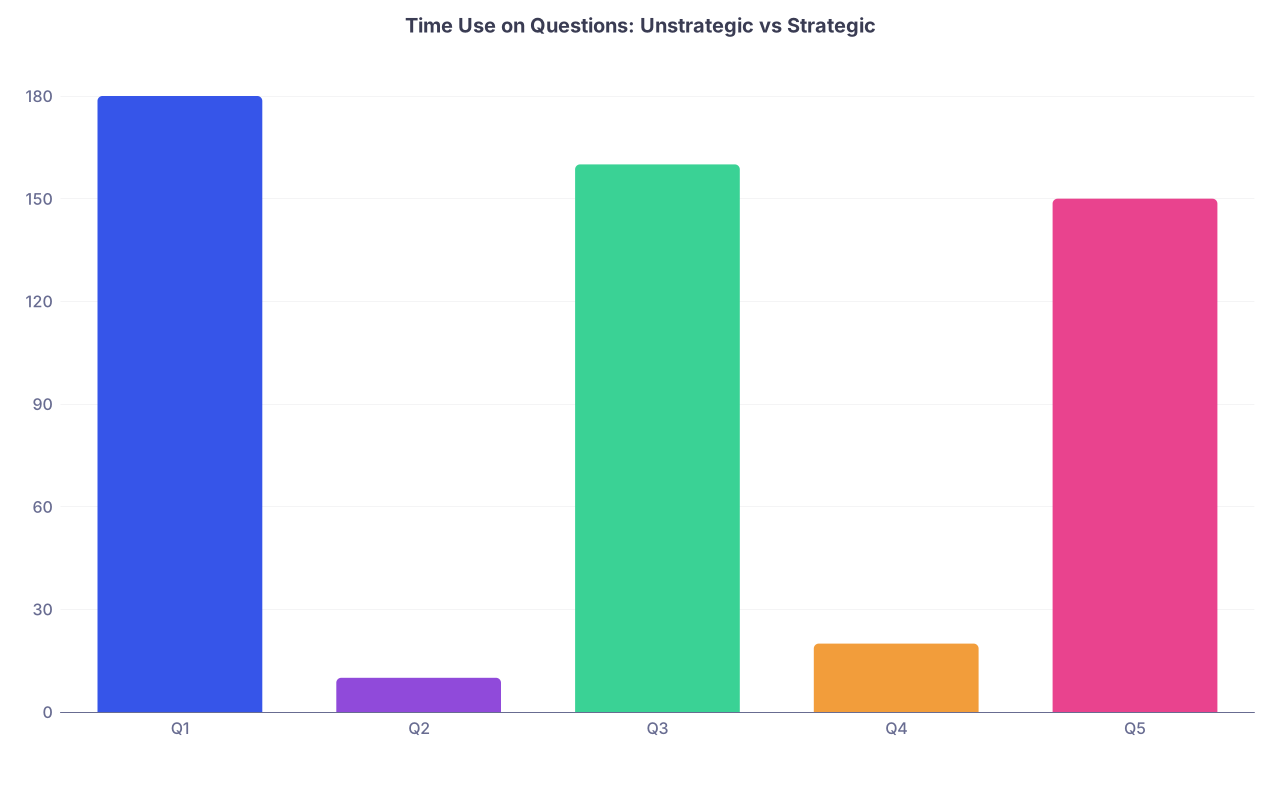
| Category | Value |
|---|---|
| Q1 | 180 |
| Q2 | 10 |
| Q3 | 160 |
| Q4 | 20 |
| Q5 | 150 |
That’s the unstrategic panicked version: three questions get 2–3 minutes, two questions get panic-clicked. Your accuracy tanks.
The strategic version is more like:
60 sec, 80 sec, 90 sec, 50 sec, 75 sec.
No drama. You’re not sprinting or dying. You’re just…paced.
And yes, people who self-identify as “slow readers” absolutely get there once they stop trying to read like they’re in a journal club.
Concrete strategies if your reading speed is wrecking your confidence
Let’s be real. You probably don’t want vague “just practice more” advice. You’re already doing questions. You’re still panicking about time. So here’s what actually changes things.
1. Change the order: before you read the whole stem
For long vignettes, slow readers get slaughtered by reading everything line by line, then getting to the question and realizing half of what they just read was irrelevant trivia.
Flip it:
- Glance at the last line first: “What’s the most likely diagnosis / best next step / mechanism?”
- Then your brain knows what it’s looking for as you read the stem. You filter.
You are not reading a short story. You’re hunting.
If the question is “Most appropriate next step in management?”, you’re laser-focused on:
- Stability
- What’s already been tried
- Timeline and severity
You are emphatically not deeply absorbing their grandmother’s smoking history unless it’s obviously relevant.
This single change saves ridiculous amounts of time for slow readers.
2. Accept that you will never be 100% sure
Here’s the thing nobody likes to admit: on a big board exam, there will be dozens (plural) of questions where you’re choosing between two answers that both kind of fit and you’re never going to feel fully certain.
If your rule is “I move on only when I feel confident,” you are dead on arrival.
New rule:
If I’ve spent ~90 seconds, narrowed it to 2, and there’s no new information coming from staring at it, I pick one and move on. Full stop.
Is that scary? Yep.
Is that what people who pass do? Also yes.
People who finish on time are not magical fast thinkers. They’re people who are willing to be uncomfortable and click “next” anyway.
3. Use a hard cutoff rule
Slow readers hate this, but it works.
Set a brutal, inflexible rule for yourself:
If I hit 90 seconds and I’m still flailing, I choose my best guess, flag it, and move on. No negotiation.
Because what’s worse?
- Burning 4 minutes on one question and leaving 5 blank at the end
or - Guessing on that one, saving 3 minutes, and earning yourself enough time to correctly solve 3–4 other questions you actually know?
You already know the math.
On a high-stakes board, the person who leaves 10 questions blank because they ran out of time is in a much worse spot than the person who guessed on all 10 with 10 seconds to spare. A random guess has a non-zero chance. A blank is a guaranteed miss.
4. Train pace separately from knowledge
Most people mix these and then get confused.
You have to run two different types of blocks:
Learning blocks (untimed or soft-timed)
You go slower, read explanations in detail, build understanding.Speed/pace blocks (strictly timed)
Your main objective is not maximum learning.
Your objective is staying on a 1.5 min/question pace no matter what, even if it means you guess more than you’d like on hard questions.
If every block you’ve ever done is “I’m doing questions to learn,” you’ve literally never practiced the separate skill of “I’m doing questions to finish on time.” Of course timing feels impossible.
You cannot magically be a different test-taker on exam day than you are in practice.
What if you have an actual reading/processing issue?
Let’s hit the fear you probably don’t even want to say out loud:
“What if I actually can’t read fast because of ADHD/dyslexia/processing speed issues? What if I’m doomed?”
You’re not doomed. But you do need to be honest.
If any of these sound like you:
- You have to reread the same sentence 3–4 times to even retain it
- You consistently run out of time on standardized tests, even in different subjects, over years
- Your practice exams show a pattern of huge time pressure and rushed last questions, even after using all the strategies above
- You’ve always been told “you’re smart but slow to read / process” since childhood
Then you should at least consider if a learning disability / processing speed issue is part of this.
Because here’s the actual thing programs and boards don’t advertise loudly: documented disabilities can qualify you for extended time accommodations. I’ve seen people go from “never finished a block in their life” to “actually had time to breathe” once they got 1.5x time.
Is it a pain to pursue testing and documentation as a resident? Yes.
Is it sometimes the difference between failing and passing? Also yes.
There’s a brutal stigma around this in medicine—like if you ask for accommodations you’re weak or cheating. That’s nonsense. It’s like calling glasses cheating in an eye exam.
If you even mildly suspect this might be you, talk to your program, your school’s disability office (if you still have access), or a neuropsychologist. Don’t wait until you’ve failed something.
How to realistically practice so you don’t melt down on test day
The nightmare scenario your brain keeps replaying is probably something like:
“I get into block 3, realize I’m behind time, panic, and then everything collapses.”
So you practice against that scenario specifically.
Take a full-length practice day. Not just one block. The whole painful thing.
Then do this:
- Go in with a concrete pace plan: e.g., “After 10 questions, I should have ~45–50 min left; after 20 questions, 30–35 min left; after 30 questions, 15–20 min.”
- Force yourself to check the clock only at those checkpoints. Not after every question. That just raises your heart rate for no benefit.
- When you see you’re behind, immediately switch into “move faster and accept more guessing” mode for 5 questions. Don’t panic—intentionally loosen your thoroughness on the next 5. You’re practicing the recovery, not perfection.
Then you review your performance:
- Did you actually miss more questions when you moved faster? Usually the answer is “not as many as I feared.”
- Where did you hemorrhage time? It’s almost always a cluster of 3–5 questions in the middle where you refused to let go.
The goal of practice is not to create this mythical test-taker who never feels rushed. The goal is to prove to yourself you can feel rushed and still execute a plan.
Here’s the mental model that helps:

| Step | Description |
|---|---|
| Step 1 | Start Block |
| Step 2 | Check time at Q10 |
| Step 3 | Continue normal pace |
| Step 4 | Speed up for 5 questions |
| Step 5 | Accept more guessing |
| Step 6 | Recheck time at Q20 |
| Step 7 | Behind pace? |
| Step 8 | On pace now? |
That’s it. Not magic. Just a rule you follow even when your anxiety is screaming.
The part you probably need to hear most
You can absolutely finish a full-length board exam on time as a “slow reader” if:
- You stop demanding certainty on every question
- You accept that some questions get a hard time cutoff
- You practice pace as a separate skill from content
- And, if needed, you advocate for accommodations instead of quietly suffering
The thing that actually destroys people isn’t their baseline reading speed. It’s this mix of:
“I must prove I’m not dumb on every question”
“I must read every word like it’s life-or-death”
“I’ll just magically be faster on exam day somehow”
You’re not going to magically be faster. But you can absolutely be more strategic, less perfectionistic, and more ruthless with your time.
And that’s enough.
FAQ (exactly 5 questions)
1. What if I always run out of time on UWorld—doesn’t that mean I’ll automatically run out of time on the real thing?
Not automatically. Most people do UWorld in “learning mode” and then assume that timing carries over. If you’ve never done multiple blocks with strict 1.5 min/question pace and forced yourself to move on at 90 seconds, you don’t actually know your “exam mode” speed. You might still need work, but UWorld timing in isolation—without strategy—overestimates how bad things are.
2. Should I read the whole question stem first or jump straight to the question?
For long vignettes, go to the question line first. Then read the stem with a purpose, hunting for what actually matters. For shorter stems, it’s fine to just read straight through. What you should not do is read every long stem twice because you’re scared of missing details you probably don’t need.
3. Is it better to leave questions blank than to guess if I’m running out of time?
No. On major board exams, blanks are essentially guaranteed wrong. A guess, even a fast one, has a real chance of being right, especially when you can eliminate 1–2 options quickly. If the clock is dying, you’re always better off bubbling something in for everything, even if it’s just a best guess.
4. How many full-length practice exams should I do to feel confident about timing?
You don’t need ten. Usually 2–3 true full-length days (with your actual planned break structure and strict timing) are enough to prove to yourself that you can maintain pace over multiple blocks. What matters more is that you treat those days seriously and adjust based on what you learn, instead of just suffering through them and moving on.
5. What if I’ve already failed one board exam because of timing—does that mean I’m just not cut out for test-taking?
No. It means your current system failed you, not that you’re fundamentally broken. I’ve seen people fail on their first attempt because they were perfectionistic and slow, get ruthless with pace, sometimes pursue accommodations if appropriate, and then pass comfortably. A failed attempt is brutal, but it’s not a personality trait. It’s a feedback signal that something in your timing and strategy needs to change—and it absolutely can.