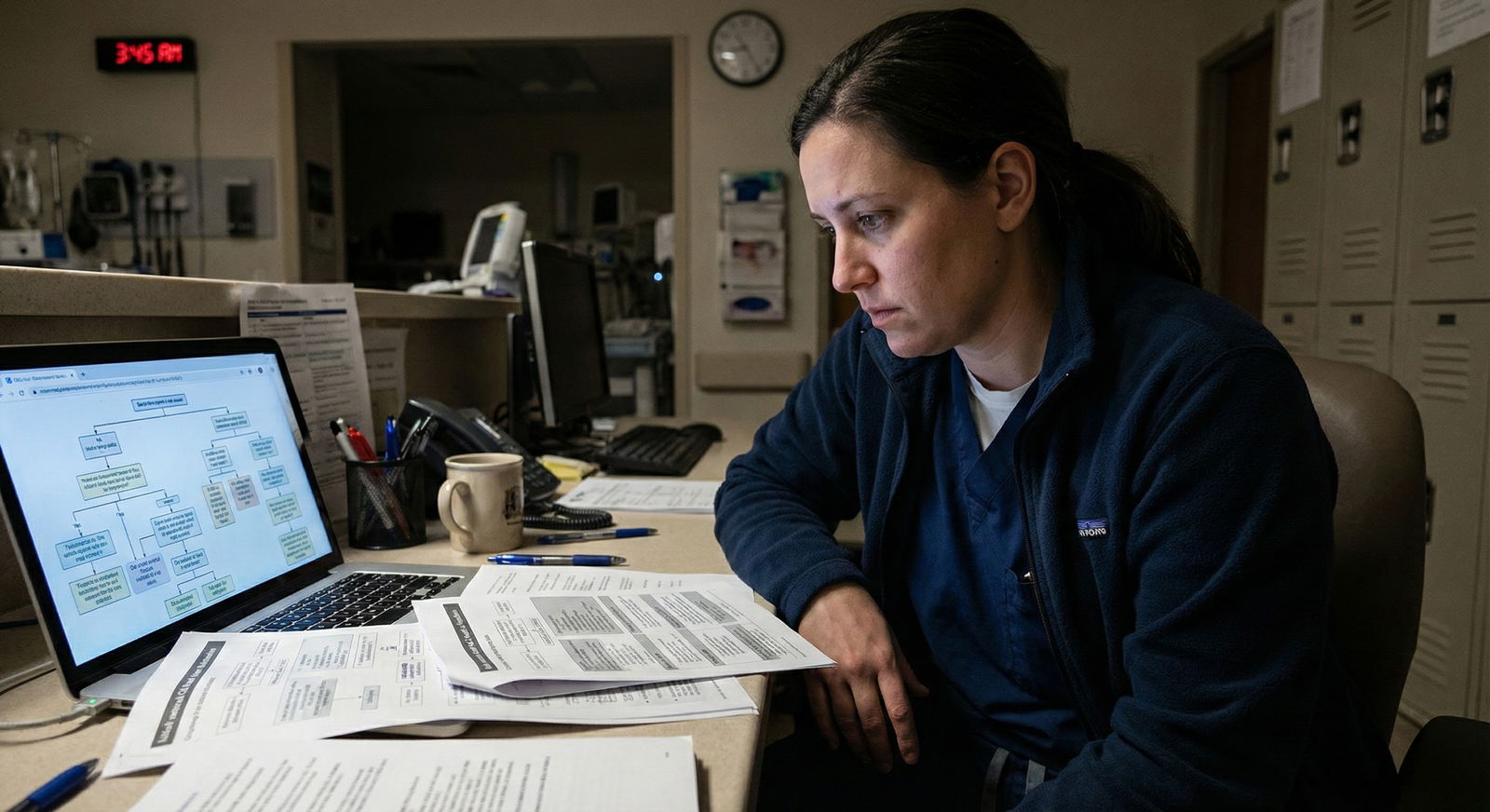
What if you’re a PGY-3 and suddenly can’t remember stuff you knew as an intern?
You’re on nights, nurse calls about chest pain in a 70-year-old, and your brain… stalls. You know you know this. But your mind serves you five different ACS algorithms, three guideline updates, and absolutely zero confidence.
And then the thought hits: “I’m a PGY-3. I’m supposed to be the senior. Why am I blanking on basic crap while I’m supposedly ‘studying for boards’ all the time? Is this… bad? Like actually unsafe bad?”
Let me say it plainly: what you’re describing is normal. Ugly, unsettling, panic-inducing. But normal.
And no, it doesn’t mean you’re going to fail your boards or kill someone on your next call shift.
What’s actually happening to your brain in PGY-3
You’re not just “forgetting basics.” You’re juggling:
- 60–80 hour weeks (even if the schedule says 55, let’s be honest about the “just stay to finish this…” culture)
- Constant interruptions
- Emotional load (codes, angry families, sick patients, attendings with “feedback”)
- Board prep on top of all that
Your brain is not a magical bottomless filing cabinet. It’s more like a hard drive that’s being defragged while you’re running a thousand programs at once.
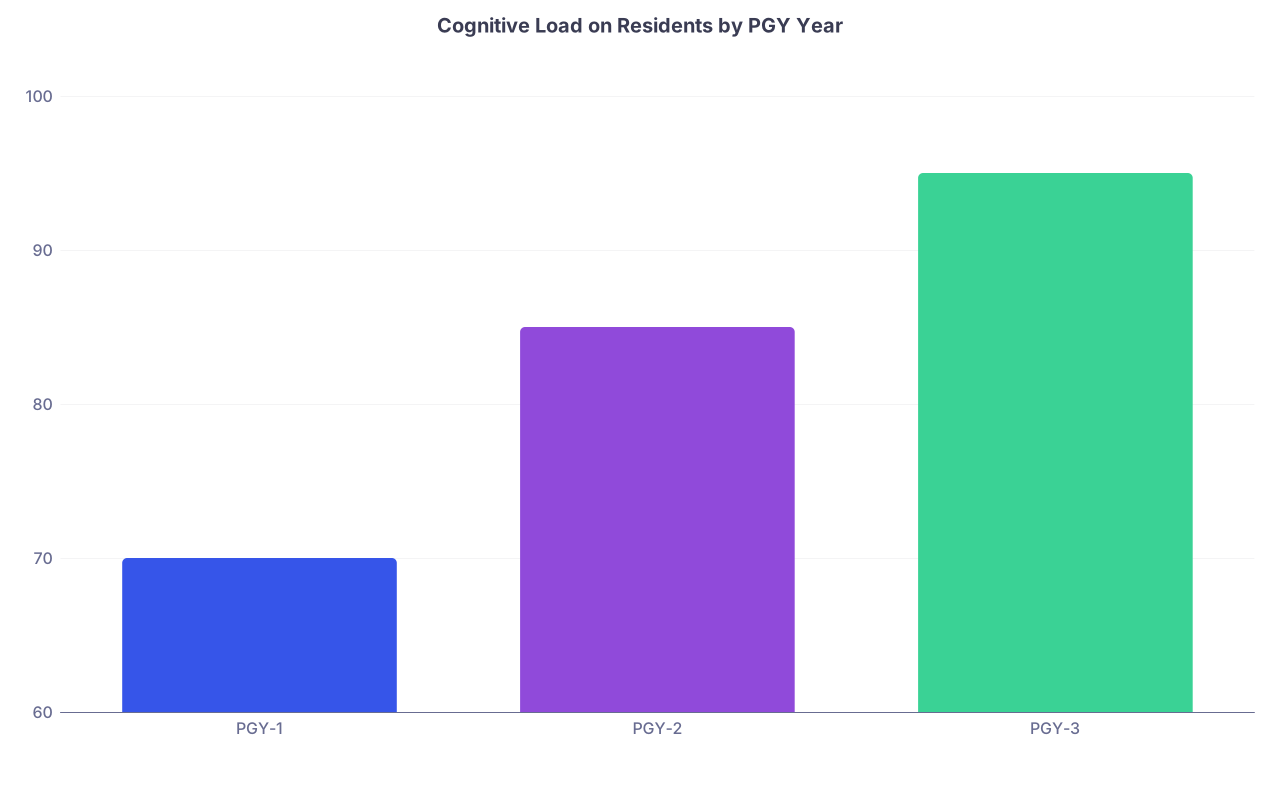
| Category | Value |
|---|---|
| PGY-1 | 70 |
| PGY-2 | 85 |
| PGY-3 | 95 |
Here’s what I’ve seen over and over:
- Intern year: You remember the “rules” because you just memorized them yesterday. Pure short-term brute force.
- PGY-2: You start actually understanding stuff, but you’re still insecure, so you overcompensate with more reading.
- PGY-3: You’re managing teams, discharges, social issues, procedures, codes, teaching, triage. Your brain prioritizes pattern recognition and decision-making over clean textbook definitions.
So on a random Tuesday night at hour 26 of your “24-hour” call, of course you can’t instantly recall the exact diagnostic criteria for some zebra you saw on UWorld last week.
That’s not failure. That’s context.
Why board studying can make the forgetting feel worse
There’s this sick joke that happens in PGY-3: the more you study, the dumber you feel.
You start boards prep and suddenly:
- You remember obscure enzyme deficiencies
- But forget the insulin sliding scale you’ve been using since intern year
- You know the mechanism of action of 10 different chemo drugs
- But freeze when someone asks you “What’s the dose of IV Lasix you’d start with?”
Here’s what’s going on:
You’re switching “modes” constantly.
Clinical mode = pattern recognition, shortcuts, speed.
Boards mode = slow, nitpicky, abstract details and “classic vignettes.”Board prep exposes gaps that were always there.
You just weren’t staring directly at them while tired and scared with a Qbank dashboard screaming “58% correct” at you.You’re overloading working memory.
You’re cramming guidelines, rare diseases, and algorithms on top of everything you already do. Something will fall out of your active brain. Usually something basic, just to mess with your head.
I’ve watched rock-solid PGY-3s on wards forget:
- How to calculate maintenance fluids
- The exact CURB-65 cutoffs
- Difference between Type 1 and Type 2 RTA
- The order of SIRS → sepsis → septic shock (yes, really)
And then those same people pass their boards. Some with very comfortable margins.
When is “forgetting basics” actually a red flag?
You want honesty, so here it is: sometimes forgetting can be a warning sign, but it’s usually not about intelligence. It’s about burnout and bandwidth.
Red flags to take seriously:
- You’re so foggy you can’t follow a full patient presentation without zoning out
- You’re repeatedly forgetting critical safety steps (anticoag reversal, ACLS, insulin orders)
- You’re making the same basic mistake over and over, even after feedback
- You’re falling asleep while reading notes, driving, or writing orders
- You can’t remember what you read 2 minutes ago, every time you sit down to study
If that sounds like you, this is not a “you’re dumb” problem. It’s likely:
- Sleep debt that’s gone from “lol we all suffer” to actually dangerous
- Depression or anxiety pushing your brain into survival mode
- Burnout so deep that your memory is collateral damage
That deserves attention. From program leadership. From your PCP. From mental health support. Not just more Anki cards and more coffee.
But the classic scenario—forgetting minutiae, stumbling on questions you “should know,” feeling like your knowledge is Swiss cheese—that’s just the residency + boards combo meal.
Why PGY-3 especially feels like you’re getting “worse,” not better
We all have this fantasy that PGY-3 you will feel like:
- Calm
- Sharp
- Confident
- Basically mini-attending
Reality is more like:
- Constantly behind on notes
- Juggling 10 discharges and 2 ICU transfers
- Prepping for boards
- Wondering if everyone else secretly knows way more than you
There’s also a weird phenomenon: as you become more competent, you become more aware of what you don’t know. That’s not impostor syndrome; that’s just what expertise actually feels like.
Up close, expertise looks like:
- “Wow, I missed that nuance before”
- “I did that wrong for two years”
- “Wait, the guideline changed… again?”
Meanwhile, your memory has shifted from:
- “I can recite the JNC-8 HTN targets line by line”
to - “I know the principle: treat the patient based on risk, comorbidities, and tolerance”
That’s good for real life. Terrible for multiple-choice questions that want the exact number.
So when you’re doing UWorld and missing “which of the following is the best next step” questions, it’s tempting to think:
“I’m actually getting dumber.”
You’re not. You’re experiencing a mismatch between:
- Test logic
- Real-world logic
- Sleep-deprived PGY-3 brain

Concrete things you can do when you feel like you’re “losing basics”
You don’t fix this by trying to brute-force everything. That just deepens the panic.
Here’s what actually helps, and I mean in a realistic PGY-3 way, not in some fantasy world where you’re off service for three months with a private tutor.
Anchor your basics to your real patients.
If you admitted a DKA last night, read 5–10 focused minutes about DKA that same day:- Pathophys
- Management steps
- Board traps (bicarb use, potassium timing)
One patient → one short review → sticks way better than passive flashcards.
Use micro-reps instead of “I’ll study 3 hours after this 28-hour call.”
- 10 questions in the resident lounge before sign-out
- One page of notes while eating
- 5 flashcards while walking to clinic
Tiny, consistent reps beat heroic, unsustainable cram sessions.
Have a “Basics Panic List.”
Literally a small list (paper or phone) of things you feel oddly shaky on, like:- Pressor choices
- Insulin regimens
- Anticoag reversal
- COPD/asthma acute management
Once a week, spend 30–45 minutes just knocking out 1–2 of those with focused reading.
Study the gaps your day exposes.
You froze on hyponatremia? That goes on the list.
You confidently handled GI bleed? You don’t need to reread that tonight.Use one decent resource instead of ten conflicting ones.
Too many resources = cognitive overload.
| Approach | What It Looks Like |
|---|---|
| Qbank + Rapid Review Book | UWorld or AMBOSS plus a concise review text |
| Qbank Only | Focused on questions with explanations and short notes |
| Anki + Qbank | Cards for recall, questions for application |
| Video Series + Qbank | Short videos + active question practice |
| In-Training Exam Review + Targeted Study | Use ITE to guide weak-topic review |
Pick one of those and stop doom-scrolling Reddit trying to find “the perfect combo.”
The fear beneath all this: “What if I fail boards?”
Let’s be honest: this is what really keeps you up.
It’s not just “I forgot maintenance fluids.” It’s “If I can’t remember maintenance fluids, how the hell am I going to pass a 7–10 hour exam and not derail my career?”
Some reality checks:
- People who are way less anxious and way less conscientious than you pass these exams every year.
- Most PGY-3s feel behind. They still pass.
- A bad UWorld percentage in October doesn’t predict your fate in May.
Your risk of failing is higher if:
- You never sit for long stretches of questions
- You’re consistently scoring very low (like sub-50%) on second-pass question sets close to the exam
- You keep postponing your exam because “I don’t feel ready” without changing your approach
But forgetting random basics while exhausted? That’s not a predictor. That’s just residency.
If you’re truly worried, set up a small, brutally honest checkpoint:
- 1–2 blocks of timed questions once a week, every week
- Track that over 4–6 weeks
- Look for trend, not perfection on any single day
If the trend is flat or going up, you’re probably fine, even if day-to-day feels chaotic.
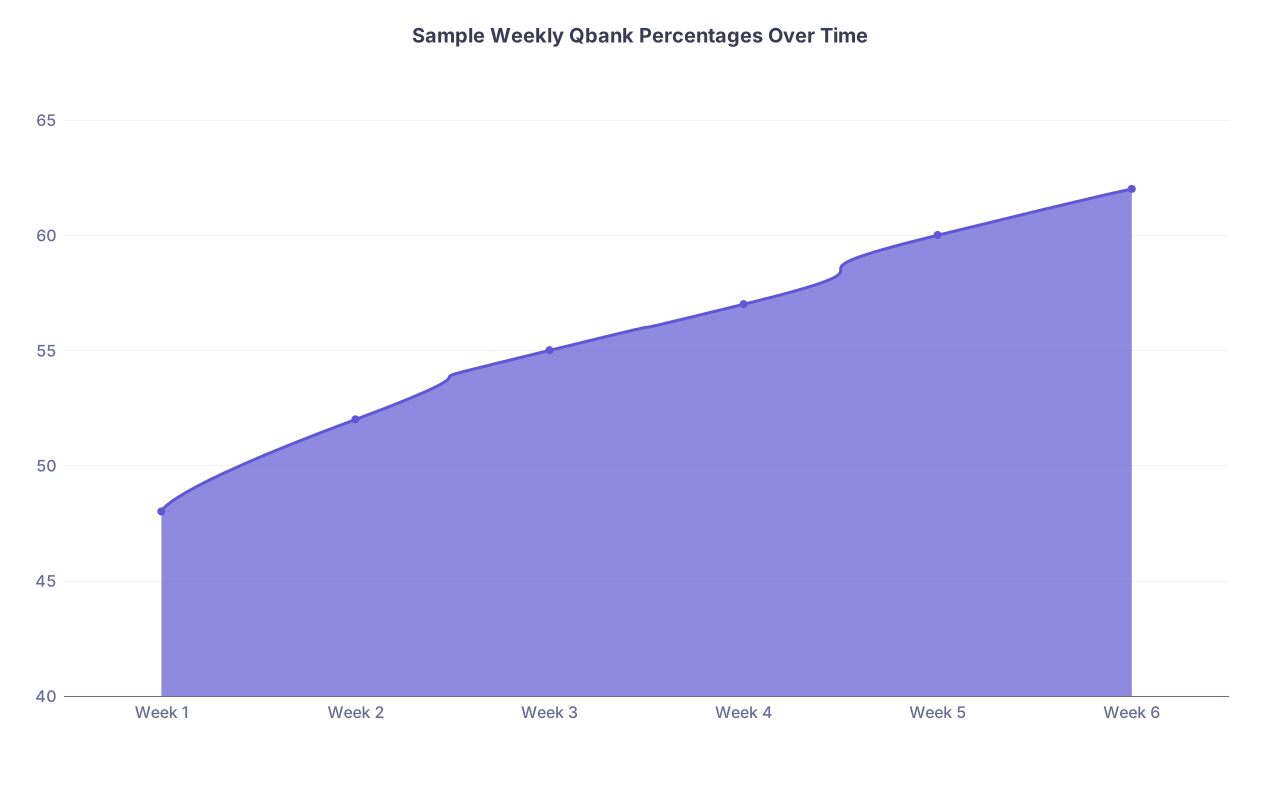
| Category | Value |
|---|---|
| Week 1 | 48 |
| Week 2 | 52 |
| Week 3 | 55 |
| Week 4 | 57 |
| Week 5 | 60 |
| Week 6 | 62 |
That kind of slow, messy improvement is what progress actually looks like during residency.
How to tell yourself a story that doesn’t destroy you
The story you’re probably telling yourself is:
“I’m a PGY-3. I should have this down. Other people probably do. If I’m forgetting, it means I’m behind, unprepared, and maybe not cut out for this.”
Here’s a different story that’s actually more accurate:
“I’m a PGY-3 in a system that expects me to be a full clinician, a teacher, and a test-taker simultaneously, while sleep-deprived. My brain is prioritizing real-world skills over clean textbook recall. That’s why the basics sometimes feel fuzzy. I can tighten up the gaps with targeted practice, but this doesn’t mean I’m failing.”
One of the strongest PGY-3s I’ve known once quietly told me:
“I forgot how to treat hyperkalemia on rounds last week. Like fully blanked. Went home and cried. I’ve also been running codes and handling the sickest patients on the team. Both things are true.”
You can be competent and still feel scrambled. You can be board-ready and still have holes. You can be allowed to graduate and be safe.

| Step | Description |
|---|---|
| Step 1 | Clinical Work |
| Step 2 | Fatigue |
| Step 3 | Board Study |
| Step 4 | Overload |
| Step 5 | Memory Lapses |
| Step 6 | Focused Study |
| Step 7 | Better Recall |
| Step 8 | Less Overwhelm |
| Step 9 | Adjust Approach |
You are not the only PGY-3 going home thinking, “How am I this far along and still Googling basic stuff?” Most of them just don’t say it out loud.
Years from now, you won’t remember which facts you blanked on during PGY-3. You’ll remember whether you treated yourself like a failure—or like a tired human doing something genuinely hard.