Residents in Rural Programs: Getting Access to Quality Board Resources
It’s 10:45 p.m. You just finished admitting a septic patient, triaged three ED consults, and now you’re back in a windowless call room in a 50-bed hospital an hour from the nearest Starbucks. Your co-resident at the big academic center is posting screenshots of fancy question bank dashboards. You? You’re staring at an outdated board review book from 2015 that someone left on the shelf.
You know the stakes. If you blow your boards, it hits you harder than the big-city folks:
- Fewer local mentors.
- Fewer backup fellowship options.
- Program reputation on the line with every pass/fail.
And your reality: limited budget, limited Wi‑Fi, maybe not even institutional access to the best Qbanks.
Let’s fix that. Here’s how you, as a resident in a rural program, get access to quality board resources without a home institution doing everything for you.
Step 1: Be Ruthless About What Actually Matters
You do not have time or money to dabble in 7 different resources. You need a tight, deliberate setup.
For almost every specialty, “quality board prep” boils down to three pillars:
- A primary Qbank that matches your exam style and difficulty.
- A trusted, concise reference (book or outline) aligned with the exam blueprint.
- A way to track your progress and gaps (self-assessments, score predictors, or structured review).
If you’re rural, your problem isn’t that you can’t get these. It’s that:
- No one is curating them for you.
- You may not get institutional logins.
- The default culture might be “just read UpToDate and you’ll be fine” (you won’t).
So your first job is deciding: what is your “big three” for your specialty?
Here’s a simple way to think about it.
| Specialty | Primary Qbank | Core Reference | Self-Assessment Option |
|---|---|---|---|
| IM | UWorld | MKSAP/Step-Up | UWorld SA, ABIM practice |
| FM | AAFP Board Review Qs | Swanson's / AAFP materials | AAFP in-training style exams |
| EM | Rosh / EM:RAP Qs | Tintinalli / Rosen-based outlines | Rosh predictor exams |
| Surgery | TrueLearn / SCORE | SCORE modules | ABSITE & SCORE practice |
| Peds | PREP Qbank | Nelson/Board review book | PREP assessments |
If your program hasn’t already pushed one of these at you, ask senior residents:
“What did the last class use to pass boards?”
Not “what’s nice.” What actually produced passes.
Step 2: Squeeze Every Drop from What Your Program Already Has
A lot of rural programs genuinely do not advertise the resources they’re already paying for. I’ve seen this more than once: faculty think residents “already know,” residents think there’s “no money,” and the reality is there are unused institutional licenses floating around.
Your move: go hunting.
Here’s your checklist to run through with your PD or chief resident:
Do we have access to a major Qbank through GME or the hospital system?
Ask explicitly: “Do we have institutional UWorld, TrueLearn, Rosh, MKSAP, or PREP?”Do we have a relationship with a university affiliate that has access I can use remotely?
Sometimes you’re technically part of University X’s training program and their library has gold.Does our library (yes, even small hospitals) have:
- Online access to a board review series (e.g., AccessMedicine, Ovid, LWW Board Review)?
- Specialty society membership benefits (AAFP, ACP, AAP) with included questions?
Is there money earmarked for “educational funds” per resident per year?
You’d be amazed how often there’s a $500–$1000 line item no one proactively tells you about.
If this feels awkward, script it:
“I want to make sure I’m set up to pass my boards on the first try. What board resources does the program or hospital already pay for that I can access? Qbanks, online libraries, or society memberships?”
Ask in a group meeting so everyone hears the answer. Once one person asks, others will follow, and suddenly faculty realize they actually have to say what exists.
Step 3: When the Program Has Nothing – Go Direct to the Sources
You might be in the “we have literally nothing besides UpToDate” situation. Annoying, but not terminal.
Here’s how to get quality resources anyway, strategically and cheaply.
3.1 Use group licenses and cohort bargaining
Most Qbanks will cut prices for:
- Group purchases of 5+ residents.
- Program-wide licensing.
If you’re in a small class (say 3–6 residents per year), band together:
- Identify your preferred Qbank (e.g., Rosh for EM, TrueLearn for IM, etc.).
- Email their sales rep as a group:
“We’re a rural residency with X residents and limited institutional support. We’re interested in a group license or discount. What can you do for us?”
Then loop in your PD and say:
“We found a discounted group rate. Could our education funds cover part or all of this for the class?”
You’re doing the legwork. Leadership is much more likely to say yes when you bring them a concrete, discounted proposal, not just “can we get UWorld?”
3.2 Leverage cheaper but still high-yield options
Some resources are simply more budget-friendly while still being legit:
- Specialty society board Qbanks (AAFP, ACP, AAP, etc.) often cheaper than commercial.
- Used or slightly older editions of board review books – fine if the exam hasn’t changed dramatically.
- Self-published or smaller vendors that offer promo codes for residents.
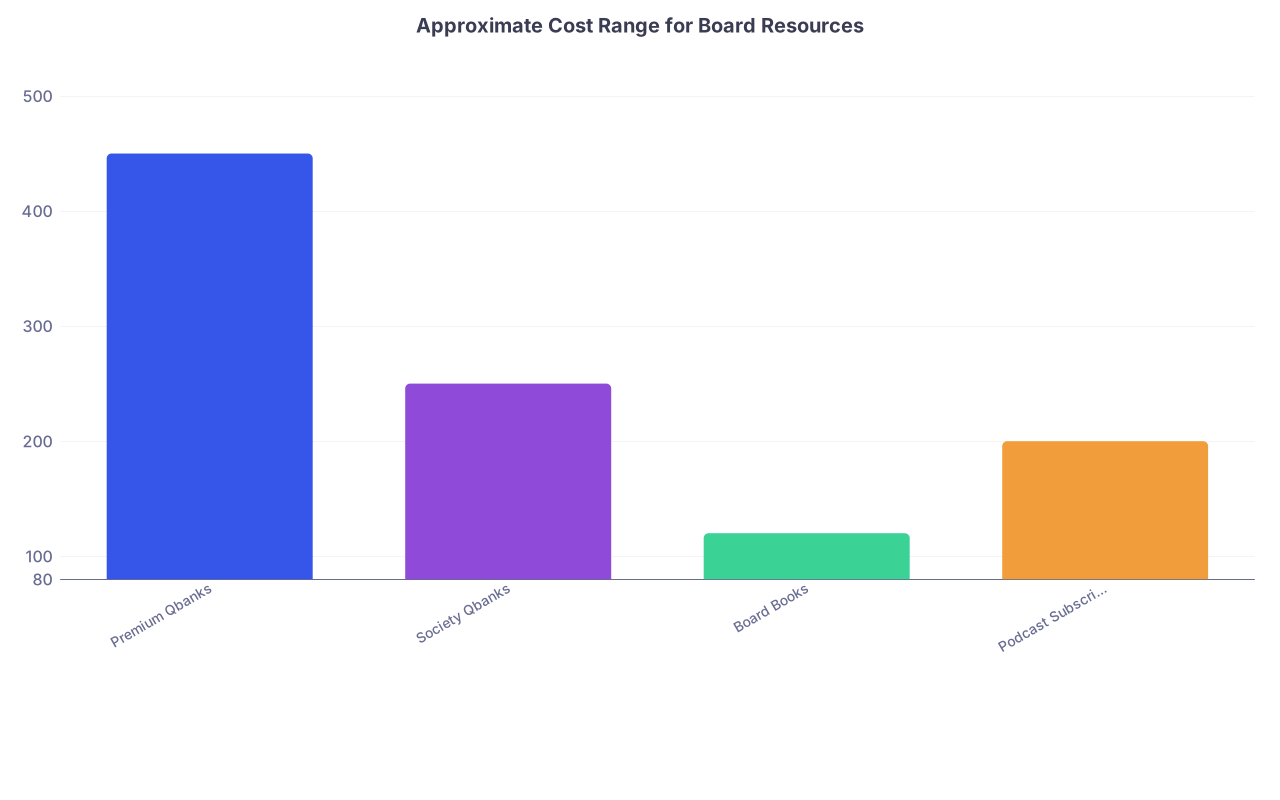
| Category | Value |
|---|---|
| Premium Qbanks | 450 |
| Society Qbanks | 250 |
| Board Books | 120 |
| Podcast Subscriptions | 200 |
If you truly can’t afford premium Qbanks, your minimum setup should be:
- At least one solid Qbank (even if not “the top” one).
- One organized review text or outline.
- Some form of timed practice exams (many societies or vendor “free trials” include these).
Step 4: Turn Rural Limitations into Study Advantages
You don’t have noon conference five days a week with 10 subspecialists. Fine. That can actually work in your favor if you structure it correctly.
4.1 Build your own “virtual academic center”
Think in terms of inputs you control:
Questions: Your Qbank is your daily conference. Do 10–20 questions on every non-call day, 5–10 on busy days. Timed, mixed if boards are approaching.
Reading: Every week, choose 1–2 weak topics from your Qbank performance and hit a focused review chapter, guideline, or society summary.
Cases: Your rural patients are gold. You often get “everything”: undifferentiated sepsis, multi-comorbid elderly, no specialist backup. Use these to anchor your studying.
Example:
You admitted a 72-year-old with new-onset atrial fibrillation and CHF exacerbation. That week:
- Do 15–20 Qbank questions on AF and CHF.
- Read the core guideline summary.
- Write 5–10 bullet points in your own words. Keep a running digital notebook.
4.2 Make up for missing subspecialty exposure with targeted blocks
If your rural program rarely sees:
- Complex rheumatology
- Hematologic malignancies
- Advanced heart failure therapies
You cannot rely on “learning from patients.” You won’t see enough.
So build 2–4 week micro-blocks:
- “Rheum month”: 200 rheum questions + 3–4 key review articles.
- “Heme-onc month”: same idea.
Do this 6–9 months before boards. Turn your gaps into focused projects rather than vague anxieties.
Step 5: Fight the Time and Energy Problem Head-On
The real rural killer is not lack of resources. It’s exhaustion and isolation. You get home after a 24-hour shift and you just want to disappear into your couch.
You’re not going to “out-discipline” your physiology. You have to design around it.
5.1 Use a brutally realistic weekly structure
Stop pretending you’ll study 3 hours every evening. You won’t. Especially with night float, home call, and driving.
Instead, aim for:
- 5 days per week: 20–40 minutes of questions + quick review.
- 1–2 half-days off per week: 1–2 hours deeper study (weak topics, reading, notes).
- 1 real off-day per month where you do a full practice block or mini-assessment.
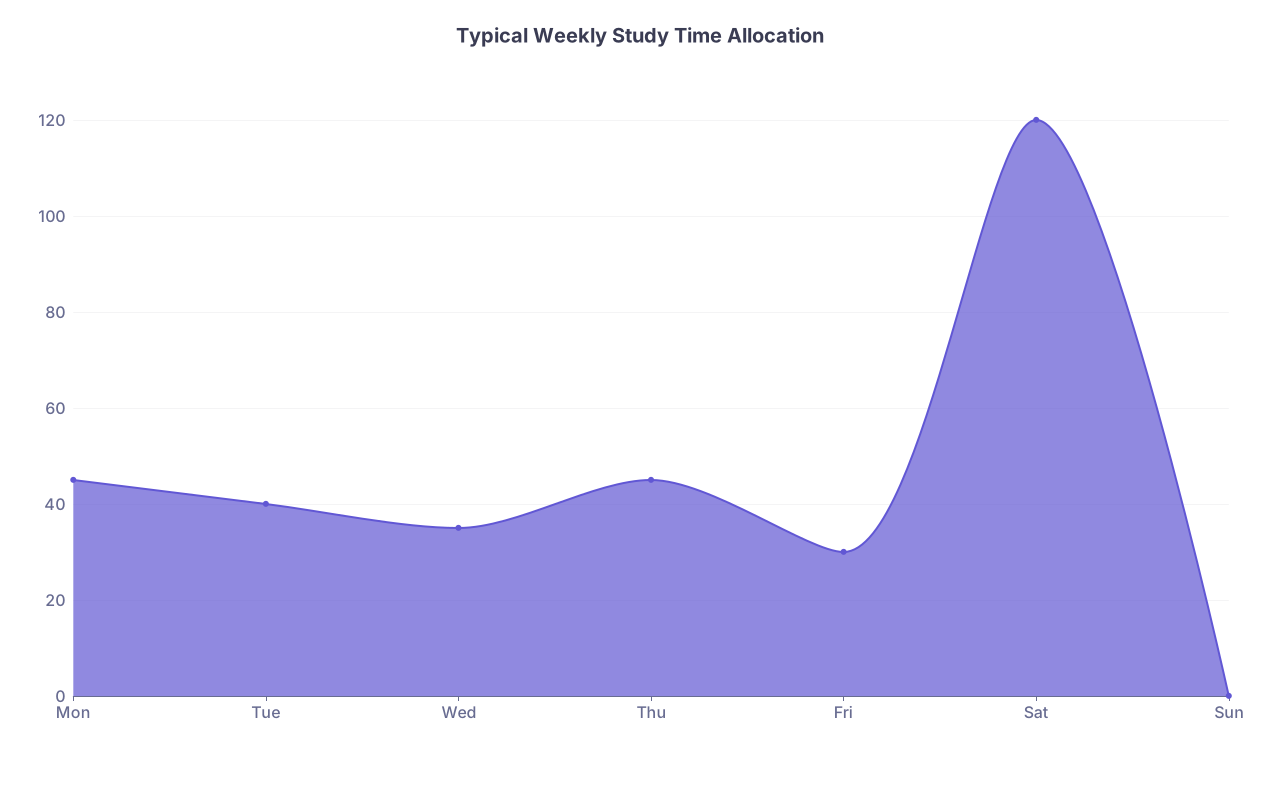
| Category | Value |
|---|---|
| Mon | 45 |
| Tue | 40 |
| Wed | 35 |
| Thu | 45 |
| Fri | 30 |
| Sat | 120 |
| Sun | 0 |
That’s enough if you’re consistent over 6–12 months, especially if you integrate real patients into your studying.
5.2 Use micro-moments instead of 3-hour marathons
Rural schedules have weird gaps:
- 10 minutes waiting for CT.
- 15 minutes between ED consults.
- The 20-minute lunch where no one is talking.
Stack:
- 5 question bursts.
- One-topic flash review (Anki, self-made cards, screenshots).
- Listening to 5–10 minute audio summaries.
If you can convert even half of these micro-gaps into board exposure, you’ll outperform classmates who “plan” to study and then crash on the couch.
Step 6: Fix the Internet and Access Problem (Yes, You Can)
I’ve seen this excuse: “Our Wi‑Fi is trash, so I can’t use online Qbanks consistently.” Valid complaint. Still solvable.
6.1 Technical workarounds
Use offline modes: Some Qbanks have app-based offline question modes. Download blocks while you have decent Wi‑Fi (home, coffee shop) and do them later on the ward or in call rooms.
Mobile hotspot: If your hospital Wi‑Fi is firewalled or slow, your phone’s hotspot may be faster. Yes, watch your data cap. But for text-based questions, it’s usually manageable.
Download PDFs and eBooks: Many board resources let you download PDFs per chapter. Keep them on a tablet or laptop. Zero bandwidth needed.
6.2 Protect your “good internet” time
If you live 30–45 minutes from the hospital and have decent Wi‑Fi at home:
- Decide on 2–3 “internet heavy” sessions per week at home: Qbanks, self-assessments, video lectures.
- Keep hospital time for:
- Reviewing incorrect questions.
- Reading guidelines and notes.
- Flashcards and summaries.
Basically: treat the hospital as your “offline study bunker” and home as your “Qbank station.”
Step 7: Use External Mentors and Communities
Rural programs sometimes lack faculty who are truly up to date on board-style questions. Some are fantastic clinicians but haven’t thought about exam strategy in 15 years.
You don’t have to rely only on them.
7.1 Find external mentors
Options:
- Alumni of your program who recently took boards.
- Residents or fellows at your affiliated university.
- Online communities (yes, the sane parts of Reddit/Discord/Slack groups for your specialty).
Ask specifically:
- “What resources did you use?”
- “If you had to cut to only two, which?”
- “How far out from the exam did you ramp up?”
You’re not looking for generic study tips; you’re trying to steal someone’s exact setup and timeline, then adjust for your schedule.
7.2 Set up a small virtual study pod
If you can find even 2–3 humans with the same exam date:
- Once a week: 30–45 minute Zoom or phone session.
- Each person brings:
- 3–5 high-yield questions they missed that week.
- 1 topic they reviewed that others probably haven’t mastered.
Doesn’t need to be fancy. It keeps you accountable and stops the “I’m the only one struggling out here” spiral that rural programs can create.
Step 8: Align Your In-Training Exam with Your Board Strategy
Your in-training exam score is more than a slap on the wrist. It’s your early-warning system.
Treat it like a diagnostic, not a judgment.
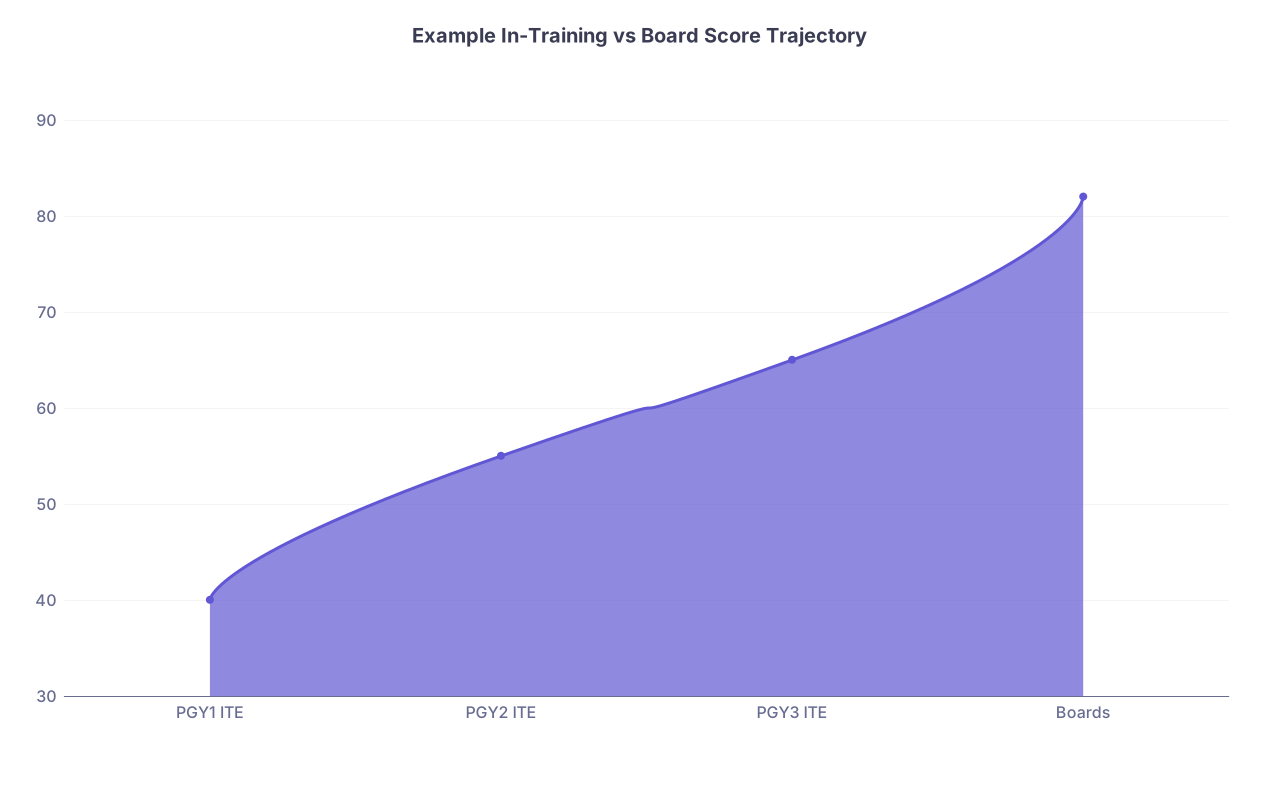
| Category | Value |
|---|---|
| PGY1 ITE | 40 |
| PGY2 ITE | 55 |
| PGY3 ITE | 65 |
| Boards | 82 |
Here’s how to use it:
PGY1:
Just get a baseline. Identify bottom 2–3 domains and make those mini-focus areas.PGY2:
This is the “real” warning signal. If you’re <40–50th percentile, you must tighten your resource setup and consistency. No more random reading. Stick to your Qbank + core text.PGY3 (or final year):
Treat this as a mock-board. Whatever is still weak here needs a 2–3 month targeted assault before the real exam.
If your PD brushes off in-training results with “oh, you’re fine, everybody passes,” don’t fully trust that. Ask for the actual report, look at content-area breakdowns, and build a specific plan.
Step 9: Protect Your Mental Bandwidth (Because Burnout Wrecks Studying)
You’re not in a fancy city with 24/7 food, yoga studios, and a resident wellness office with free massages. You’re in a town where the “nice dinner” is Applebee’s 40 minutes away.
Two realities:
- Rural residency can be lonelier.
- Lonely + tired = zero bandwidth for board prep.
You cannot just grind harder. You need a sustainable baseline.
Minimums:
- Sleep: 5–6 hours on bad days, protect 7–8 hours when off. Chronic 4-hour nights nuke your retention.
- One real non-medical thing: lifting, running, a hobby, time with your partner or kids. Non-negotiable.
- Boundaries: On golden weekends, protect at least one half-day as “no medicine, no Qbanks.” Your brain will not implode; it will work better afterward.
This isn’t soft advice. It’s pragmatic: exhausted residents do sloppy questions, memorize nothing, and then panic two months before boards. That’s how people fail from rural and community programs.
Step 10: If You’re Already Behind – Triage, Don’t Panic
Say you’re 4–6 months from boards, you’re rural, your ITE wasn’t great, and you’ve done…not much.
Here’s a bare-bones salvage plan:
- Pick one Qbank. Not three. One.
- Commit to a specific number of questions per week (e.g., 150–200).
- Every missed question:
- Tag the topic.
- Write a 1–2 sentence “if I see this again” rule.
- Every week, pick your single weakest domain and do a 1–2 hour deep dive (guideline + chapter + more questions).

| Step | Description |
|---|---|
| Step 1 | Today |
| Step 2 | Pick single Qbank |
| Step 3 | Set weekly question target |
| Step 4 | Do timed blocks 5 days/wk |
| Step 5 | Track weak topics |
| Step 6 | Weekly 2 hr deep dive |
| Step 7 | Monthly self assessment |
| Step 8 | Adjust targets and focus |
| Step 9 | Exam day |
You will not feel “ready.” Few people do. But this plan moves you from random flailing to controlled, measurable progress.
FAQs
1. My program leadership says, “We all passed without Qbanks; you don’t need them.” Are they wrong?
They’re living in a different era. Exams have shifted heavily toward question-style reasoning and pattern recognition. You can pass without Qbanks, but your odds drop, especially if your training environment is narrower (which rural often is). I’d still use at least one decent Qbank, even if you have to self-fund or split a group discount.
2. Is it okay to share a Qbank account with a co-resident to save money?
Most vendors prohibit this. Ethically and contractually, it’s in the gray-to-bad zone. Practically, sharing skews performance data, screws up “percentage correct,” and often locks one of you out. If money is tight, a better route is to negotiate a discount, apply educational funds, or combine cheaper resources (society Qbanks + older books) rather than blatantly sharing one login.
3. How many total questions should I aim for before boards?
Depends on specialty and your baseline. As a rough order of magnitude:
- IM, FM, Peds: 2,000–4,000 questions total
- EM, Surgery, OB: 2,000–3,000 (often more focused banks)
The key isn’t the raw number; it’s whether you’re learning from each missed question and revisiting weak areas. I’d rather see 2,000 carefully reviewed questions than 5,000 rushed through at 1.5x speed.
4. Are video lecture courses worth it for rural residents?
Only if:
- You’re genuinely an audio/visual learner, and
- You can carve out consistent time to watch them at 1.25–1.5x speed, and
- You still commit to a real Qbank.
Videos alone don’t cut it. In a rural setting where time and bandwidth are limited, I’d rank Qbank + concise text above long video series unless you need a structured curriculum because your program teaching is very weak.
5. My in-training score was low. Does that mean I’ll fail my boards?
No, but it’s a warning sign, not a prophecy. I’ve watched plenty of residents jump from bottom percentiles on PGY1–2 ITEs to solid passes on boards once they:
- Chose a single primary Qbank.
- Studied consistently for 6–9 months.
- Targeted their weakest domains intentionally.
If you ignore the signal and keep doing what you’ve always done, then yes, your risk is higher. Use the score as data, not doom.
Key takeaways:
- You can absolutely get quality board prep in a rural program, but you’ll have to be the one to find, negotiate, and structure it.
- One solid Qbank + one core text + consistent, realistic use of both beats a pile of half-used resources every time.
- Your biggest threats aren’t “no access” but fatigue, isolation, and vague plans—solve those, and you’ll walk into boards prepared, regardless of your ZIP code.