
How do you tell the difference between a residency that puts “global health” on its website and one that will actually get you on a plane, in the field, and building a real career in global work?
If you are choosing between Family Medicine (FM) and Pediatrics (Peds) with a serious interest in global health, the specialty is only half the decision. The other half—often more important—is which programs you pick. Because some residencies will grow your global career. Others will quietly kill it.
Let’s walk through this like you are right in the middle of the process:
- You know you want FM or Peds.
- You care deeply about global health, not as a “cool elective” but as part of your long-term work.
- You’re staring at 40+ program websites with the words “global health” tossed around like confetti.
Here’s how to cut through the noise and build a rank list that actually matches your goals.
Step 1: Decide What “Global Health” Means For You (Before You Look at Programs)
If you skip this step, every program will sound “pretty good.” Then you end up matching somewhere that looked global on paper and realize they meant “we had a mission trip in 2017.”
You have to define your non-negotiables first.
Start with three questions:
Are you picturing mostly short-term experiences or a long-term career in global health?
- Short-term: 2–4 week rotations, cultural exposure, learning to work cross-culturally.
- Long-term: living abroad, global health research, policy work, NGO leadership, academic global health.
Do you care more about:
- Clinical care abroad?
- Research and implementation science?
- Health systems, policy, or humanitarian work?
How much of your residency time are you realistically willing to trade for global work?
(Because real global tracks will take a chunk of your elective time, your weekends, sometimes your vacations.)
Once you’re clear on those, you can look at program offerings and ask: Does this actually match my version of global health?
Example:
- If you want to be in rural Malawi doing systems-level work, a program with just one 2-week trip to Costa Rica and no faculty doing long-term global work is not a match.
- If you want to be a community-based FM doc in the U.S. with the option to occasionally work abroad, that might be more than enough.
Step 2: Understand How FM vs Peds Play Out in Global Health
You can do global health with either FM or Peds. But the flavor of opportunities and career paths will be a bit different.
Broad reality check
| Aspect | Family Medicine | Pediatrics |
|---|---|---|
| Breadth of practice | Adults, kids, OB (at some sites) | Children and adolescents only |
| Typical global roles | Primary care, district hospital work, maternal-child health | Child health, NICU/PICU support, immunization, malnutrition programs |
| Common partner sites | Rural district hospitals, mixed-age clinics | Children’s hospitals, pediatric wards, NGO pediatric sites |
| Academics & research | Often health systems, primary care models | Stronger pipelines in child health, vaccines, global child mortality |
If you want to be the person in a rural African district hospital seeing adults, kids, prenatal care, maybe delivering babies, FM is naturally aligned.
If your heart is in child survival, immunizations, malnutrition programs, neonatal care, pediatric HIV—Peds is very strong globally with a huge NGO and academic footprint.
What matters more than the specialty: Does the specific program train you in what you want to be useful for abroad? That means OB for FM if you want maternal-child health. NICU/PICU and strong inpatient exposure for Peds if you want to be clinically valuable overseas.
Step 3: Spotting Real Global Health Tracks vs Marketing Fluff
This is where most applicants get fooled. Programs love listing “global health” on the website because it sounds noble. Only some actually invest.
Here’s the blunt filter I use when advising students:
If a program cannot answer “yes” to at least three of these, their “global health” is probably weak:
- Is there a formal global health track, certificate, or pathway with defined curriculum?
- Are there named global health faculty with protected time (and bios that show real work abroad)?
- Are there long-standing, recurring partnerships with the same international sites?
- Can residents go more than once to the same site (ideally with progressive responsibility)?
- Are there funds/stipends specifically earmarked for global rotations or projects?
Now here’s how this looks in the real world.
Red flag language on websites and interviews
“We support resident-initiated global electives.”
Translation: you’re on your own to set it up, fight GME bureaucracy, and pay for it.“Several residents have traveled abroad in the past.”
Whose contacts? Still active? Funded? Or just a couple of random mission trips?“We are exploring opportunities for future global health involvement.”
Means: nothing is in place yet. You’ll be the guinea pig.“Our community is very diverse—this is global health at home.”
That’s actually true and valuable. But if they’re selling this instead of any actual global pathway, then you are not getting international experience through them.
Green flag language and details
You want to hear things like:
- “We have a global health track with 6–8 residents per class.”
- “Residents can spend up to 2–3 months total abroad during residency.”
- “We partner with sites in X country, Y country, and have been at our Uganda site for 11 years.”
- “Funding: Residents get a $1500–$4000 stipend for global rotations.”
- “Our faculty work with Partners In Health / Doctors Without Borders / academic global consortia and take residents with them.”
If they can’t name the countries, sites, and involved faculty on the spot, it’s usually fluff.
Step 4: What To Look For on Program Websites (before you even apply)
Most applicants skim websites. You cannot afford to if global health is central for you.
Create a simple tracking sheet for the programs you’re considering with these columns:
| Program | Formal Track | Funding | # of Sites | Repeat Access | Primary Faculty |
|---|---|---|---|---|---|
| Program A | Yes | $2000 | 3 | Yes | Dr. X, Dr. Y |
| Program B | No | None | 1 (ad hoc) | No | None listed |
| Program C | Yes | $3500 | 2 | Yes | Dr. Z |
On each website, hunt for:
A dedicated Global Health page
If all you see is one bullet under “electives,” be skeptical.Names and bios of global health faculty
Click through. Ask:- Have they actually worked abroad (not just “interested in global health”)?
- Any publications or leadership roles in global projects?
- Are they FM/Peds trained and still active at the sites?
Descriptions of partnerships
Strong programs will say:- “We partner with Hospital X in Country Y, our residents rotate there in PGY-2 and PGY-3.” Weak ones say:
- “Residents have the opportunity to gain international exposure.”
Curriculum PDF or structure
Look for:- Core seminars on global health ethics, health systems, humanitarian response.
- Language training or cultural humility components.
- Expectations: projects, QI, teaching, research.
If a program claims a track but never explains what it is, that’s a sign it’s either new, not maintained, or not central to the program.
Step 5: During Interviews – The Questions That Separate Talk from Action
The interview day is where you can really see who’s serious. You just have to stop asking soft questions like “Do you have any global opportunities?” and start asking questions that pin down reality.
Here’s what you actually ask:
To the program director or global health lead:
- “How many residents in the last 3 years have done at least one global rotation? More than one?”
- “Which countries and sites are active right now? How long have those partnerships existed?”
- “What proportion of residents in the global track actually complete the track?”
- “Is there funding for travel, housing, or program fees? About how much per resident, and is it guaranteed or competitive?”
- “What year(s) can residents go abroad, and how much total time is allowed?”
- “Do you have any graduates who are now working in global health full-time or part-time? Where are they and what are they doing?”
To residents:
- “Who here is doing the global track or has gone abroad? Can I talk to them specifically?”
- “Was it hard to get approval from the program or was the route clear?”
- “Did you pay out-of-pocket? Roughly how much?”
- “What exactly did you do on the rotation—were you actually useful, or more just observing?”
- “Have any global experiences been canceled last-minute? Why?”
You’re looking for quick, confident, specific answers. If people hesitate, look at each other, or say, “We used to have something pre-COVID…”—you’ve got your answer.
Step 6: Evaluating “Global Health at Home” vs International Work
There’s a shift right now: a lot of programs are emphasizing “global is local” — working with refugee populations, migrant health, indigenous communities. This is not fake global health. It’s absolutely legitimate and often more sustainable.
But you need to be very clear with yourself:
- If your non-negotiable is getting significant time abroad, a “global is local only” program will leave you frustrated.
- If you actually care more about health equity and you’re not attached to stamps in your passport, a high-quality “global/local” program might be more impactful than some random 2-week trip with no continuity.
Ask how the program thinks about this balance.
A serious program will say something like:
“We have both. We expect our global track residents to do serious work with local underserved communities and we also have long-term relationships with international partners.”
A less serious one will use “global is local” as a way to avoid the messy, expensive work of building and sustaining overseas partnerships.
Step 7: Reading the Culture: Will They Actually Support You, or Just Say Yes?
Global health in residency takes work. Approvals. Paperwork. Scheduling. Money. You do not want to be fighting your own program leadership every time you want to go abroad.
Here’s what I’ve seen play out:
Resident A at an FM program with a mature global track:
- They email the global health coordinator.
- Get a list of approved sites and dates.
- Grant paperwork and GME approval are standardized.
- Money is already allocated.
- They go twice, build continuity at one site, present a project at a national conference.
Resident B at a Peds program with “support for global electives” but no structure:
- Spends 6–9 months emailing random contacts.
- Fights with scheduling to carve out elective time.
- GME won’t approve the site for liability reasons.
- Has to pay flights and housing entirely out-of-pocket.
- Goes once for 2 weeks, mostly shadowing, and that’s it.
You want to be Resident A.
During your interview and second look, listen for things like:
- “We handle most of the logistics through our office.”
- “All our global sites are pre-approved by GME.”
- “We have a regular pre-departure training and post-return debrief.”
- “Residents have call coverage arranged while away.”
If instead you hear:
- “Each resident has to figure out their own setup.”
- “It really depends on the chief residents that year.”
- “It’s case-by-case with GME”
→ That program will fight you, even if they’re “supportive in spirit.”
Step 8: How to Weigh a Strong Program Without Global vs a Weaker Program With It
Huge real-world dilemma: You get into an excellent FM or Peds program with no real global structure, and a mid-tier program with a great track and international partnerships.
Which do you rank higher?
Here’s the blunt framework:
- If global health is central to your career vision (something you want to spend >25–30% of your work-life doing long-term), then a legit global program is worth more than prestige.
- If you mainly want one or two good experiences and a strong general training base, lean toward overall program quality and local mission, with global as a bonus.
What I tell people:
If you can see yourself as an academic or NGO global health leader, or working substantial time abroad long-term, you should prioritize:
- Strong track
- Strong mentorship
- Identifiable alumni doing what you want to do
If you picture yourself mostly in the U.S. with occasional work abroad, you can:
- Pick the best overall training.
- Make sure they at least do not block international electives.
- Build global experience post-residency (fellowships, NGOs, etc.).
Step 9: Special Case – Pediatrics vs FM in Very Resource-Limited Settings
If you’re imagining working in extremely low-resource areas (like district hospitals in sub-Saharan Africa or rural South Asia), specialty choice does matter in a very practical way.
In many such settings, there is no separate pediatric hospital.
FM can be powerful because you can cover:- Adult medicine
- Basic OB
- Pediatrics
- Sometimes simple procedures and emergency care
In some global academic or NGO roles (UNICEF, large children’s hospitals, vaccine policy, childhood malnutrition work), Peds is the default background.
If you’re undecided:
- Look at where the faculty in the global health programs you admire trained. FM? Peds? Med-Peds? OB? Talk to them about what helped and what they wish they had.
Step 10: Final Rank List Check – Three Non-Negotiables
When you’re staring at your rank list, ask three ugly, practical questions about each FM or Peds program you’re seriously considering:
- Will this program give me at least one meaningful, well-supported international experience (4+ weeks, with clear role and supervision), without wrecking my finances?
- Is there at least one faculty member who is the kind of global health professional I want to become, and available enough to mentor me?
- Will I graduate clinically strong enough (breadth, procedures, inpatient exposure) to be useful in the settings I care about?
If a program fails all three, I don’t care what their website says. That’s not a global health program for you.
If they nail at least two, they’re worth serious consideration.
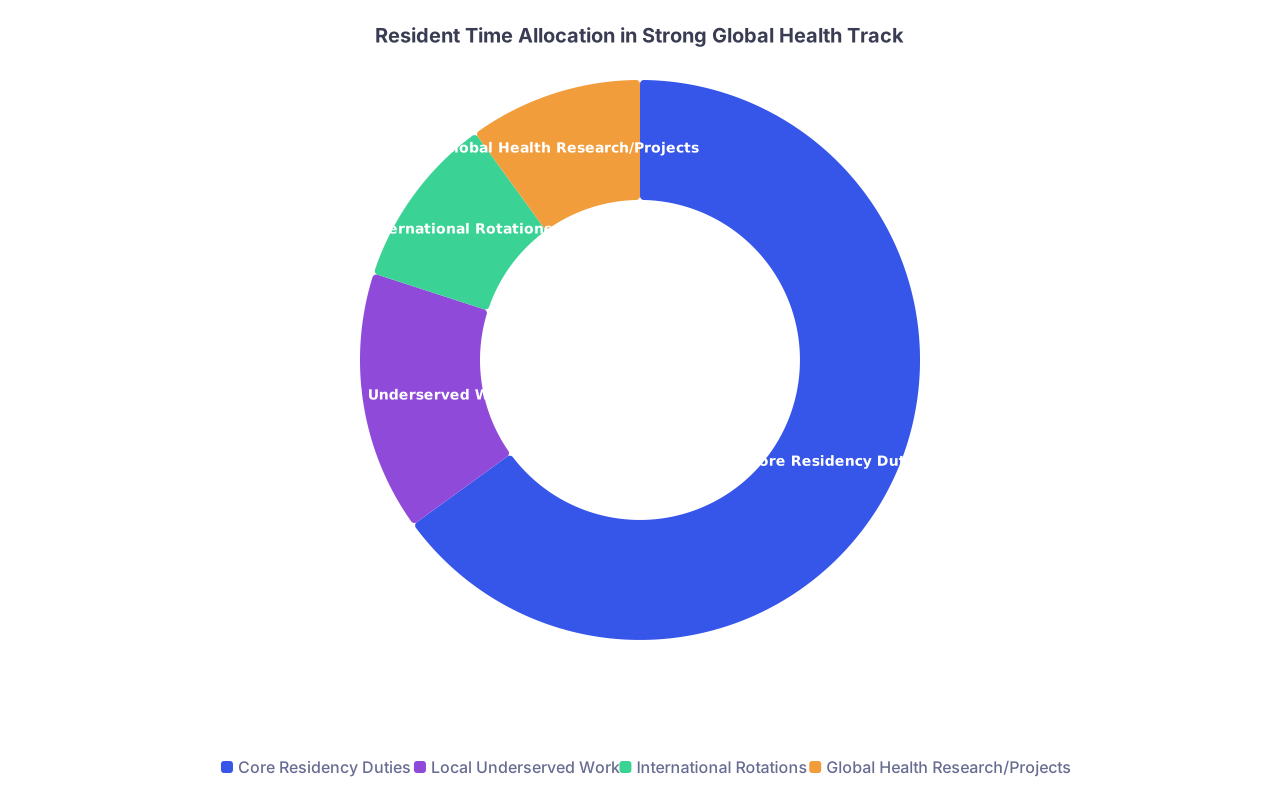
| Category | Value |
|---|---|
| Core Residency Duties | 65 |
| Local Underserved Work | 15 |
| International Rotations | 10 |
| Global Health Research/Projects | 10 |

| Step | Description |
|---|---|
| Step 1 | Choose FM or Peds |
| Step 2 | Target programs with formal track |
| Step 3 | Target strong overall training |
| Step 4 | Apply and interview |
| Step 5 | Deprioritize program |
| Step 6 | Ensure some elective flexibility |
| Step 7 | Ask hard questions on interview day |
| Step 8 | Build rank list matching your goals |
| Step 9 | Global central to career? |
| Step 10 | Real track or fluff? |
What You Should Do Today
Do not just bookmark more program websites. Take one concrete step.
Open a spreadsheet and list 5–10 FM or Peds programs you’re already considering. Add columns for:
- Formal global health track (Y/N)
- Funding available (amount, Y/N)
- Named global health faculty
- Alumni in global careers (Y/N, who)
- Max time allowed abroad
Then visit each website and actually fill in those cells. If you cannot find real details, that tells you something.
That sheet will do more to clarify your global health path than another week of vague “program research.”
Start it now.