The myth that you have to be a “kids person” to belong in pediatrics is messing people up.
You can absolutely get into peds, finish intern year, and then suddenly think, “Wait. I might actually not like working with kids… at all.” And your brain immediately jumps to the nuclear scenario: wrong specialty, wasted years, everyone will know I failed.
Let’s walk through this like someone who’s already catastrophizing every angle. Because honestly? Most attendings gloss over this, and it’s exactly the kind of thing that keeps you up at 2 a.m. on call.
First: How “Too Late” Is Too Late?
Your anxiety probably sounds like this:
- “What if I realize this halfway through intern year?”
- “What if I already matched? Am I done for?”
- “What if it doesn’t hit me until PGY-3?”
The brutal truth: there isn’t some magic deadline after which your life is permanently ruined if you’re not a kids person.
There are really three different “oh no” moments:
- You’re a med student on your peds rotation and you’re worried you might not be a kids person.
- You’re an intern or early resident in pediatrics and you’re realizing you actively dislike the day-to-day.
- You’re deeper in (late PGY-2 or PGY-3) and starting to think, “I picked wrong.”
Each of those has options. None of them equals “career over.”
Let’s be precise about what “too late” actually looks like in the real system:
| Stage | What You Can Still Change |
|---|---|
| M3–M4 | Specialty choice, away rotations, letters, residency list |
| Pre-Match/Rank List | Rank list strategy, backup specialties (rare but possible) |
| PGY-1 | Switch programs/specialties, reapply, modify future path |
| PGY-2/3 | Pivot within peds, plan fellowship, future non-clinical roles |
So no, there isn’t some hard “you’re locked in or you die here” line. There’s just a decreasing level of flexibility and an increasing need to be strategic instead of panicked.
What “Not a Kids Person” Actually Means (And What It Doesn’t)
Here’s where most people get confused. You say, “I’m not a kids person,” but that phrase is doing way too much vague emotional work.
It can mean wildly different things:
- You don’t enjoy baby talk, high-pitched voices, or playing on the floor.
- You feel awkward with teenagers who don’t talk.
- You actually like the medicine but dread the parent interactions.
- You feel emotionally wrecked by sick kids and can’t turn it off at home.
- You feel nothing at all around children and you’re wondering if that’s…bad?
Those are not all the same problem.
Let me be blunt: a lot of pediatrics is actually about:
- Managing parents
- Systems of care (social work, CPS, case management)
- Chronic disease management
- Communication with anxious families
Kids are part of it, yes. But you’re not in a daycare. You’re not a camp counselor. You’re a physician in a system that involves children, families, and a lot of adult-level complexity hidden under dinosaur scrubs.
So if your brain is screaming:
- “I don’t melt when I see babies, am I a monster?”
- “I don’t want to pretend to enjoy singing songs about shots.”
- “I don’t like being climbed on.”
That doesn’t automatically disqualify you from pediatrics. Lots of solid pediatricians are calm, serious, slightly awkward people who aren’t Pinterest-level kid entertainers.
The real red flags are more like:
- You dread every clinical interaction with kids.
- You feel contempt, not just discomfort, toward parents.
- You find yourself apathetic about kids’ suffering.
- You’re counting minutes until you’re out of the pediatrics environment every single day.
If you’re in that territory consistently for months, not just on a few burned-out days, then yeah, that’s a bigger issue.
The Nuclear Fear: “Did I Ruin My Career Picking Peds?”
No. But I know that doesn’t stop the mental spiral. So let’s walk it out.
Your worst-case fantasy probably looks like this:
- You realize you’re not a kids person.
- You try to stick it out, everyone can tell you’re miserable.
- You fail your rotation or get bad evals.
- You can’t switch specialties because “no one will take you.”
- You end up stuck in a job you hate or you leave medicine entirely.
I’ve seen pieces of this, but not the dramatic full collapse you’re imagining. Here’s what actually tends to happen:
- Residents talk quietly to their PD or a trusted attending.
- Sometimes they switch to another specialty (FM, psych, anesthesia, EM, IM).
- Sometimes they finish peds and pivot into subspecialties or more adult-adjacent roles.
- Sometimes they realize they don’t hate pediatrics—they hate this rotation, this hospital, or this schedule.
Let me underline this: one brutal month in inpatient gen peds with endless bronchiolitis, screaming toddlers, and 28 discharges a day is not a valid sample of your entire potential career.
You can hate that and still like:
- Adolescent medicine clinic
- Pediatric endocrinology (honestly half adult-style medicine with growth charts)
- NICU (where most communication is with adults)
- Allergy/immunology (lots of talking, less chaos)
- Pediatric emergency (procedures, acuity, short-term relationships)
So before you stamp “I chose wrong and my life is over” on your forehead, you need better data.
Concrete Steps If You’re in Med School and Already Worried
If you’re M3/M4 and you’re realizing during your peds rotation, “I may not be a kids person,” your brain will want you to pick a different specialty yesterday.
Slow down.
Do these three things:
Separate “kids” from “this rotation.”
Ask yourself:- Is it the schedule?
- The specific attending’s style?
- The constant family drama?
- The age group (babies vs teens)?
Get a different peds exposure.
If you’ve only seen inpatient general peds, you have not seen pediatrics. Try:- Outpatient clinic
- Subspecialty clinic
- ED peds shift
- NICU or PICU shadow
Compare your reaction to other rotations.
If you feel “meh” everywhere, that’s a general burnout/mood problem.
If you feel specifically drained around kids and energized on adult IM or EM, that’s relevant.
Here’s a quick comparison of specialties people often jump to when they decide they might not be a peds person:
| Specialty | Why It Appeals | Hidden Gotcha |
|---|---|---|
| Family Med | Mix of ages, continuity, outpatient-heavy | Still lots of kids |
| IM | All adults, broad options, hospital or clinic | Less “cute,” more chronic disease burden |
| EM | Short interactions, procedures, mix of ages | Peds still part of it, plus chaos and nights |
| Psych | Minimal kids if you choose adult | Very different skill set, long visits |
| Anesthesia | Mostly adults, procedural | Peds cases still exist in many hospitals |
You’re allowed to pivot. But make sure you’re running toward something you like, not just running away from a single bad month.
If You’re Already a Peds Resident and Panicking
This is where the “too late” fear gets loud.
You’re PGY-1 or PGY-2, you’re exhausted, and you realize:
“I don’t think I like this. At all. I don’t enjoy kids. I dread talking to parents. I don’t want three more years of this, let alone a lifetime.”
Your thoughts go:
- “My PD will think I’m a failure.”
- “I’ll never get a letter to switch.”
- “I’ll look flaky if I apply somewhere else.”
- “I already ‘used up’ my chance by matching once.”
Here’s the reality no one advertises: people switch specialties. Every year. Quietly.
You have a few paths:
Stay in pediatrics but change the type of work you plan to do.
For example:- Aim for adolescent medicine, where it’s basically adults in teen bodies.
- Go into pediatric EM and embrace procedures/acuity over long-term parenting drama.
- Target allergy/immunology or rheumatology, where the vibe is less “playroom” and more “chronic disease partner.” You don’t have to become the bubbly outpatient pediatrician with stickers in their coat.
Finish residency, then pivot your career.
You can move into:- Admin, quality improvement, or hospital leadership
- Public health roles
- Medical education
- Industry or pharma (clinical research, medical affairs) Your day-to-day may involve almost zero direct child interaction after a few years.
Switch residencies.
This is the one everyone’s scared to even say out loud. It is possible to:- Talk to your PD and say you’re thinking of moving to IM/EM/FM/etc.
- Use your peds training to strengthen an application elsewhere.
- Start over at PGY-1 in another field, or sometimes get some credit for prior training.
Is it fun? No. Is it easy logistically? Also no. But is it done? Yes.
How Much of This Is Just Burnout Talking?
This is the part you probably don’t trust yourself about.
You’re sleep-deprived, hungry, behind on notes, and some 3-year-old just kicked you while their parent yelled at you about wait times. Your brain screams:
“I HATE KIDS. I HATE THIS JOB. I CHOSE WRONG.”
I’ve watched residents swear off pediatrics forever…then three months later on an easier rotation they’re happily showing off baby pictures and talking about how much they “love the little ones.”
Here’s a quick gut check:
- Do you still have some joy on your easier days?
- Do you like at least one age group (babies, toddlers, teens)?
- Are there any types of peds encounters you enjoy (well visits, adolescents, complex chronic kids, ER cases)?
If the answer is “yes, sometimes,” even if it feels faint, that’s different from “I hate 100% of this 100% of the time.”
You’re allowed to say, “I’m not a naturally kids person, but I can still be a good pediatrician if I find the right niche.”
Accepting That You May Never Be the “Classic” Peds Person
The stereotype is loud:
- The resident with cartoon badge reels and themed socks
- The attending who remembers every sibling’s name and favorite soccer team
- The person who genuinely LOVES floor time, singing, and crafts
If that’s not you, it’s very easy to tell yourself: “I don’t belong here.”
Let me be very clear: pediatrics also needs:
- Calm, serious people who talk to parents like adults, not like Instagram followers
- Analytical thinkers who love guidelines, growth charts, and chronic disease workups
- Procedure-oriented people who like lines, LPs, codes, and resuscitations
You don’t have to be sunshine and glitter. You do have to:
- Care that kids get good care
- Respect parents, even when they’re a lot
- Communicate clearly and kindly
You’re allowed to be the more reserved, steady pediatrician. As long as you’re not resentful of kids existing in your workspace, you’re not disqualified.
What If You Genuinely Don’t Like Kids?
Let’s not sugarcoat.
If when you’re honest with yourself, your internal monologue sounds like:
- “I actively dislike being around children.”
- “I have zero interest in their lives beyond the bare minimum.”
- “Their emotions and behavior just irritate me constantly.”
- “If I never had to talk to a kid again, I’d be relieved.”
Then yeah, that’s a problem for a peds career.
Not because you have to be the Fun Aunt/Uncle type, but because kids can feel when adults don’t want to be there. Parents can feel it too. That’s not fair to them, and it’s not fair to you.
In that case, the responsible thing is:
- A brutally honest self-assessment (ideally written down, not just in your head).
- A confidential conversation with:
- A trusted attending, or
- Your PD, or
- A mentor outside your program who can be blunt with you.
- Exploring alternative paths while you still have time and energy to make a move.
You’re not a failure if you realize, “I picked wrong.” You’d be more at fault if you stay in a field where your core population feels like a burden to you.
Practical “Tonight” Plan So You Don’t Just Spiral
You need something structured, or your brain will keep re-running the same anxious loop.
Do this, literally on paper or in a notes app:
List 3 clinical moments from the last month in pediatrics you didn’t hate.
Even if they’re tiny. A satisfying diagnosis. A parent who thanked you. A teen who actually opened up.List 3 things you absolutely dread in your current role.
Be specific: “explaining vaccines to hostile parents,” “toddlers screaming during exams,” “talking in a baby voice.”Circle what’s pediatrics-specific vs what’s just medicine-in-general.
Hate EMR? That’s not peds. Hate parents? That’s more peds. Hate sick people being needy? That’s every specialty.Pick one person to talk to this week.
Not “sometime.” This week. A chief resident, a faculty mentor, someone who’s seen you work.Ask them one direct question:
“Based on what you’ve seen of me, do you think I could build a sustainable career in pediatrics, and if so, what niche do you think would fit me best?”
Let them answer honestly. You might be surprised how often they say, “You’re not a stereotypical kids person, but you’re good at X—which fits really well in Y.”
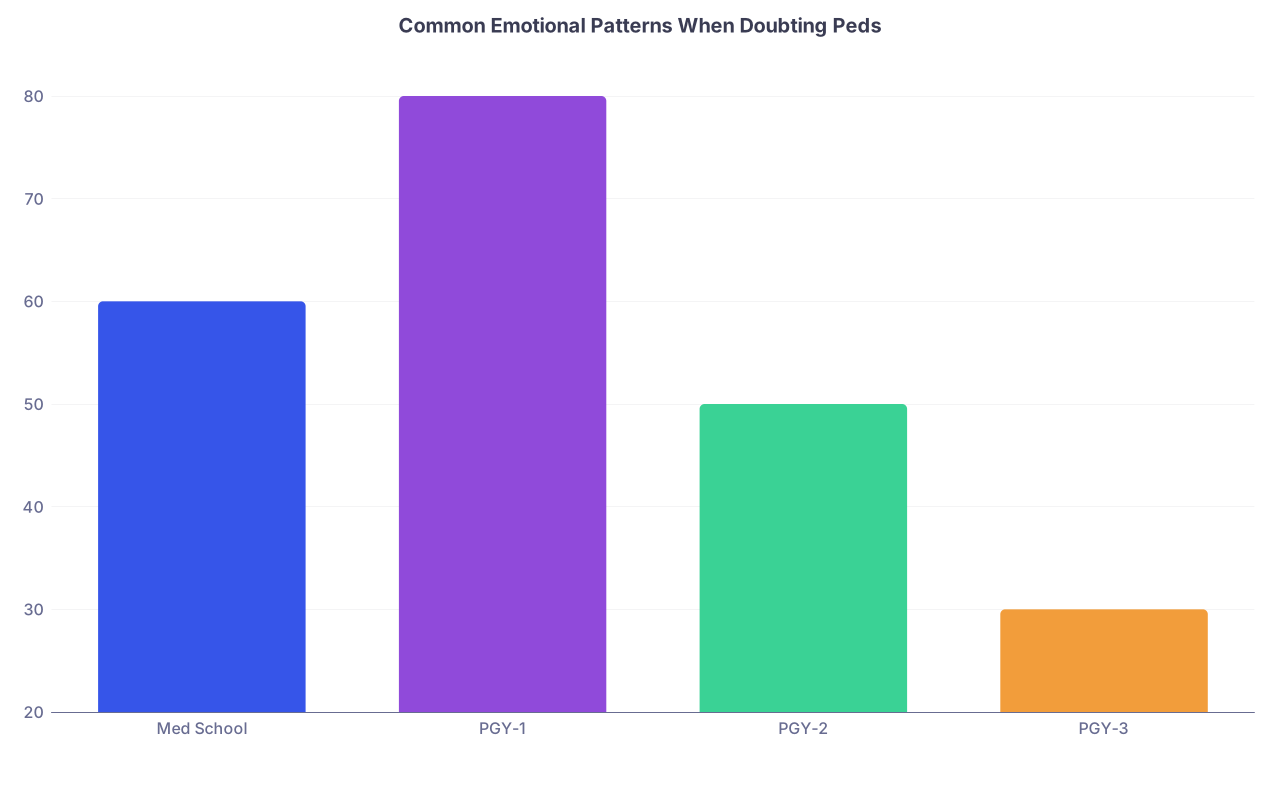
| Category | Value |
|---|---|
| Med School | 60 |
| PGY-1 | 80 |
| PGY-2 | 50 |
| PGY-3 | 30 |

| Step | Description |
|---|---|
| Step 1 | Realize you may not be a kids person |
| Step 2 | Identify peds niches you like |
| Step 3 | Consider switching specialty |
| Step 4 | Talk to mentor or PD |
| Step 5 | Plan next 6-12 months strategically |
| Step 6 | Still any joy in peds? |

Key Reassurances You Probably Need to Hear Plainly
Let me say the quiet part out loud for you:
- You didn’t “lie” by going into pediatrics and then realizing you’re not a kids person. People change. Experiences change you.
- You’re not trapped forever just because you matched into peds once.
- You’re also not obligated to blow up your life over one rough rotation or one identity crisis.
- Plenty of “non-kid-obsessed” people are excellent pediatricians because they respect children and families and they show up for them consistently.
You’re allowed to be uncertain. You’re allowed to reevaluate. You’re allowed to protect your future self from burnout and resentment.
The only truly bad move is to shut down, say nothing, and drift through training hating every day while pretending you’re fine.

FAQ (Exactly 5 Questions)
1. What if I realize I’m not a kids person after I’ve already matched into pediatrics?
You are not doomed. Match isn’t a prison sentence. You can explore different types of pediatrics (NICU, PICU, subspecialty clinics, adolescent medicine) before you decide it’s a total mismatch. If it truly is, you can talk to your PD and explore switching programs or specialties. It’s awkward but not unheard of. The key is to act early and communicate, not silently suffer for three years.
2. Will program directors judge me if I say I’m not sure I’m a “kids person”?
Depends how you say it. If you walk in and announce, “I hate kids,” yeah, that’s a problem. But if you say, “I’m realizing I don’t fit the stereotypical bubbly peds mold, and I’m trying to figure out what kind of role in pediatrics or elsewhere fits me best,” that’s honest and mature. Good PDs care about fit and long-term sustainability more than you performing as the cartoon version of a pediatrician.
3. Can I still be a good pediatrician if I don’t naturally love being around kids?
Yes, if you genuinely care about their well-being and treat them and their families with respect. You don’t need to be obsessed with babies or enjoy playground-level interaction. You do need to be patient, professional, and willing to adapt your communication to their developmental level. Many solid pediatricians are more quiet, analytical types who found their niche within the field instead of trying to be the stereotype.
4. Is switching from pediatrics to another specialty going to ruin my reputation or chances elsewhere?
Not automatically. If you’re professional, honest, and frame it as a thoughtful re-evaluation rather than a meltdown, other specialties will listen. Having completed some pediatric training can actually make you more attractive to fields like family medicine, EM, psych, or even IM. The red flag isn’t switching; it’s burning bridges, disappearing, or getting labeled as unprofessional in the process.
5. How do I tell if this is a real mismatch with pediatrics vs just burnout from residency?
Patterns and timing. If you’ve felt this consistently for months across different rotations, settings, and teams—and your distress is specifically tied to being around kids and parents—that suggests a true mismatch. If your dread spikes only on brutal inpatient months, post-call days, or during personal life chaos, it’s more likely burnout. A good test: when you imagine a lighter, more outpatient, more focused peds job in the future, do you feel relief or still deep resistance? Your gut answer there matters.
Open a blank note right now and write two headings: “Things I Like in Peds” and “Things I Dread in Peds.” Force yourself to fill in at least three items under each. That list is your starting point for an honest conversation with a mentor in the next 7 days. Don’t just sit in your head with this.